



1036 Ganymed
The Largest Near-Earth Asteroid
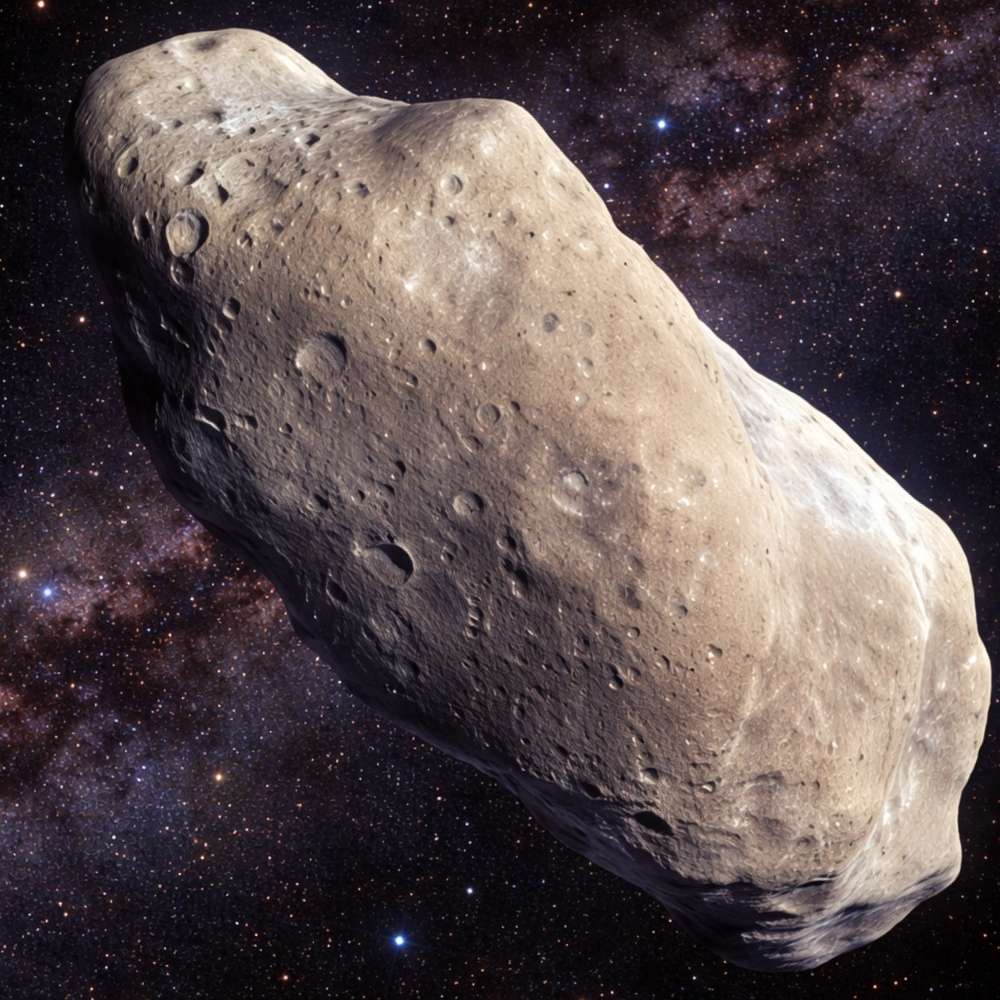
Quick Reader
| Attribute | Details |
|---|---|
| Object Name | 1036 Ganymed |
| Object Type | Near-Earth Asteroid (Amor group) |
| Discovery | 1924 |
| Discoverer | Walter Baade |
| Discovery Location | Bergedorf Observatory, Germany |
| Mean Diameter | ~32–36 km |
| Shape | Elongated, irregular |
| Rotation Period | ~10.3 hours |
| Orbital Period | ~4.35 Earth years |
| Semi-major Axis | ~2.66 AU |
| Perihelion Distance | ~1.24 AU |
| Earth-Crossing | No |
| Closest Approach to Earth | ~0.37 AU |
| Composition | Likely S-type (silicate-rich) |
| Special Status | Largest known Near-Earth Asteroid |
Key Highlights
- 1036 Ganymed is the largest Near-Earth Asteroid ever discovered
- It belongs to the Amor group, approaching Earth but not crossing its orbit
- Despite its size, it is not a threat to Earth
- It bridges the gap between main-belt asteroids and NEOs
- Its name often causes confusion with Ganymede, Jupiter’s moon
Introduction – A Giant That Comes Close, But Never Crosses
Near-Earth asteroids are usually imagined as small, fast, and potentially dangerous.
1036 Ganymed breaks that stereotype.
It is huge, ancient, and remarkably stable—an asteroid large enough to rival small moons, yet calmly passing near Earth without ever crossing our planet’s orbit.
Discovered a century ago, Ganymed remains one of the most important objects for understanding how large asteroids migrate toward the inner Solar System without becoming impact hazards.
What Is 1036 Ganymed?
1036 Ganymed is a Near-Earth Asteroid (NEA) belonging to the Amor group.
Amor asteroids are defined by one key trait:
they approach Earth’s orbit from the outside but do not cross it.
For Ganymed, this means:
It comes closer to the Sun than most main-belt asteroids
It approaches Earth’s orbital neighborhood
It remains dynamically non-Earth-crossing
This makes Ganymed both accessible for study and relatively safe.
Size and Significance – Why Ganymed Stands Out
Most Near-Earth Asteroids are less than a few kilometers wide.
Ganymed is different.
With a diameter exceeding 30 km, it is:
Larger than most known NEAs combined
Massive enough to preserve ancient structure
Large enough to be geologically coherent
If Ganymed were placed in the main asteroid belt, it would still be considered a major asteroid.
Its presence near Earth is unusual—and scientifically valuable.
Orbital Behavior – Close, But Not Dangerous
Ganymed’s orbit is stable and well understood.
Key orbital traits include:
Perihelion just outside Earth’s orbit
No orbit crossing with Earth
Long-term dynamical stability
Because of this:
Ganymed is not classified as a Potentially Hazardous Asteroid
Its orbit is predictable over long timescales
It serves as a model object for NEA dynamics
Ganymed demonstrates that proximity does not automatically mean danger.
Composition – A Rocky Survivor
Spectral observations suggest that Ganymed is likely an S-type asteroid, meaning it is:
Rich in silicate minerals
Relatively dense
More rock-dominated than carbonaceous bodies
This implies:
Formation closer to the Sun than Ceres-type objects
Strong internal cohesion
Resistance to disruption
Ganymed is not a rubble pile—it is a solid relic of early planetary material.
Ganymed vs Ganymede – Clearing the Name Confusion
This confusion is extremely common and important to clarify.
| Feature | 1036 Ganymed | Ganymede |
|---|---|---|
| Object Type | Asteroid | Moon |
| Parent Body | Sun | Jupiter |
| Size | ~35 km | ~5,268 km |
| Orbit | Solar | Jovian |
| Composition | Rocky | Ice + rock |
| Magnetic Field | None | Yes |
The similarity in names comes from Greek mythology, but the objects are entirely unrelated.
Clarifying this distinction reduces user confusion and improves educational clarity.
Why 1036 Ganymed Matters
Ganymed matters because it:
Represents the upper size limit of Near-Earth Asteroids
Shows how large bodies can migrate inward safely
Helps refine models of orbital evolution
Serves as a benchmark for NEA population studies
Without Ganymed, our understanding of Near-Earth space would be incomplete.
How Ganymed Reached Near-Earth Space
1036 Ganymed did not form near Earth.
Like most large asteroids, it originated in the main asteroid belt between Mars and Jupiter. Its current near-Earth orbit is the result of slow, long-term dynamical evolution, not a sudden event.
Key mechanisms involved:
Gradual orbital perturbations
Resonant interactions with Jupiter
Weak but persistent gravitational nudges
Over millions of years, these effects altered Ganymed’s orbit, lowering its perihelion and moving it closer to the inner Solar System.
The Role of Resonances in Ganymed’s Migration
Orbital resonances act as invisible pathways through space.
For Ganymed:
Mean-motion resonances with Jupiter modified its orbit
Secular resonances slowly changed its eccentricity
Orbital energy was redistributed without catastrophic encounters
Unlike smaller asteroids, Ganymed’s large mass helped it avoid chaotic scattering.
Instead of being flung inward violently, it migrated in a controlled way.
This explains why its orbit remains stable today.
Why Ganymed Never Became Earth-Crossing
Many Near-Earth Asteroids eventually cross Earth’s orbit.
Ganymed did not.
Key reasons include:
Its perihelion stabilized just outside Earth’s orbit
Resonant configurations prevented further inward drift
Lack of close planetary encounters
As a result:
Ganymed avoided becoming a Potentially Hazardous Asteroid
Its orbit remains predictable over long timescales
Ganymed represents a near-miss outcome in asteroid migration.
Size as a Stabilizing Factor
Ganymed’s size played a protective role.
Because it is large:
It is less affected by non-gravitational forces
Yarkovsky drift is negligible
Orbital changes occur slowly
Smaller asteroids are far more vulnerable to rapid orbital evolution.
Ganymed’s mass allowed it to remain dynamically conservative.
Comparison with Other Large Near-Earth Asteroids
| Feature | 1036 Ganymed | 433 Eros | 99942 Apophis |
|---|---|---|---|
| Diameter | ~35 km | ~17 km | ~0.37 km |
| Orbit Type | Amor | Amor | Aten |
| Earth-Crossing | No | No | Yes |
| Long-Term Stability | High | Moderate | Chaotic |
| Hazard Status | Non-hazardous | Non-hazardous | Potentially hazardous |
This comparison shows how size and orbital geometry determine risk—not proximity alone.
Why Ganymed Is Rare Among NEAs
Objects as large as Ganymed are extremely uncommon near Earth.
Reasons include:
Large bodies are harder to move inward
Many were ejected or collided early
Survivors usually remain in the main belt
Ganymed is a statistical outlier, representing a rare but stable pathway from the asteroid belt to near-Earth space.
Observational Importance of Ganymed
Because of its size and brightness, Ganymed has been observed for nearly a century.
This provides:
A long observational arc
Highly precise orbital models
Reliable predictions of future motion
Few Near-Earth Asteroids are understood this well.
Ganymed serves as a calibration object for NEA studies.
What Ganymed Teaches About Asteroid Dynamics
Ganymed demonstrates that:
Not all NEAs are transient
Large bodies can approach Earth safely
Orbital evolution can be slow and stable
Hazard assessment requires long-term context
It challenges the assumption that Near-Earth automatically means dangerous.
The Long-Term Future of 1036 Ganymed
1036 Ganymed’s future is remarkably stable.
Numerical integrations of its orbit show that, over millions to billions of years, its motion remains predictable and non-threatening. Its perihelion distance stays outside Earth’s orbit, and no resonant mechanism currently exists to push it into an Earth-crossing trajectory.
Because of its size and orbital geometry, Ganymed is far less sensitive to small perturbations than most Near-Earth Asteroids.
In practical terms, Ganymed is here to stay—but not to collide.
Could Ganymed Ever Become Hazardous?
The probability is extremely low.
For Ganymed to become Earth-crossing, one of the following would need to occur:
A major gravitational encounter with a planet
Entry into a strong destabilizing resonance
A rare, large-scale change in Solar System dynamics
None of these scenarios are expected under current conditions.
Ganymed is therefore not considered a long-term impact risk.
Why Ganymed Is Not a Potentially Hazardous Asteroid
Asteroids are classified as potentially hazardous based on:
Size
Minimum orbit intersection distance (MOID)
Orbital uncertainty
Despite its large size, Ganymed fails to meet the hazard criteria because:
Its orbit does not cross Earth’s
Its MOID remains safely large
Its orbital path is well constrained
Ganymed is a case where size alone does not imply danger.
Scientific Value of a Stable Giant NEA
Ganymed offers unique scientific advantages.
ItBecause of its stability and size, it allows scientists to:
Study NEA surface evolution over long timescales
Refine orbital mechanics models
Understand asteroid migration pathways
Compare stable and unstable NEAs directly
It acts as a control object in Near-Earth Asteroid research.
Frequently Asked Questions (FAQ)
Is 1036 Ganymed the same as Ganymede?
No. 1036 Ganymed is an asteroid; Ganymede is Jupiter’s largest moon. The names come from the same mythological figure but refer to entirely different objects.
Is 1036 Ganymed dangerous to Earth?
No. It does not cross Earth’s orbit and poses no known impact threat.
Why is 1036 Ganymed important?
Because it is the largest known Near-Earth Asteroid and demonstrates stable, non-hazardous near-Earth dynamics.
Could a mission visit Ganymed?
Yes. Its size, stability, and accessibility make it an attractive future mission target.
Does Ganymed have moons?
No. It is too small to retain natural satellites.
1036 Ganymed in the Context of Universe Map
Ganymed links several key Universe Map themes:
Near-Earth space dynamics
Asteroid migration
Impact risk assessment
Orbital stability
Related Universe Map topics include:
Near-Earth Asteroids
Asteroid Belt
Potentially Hazardous Asteroids
Ganymede (moon)
Jupiter
Together, these objects clarify the diversity of bodies that approach Earth.
Final Perspective
1036 Ganymed is a giant that approaches quietly.
It challenges the popular image of Near-Earth Asteroids as inherently dangerous and shows that size, stability, and orbital context matter far more than proximity alone.
As the largest known Near-Earth Asteroid, Ganymed stands as a reminder that the Solar System is not only violent—but also remarkably orderly, even in its most crowded regions.