





Local Supercluster Map
Virgo Supercluster
The Virgo Supercluster is the classic local supercluster containing the Milky Way, the Local Group, the Virgo Cluster, and many nearby galaxy groups arranged across a flattened region of the local universe.
It was once treated as our largest cosmic address. Today it is better understood as the Virgo lobe within the broader Laniakea flow basin, which makes it both historically important and still scientifically useful.
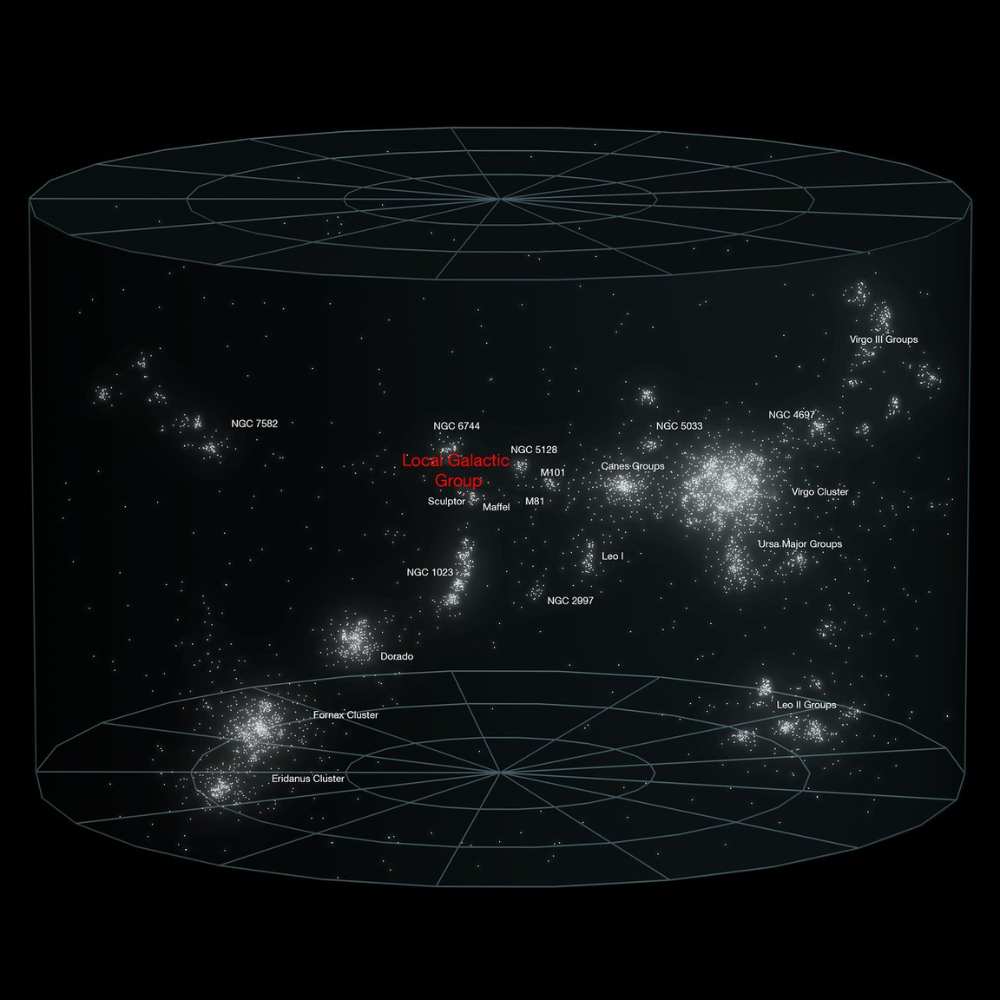
Read the Virgo Supercluster as a Local Flow Map
The preview shows the main idea without heavy 3D code: a flattened galaxy sheet, a dense Virgo Cluster anchor, the Local Group near the outskirts, and faint motion streams connecting the local environment to larger cosmic flows.
Virgo Supercluster Quick Facts
The Local Supercluster is the older and still useful name for this structure. It places the Milky Way inside a broad galaxy distribution centered on the Virgo Cluster, the nearest large rich cluster to our Local Group.
| Attribute | Details |
|---|---|
| Name | Virgo Supercluster, also called the Local Supercluster in many astronomy references |
| Main anchor | Virgo Cluster, a nearby rich galaxy cluster containing M87, M49, M84, M86, and many other galaxies |
| Milky Way position | Inside the Local Group, on the outskirts of the larger Virgo-centered structure |
| Virgo Cluster distance | Common public values place the cluster around 50-65 million light-years away |
| Approximate supercluster scale | Often described as roughly 100-110 million light-years across, depending on boundary definition |
| Modern interpretation | A major local component or lobe within the larger Laniakea Supercluster flow basin |
What Is the Virgo Supercluster?
The Virgo Supercluster is a broad nearby arrangement of galaxy groups and clusters. It is not a single galaxy, not a compact cluster, and not a sharply bounded object. It is a large-scale structure traced by the distribution and motion of galaxies in our part of the universe.
Its importance is partly historical. Before the Laniakea map, this was often presented as the largest structure containing the Milky Way. That older view was not useless; it captured the local Virgo-centered pattern. The newer view simply places that pattern inside a larger velocity-defined basin.
Virgo Supercluster Structure
The structure is usually described as flattened, sheet-like, and irregular rather than spherical. The Virgo Cluster forms the densest landmark, while nearby groups and clouds spread outward through the local cosmic web.
The Local Group is far from the core. We sit in a relatively modest galaxy group containing the Milky Way, Andromeda, Triangulum, and many dwarf galaxies. This position makes the Virgo Cluster a distant but important reference point for local galaxy motions.
Virgo Supercluster and the Virgo Cluster
The Virgo Cluster is the main gravitational and visual anchor. It is the nearest large galaxy cluster and contains a rich population of ellipticals, lenticulars, spirals, dwarf galaxies, hot intracluster gas, and dark matter.
M87 is one of its most famous members. This giant elliptical galaxy hosts the supermassive black hole imaged by the Event Horizon Telescope and powers a visible relativistic jet. Other major cluster galaxies include M49, M84, M86, and M90.
NASA and ESA public resources commonly describe the Virgo Cluster as having around 1,300 to more than 2,000 galaxies depending on catalog depth and membership criteria. That range is safer than treating one number as permanently fixed.
Virgo Supercluster and the Milky Way
The Milky Way belongs first to the Local Group. The Local Group then sits within the local supercluster environment, with the Virgo Cluster tens of millions of light-years away toward the constellation Virgo.
Our galaxy is not falling cleanly toward Virgo alone. Local motion is shaped by a mixture of attractions and underdensities, including the Virgo region, the Local Void, the Great Attractor direction, and the larger Laniakea flow field.
This is why modern maps avoid a simple "everything orbits Virgo" story. The local universe moves through a layered gravitational landscape, and Virgo is one major nearby landmark inside that landscape.
Virgo Supercluster Within Laniakea
In 2014, Tully and collaborators used galaxy peculiar velocities to define the Laniakea Supercluster as a larger basin of attraction. In that framework, the older Virgo-centered supercluster becomes part of a wider system of galaxy flows.
This does not make the Virgo map obsolete. It changes the scale of the map. Virgo remains the closest rich cluster and a key marker of our local environment, while Laniakea explains how that environment connects to Hydra-Centaurus, Norma, Pavo-Indus, and the Great Attractor region.
For SEO and accuracy, the best wording is not "Virgo was wrong." The better wording is: Virgo is a classic local supercluster description nested inside the larger Laniakea flow basin.
Virgo Supercluster Galaxy Motions
Galaxy motion in this region is measured through redshifts, distances, and peculiar velocities. Peculiar velocity means the motion left over after subtracting the smooth expansion of the universe.
Older educational sources often describe the Local Group moving toward the Virgo region at several hundred kilometers per second. Newer flow maps treat that motion as one part of a more complex pattern influenced by nearby clusters, voids, and larger mass concentrations.
The key point for readers is simple: the supercluster is not static. It is a living map of gravity, expansion, and structure formation across the local universe.
Virgo Supercluster Size and Scale
The common scale is about 100-110 million light-years across. This is much larger than the Local Group, which spans roughly ten million light-years, but far smaller than the Laniakea basin, which is commonly described as roughly 500-520 million light-years across.
Scale values vary because a supercluster is not measured like a planet. It has no solid surface. Depending on whether astronomers use galaxy positions, density contours, velocity flows, or historic naming conventions, the quoted boundary can shift.
| Structure | Approximate scale | How it relates to us |
|---|---|---|
| Local Group | About 10 million light-years | Immediate galaxy family of the Milky Way |
| Virgo Supercluster | About 100-110 million light-years | Classic local supercluster containing the Local Group |
| Laniakea Supercluster | About 500-520 million light-years | Larger flow basin containing the Virgo region |
Is the Virgo Supercluster Gravitationally Bound?
Parts of it are gravitationally bound. The Local Group is bound, and many galaxy groups or cluster substructures are bound. But the whole supercluster should not be described as a single future-collapsing object.
On scales of tens to hundreds of millions of light-years, cosmic expansion, dark energy, local voids, and larger flow basins all matter. That is why modern large-scale structure pages should use careful wording: a supercluster is a galaxy distribution and dynamical environment, not a simple giant object.
Virgo Supercluster Galaxy Evolution
The Virgo region is scientifically valuable because it contains many environments in one nearby cosmic neighborhood. Dense cluster cores, infalling spirals, small groups, isolated galaxies, and void edges all appear within the larger map.
In the Virgo Cluster, galaxies can lose gas through ram pressure as they move through hot intracluster material. This can reduce star formation and help transform gas-rich spirals into quieter systems. In the outskirts, galaxies may evolve more slowly with fewer strong interactions.
That environmental contrast makes the supercluster useful for studying how galaxy surroundings shape morphology, star formation, and gas content over cosmic time.
How to Read a Virgo Supercluster Map
Start with the Virgo Cluster as the dense core. Then locate the Local Group on the outskirts. The important mental model is not a circular empire around Virgo, but a flattened and irregular network of groups, clouds, filaments, and nearby voids.
If the map includes Laniakea, zoom out mentally. Virgo becomes one local lobe inside a broader flow basin. If the map includes the Local Void, remember that underdense regions can also influence motion by letting matter flow away from emptier zones toward denser ones.
A good map should make scale honest. The Virgo Cluster is near by cosmic standards, but it is still tens of millions of light-years away from the Milky Way.
Virgo Supercluster Compared With Nearby Structures
The best comparison is by map layer. The Local Group is our immediate galaxy family. The Virgo-centered supercluster is the classic local large-scale structure. Laniakea is the larger flow-defined basin. Shapley is a still more distant and massive concentration influencing the broader velocity field.
| Structure | Best description | Why it matters |
|---|---|---|
| Local Group | Bound group containing the Milky Way and Andromeda | Our direct galaxy neighborhood |
| Virgo Cluster | Nearest large rich galaxy cluster | Dense core landmark of the local supercluster |
| Virgo Supercluster | Classic local supercluster containing the Local Group | Useful bridge between local galaxies and Laniakea |
| Laniakea | Flow-defined basin containing the Virgo region | Modern larger cosmic address for the Milky Way |
Virgo Supercluster FAQ
What is the Virgo Supercluster?
It is the classic local supercluster containing the Milky Way's Local Group and the Virgo Cluster, now understood as part of the larger Laniakea flow basin.
Are we inside it?
Yes. The Milky Way is in the Local Group, and the Local Group lies in the broader Virgo-centered local supercluster environment.
How far is the Virgo Cluster?
Public astronomy sources commonly place the Virgo Cluster around 50-65 million light-years away, depending on distance method and cluster member used.
Is it larger than Laniakea?
No. Laniakea is much larger. The Virgo-centered structure is best treated as a local component inside the broader Laniakea basin.
Is it gravitationally bound?
Some parts are bound, but the whole supercluster is not best described as one single bound object that will collapse together.