




Cosmic Flow Basin
Laniakea Supercluster
The Laniakea Supercluster is the flow-defined cosmic basin that contains the Milky Way, the Local Group, the Virgo region, and tens of thousands of galaxies moving through a shared gravitational landscape.
Laniakea is best understood as a map of motion, not a solid wall in space. Its boundary was drawn from galaxy velocities, showing where nearby galaxies flow inward toward the Great Attractor region and where neighboring flows peel away toward other basins.
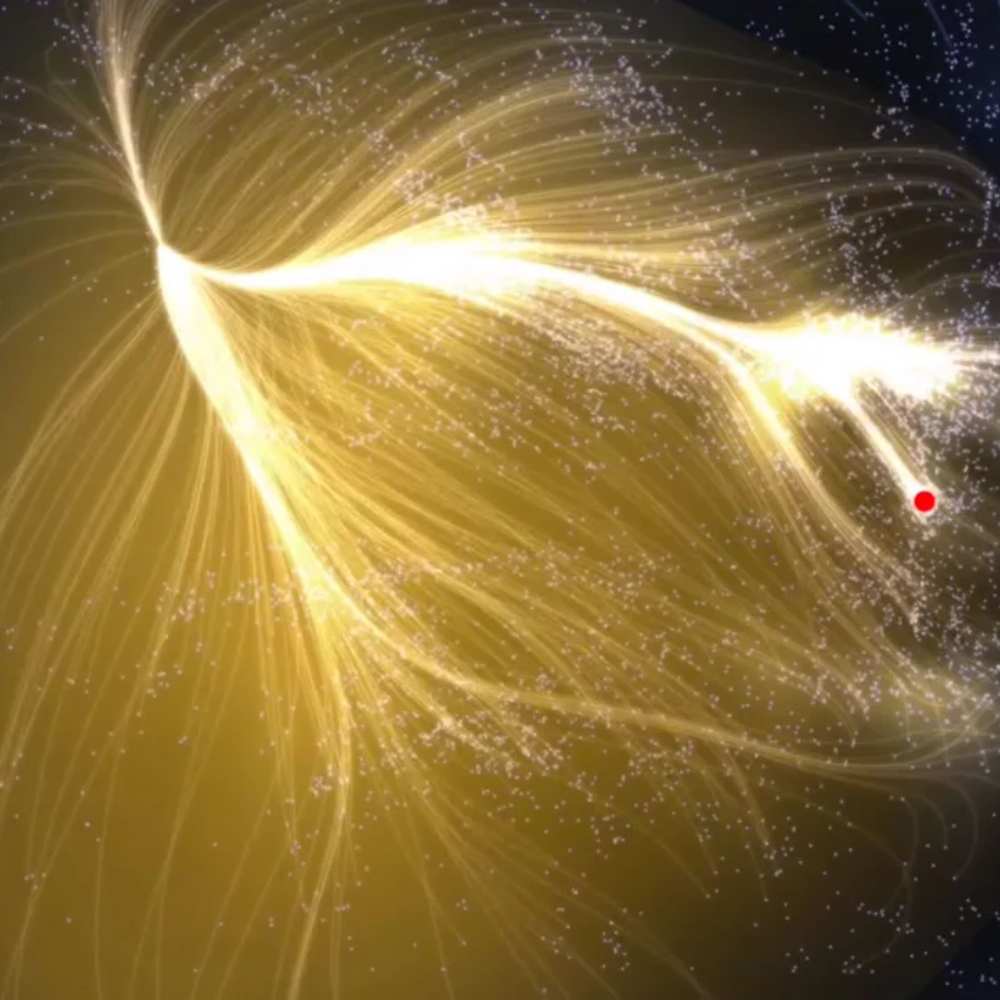
Explore the Laniakea Supercluster in 3D
The 3D map helps turn the article into a spatial experience: the Milky Way sits near the edge of a galaxy flow basin, while Virgo, Hydra, Centaurus, Norma, filaments, and voids shape the motion toward the Great Attractor region.
Laniakea Supercluster Quick Facts
The Laniakea Supercluster was defined in 2014 by R. Brent Tully, Helene Courtois, Yehuda Hoffman, and Daniel Pomarede using galaxy peculiar velocities from the Cosmicflows program. The result gave the Milky Way a larger cosmic address based on motion through the nearby universe.
| Attribute | Current best description |
|---|---|
| Name | Laniakea Supercluster |
| Name meaning | Commonly explained as "immense heaven" or "spacious heaven" in Hawaiian |
| Definition method | Galaxy velocity flows after subtracting the mean cosmic expansion |
| Approximate diameter | 160 megaparsecs, usually rounded to about 500-520 million light-years |
| Estimated contents | About 100,000 large galaxies and a mass near 10^17 solar masses |
| Main landmarks | Milky Way, Local Group, Virgo region, Hydra-Centaurus, Norma, Pavo-Indus filament, and nearby voids |
| Important update | Newer Cosmicflows-4 work suggests Laniakea may be part of a larger Shapley basin of attraction |
What Is the Laniakea Supercluster?
The Laniakea Supercluster is our large-scale cosmic neighborhood, but it is not a bright object with a clean edge. It is a dynamical region: a volume where galaxies share an inward flow pattern after astronomers remove the smooth expansion of the universe and other large-scale motions.
That makes Laniakea different from a galaxy cluster, a spiral galaxy, or a star system. A cluster can be gravitationally bound and compact enough to recognize visually. Laniakea is vastly larger, shaped by galaxy groups, clusters, filaments, voids, and dark matter across hundreds of millions of light-years.
How the Laniakea Supercluster Was Mapped
A normal galaxy map shows where galaxies appear to be. The Laniakea map asks a deeper question: where are galaxies actually moving after the general expansion of space is accounted for?
A galaxy's peculiar velocity is the extra motion left after subtracting the Hubble expansion from its observed motion. Those small departures are clues to hidden mass, because gravity from galaxies, clusters, filaments, and dark matter bends the path of motion over cosmic time.
The 2014 Nature study used those velocities to find watershed-like divides. Inside the Laniakea surface, flow lines move inward toward the local basin. Outside it, flows peel toward other attractors. This is why the most accurate description of Laniakea is a basin of attraction, not a hard shell.
Laniakea Supercluster Size and Mass
The original Laniakea definition gives a scale of about 160 megaparsecs across. In public astronomy writing, that is usually rounded to about 500 million light-years, while some educational summaries use about 520 million light-years.
The mass estimate is about 10^17 solar masses, or roughly one hundred quadrillion times the mass of the Sun. Most of that mass is not starlight. Like the rest of the cosmic web, Laniakea is shaped heavily by dark matter, while galaxies act as visible markers of the deeper gravitational field.
Laniakea Supercluster Galaxy Flows and the Great Attractor
The Great Attractor is the best-known gravitational landmark inside the Laniakea story. It is not a single galaxy or a black hole. It is a dense region of mass associated with rich galaxy clusters near the Norma and Hydra-Centaurus directions, partly hidden by dust and stars in the Milky Way's plane.
Within the 2014 Laniakea model, motions stream inward toward this region like water draining toward a valley. That valley analogy is powerful because it explains why a supercluster can be defined by motion even when its visual outline is messy.
Recent orbit reconstructions still show the Great Attractor as a major feature, but also place it in a bigger context. The local universe is influenced by pull from overdense regions and by the relative "push" away from underdense voids.
Laniakea Supercluster Structure
The Laniakea Supercluster contains a dense network of galaxy groups, clusters, filaments, and voids. The Milky Way is not near the center. It lies in the outskirts of the larger flow basin, inside the Local Group and near the Local Void environment.
Important landmarks in the original Nature description include the Virgo Cluster region, the Norma, Hydra, and Centaurus clusters associated with the Great Attractor, the Pavo-Indus filament, and several voids. These features form a cosmic landscape with ridges, valleys, and emptier regions rather than a clean geometric shape.
One correction matters: older simplified pages often list the Coma Cluster as a Laniakea component. Coma is a major nearby-universe landmark, but it is not one of the core structures named in the original 2014 Laniakea definition.
Is the Laniakea Supercluster Gravitationally Bound?
Laniakea should not be described as fully gravitationally bound in the same way the Local Group is. The Local Group is a smaller system where the Milky Way and Andromeda are moving toward a future merger. Laniakea is much larger, and cosmic expansion becomes more important across those scales.
The safer description is that Laniakea is a gravitational basin or flow basin in the present-day velocity field. Some dense regions inside it are bound. The entire supercluster, however, is not expected to collapse into one future object.
This wording keeps the page scientifically accurate while still preserving the wonder: Laniakea is a real dynamical map of our cosmic environment, even if it is not a future mega-galaxy.
Laniakea Supercluster and the Milky Way
The Milky Way sits inside the Local Group, the Local Group sits within the broader local cosmic flow, and that flow was mapped as part of Laniakea. This gives our galaxy a nested address: Solar System, Milky Way, Local Group, Laniakea Supercluster, cosmic web.
Our position is not central. We are closer to the edge of the basin than to the Great Attractor region. That is why a Laniakea map often feels surprising: it places the Milky Way as a small marker on the outskirts of a far larger motion pattern.
The Milky Way's observed motion reflects several influences, including nearby clusters, distant mass concentrations, and surrounding voids. Laniakea is one important layer in that bigger movement.
Laniakea Supercluster in Newer Research
The 2014 Laniakea paper remains the foundation for the name and the classic map. But cosmography is still moving. A 2024 Nature Astronomy study used newer Cosmicflows-4 data and a probabilistic basin-of-attraction method, finding a slight preference that Laniakea may be part of the larger Shapley basin.
That does not erase Laniakea. It means the boundary should be presented as a data-driven interpretation that can be refined. This is exactly how large-scale cosmic mapping improves: better distances, larger velocity catalogs, and stronger statistical models reveal whether one basin is independent or nested inside a larger one.
Laniakea Supercluster Compared With Nearby Structures
Laniakea is huge by everyday standards, but it is not the largest known structure. The universe contains immense walls, filaments, and basins that can stretch farther than Laniakea, depending on whether the structure is defined by galaxy positions, velocity flows, or gravitational potential.
| Structure | Best way to think about it | Relation to Laniakea |
|---|---|---|
| Laniakea Supercluster | Flow-defined basin containing the Milky Way in the 2014 model | Our classic home supercluster |
| Shapley concentration | Very massive overdense region and major gravitational influence | Newer work suggests Laniakea may be part of a larger Shapley basin |
| South Pole Wall | Large nearby wall-like structure mapped beyond Laniakea | Shows that the region around Laniakea is part of a larger cosmic landscape |
| Sloan Great Wall | Immense galaxy wall identified in redshift surveys | Larger than Laniakea by common structural descriptions |
How to Read a Laniakea Supercluster Map
Start by looking for the Milky Way or Local Group marker. That tells you where "we" are in the map. Then find the Great Attractor region, usually placed toward the dense Norma and Hydra-Centaurus area. The interesting part is the flow lines between them.
If the map shows arrows or streamlines, they are not spacecraft paths. They represent reconstructed galaxy motions after subtracting the smooth expansion of the universe. If the map shows a boundary surface, read it like a watershed divide: one side drains toward one attractor, the other side toward another.
A good Laniakea map should also show uncertainty. Dust in the Milky Way blocks some directions, galaxy distances have measurement errors, and newer velocity catalogs can shift the interpretation of the basin.
Why the Laniakea Supercluster Matters
Laniakea matters because it turns the Milky Way from an isolated dot into part of a moving cosmic landscape. It explains why galaxy positions alone are not enough. To understand the nearby universe, astronomers need distances, redshifts, peculiar velocities, and models of the unseen dark matter field.
It also gives readers a memorable mental model. Stars live in galaxies. Galaxies gather into groups and clusters. Those clusters trace filaments and voids. And at even larger scales, galaxy flows reveal basins of attraction that behave like gravitational geography.
Future surveys from Euclid, Rubin Observatory's LSST, and NASA's Roman Space Telescope will improve the wider map of galaxies, dark matter, and dark energy. Laniakea will remain a key local landmark inside that expanding map.
Laniakea Supercluster FAQ
What is the Laniakea Supercluster?
The Laniakea Supercluster is the classic 2014 flow-defined supercluster containing the Milky Way and Local Group. It is defined by galaxy motions toward a shared basin of attraction.
How big is the Laniakea Supercluster?
The original study describes a scale of about 160 megaparsecs, commonly rounded to about 500-520 million light-years across.
Is the Laniakea Supercluster the largest structure in the universe?
No. Laniakea is enormous, but larger walls, filaments, and basins are known or proposed. It is important because it is our classic home supercluster, not because it is the absolute largest.
Is Laniakea gravitationally bound?
Not as a single future-collapsing object. It is better described as a present-day flow basin. Some clusters and groups inside it are bound, but the full supercluster spans scales where cosmic expansion matters.
What changed in newer research?
Newer Cosmicflows-4 work suggests Laniakea may be part of a larger Shapley basin of attraction. This refines the context without removing the usefulness of the 2014 Laniakea map.
Selected References
- Tully et al. 2014, Nature: The Laniakea supercluster of galaxies
- University of Hawaii: UH scientist maps and names Laniakea
- Valade et al. 2024, Nature Astronomy: Identification of basins of attraction in the local Universe
- University of Hawaii: The cosmic velocity web
- University of Hawaii: Astronomers trace galaxy flows across 700 million light-years
- ESA: Euclid mission and large-scale structure mapping
- NASA Science: Nancy Grace Roman Space Telescope