







2001 WN₅
A Near-Earth Asteroid and a Real-World Test of Orbit Prediction
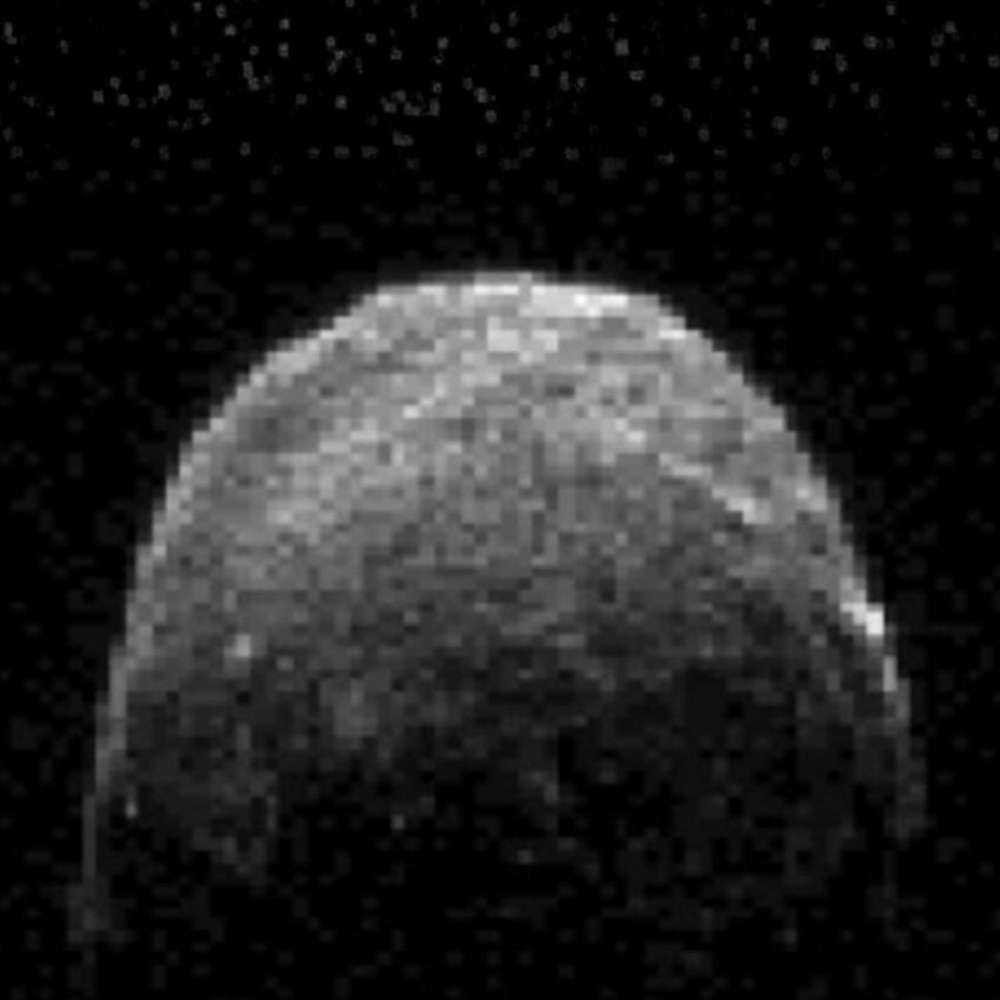
Quick Reader
| Attribute | Details |
|---|---|
| Official Designation | 2001 WN₅ |
| Object Type | Near-Earth Asteroid (NEA) |
| Asteroid Class | Apollo-type |
| Discovery Date | 21 November 2001 |
| Discoverer | LINEAR survey |
| Estimated Diameter | ~1 km (approximate) |
| Orbit Type | Earth-crossing |
| Closest Known Earth Approach | 26 June 2028 |
| Miss Distance (2028) | ~250,000 km (inside lunar distance) |
| Impact Risk | None (well constrained) |
| Scientific Role | Orbit prediction & planetary defense case study |
Scientific Role
2001 WN₅ is a textbook example used to demonstrate how asteroid orbits evolve and how impact risks can be ruled out with precision over time.
Why It Matters
This asteroid shows that close does not mean dangerous, and that modern orbital mechanics can accurately predict encounters decades in advance.
Introduction – Why 2001 WN₅ Attracted Attention
2001 WN₅ is not famous because it is large, unusual, or visually spectacular.
It is important because it will make a very close but safe pass by Earth—one close enough to test the limits of prediction accuracy.
When first discovered, its future path contained uncertainty.
With improved observations and modeling, that uncertainty collapsed.
This process—from uncertainty to confidence—is exactly how planetary defense works in practice.
Discovery – Finding a Potentially Interesting Object
2001 WN₅ was discovered by the LINEAR (Lincoln Near-Earth Asteroid Research) program, one of the most successful asteroid surveys of the early 2000s.
At discovery:
Only a short observation arc was available
Long-term orbital predictions were imprecise
Close approaches could not yet be ruled out
This is normal for newly discovered near-Earth asteroids.
Orbital Classification – An Apollo Asteroid
2001 WN₅ belongs to the Apollo group, meaning:
Its orbit crosses Earth’s orbit
It spends most of its time beyond Earth
Close encounters are geometrically possible
Key Orbital Characteristics
Earth-crossing trajectory
Moderate inclination
Sensitivity to gravitational encounters
Apollo asteroids form a major fraction of the planetary defense population because of their Earth-crossing nature.
The 2028 Close Approach – Why It Matters
On 26 June 2028, 2001 WN₅ will pass Earth at a distance inside the Moon’s orbit.
This makes it:
One of the closest predicted flybys of a kilometer-scale asteroid
A valuable test case for orbit determination
A public-interest object without actual danger
Crucially:
No impact scenario exists
The orbit is well constrained
The encounter is fully predictable
How Orbit Refinement Removed Risk
Early orbital solutions included a wide range of possibilities.
As more data was collected:
Radar and optical measurements refined its trajectory
Uncertainties shrank dramatically
Impact probabilities dropped to zero
This demonstrates a core principle of planetary defense:
Risk decreases as knowledge increases.
Why 2001 WN₅ Is Scientifically Valuable
2001 WN₅ matters because it:
Validates long-term orbit prediction methods
Demonstrates uncertainty reduction over decades
Serves as a training object for impact-risk analysis
Shows how gravitational encounters reshape orbits
It is not a threat—but it is an educational benchmark.
Why “Close” Does Not Mean “Dangerous”
A flyby inside lunar distance sounds alarming, but:
Earth–Moon distance is ~384,000 km
Many asteroids pass within this range safely
Orbital mechanics prevent random collisions
2001 WN₅’s encounter is a reminder that distance alone is not risk.
Orbital Evolution – How 2001 WN₅’s Path Changes Over Time
The orbit of 2001 WN₅ is not fixed. Like many near-Earth asteroids, it evolves due to repeated gravitational interactions—primarily with Earth, but also with Venus and Mars.
Key factors shaping its orbit:
Close planetary flybys that alter velocity and direction
Resonances that can slowly shift orbital elements
Long-term gravitational perturbations
These effects mean that:
Past orbits cannot be simply projected forward
Continuous observation is essential
Uncertainty grows without updated data
2001 WN₅ is a clean example of how predictable chaos operates in near-Earth space.
The Role of the 2028 Encounter
The 2028 flyby is especially important because close encounters act as orbital reset points.
During such a pass:
Earth’s gravity slightly bends the asteroid’s trajectory
The post-encounter orbit differs from the pre-encounter one
Future close approaches are reshaped
For 2001 WN₅:
The 2028 encounter will modify its orbital period and geometry
Future Earth encounters become easier to predict afterward
No resonance or keyhole leads to an impact outcome
This makes 2028 scientifically valuable even without any hazard.
Keyholes – Why Scientists Look for Them
In planetary defense, a gravitational keyhole is a tiny region of space during a close approach.
If an asteroid passes through such a region:
Earth’s gravity can set up a future collision
The impact may occur years or decades later
For 2001 WN₅:
Extensive modeling has identified no dangerous keyholes
The 2028 trajectory avoids all impact-enabling pathways
Post-encounter orbits remain safe
This is one of the clearest demonstrations of how risk is quantified, not guessed.
Uncertainty Management – From Wide to Narrow
At discovery, orbital uncertainty for 2001 WN₅ was large.
Over time:
Additional optical observations extended the data arc
Radar ranging improved distance accuracy
Statistical models collapsed uncertainty regions
This process turned:
A potentially concerning object
intoA fully understood, non-threatening flyby
This uncertainty-reduction pipeline is the backbone of modern asteroid monitoring.
2001 WN₅ Compared to Other Close-Approach Asteroids
| Feature | 2001 WN₅ | Typical NEA |
|---|---|---|
| Size | Large (~1 km) | Often <300 m |
| Close Approach | Inside lunar distance | Often farther |
| Prediction Lead Time | Decades | Years to decades |
| Impact Risk | None | Usually none |
| Defense Value | High (case study) | Variable |
Interpretation
2001 WN₅ is unusually valuable because it combines large size, close approach, and long lead time—ideal for testing prediction systems.
Why This Asteroid Is Used in Education and Training
Planetary defense teams often use objects like 2001 WN₅ to:
Train orbit analysts
Test uncertainty propagation models
Practice public risk communication
Because the outcome is safe but non-trivial, it provides a realistic yet controlled scenario.
Public Perception vs Scientific Reality
Close-approach asteroids often trigger alarming headlines.
Scientifically:
Distance thresholds are well defined
Impact probabilities are numerical, not emotional
Risk is communicated in transparent terms
2001 WN₅ illustrates the gap between:
How close approaches sound
How they are actually assessed
Bridging this gap is a core responsibility of planetary defense.
Why Predictive Accuracy Matters
Accurate predictions allow:
Early reassurance
Efficient allocation of observation resources
Avoidance of unnecessary alarm
2001 WN₅ demonstrates that decades-ahead predictions are possible when data quality is sufficient.
Long-Term Monitoring – Why Scientists Keep Watching 2001 WN₅
Even after an impact has been ruled out, near-Earth asteroids like 2001 WN₅ remain under observation.
Reasons include:
Refining post-encounter orbit predictions
Detecting subtle non-gravitational effects
Maintaining confidence in long-term models
Continuous monitoring ensures that:
Predictions remain accurate
Future encounters remain well understood
No new risk pathways emerge
Planetary defense is an ongoing process, not a one-time calculation.
Non-Gravitational Effects – Small Forces, Big Timescales
Over long periods, small forces can alter asteroid orbits.
For 2001 WN₅, scientists consider:
The Yarkovsky effect, caused by uneven heat emission
Seasonal and diurnal thermal forces
Slow but cumulative trajectory changes
While negligible over years, these effects matter over decades. Accounting for them is part of modern orbit prediction.
What 2001 WN₅ Teaches About Planetary Defense
This asteroid highlights several key lessons:
Early discovery dramatically improves prediction quality
Close approaches do not imply danger
Data-driven analysis replaces speculation
Transparency builds public trust
2001 WN₅ shows that planetary defense is predictive science, not emergency response.
Frequently Asked Questions (FAQ)
Will 2001 WN₅ hit Earth in 2028?
No. The 2028 flyby is close but completely safe.
How close will it come to Earth?
Approximately 250,000 km, inside the Moon’s orbit but far from Earth.
Why is this asteroid important if it poses no threat?
Because it tests orbit prediction accuracy under realistic conditions.
Can future observations change the risk assessment?
They can refine predictions further, but no impact scenario exists.
Is 2001 WN₅ large enough to cause damage if it impacted?
Yes, a kilometer-scale asteroid would be dangerous—but this one will not collide with Earth.
2001 WN₅ in the Broader Context of Near-Earth Objects
This asteroid occupies a critical middle ground:
Large enough to matter
Close enough to test models
Safe enough to study calmly
Objects like 2001 WN₅ help ensure that planetary defense systems are ready long before they are needed.
What We Would Not Learn Without 2001 WN₅
Without this case:
Long-term prediction models would be less validated
Public understanding of close-approach safety would be weaker
Training scenarios for defense teams would be less realistic
2001 WN₅ provided a real-world rehearsal without real-world risk.
Related Topics for Universe Map
Near-Earth Asteroids (NEAs)
Apollo Asteroids
Planetary Defense
Gravitational Keyholes
Yarkovsky Effect
Radar Astronomy
Together, these topics explain how Earth evaluates and manages asteroid encounters.
Final Perspective
2001 WN₅ is not remembered for danger—but for precision.
It demonstrates how modern astronomy transforms uncertainty into confidence, and proximity into knowledge.
As it passes safely by Earth in 2028, it will not be a threat—but a quiet validation of humanity’s growing ability to understand and predict its cosmic environment.