










433 Eros
The First Near-Earth Asteroid Visited by a Spacecraft
Quick Reader
| Attribute | Details |
|---|---|
| Official Designation | 433 Eros |
| Object Type | Near-Earth Asteroid (NEA) |
| Asteroid Class | Amor group |
| Discovery Date | 13 August 1898 |
| Discoverer | Carl Gustav Witt |
| Orbital Region | Inner Solar System |
| Average Distance from Sun | ~1.46 AU |
| Orbital Period | ~1.76 Earth years |
| Inclination | ~10.8° |
| Mean Diameter | ~16.8 km (elongated shape) |
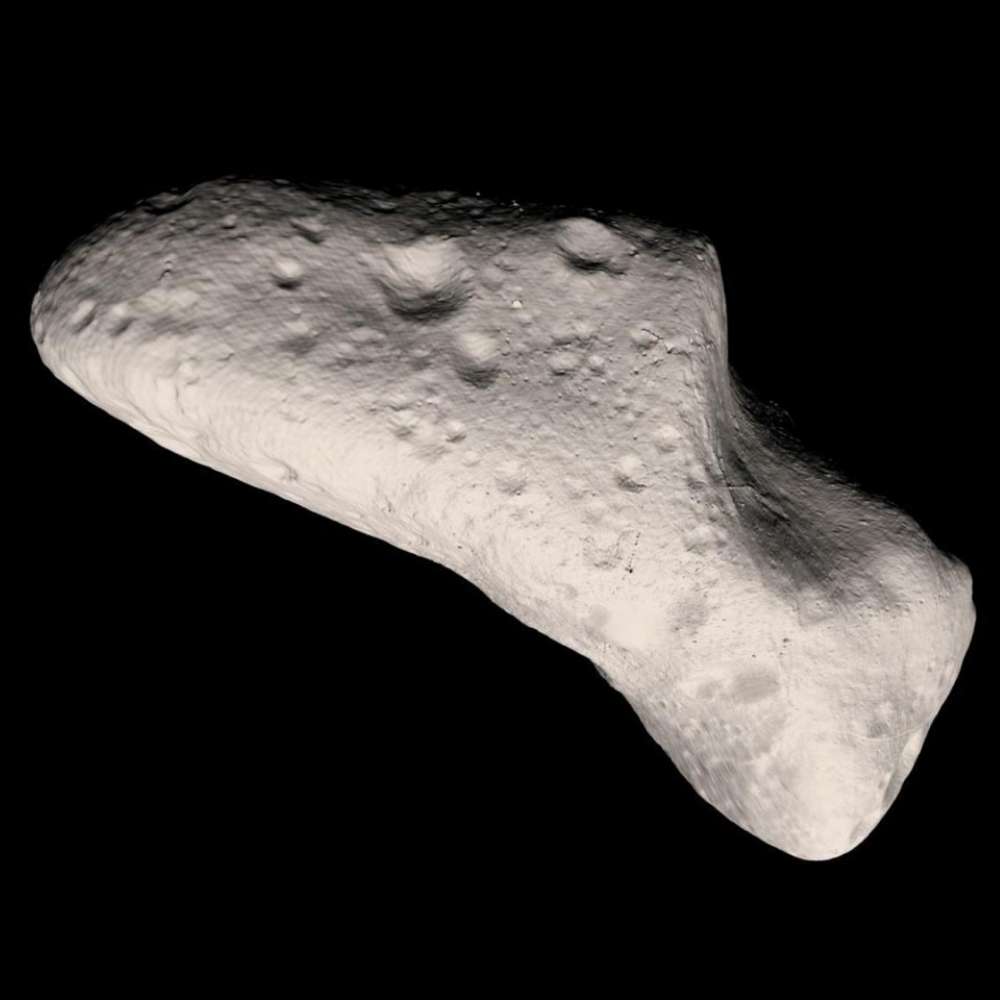
| Shape | Highly irregular, peanut-like |
| Rotation Period | ~5.27 hours |
| Mission Visited | NEAR Shoemaker (2000–2001) |
| Impact Risk | No known impact threat to Earth |
Key Points
- First near-Earth asteroid ever discovered
- First asteroid orbited and landed on by a spacecraft
- A cornerstone object in planetary defense studies
- Provides direct insight into asteroid structure and composition
Introduction – Why 433 Eros Is a Milestone Object
433 Eros holds a unique position in planetary science.
It was the first near-Earth asteroid discovered, the first asteroid orbited by a spacecraft, and the first small body ever landed upon by a human-made probe.
Unlike many distant asteroids confined to the main belt, Eros ventures relatively close to Earth, making it both scientifically valuable and historically important. Its study reshaped how astronomers understand asteroid interiors, surface geology, and long-term orbital evolution.
Discovery – The Birth of Near-Earth Asteroid Science
433 Eros was discovered in 1898, decades before the concept of “near-Earth asteroids” even existed.
At the time:
Asteroids were thought to reside mainly between Mars and Jupiter
Eros challenged that assumption by orbiting closer to Earth than Mars
This discovery marked the beginning of NEA science, revealing that the inner Solar System is populated by small bodies with dynamically complex paths.
Orbital Characteristics – Why Eros Is an Amor Asteroid
433 Eros belongs to the Amor group, meaning:
Its orbit approaches Earth’s orbit
It does not cross Earth’s orbital path
It frequently comes relatively close to Earth
Key Orbital Traits
Perihelion distance: just outside Earth’s orbit
Aphelion distance: near Mars
Gravitational interactions primarily influenced by Mars
This makes Eros:
Dynamically stable on long timescales
An ideal target for spacecraft missions
A benchmark object for orbital modeling
Physical Structure – A Stretched, Fragile World
Eros is not spherical. It is one of the most elongated asteroids ever studied.
Physical Implications
Irregular, peanut-like shape
Low overall density
Significant surface fractures and ridges
These features suggest that Eros is:
Not a solid monolith
Likely a fractured body formed by ancient collisions
Its shape alone provided early clues that many asteroids are structurally weak remnants of early Solar System violence.
Surface Geology – What Eros Reveals Without an Atmosphere
Eros has no atmosphere, allowing its surface to preserve ancient records.
Observed surface features include:
Impact craters of all sizes
Long grooves and lineaments
Boulder-strewn regolith
This shows that:
Space weathering dominates surface evolution
Seismic shaking redistributes material after impacts
Even small bodies undergo complex geological processes
Why 433 Eros Was Chosen for a Space Mission
Before any spacecraft visited an asteroid, scientists needed a target that was:
Relatively close to Earth
Large enough for detailed study
Dynamically stable
Eros met all criteria.
Its accessibility made it the perfect candidate for a historic mission that would permanently change asteroid science.
Why 433 Eros Matters
433 Eros matters because it:
Defined the near-Earth asteroid population
Proved that asteroids can be studied up close
Laid the foundation for planetary defense research
Revealed that small bodies are geologically complex
Eros transformed asteroids from distant points of light into real worlds.
The NEAR Shoemaker Mission – Humanity’s First Asteroid Encounter
433 Eros became a turning point in space exploration with the arrival of the NEAR Shoemaker spacecraft.
This mission was designed not just to fly past an asteroid, but to orbit and study it in detail—a first in human history.
NEAR (Near Earth Asteroid Rendezvous) was launched in 1996 by NASA and reached Eros in early 2000, entering a carefully planned orbital sequence that brought the spacecraft progressively closer to the asteroid’s surface.
Orbital Mapping – Seeing an Asteroid as a World
Once in orbit, NEAR Shoemaker transformed Eros from a theoretical object into a mapped planetary body.
What Orbital Observations Revealed
A globally cratered surface
Large variations in terrain roughness
Ridges and grooves extending for kilometers
Boulders scattered across slopes and crater floors
For the first time, scientists could:
Measure precise shape and volume
Determine mass and bulk density
Map gravity variations across a small body
This data confirmed that Eros is not a solid block of rock, but a fractured object with internal voids.
Surface Composition – Clues from Close Range
Spectral instruments showed that Eros is an S-type asteroid, rich in silicate minerals.
Key compositional findings:
Olivine and pyroxene dominate the surface
Composition resembles ordinary chondrite meteorites
Surface shows signs of long-term space weathering
This provided the strongest link yet between:
Asteroids in space
Meteorites found on Earth
Eros became a ground truth object for interpreting asteroid spectra across the Solar System.
Gravity, Density, and Internal Structure
By tracking NEAR’s orbit precisely, scientists measured Eros’s gravitational field.
Key Results
Average density lower than solid rock
Gravity variations consistent with a fractured interior
No evidence of a molten or metallic core
Interpretation:
Eros is likely a rubble-like, consolidated body
Formed from fragments reassembled after ancient collisions
Strong enough to hold together, but structurally fragile
This insight reshaped asteroid impact modeling and deflection strategies.
The Historic Landing – A Bonus Achievement
NEAR Shoemaker was not originally designed to land.
However, after completing its science mission, engineers guided the spacecraft into a controlled descent onto Eros’s surface in February 2001.
Why the Landing Was Historic
First soft landing on an asteroid
Continued data transmission after touchdown
Close-range measurements from the surface
The spacecraft survived the landing and transmitted data, proving that asteroid landings were feasible—an achievement that paved the way for later missions.
Regolith Behavior – A Low-Gravity Laboratory
Eros provided the first real-world view of how loose material behaves in microgravity.
Observations showed:
Regolith pooling in low areas
Slopes stabilized by weak gravity
Boulders migrating due to seismic shaking
These findings are critical for:
Future asteroid mining concepts
Sample return missions
Human interaction with small bodies
Eros became a natural testbed for surface physics beyond Earth.
Comparing Eros to Other Near-Earth Asteroids
| Feature | 433 Eros | Typical Small NEA |
|---|---|---|
| Size | Large (~17 km) | Often <1 km |
| Shape | Extremely elongated | Irregular |
| Internal Structure | Fractured | Often rubble piles |
| Mission Visited | Orbited + landed | Mostly flybys |
| Scientific Role | Benchmark object | Case-specific |
Eros remains one of the best-understood asteroids ever studied.
Long-Term Orbital Evolution – How Stable Is 433 Eros?
Although 433 Eros is classified as a near-Earth asteroid, its orbit is dynamically stable on long timescales.
Key characteristics of its evolution:
Gravitationally influenced mainly by Mars
Does not currently cross Earth’s orbit
Orbital elements change slowly over millions of years
Numerical simulations indicate that:
Eros is unlikely to become Earth-crossing in the near future
Its orbit has remained Amor-type for a very long time
Major destabilization would require rare planetary perturbations
This stability is one reason Eros has survived largely intact since early Solar System history.
Impact Risk – Is 433 Eros Dangerous to Earth?
433 Eros is not considered a hazardous asteroid.
Why the risk is low:
Its perihelion remains outside Earth’s orbit
No known resonances push it toward Earth-crossing trajectories
Continuous tracking shows no future impact scenarios
However, Eros plays an important role in planetary defense research:
It serves as a calibration object for orbit prediction
Its size represents a class of impactors that could cause regional damage if Earth-crossing
Lessons from Eros help refine deflection and mitigation strategies
Understanding safe objects is just as important as tracking dangerous ones.
What 433 Eros Tells Us About Asteroid Interiors
Before NEAR Shoemaker, asteroid interiors were largely theoretical.
Eros demonstrated that:
Many asteroids are fractured, not solid
Internal strength varies across the body
Surface geology reflects internal structure
This insight has major consequences for:
Impact modeling
Deflection mission design
Sample collection and anchoring systems
Eros showed that pushing an asteroid is not the same as pushing a solid rock.
433 Eros and the Meteorite Connection
One of the most important outcomes of studying Eros was the confirmation that:
S-type asteroids are the parent bodies of ordinary chondrite meteorites
This connection links:
Laboratory analysis on Earth
Telescopic asteroid observations
Direct spacecraft measurements
Eros became the bridge that unified three previously separate branches of planetary science.
Frequently Asked Questions (FAQ)
Is 433 Eros a moon of Earth?
No. It is an independent asteroid orbiting the Sun.
Why is Eros called a near-Earth asteroid if it doesn’t cross Earth’s orbit?
Near-Earth asteroids include objects that approach Earth’s orbital region, not only those that cross it.
Can Eros be seen from Earth?
Yes. During close approaches, Eros becomes bright enough for small telescopes and occasionally binoculars.
Was NEAR Shoemaker designed to land on Eros?
No. The landing was an extended-mission decision after orbital operations were complete.
Could humans visit Eros in the future?
Its size and stable orbit make it a realistic candidate for future robotic or crewed missions.
Why 433 Eros Still Matters Today
Even decades after its exploration, Eros remains scientifically relevant because it:
Anchors asteroid spectral classification
Guides planetary defense planning
Informs mission design for rubble-like bodies
Represents accessible targets for future exploration
Many later missions—such as Hayabusa, Hayabusa2, and OSIRIS-REx—built directly on lessons learned from Eros.
433 Eros in the Context of the Solar System
Eros occupies a unique position:
Too close to Earth to be a main-belt asteroid
Too stable to be a transient object
Large enough to preserve ancient structure
It represents a class of inner Solar System relics that quietly orbit the Sun, carrying records of planetary formation, collision history, and material evolution.
Related Topics for Universe Map
Near-Earth Asteroids (NEAs)
Amor Asteroid Group
Planetary Defense
Rubble-Pile Asteroids
NEAR Shoemaker Mission
Asteroid–Meteorite Connections
Together, these topics place 433 Eros at the foundation of modern asteroid science.
Final Perspective
433 Eros changed how humanity sees asteroids.
Once considered minor debris, asteroids became worlds with structure, history, and complexity. Eros was the first to prove that these small bodies are not just hazards or curiosities—but key witnesses to the Solar System’s earliest chapters.
By orbiting, mapping, and landing on Eros, humanity crossed a threshold:
from observing asteroids as distant points of light to understanding them as physical places.
That legacy endures.