









99942 Apophis
The Asteroid That Redefined Planetary Defense
Quick Reader
| Attribute | Details |
|---|---|
| Official Designation | 99942 Apophis |
| Provisional Name | 2004 MN₄ |
| Object Type | Near-Earth Asteroid (NEA) |
| Classification | Aten-type asteroid |
| Discovery Date | 19 June 2004 |
| Discoverers | Kitt Peak National Observatory |
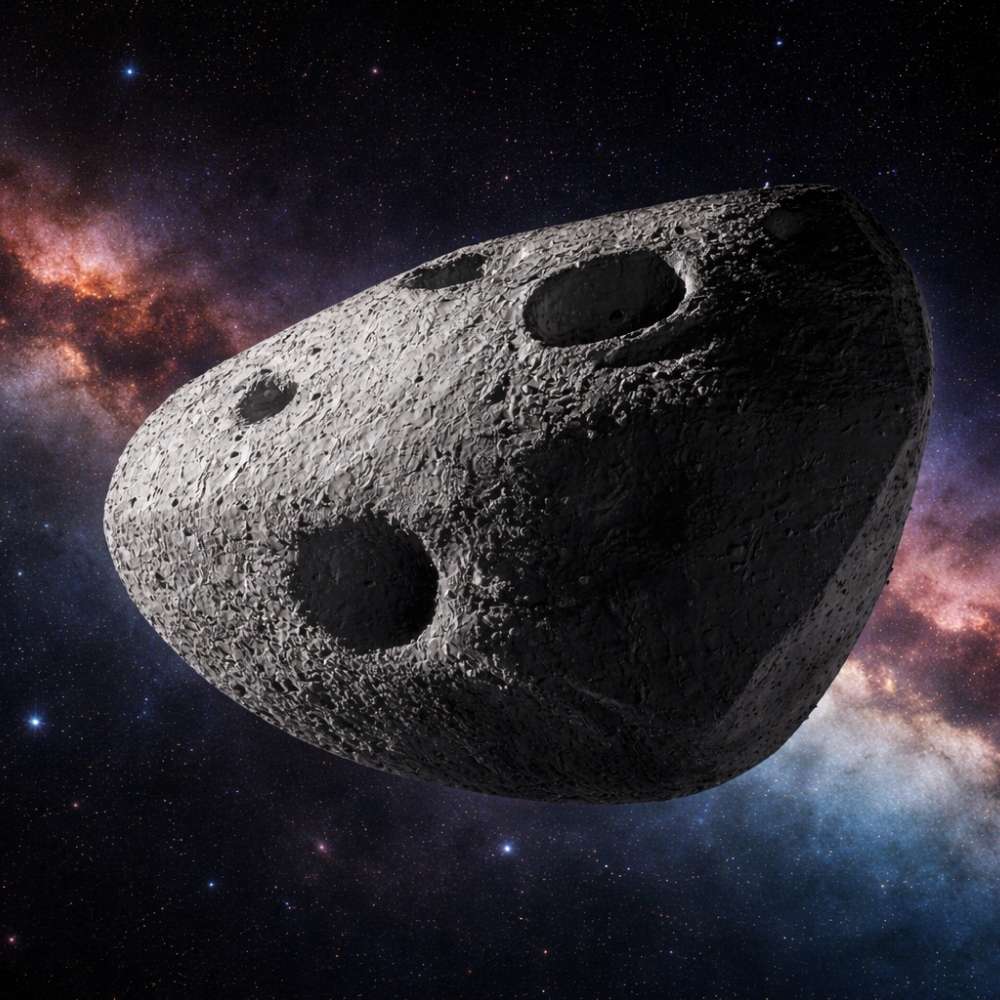
| Estimated Diameter | ~340–370 meters |
| Shape | Elongated, irregular |
| Rotation Period | ~30.6 hours |
| Composition | Likely stony (S-type) |
| Notable Encounter | Close Earth flyby – 13 April 2029 |
| Impact Status | No impact threat (confirmed) |
In two sentences
99942 Apophis is a near-Earth asteroid that once carried a significant predicted impact risk, triggering global concern and unprecedented orbital monitoring. Subsequent observations ruled out collision, transforming Apophis into a landmark case study in planetary defense.
Key takeaway
Apophis did not threaten Earth—but it permanently changed how humanity tracks and responds to asteroid hazards.
Best for
Planetary defense studies, near-Earth object research, space risk assessment, and Solar System dynamics.
Introduction – When One Asteroid Caught the World’s Attention
Most asteroids pass unnoticed.
Apophis did not.
In late 2004, early calculations suggested that a newly discovered asteroid—later named 99942 Apophis—had a small but non-negligible chance of impacting Earth in 2029. For the first time in modern history, an asteroid briefly reached the highest-ever impact risk rating on scientific hazard scales.
Although the danger was later ruled out, Apophis exposed both the limits and the urgency of asteroid detection—and forced planetary defense into the global spotlight.
What Is 99942 Apophis?
Apophis is a near-Earth asteroid whose orbit brings it repeatedly close to Earth.
Key characteristics include:
An orbit mostly inside Earth’s path around the Sun
Frequent close approaches on astronomical timescales
A size large enough to cause regional devastation if impact occurred
Although not an extinction-level object, Apophis belongs to the category of asteroids that demand serious monitoring.
Discovery and Early Risk Assessment
Apophis was discovered in 2004 and initially designated 2004 MN₄.
Early observations were limited, leading to:
Large uncertainties in its orbit
Preliminary impact probabilities that alarmed scientists
A brief assignment of Torino Scale Level 4, the highest ever recorded
This moment marked a turning point: the public became aware that asteroid risk was not purely theoretical.
Why Early Predictions Were So Alarming
Small observational errors can lead to large uncertainties over decades.
In Apophis’ case:
Limited tracking data amplified orbital uncertainty
Future close Earth encounters magnified prediction errors
A narrow “keyhole” region appeared in early simulations
This raised the possibility that Apophis could pass through a gravitational keyhole, altering its future orbit toward Earth.
Gravitational Keyholes – A Critical Concept
A gravitational keyhole is a small region of space near Earth.
If an asteroid passes through it:
Earth’s gravity slightly alters the asteroid’s orbit
A future impact years or decades later becomes possible
Apophis helped popularize this concept and demonstrated why long-term orbital tracking is essential.
Refining the Orbit – From Risk to Reassurance
As more data was collected:
Radar observations dramatically improved precision
Optical tracking extended the observation arc
Orbital models converged
By 2006, scientists confidently ruled out any impact in 2029, 2036, and later dates.
Apophis shifted from a threat to an opportunity for study.
Why the 2029 Flyby Is Still Extraordinary
On 13 April 2029, Apophis will pass closer than many geostationary satellites.
Key facts:
Closest approach distance: ~31,000 km from Earth’s surface
Visible to the naked eye from parts of Earth
Significant gravitational interaction expected
This will be one of the closest known asteroid flybys of its size in recorded history.
Why Apophis Matters Scientifically
Apophis matters because it:
Validated global asteroid monitoring systems
Improved impact-risk communication
Advanced orbital prediction methods
Elevated planetary defense from theory to practice
It transformed asteroid hazard assessment into a mature scientific discipline.
The 2029 Close Encounter – A Once-in-a-Millennium Flyby
On 13 April 2029, Apophis will pass extraordinarily close to Earth—closer than many satellites.
Key parameters of the encounter:
Closest approach: ~31,000 km above Earth’s surface
Distance: inside the orbit of geostationary satellites
Relative velocity: ~7.4 km/s
Visibility: Naked-eye from parts of Europe, Africa, and Asia
This event will be the closest approach of a large asteroid in recorded history without impact.
What Earth’s Gravity Will Do to Apophis
During the 2029 flyby, Earth’s gravity will significantly affect Apophis.
Expected effects include:
Measurable alteration of its orbit
Possible change in rotation rate (spin-up or spin-down)
Tidal stresses acting on the asteroid’s structure
This is not speculation—Apophis will pass close enough for Earth to act as a natural experiment in asteroid physics.
Will Apophis Break Apart?
Current models suggest:
Apophis will not fragment catastrophically
Internal stresses may rearrange surface material
Small landslides or regolith movement are possible
If Apophis is a “rubble-pile” asteroid, the encounter could cause surface reshaping—something never directly observed before.
Orbital Change After 2029
The 2029 flyby will permanently alter Apophis’ orbit.
After the encounter:
Its orbital period will change
Its future Earth-approach geometry will be different
Impact scenarios previously considered are eliminated
Post-2029, Apophis will be even better constrained than today.
Why Scientists Are Excited About This Flyby
Apophis offers a rare opportunity to observe:
Tidal effects on a near-Earth asteroid
Real-time orbital evolution
Surface response to planetary gravity
Normally, these processes occur invisibly over millions of years. Apophis compresses them into hours.
Planned and Proposed Missions to Apophis
Several space agencies have considered missions linked to Apophis.
Key highlights:
OSIRIS-APEX (formerly OSIRIS-REx) will rendezvous with Apophis after 2029
Ground-based radar campaigns are planned
Optical observatories worldwide will coordinate observations
These efforts will turn Apophis into the most studied asteroid in history.
Apophis and Planetary Defense Strategy
Apophis changed how planetary defense operates.
Before Apophis:
Impact risk assessment was mostly theoretical
Communication protocols were undeveloped
After Apophis:
Continuous NEO monitoring became standard
Risk scales were refined
International coordination improved
Apophis effectively served as a global planetary defense drill.
Public Perception vs Scientific Reality
Early media coverage fueled fear.
Later analysis delivered clarity.
This contrast highlighted the importance of:
Clear science communication
Transparent uncertainty handling
Rapid follow-up observations
Apophis became a case study in responsible risk communication.
Why Apophis Is No Longer a Threat
Thanks to improved tracking:
All known impact scenarios for the next century are ruled out
Orbital uncertainties are extremely small
Future encounters are safely distant
Apophis is now classified as non-hazardous, despite its dramatic reputation.
Apophis After 2029 – The Long View
The 2029 flyby will permanently reshape Apophis’ future—but not toward danger.
After the encounter:
Its orbital parameters will be precisely redefined
Long-term predictions will become even more accurate
Previously discussed impact scenarios are eliminated
In practical terms, Apophis transitions from a perceived threat to a benchmark object for asteroid science.
What Apophis Teaches Us About Near-Earth Asteroids
Apophis demonstrated several hard lessons:
Early orbital estimates can be misleading
Continuous tracking is essential
Radar observations dramatically reduce uncertainty
Small gravitational effects matter over time
Modern NEO risk assessment workflows were strengthened directly because of Apophis.
Planetary Defense – From Theory to Practice
Apophis forced the planetary defense community to mature.
Key advances driven by this case include:
Standardized risk scales (Torino, Palermo)
Rapid global observation coordination
Clear public communication protocols
Long-term funding for NEO surveys
Apophis did not hit Earth—but it hit preparedness.
Why Apophis Is a Scientific Opportunity, Not a Threat
The asteroid’s size, proximity, and predictability make it ideal for research:
Measuring tidal effects on small bodies
Studying rubble-pile vs monolithic structure
Observing spin and surface changes in real time
Testing asteroid-tracking systems under stress
Few asteroids will ever offer such a controlled, close, and safe encounter.
Missions and Observations Around the 2029 Flyby
Apophis will be observed by:
Ground-based optical telescopes
Planetary radar facilities
Space-based observatories
NASA’s OSIRIS-APEX mission will rendezvous with Apophis after the flyby, enabling before-and-after comparison—a first in asteroid science.
Frequently Asked Questions (FAQ)
Is 99942 Apophis going to hit Earth in 2029?
No.
Extensive observations have confirmed that Apophis will safely pass Earth on 13 April 2029 with no risk of impact.
How close will Apophis come to Earth?
Apophis will pass at a distance of roughly 31,000 kilometers above Earth’s surface, closer than many geostationary satellites.
Will Apophis be visible from Earth?
Yes.
During the 2029 flyby, Apophis will be visible to the naked eye from parts of Europe, Africa, and Asia under dark skies.
Could Earth’s gravity change Apophis’ orbit?
Yes.
Earth’s gravity will significantly alter Apophis’ orbit and possibly its rotation, but these changes do not lead to future impact scenarios.
Is Apophis considered a hazardous asteroid today?
No.
Apophis is no longer classified as a potentially hazardous asteroid based on current orbital data.
Why was Apophis once considered dangerous?
Early observations had limited data, leading to large orbital uncertainties.
Improved tracking and radar measurements later ruled out impact risk.
Why is Apophis important for planetary defense research?
Apophis served as a real-world test case that improved asteroid detection, tracking, risk communication, and international coordination.
Apophis in the Broader Solar System Context
Apophis represents a new category of object:
Large enough to matter
Close enough to study in detail
Predictable enough to observe safely
It bridges asteroid science, orbital mechanics, and planetary defense into a single narrative.
Related Topics for Universe Map
Near-Earth Objects (NEOs)
Planetary Defense
Gravitational Keyholes
OSIRIS-APEX Mission
Asteroid Flybys
Impact Risk Scales
Together, these topics explain how humanity monitors and manages cosmic hazards.
Final Perspective
Apophis was never the asteroid that would end the world.
It was the asteroid that woke the world up.
By forcing scientists, governments, and the public to confront real asteroid risk—and then resolve it through data and collaboration—Apophis transformed planetary defense from speculation into science.
In the history of near-Earth objects, Apophis will be remembered not for what it threatened, but for what it taught.