



Brightest Supernovae
Nature’s Most Powerful Light Show
Quick Reader
| Attribute | Details |
|---|---|
| Name | Brightest Supernova (SN 2006gy and others) |
| Type | Superluminous Supernova (SLSN), Pair-instability, Type IIn |
| Notable Example | SN 2006gy, SN 2016aps, SN 1006, SN 1987A |
| Peak Absolute Magnitude | SN 2006gy: ~–22 (about 50× brighter than a normal supernova) |
| Location | SN 2006gy: Galaxy NGC 1260, ~238 million light-years away |
| Detection Date | September 2006 (SN 2006gy) |
| Observation Methods | Optical (Hubble), X-ray (Chandra), Spectroscopy |
| Main Feature | Incredibly bright light curve lasting for months |
| Scientific Importance | Clues to first stars, black hole formation, and pair-instability physics |
| Energy Output | Over 10^51 ergs (10x typical SN) |
| Visibility to Earth | Some historical events visible to naked eye for weeks/months |
| Best Instruments | Hubble, Chandra, Keck, ground-based large telescopes |
Introduction – When Stars Die with a Bang So Bright, Galaxies Take Notice
Supernovae are the violent deaths of massive stars, releasing tremendous energy in just a few seconds. But among these cosmic catastrophes, some stand out—not for their violence, but for their sheer brightness. These are the brightest supernovae ever recorded, lighting up the universe far beyond what typical stellar deaths achieve.
The brightest supernovae often shine 10 to 100 times more than a standard Type II supernova. Some can outshine the entire host galaxy for weeks or months. These are rare, powerful events—Superluminous Supernovae (SLSNe)—and they’re more than just stunning light shows. They offer critical insights into:
The deaths of the first generation of stars (Population III),
Formation of stellar-mass black holes,
Exotic physics like pair-instability collapse,
How galaxies evolve through feedback and enrichment.
From SN 1006 seen in the sky over ancient Arabia to modern marvels like SN 2006gy and SN 2016aps, the story of the brightest supernovae stretches from human history to the edge of the known universe.
What Makes a Supernova “Superluminous”?
Most core-collapse supernovae (Type II, Ib/c) release about 10^51 ergs of energy and reach absolute magnitudes around –17 to –19. But superluminous supernovae (SLSNe) go beyond:
Defining Features of SLSNe
- Absolute Magnitude: –21 to –23 (vs. –19 for standard)
- Brightness: 10–100× brighter than regular SN
- Light Curve: Slower rise and decay, lasting several months
- Spectra: Often hydrogen-rich (Type IIn) or hydrogen-poor (Type I SLSN)
Types of SLSNe
| Type | Key Feature | Example |
|---|---|---|
| SLSN-I | No hydrogen lines (stripped-envelope) | SN 2005ap |
| SLSN-II / IIn | Strong hydrogen lines; dense circumstellar medium | SN 2006gy |
| Pair-instability | Theoretical; total star disruption from γ-photon–pair creation | SN 2007bi (candidate) |
These events are not powered by standard mechanisms like iron-core collapse alone. Additional energy sources are involved:
- Interaction with circumstellar matter (CSM)
- Central magnetar spin-down
- Radioactive nickel decay in massive quantities
- Pair-instability thermonuclear explosion
SN 2006gy – The Brightest Supernova Ever Observed (At That Time)
One of the best-known brightest supernovae is SN 2006gy, discovered in September 2006 in the galaxy NGC 1260, located about 238 million light-years away in Perseus.
Key Features
Peak absolute magnitude: ~–22
Duration: Bright for more than 70 days
Energy release: Over 10^51 ergs
Spectral type: Type IIn (strong interaction with dense hydrogen gas)
Host Galaxy: Luminous infrared galaxy, rich in dust and star formation
SN 2006gy’s light curve and spectra suggested that it was not a typical supernova. One possible cause: a massive star (over 100 solar masses) that ejected huge amounts of material before exploding. The expanding SN shockwave slammed into this material, converting kinetic energy into light—boosting its brightness to extreme levels.
Why These Supernovae Matter
These brightest events help solve long-standing puzzles in astrophysics:
1. Population III Star Analogs
Early universe stars were huge and metal-free.
SLSNe like SN 2007bi or SN 2016aps may mimic those early deaths.
Studying them helps infer conditions in the first billion years of the universe.
2. Black Hole Formation
The massive progenitors of SLSNe likely collapse into stellar-mass black holes.
These events allow direct observation of the transition from star to black hole.
3. Enriching the Cosmos
SLSNe eject huge amounts of heavy elements into surrounding space.
This drives chemical evolution in galaxies and triggers star formation nearby.
Other Contenders for the Brightest Supernova Title
While SN 2006gy was once crowned the brightest, several other supernovae have since challenged or even surpassed it in luminosity. Each brings a unique story, shedding light on the extremes of stellar death.
1. SN 2016aps – The New Record Holder (As of 2020)
Discovered: 2016, but analyzed and published in 2020
Peak brightness: Estimated absolute magnitude ~–22.5, possibly 5× brighter than SN 2006gy
Distance: ~4 billion light-years (redshift z ≈ 0.265)
Energy Output: ~10^52 ergs—more than any known supernova
Cause: Likely the merger of two massive stars, followed by a pair-instability-like explosion
Spectral Type: IIn (interaction with dense gas)
This supernova showed evidence of a shell of hydrogen ejected before explosion, into which the blast slammed, converting kinetic energy into a massive light surge.
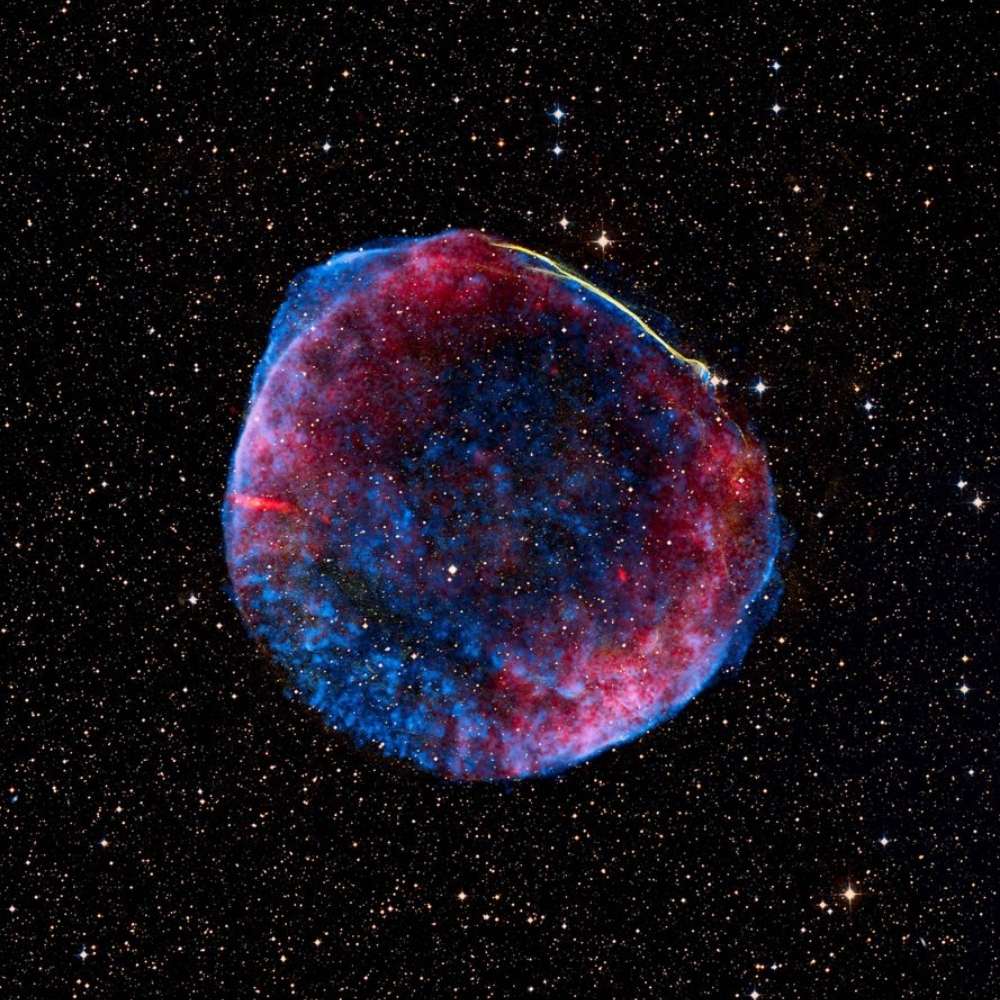
2. SN 1006 – The Brightest Supernova Seen by the Naked Eye
Date: April 30, 1006 AD
Location: Constellation Lupus
Visibility: Brighter than Venus, possibly even visible during the daytime
Peak magnitude: Apparent –7.5 (visible to the naked eye for months)
Distance: ~7,200 light-years
Type: Type Ia (white dwarf explosion)
Historical Accounts: Recorded in China, Japan, Middle East, Europe
Scientific Impact: First clear historical record that matches modern supernova classification
Though not intrinsically the most powerful, SN 1006 holds the record for most visually striking supernova in human history.
3. SN 1987A – The Most Studied Supernova Ever
Date: February 23, 1987
Location: Large Magellanic Cloud (~168,000 light-years)
Type: Type II (core-collapse)
Importance:
First modern supernova close enough to study neutrinos
Showed a blue supergiant progenitor, not a red giant
Provided insight into nucleosynthesis and shock breakout physics
Helped improve light curve models and understanding of supernova remnants
SN 1987A wasn’t the brightest ever, but its proximity made it a milestone in observational astrophysics.
How Do Astronomers Observe Superluminous Supernovae?
Studying these events requires multi-wavelength coordination across the globe and in space.
1. Optical Telescopes
Detect light curves and monitor changes in brightness
Hubble Space Telescope, Pan-STARRS, ZTF, and large ground-based telescopes like Keck
2. Spectroscopy
Reveals chemical composition of ejecta and circumstellar material
Tracks velocities and interaction between blast and surrounding gas
3. X-Ray and UV Telescopes
Instruments like Chandra or Swift observe shock-heated gas
Helps identify shock breakout and circumstellar interaction
4. Radio Observations
Tracks the blast wave’s expansion through surrounding space
Measures interaction with interstellar medium
5. Gravitational Wave and Neutrino Detectors (Future Potential)
Might one day detect early collapse stages of massive star supernovae
Could help understand core physics in real time
What Superluminous Supernovae Reveal About the Early Universe
These ultra-bright explosions may be the only windows into ancient times when telescopes can’t see individual stars.
1. Population III Star Deaths
SLSNe resemble what astronomers believe first stars might have looked like upon death
Their brightness means we can see analogs billions of light-years away
2. Feedback Mechanisms in Galaxies
Massive explosions blow gas out of galaxies, regulating star formation
Helps shape galactic morphology and chemical enrichment
3. Star Formation in Dusty Galaxies
SLSNe are sometimes found in low-metallicity, starburst dwarf galaxies
These resemble conditions in early-universe galaxies
The Death of a Star, the Birth of Something New
Every supernova, especially the brightest ones, marks the end of a star’s life—but also the beginning of something greater.
1. Black Holes and Neutron Stars
SLSNe often result in black hole formation from the collapse of extremely massive cores.
In other cases, a magnetar (a rapidly spinning neutron star with a strong magnetic field) may power the explosion’s luminosity.
2. Cosmic Recycling
The explosion ejects heavy elements like iron, oxygen, calcium, and gold into interstellar space.
These materials enrich nearby gas clouds, triggering new star formation and contributing to planetary systems.
3. Probing the Physics of Extremes
These events are natural laboratories for testing:
Relativistic shockwaves
Radiation–matter interactions
Exotic particle behaviors in core collapse
They offer insight into fundamental physics that cannot be replicated on Earth.
Frequently Asked Questions (FAQ)
Q: What is the brightest supernova ever recorded?
A: As of 2020, SN 2016aps is the most luminous, with a brightness ~5× greater than SN 2006gy. It released more than 10^52 ergs of energy and likely resulted from a stellar merger followed by a pair-instability-like explosion.
Q: Can supernovae be seen with the naked eye?
A: Yes, some historical supernovae like SN 1006 and SN 1054 (Crab Nebula) were visible for months. Today’s brightest SLSNe are too far to be seen without telescopes, but would outshine entire galaxies if they occurred nearby.
Q: What causes a superluminous supernova?
A: Possible causes include:
Interaction with dense circumstellar gas
Collapse of extremely massive stars
Pair-instability explosion
Central engine like a magnetar injecting energy after the collapse
Q: Are these the deaths of the most massive stars?
A: Yes. Many SLSNe originate from stars with masses over 100 solar masses. These are rare stars with short lifespans, and their deaths are just as rare and dramatic.
Q: How often do superluminous supernovae occur?
A: Very rarely—about 1 in 10,000 core-collapse supernovae. Their rarity and extreme brightness make them valuable tools for studying the high-redshift universe.
Final Thoughts – Light That Redefines the Darkness
The brightest supernovae are cosmic beacons—temporary but brilliant, they tell us stories about the life cycle of the universe:
How stars are born, live, and die
How black holes are formed
How galaxies evolve and recycle matter
In their fleeting existence, they illuminate cosmic history and point toward the earliest times in the universe. With every new detection of a superluminous event, we move one step closer to understanding:
The first stars
The nature of dark energy
And possibly, the origin of everything we see around us
As telescopes grow more powerful and surveys like LSST and JWST deepen their reach, the next brightest supernova might not just rewrite the record books—it could rewrite our understanding of the cosmos.