





Ring Nebula (M57)
A Cosmic Smoke Ring in Lyra
Quick Reader
| Attribute | Details |
|---|---|
| Name | The Ring Nebula (Messier 57 / NGC 6720) |
| Type | Planetary Nebula |
| Constellation | Lyra |
| Distance from Earth | ~2,300 light-years |
| Apparent Magnitude | 8.8 |
| Diameter | ~1 light-year (about 1.3 arcminutes across) |
| Central Star | White Dwarf (~0.6 M☉, surface temperature ~120,000 K) |
| Discovered By | Antoine Darquier de Pellepoix (1779), independently by Charles Messier |
| Age | ~7,000 years (since the star’s outer layers were ejected) |
| Observation Wavelengths | Visible, Infrared, Ultraviolet, and X-ray |
| Best Viewing Time | June–September (Northern Hemisphere) |
Introduction — A Glowing Ring in the Sky
Floating in the small constellation Lyra, between the bright stars Sheliak and Sulafat, lies one of the most mesmerizing objects in the heavens — the Ring Nebula (M57).
It’s the glowing remnant of a dying star, whose outer layers have been cast off into space, forming a luminous ring of ionized gas surrounding a fading white dwarf.
The Ring Nebula is the textbook example of a planetary nebula — a misleading term coined in the 18th century because these round gas shells looked like planets through early telescopes.
In reality, they are stellar death shrouds, the last stage of medium-mass stars like our Sun.
When viewed through a telescope, M57 appears as a tiny, ethereal smoke ring — a glowing oval suspended in the darkness.
Its beauty and proximity have made it one of the most studied nebulae in astronomy.
Discovery and Historical Observations
The Ring Nebula was discovered in January 1779 by Antoine Darquier de Pellepoix, who described it as “a dull planet surrounded by a luminous ring.”
Shortly afterward, Charles Messier independently observed it and added it to his famous catalog as Messier 57.
Milestones in Observation
1800s: Early astronomers debated whether it was a true ring or a spherical shell seen from the side.
1864: William Huggins used spectroscopy to show it emits bright emission lines — proof that it’s a gaseous nebula, not a solid object.
1900s–2000s: Photographs and later Hubble Space Telescope (HST) images revealed its intricate, multi-layered structure and inner shocks.
2020s: Observations from the James Webb Space Telescope (JWST) have provided unprecedented infrared detail, showing filaments, knots, and faint halos around the main ring.
From optical to infrared to ultraviolet, M57 has transformed from a simple curiosity into a laboratory of stellar death and rebirth.
Structure and Appearance — Layers of a Stellar Ghost
At first glance, the Ring Nebula looks like a perfect circle. But deeper imaging reveals that it is actually a 3D torus (doughnut-shaped shell) of gas and dust, surrounded by fainter outer halos from earlier mass-loss episodes.
Main Structural Components
| Region | Description | Composition |
|---|---|---|
| Bright Inner Ring | Dense ionized gas glowing in visible light | Hydrogen, oxygen, nitrogen, helium |
| Outer Halo | Faint, spherical shell from earlier stellar winds | Mostly hydrogen |
| Central Cavity | Region cleared by stellar radiation | Filled with hot gas and shock fronts |
| Knots and Filaments | Small dense clumps within the ring | Molecular hydrogen and dust grains |
Colors and Emission Lines
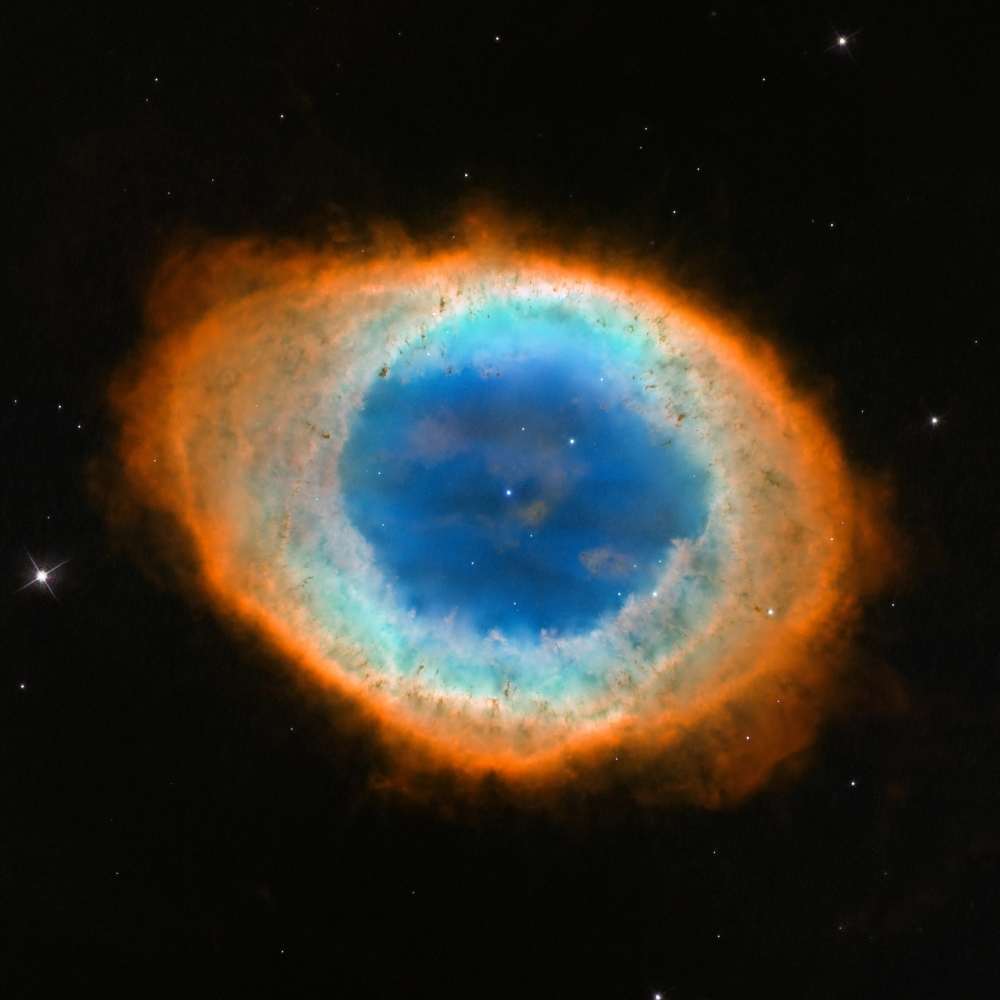
- Red: Hydrogen-alpha (Hα) and nitrogen emissions.
- Green/Blue: Doubly ionized oxygen ([O III]) — the most prominent glow.
- Faint Violet: Helium emissions near the center.
The vivid colors seen in astrophotographs represent real atomic transitions caused by ultraviolet radiation from the dying central star.
The Central Star — A Dying Sun
At the center of the Ring Nebula lies a white dwarf, the collapsed core of the original star that created the nebula.
This stellar remnant shines faintly with a surface temperature of ~120,000 K, radiating ultraviolet light that makes the nebula glow.
Stellar Facts
Original Star Mass: ~1–2 solar masses (similar to our Sun).
Current Core Mass: ~0.6 M☉.
Luminosity: ~200 times that of the Sun (mostly in UV).
Fate: Will cool over billions of years into a black dwarf.
The Ring Nebula thus offers a preview of our Sun’s distant future — in about 5 billion years, the Sun too will swell into a red giant, shed its outer layers, and illuminate them as a planetary nebula before fading to a white dwarf.
Distance and Size — Measuring the Smoke Ring
Determining distances to planetary nebulae is challenging, but modern parallax measurements from Gaia have pinned M57 at about 2,300 light-years away.
Its angular diameter of ~1.3 arcminutes translates to a physical size of about one light-year across.
Expansion and Age
Expansion Velocity: ~20 km/s
Estimated Age: ~6,500–7,000 years since ejection.
That means the light we see from the Ring Nebula today began its journey from a star that died during humanity’s Neolithic era — long before civilization began recording its own history.
Multi-Wavelength Observations — Seeing the Ring in Every Light
To the human eye, the Ring Nebula (M57) glows as a delicate blue-green oval.
But when seen through the eyes of different telescopes — from visible to infrared to X-ray — its true complexity emerges.
Each wavelength reveals a different layer of the dying star’s story.
1. Optical Observations (Hubble Space Telescope)
The Hubble Space Telescope (HST) captured some of the most iconic images of the Ring Nebula in visible and near-infrared light.
These images reveal the main ring’s intricate filamentary structure, including comet-like knots with bright heads and faint tails pointing away from the central star.
The inner shell is rich in ionized oxygen ([O III]) and nitrogen ([N II]), producing its vivid turquoise and red hues.
2. Infrared Observations (James Webb Space Telescope)
JWST’s NIRCam and MIRI instruments unveiled the nebula’s faint outer halos, invisible in optical light.
In the infrared, the ring appears filled with warm molecular hydrogen and dust, showing ripples caused by multiple episodes of stellar mass loss.
Tiny arcs and concentric shells indicate that the dying star shed its layers in pulses rather than a single explosion — possibly linked to late thermal pulses in its red giant phase.
3. Ultraviolet Observations (GALEX & HST UV Imaging)
Ultraviolet data show intense radiation from the central white dwarf, illuminating the gas and ionizing it layer by layer.
The UV flux provides key insights into how fast the central star is cooling and how its radiation interacts with the surrounding nebula.
4. X-ray Observations (Chandra Space Telescope)
X-ray images reveal a hot bubble of shocked gas in the nebula’s center, with temperatures reaching several million Kelvin.
This emission arises where the fast stellar wind (from the white dwarf) collides with the slower-moving material previously ejected — a classic “wind–wind interaction” zone.
Together, these multi-wavelength views allow astronomers to reconstruct the Ring Nebula’s 3D structure and evolutionary timeline with astonishing detail.
The Three-Dimensional Structure — Not a Flat Ring After All
Although the Ring Nebula looks circular from Earth, its true shape is a distorted torus or ellipsoid, tilted at an angle of about 30° to our line of sight.
Structural Model (Based on HST & JWST Data)
| Region | Shape | Description |
|---|---|---|
| Main Ring | Torus (doughnut-shaped) | Dense gas in the equatorial plane; glowing brightly in optical light. |
| Polar Lobes | Bipolar outflows | Faint, elongated structures extending perpendicular to the ring — remnants of directional stellar winds. |
| Outer Halo | Spherical shell | Material lost earlier in the red giant phase. |
| Inner Cavity | Hot bubble | Filled with ionized gas and high-energy radiation. |
This geometry shows that the Ring Nebula is not a true “ring” but rather a 3D bubble viewed nearly face-on, with the bright ring marking its densest equatorial zone.
Expansion and Dynamics — The Nebula in Motion
Even though the Ring Nebula appears static, it is actually expanding — slowly but steadily — as the ejected gas drifts away from the dying star.
Expansion Details
Expansion Velocity: ~19–20 km/s
Diameter: ~1 light-year
Age Estimate: ~6,500–7,000 years
Energy Source: Radiation and stellar wind pressure from the central star.
Hubble’s precise imaging over decades has allowed astronomers to directly measure this expansion, confirming that the nebula is spreading outward at the expected speed for planetary nebulae.
As the white dwarf cools, its UV output will decline, and the nebula’s glow will gradually fade — eventually blending into the interstellar medium within about 10,000 years.
Chemical Composition — The Ashes of a Star
The Ring Nebula’s luminous gases are the processed remains of nuclear fusion, enriched with heavier elements that once formed deep inside its parent star. When the star expelled its outer layers, these materials were spread into space — recycling them into the next generation of stars and planets.
Elemental Abundances (Average)
| Element | Relative Abundance | Origin |
|---|---|---|
| Hydrogen (H) | Dominant | Primordial from Big Bang |
| Helium (He) | 2nd most abundant | Fusion product of hydrogen burning |
| Oxygen (O) | Enhanced | Produced by helium burning in red giant phase |
| Nitrogen (N) | Enriched | Created through CNO cycle in stellar core |
| Carbon (C) | Moderate | Synthesized during helium fusion |
| Neon (Ne) | Trace | Generated in later fusion layers |
The abundance of oxygen and nitrogen gives M57 its characteristic blue-green and red colors — visible proof of chemical evolution in action.
Lessons from the Ring — A Glimpse into the Sun’s Future
The Ring Nebula provides an eerie but beautiful preview of our own star’s fate.
In roughly 5 billion years, the Sun will exhaust its hydrogen, swell into a red giant, and eventually eject its outer layers just as the M57 progenitor did.
The Sun’s own planetary nebula will likely look similar in structure and size, glowing for several thousand years before fading into the galactic background.
Thus, M57 isn’t just an astronomical object — it’s a time mirror showing what awaits every mid-sized star in the universe.
Astrophysical Importance — A Laboratory of Stellar Death
The Ring Nebula (M57) is one of the most studied planetary nebulae in the Milky Way — not only for its beauty, but for what it reveals about how stars end their lives.
Because of its proximity, clarity, and symmetrical structure, M57 has become a template object for modeling planetary nebula physics.
1. Understanding Stellar Mass Loss
The nebula offers direct evidence of how stars lose mass during the red giant phase.
Observations of multiple concentric shells show that this process occurs in episodic bursts, not a single event — reshaping our understanding of how stars shed their envelopes.
2. Testing Radiative Transfer Models
The Ring Nebula’s emission lines of [O III], [N II], and Hα are used to test photoionization models, which explain how ultraviolet radiation interacts with surrounding gas.
Such studies refine calculations of temperature, density, and ionization balance within nebulae.
3. Stellar Remnants and White Dwarf Physics
Its central white dwarf allows astronomers to measure the cooling rate and temperature evolution of such remnants — key data for estimating stellar lifetimes and the future of solar-type stars.
4. Galactic Chemical Enrichment
By studying M57’s elemental yields, scientists trace how stars like the Sun enrich the interstellar medium with heavy elements — the same elements that later form planets, atmospheres, and even life.
In essence, M57 is a stellar autopsy — every photon from its glowing gases tells us how matter recycles through the Galaxy.
Comparing the Ring Nebula with Other Planetary Nebulae
| Nebula | Common Name | Distance (ly) | Morphology | Central Star Type | Notable Features |
|---|---|---|---|---|---|
| M57 (NGC 6720) | Ring Nebula | ~2,300 | Torus / Elliptical | Hot White Dwarf | Perfect symmetry, intense [O III] emission |
| M27 (NGC 6853) | Dumbbell Nebula | ~1,200 | Bipolar | White Dwarf (~85,000 K) | Large, irregular lobes, extended halo |
| NGC 7293 | Helix Nebula | ~650 | Ring / Helical | White Dwarf (~100,000 K) | Closest planetary nebula to Earth |
| NGC 6543 | Cat’s Eye Nebula | ~3,300 | Complex, multiple shells | Wolf–Rayet-type central star | Intricate internal filaments |
| NGC 7009 | Saturn Nebula | ~1,400 | Elliptical | White Dwarf (~90,000 K) | Bright jets and outer ansae lobes |
Among these, the Ring Nebula stands as the most iconically symmetrical, offering a near-ideal example of how a planetary nebula should look in the absence of strong asymmetrical forces.
The Fate of the Nebula — A Fleeting Beauty
The Ring Nebula’s existence is temporary.
As the central star cools, its UV radiation will fade, and the surrounding gas will gradually disperse into interstellar space.
Evolutionary Timeline
Now: Bright, fully ionized shell glowing from UV radiation.
+5,000 years: Expansion doubles its size; brightness decreases.
+10,000 years: UV flux drops sharply; gas begins to fade.
+20,000 years: The nebula dissipates completely, leaving only a cool white dwarf surrounded by diffuse gas.
Eventually, that white dwarf will cool for billions of years, becoming a black dwarf — a cold, invisible ember in the cosmic night.
Thus, the Ring Nebula represents not a permanent structure, but a brief, radiant afterglow in the long, slow death of a star.
Observing the Ring Nebula — A Timeless Target
How to Find It
Constellation: Lyra
Coordinates: RA 18h 53m, Dec +33° 02′
Location Tip: Between the stars Sheliak (β Lyrae) and Sulafat (γ Lyrae).
Viewing Experience
Binoculars: Appears as a small, faint oval haze.
Small Telescope (4–6 inch): Clearly resolves the central hole — the classic “smoke ring.”
Large Telescope (≥10 inch): Reveals internal structure and color gradients — turquoise-blue center fading to reddish edges.
Astrophotography: Long exposures capture outer halos and faint hydrogen arcs extending beyond the main ring.
Even centuries after its discovery, M57 continues to inspire both professional astronomers and backyard observers as one of the most photogenic objects in the night sky.
Frequently Asked Questions (FAQ)
Q1: Why is it called the “Ring” Nebula?
Because, when seen through small telescopes, it looks like a perfect glowing ring — a circular shell of gas ejected by a dying star.
Q2: Is it a supernova remnant?
No. Planetary nebulae like M57 come from low- to medium-mass stars (like the Sun), not massive stars that explode as supernovae.
Q3: What causes the bright colors?
The colors come from ionized elements — green-blue from oxygen ([O III]) and red from hydrogen (Hα) and nitrogen ([N II]).
Q4: How hot is the central star?
Roughly 120,000 K — over 20 times hotter than the surface of our Sun.
Q5: Can I see it with a telescope?
Yes! Even a small telescope under dark skies will reveal M57’s oval shape, while larger telescopes or astrophotographs show its vibrant color structure.
Related Objects and Further Reading
M27 (Dumbbell Nebula): The first planetary nebula ever discovered; much larger and brighter.
Helix Nebula (NGC 7293): Closest planetary nebula to Earth, showing a similar ring-like shape.
NGC 7009 (Saturn Nebula): Displays outer “ring handles” resembling Saturn’s shape.
Cat’s Eye Nebula (NGC 6543): One of the most complex and multi-layered planetary nebulae known.
Final Thoughts
The Ring Nebula (M57) is a portrait of transformation — a momentary phase between a star’s fiery life and its quiet afterlife.
It reminds us that the cosmos is both impermanent and eternal: even the death of a star gives rise to breathtaking beauty and new beginnings.
Through its ghostly glow, we witness the future of our own Sun, the recycling of cosmic material, and the artistry of the universe at work.
Long after its light fades, M57’s story will live on — a cosmic smoke ring suspended in time, marking the cycle of creation, death, and rebirth that defines the stars themselves.