




Betelgeuse
The Great Red Supergiant of Orion
Quick Reader
| Attribute | Details |
|---|---|
| Name | Betelgeuse |
| Bayer Designation | α Orionis |
| Star Type | Red Supergiant (semi-regular variable) |
| Spectral Class | M1–M2 Ia–ab |
| Constellation | Orion |
| Distance from Earth | ~548 light-years (Gaia DR3 estimate) |
| Radius | ~750–1,000 R☉ (highly variable) |
| Mass | ~16–20 M☉ |
| Temperature | ~3,500 K |
| Luminosity | ~90,000–120,000 L☉ |
| Variability | Semi-regular, pulsation periods ~400–2,000 days |
| Notable Event | The “Great Dimming” of 2019–2020 |
| Evolutionary Stage | Advanced red supergiant, nearing final fusion cycles |
| Fate | Future Type II Supernova |
| Best Viewing Months | December to February |
Introduction – The Red Star That Captures Human Imagination
Betelgeuse, the bright red star marking Orion’s shoulder, is one of the most famous and widely studied stars in the night sky. Its fiery orange-red hue, enormous size, and unpredictable behavior have fascinated astronomers for centuries. As a massive red supergiant nearing the end of its life, Betelgeuse represents one of the final evolutionary stages of high-mass stars before they collapse and explode as supernovae.
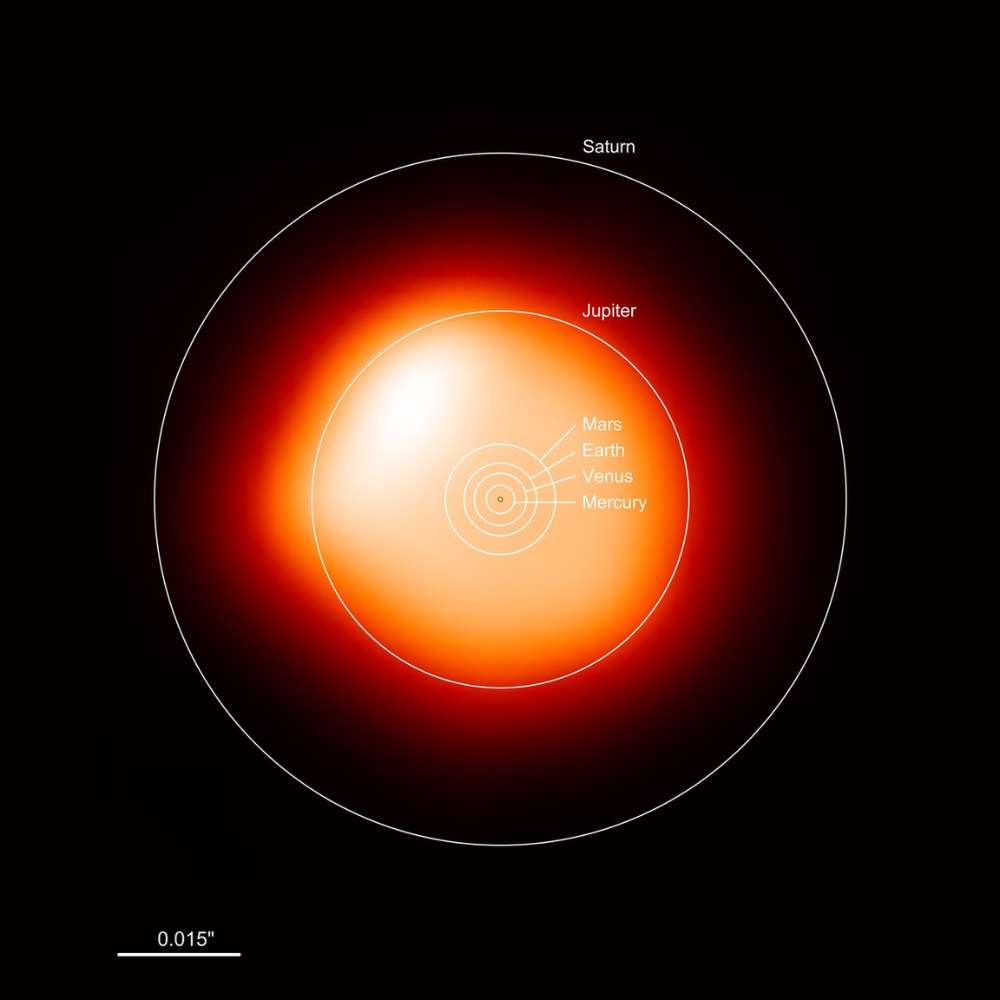
Visible from nearly every inhabited part of Earth, Betelgeuse gleams as one of the brightest stars in the sky. But brightness is only part of its story. Betelgeuse is physically gigantic—if placed at the center of the Solar System, its outer layers would extend beyond the orbit of Jupiter, possibly nearing Saturn depending on its pulsation phase.
Because Betelgeuse is both relatively close and extremely massive, it serves as a key object for studying stellar atmospheres, convection, mass loss, and supernova precursors. No other red supergiant has been observed in such detail.
A Star in Constant Motion – Pulsations, Convection, and Instability
Betelgeuse is not stable. Its surface and atmosphere are constantly shifting, driven by intense internal processes:
Giant Convection Cells
The star’s outer layers contain massive convection cells—each the size of the Earth’s orbit or larger. These cells churn and rise, producing surface irregularities that cause Betelgeuse to brighten and fade.
Semi-Regular Pulsations
Betelgeuse pulsates with multiple overlapping cycles:
~400-day primary pulsation
~1,000–2,000-day long secondary period
Irregular short-term variations
These pulsations change the star’s radius, temperature, and brightness.
Surface Turbulence
Betelgeuse’s photosphere is patchy and dynamic, with regions that vary dramatically in temperature and brightness. High-resolution imaging reveals:
Hot spots
Cool regions
Shock waves
Large-scale atmospheric flows
These contribute to Betelgeuse’s irregular variability and were central to the dramatic dimming that occurred in 2019–2020.
The Great Dimming of Betelgeuse – What Happened?
In late 2019, astronomers and the public alike witnessed an unprecedented event: Betelgeuse faded to roughly one-third of its usual brightness. Many speculated that the star was about to explode as a supernova.
However, research showed that the dimming was caused by two converging factors:
1. A Giant Cool Spot
Part of Betelgeuse’s surface cooled significantly, reducing its brightness.
2. Dust Formation
Simultaneously, a massive outflow of gas condensed into dust, partially blocking starlight.
The combination produced a dramatic dip in brightness—an event likely linked to the star’s intense convection and mass loss. The dimming was temporary, but it revealed how violent and unpredictable red supergiant atmospheres can be.
Mass Loss and the Surrounding Envelope
Betelgeuse is losing mass at a rapid rate, forming a vast extended atmosphere and surrounding nebular structures.
Key features:
Extended Atmosphere
Betelgeuse’s atmosphere stretches far beyond its visible surface, containing:
Molecules
Dust
Shock-heated gas
This creates difficulty in measuring its true radius, since different wavelengths probe different depths.
Circumstellar Material
Betelgeuse is surrounded by arcs and shells of gas and dust, created by episodes of mass loss. These arcs expand outward, shaping the environment into which the future supernova will explode.
Bow Shock
As Betelgeuse moves through the interstellar medium, its stellar wind creates a bow shock—a curved structure shaped like the wake of a ship.
The complexity of its outflow makes Betelgeuse a prime object for understanding how massive stars enrich the galaxy with heavy elements.
Why Betelgeuse Is Culturally Iconic
Throughout human history, Betelgeuse has appeared in myths, stories, navigation traditions, and early astronomy. It is:
The “armpit of the giant” in ancient Greek interpretations of Orion
A seasonal marker in Polynesian navigation
One of the Royal Stars in Persian astrology (as “Aldebaran’s counterpart”)
Revered in Indigenous North American and Australian traditions
Its brightness, color, and conspicuous location in Orion make Betelgeuse one of the most recognizable stars in the entire sky.
Betelgeuse’s Physical Structure – A Star with No Sharp Surface
Unlike smaller stars such as the Sun, Betelgeuse does not have a well-defined surface. Instead, it possesses an extended, diffuse photosphere that blends gradually into its massive atmosphere.
Key structural features:
Extended Photosphere: Betelgeuse’s “surface” varies with wavelength; infrared measurements see deeper layers than optical observations.
Molecular Envelope: Surrounding the star is a shell of molecules such as CO, SiO, and H₂O that form at cooler temperatures.
Dust-Forming Zones: Farther out, dust grains condense from the outflowing material.
Giant Convection Cells: These dominate the visible surface, producing brightness variations and irregular shapes.
This lack of a sharp boundary makes measuring Betelgeuse’s radius difficult—estimates can vary by hundreds of solar radii depending on the observational method.
Betelgeuse’s Enormous Size — How Big Is It Really?
Even with measurement challenges, Betelgeuse is unquestionably colossal.
Current best estimates:
Radius: ~750–1,000 times the Sun
Diameter: Nearly 1.2 billion kilometers
If placed at the Sun’s position:
It would engulf Mercury, Venus, Earth, and Mars.
It would likely extend between Jupiter’s orbit and Saturn’s orbit, depending on its pulsation phase.
Betelgeuse is not the largest star known, but it is one of the largest visible to the naked eye, making its size especially striking for observers.
How Betelgeuse Loses Mass
Betelgeuse’s weak surface gravity enables material to escape easily. The star sheds mass through:
Pulsation-Driven Outflows
Its expansion–contraction cycles push gas outward.
Convection
Massive ascending cells lift material from deep inside the star to the upper atmosphere.
Shock Waves
Generated by pulsations, shock waves push matter outward and cool, enabling dust formation.
Dust-Driven Winds
Dust grains absorb stellar radiation and accelerate outward, dragging gas along.
Betelgeuse is losing mass at a rate roughly ten million times higher than the Sun, shaping a vast circumstellar environment that will influence the future supernova.
Betelgeuse as a Pre-Supernova Laboratory
Because Betelgeuse is close, large, and well-observed, it serves as a model for understanding how massive stars behave right before they explode.
Astronomers study:
Internal Convection
Observations using interferometers show turbulent flows across the photosphere.
Short-Term Temperature Drops
Episodes like the Great Dimming indicate sudden cooling in localized surface regions.
Fast Mass Ejections
Imaged plume-like structures reveal how violently the star can release material.
Possible Rotation
There is evidence that Betelgeuse rotates faster than previously thought, affecting mass distribution.
Core Evolution
While direct observation is impossible, models suggest Betelgeuse is burning helium and heavier elements in layers.
Betelgeuse allows scientists to test supernova prediction models, particularly what observable changes occur before core collapse.
Where Betelgeuse Stands in Massive-Star Evolution
Betelgeuse is currently in an advanced red supergiant phase, but its exact position on the evolutionary timeline is debated.
Most models agree:
Betelgeuse has exhausted core hydrogen.
It is burning helium into carbon.
It may have begun fusing heavier elements in shells.
It is unstable and subject to dramatic structural changes.
However, the star’s future pace is uncertain. It may still have tens to hundreds of thousands of years before exploding.
Observing Betelgeuse Across the Electromagnetic Spectrum
Different wavelengths reveal different layers and processes:
Visible Light
Shows the patchy photosphere and pulsations.
Infrared
Reveals dust, extended atmosphere, and warm circumstellar material.
Radio
Maps the stellar wind, bow shock, and large-scale mass outflow.
Ultraviolet
Highlights hotter patches and shock fronts.
X-rays
While faint, X-ray observations sometimes detect interactions in the outer atmosphere.
This multi-wavelength synergy makes Betelgeuse one of the best-characterized stars in the universe.
Betelgeuse and Orion – A Cultural and Astronomical Icon
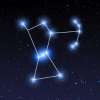
Betelgeuse anchors the shoulder of Orion, one of the most recognizable constellations.
Its significance:
Marks seasonal sky patterns around the world
Used in agricultural calendars in ancient civilizations
Represents mythological warriors, hunters, and spirits
Serves as a navigational reference point
Is one of the few bright red stars visible across both hemispheres
Betelgeuse’s position within a prominent constellation has ensured its fame for millennia.
Will Betelgeuse Go Supernova Soon?
Betelgeuse’s future supernova is one of the most anticipated events in astronomy. However, despite its recent dimming episode and turbulent behavior, current evidence suggests that Betelgeuse is not on the verge of exploding.
Reasons it will not explode imminently:
Its core is still likely burning helium or beginning heavier shell fusion.
Observed changes (pulsations, mass ejections, dimming) are normal for red supergiants.
Models estimate anywhere from 10,000 to 100,000+ years before core collapse.
Although sudden changes could theoretically happen, there is no indication of immediate danger or collapse.
How bright would the supernova be?
When Betelgeuse explodes:
It would shine as bright as the full Moon, perhaps brighter.
It would be visible in daytime for weeks.
At night, it would cast shadows.
The explosion would be completely safe for Earth.
The resulting supernova remnant would expand for tens of thousands of years, forming an evolving nebula in Orion.
What Will Happen During Betelgeuse’s Supernova?
A massive star like Betelgeuse will follow the typical path of a Type II supernova:
1. Core Collapse
Iron builds in the core until fusion is no longer possible.
Gravity overwhelms the core, collapsing it at 25% of light speed.
2. Shockwave Formation
The collapsing core rebounds, sending a powerful shockwave through the outer layers.
3. Explosion
The star’s outer layers are blasted into space with incredible force.
The explosion will momentarily outshine an entire galaxy.
4. Remnant Formation
Two outcomes are possible:
Neutron Star: If the remaining core is between ~1.4–3 solar masses.
Black Hole: If the core exceeds the neutron-star limit.
Current models lean toward neutron star, but Betelgeuse’s true mass-loss history is still uncertain.
5. Enrichment of the Galaxy
Betelgeuse will seed the Orion region with:
Carbon
Oxygen
Silicon
Iron
Heavy metals formed during fusion
These enriched materials contribute to future stars and planetary systems.
Betelgeuse in the Hertzsprung–Russell Diagram
Betelgeuse occupies the extreme upper-right region of the H-R diagram:
Low temperature
Extremely high luminosity
Enormous radius
Highly unstable structure
This location marks the late evolutionary path of high-mass stars—one of the shortest-lived phases in stellar evolution.
Betelgeuse is a key benchmark for modeling:
Red supergiant evolution
Mass-loss processes
Pre-supernova conditions
Convection-driven variability
Its data is essential for refining theoretical models for stars that are approaching the end of their lives.
Frequently Asked Questions (FAQ)
Why did Betelgeuse dim so dramatically in 2019–2020?
Because of a combination of a large cool spot and a burst of dust formation that temporarily blocked starlight.
Is Betelgeuse bigger than Antares?
Both are enormous red supergiants. Depending on measurement method and pulsation phase, Betelgeuse can be slightly larger or slightly smaller.
Is Betelgeuse the closest supernova candidate to Earth?
It is one of the closest. Others include Antares and Gamma Velorum. None pose danger.
Will the supernova harm Earth?
No. Betelgeuse is too far away for any harmful radiation to reach Earth at dangerous levels.
Can Betelgeuse be seen from both hemispheres?
Yes. Orion is visible worldwide, making Betelgeuse one of the most widely recognized stars.
Is Betelgeuse rotating?
Yes, though slowly. Rotation may influence mass-loss asymmetry.
Related Stars and Comparative Study
Antares – A similar red supergiant nearing the end of its life
Mu Cephei – Herschel’s famous red supergiant
Aldebaran – A bright orange giant used for contrast
Rigel – The blue supergiant counterpart within Orion
VY Canis Majoris – One of the largest known hypergiants
Comparing Betelgeuse with these helps map the entire evolutionary range of massive stars.
Final Thoughts
Betelgeuse is more than just a bright star—it is a living, evolving laboratory that shows us how massive stars age, shed mass, produce dust, and prepare for the most spectacular death in the universe: a supernova explosion.
Its proximity, enormous size, dynamic behavior, and rich observational history make it one of the most valuable stars in astrophysics. Whether studied for its atmospheric complexity, its future supernova, or its place in cultural astronomy, Betelgeuse stands as one of the true giants of the night sky.
Someday—though probably far in the future—Betelgeuse will end in a brilliant supernova, reminding the cosmos of its extraordinary life.