





Heliopause
The True Edge of the Solar System
Quick Reader
| Attribute | Details |
|---|---|
| Name | Heliopause |
| Type | Boundary region (plasma boundary) |
| Defines | Outer edge of the Sun’s heliosphere |
| Location | ~120–125 AU from the Sun (varies with solar activity) |
| Medium | Boundary between solar wind plasma and interstellar medium |
| Discovery (in-situ) | Voyager 1 (2012), Voyager 2 (2018) |
| Related Regions | Termination Shock, Heliosheath |
| Not a Solid Surface | Yes |
| Shape | Asymmetric, comet-like bubble |
| Scientific Importance | Solar–interstellar interaction, cosmic ray shielding |
| Beyond It | Interstellar space |
Introduction – Where the Sun’s Influence Truly Ends
When people talk about the “edge of the Solar System,” they often imagine the orbit of Neptune or the distant Oort Cloud. In reality, neither of these marks the true physical boundary of the Sun’s influence. The real frontier lies much farther out, in a region defined not by gravity alone, but by plasma, magnetic fields, and stellar winds. This boundary is known as the heliopause.
The heliopause is the outermost limit of the heliosphere—a vast, bubble-like region carved out by the solar wind as it pushes against the surrounding interstellar medium. Inside this bubble, the Sun dominates the local space environment. Beyond it, the influence of other stars and the galaxy itself takes over.
Crossing the heliopause is not like crossing a wall or a shell. It is a gradual but dramatic transition, where the supersonic flow of solar particles finally yields to the pressure of interstellar plasma. This invisible boundary represents the point where the Sun’s wind can no longer win.
Understanding the heliopause is essential for understanding how star systems interact with the galaxy, how cosmic radiation enters planetary systems, and how habitable environments are protected—or exposed—on cosmic scales.
What Is the Heliopause?
The heliopause is the boundary where the outward pressure of the solar wind balances the inward pressure of the interstellar medium. At this point:
Solar wind particles slow to a halt
The Sun’s magnetic field weakens sharply
Interstellar plasma and magnetic fields begin to dominate
It is not a physical surface, but a plasma boundary—a transition zone defined by changes in particle density, temperature, velocity, and magnetic field orientation.
Inside the heliopause, charged particles primarily originate from the Sun. Outside it, they come from the galaxy at large.
In simple terms:
The heliopause is where the Sun’s space weather ends and the galaxy’s space weather begins.
The Structure of the Heliosphere
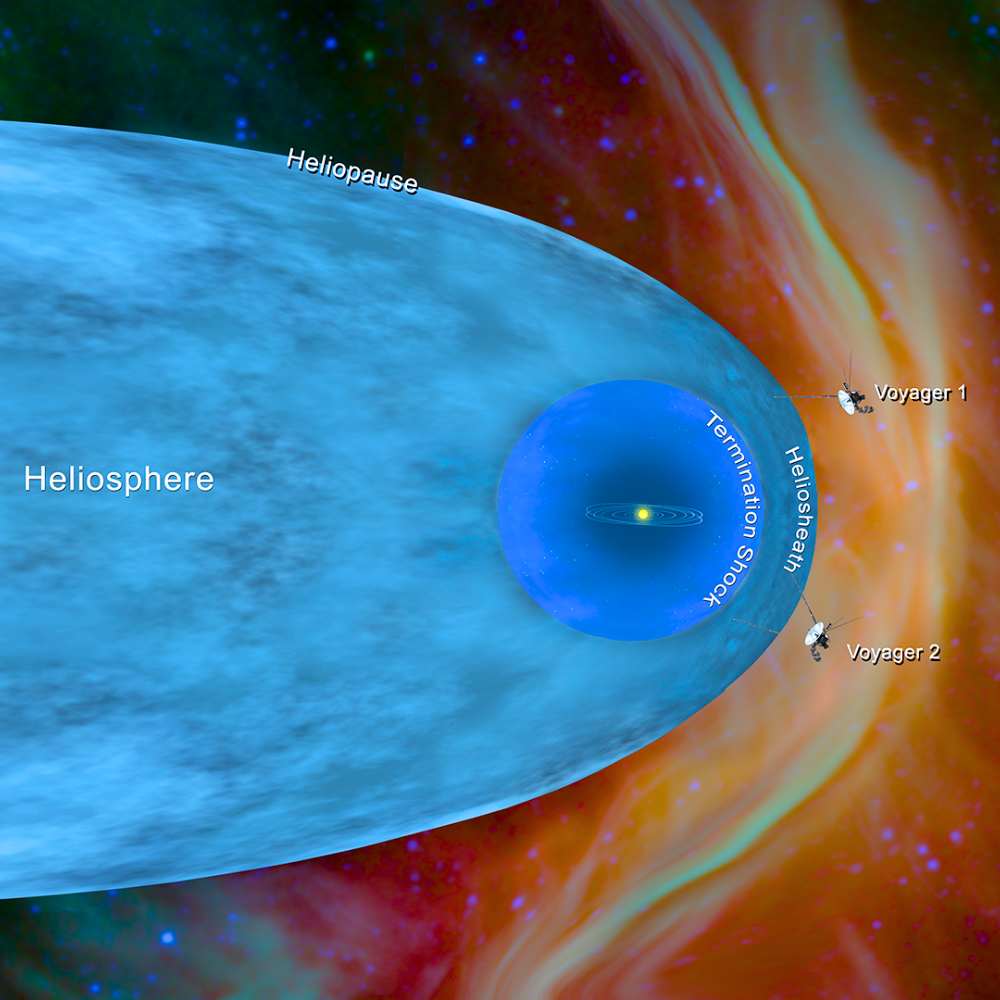
To understand the heliopause properly, it must be placed within the larger structure of the heliosphere. The Sun’s interaction with interstellar space unfolds in several distinct regions.
Solar Wind Region
This is the innermost zone, extending from the Sun outward. Here:
The solar wind flows supersonically
Particle speeds reach ~400–800 km/s
Plasma density steadily decreases with distance
All planets reside within this region.
Termination Shock
Far beyond the orbit of Pluto, the solar wind begins to slow down abruptly. This slowdown happens at the termination shock, where the solar wind transitions from supersonic to subsonic speeds due to pressure from the interstellar medium.
This region marks the first major warning that the Sun’s dominance is weakening.
Heliosheath
Beyond the termination shock lies the heliosheath, a turbulent, chaotic zone where:
Solar wind plasma is compressed and heated
Magnetic fields become tangled
Particle flow becomes irregular
This region can be tens of astronomical units thick and acts as a buffer zone before the final boundary.
Heliopause
At the outer edge of the heliosheath lies the heliopause—the final frontier of the heliosphere.
Here, the outward solar wind pressure equals the inward pressure of interstellar plasma. Past this point, solar particles can no longer push outward in any meaningful way.
Is the Heliopause a Fixed Distance?
No. The heliopause is dynamic and variable, not static.
Its distance from the Sun changes due to:
Solar activity cycles (approximately 11 years)
Variations in solar wind pressure
Density and velocity of the surrounding interstellar medium
During periods of high solar activity, the heliosphere expands, pushing the heliopause farther outward. During quieter solar phases, it contracts.
Measurements suggest an average distance of roughly 120 astronomical units, but this value fluctuates over time and varies depending on direction.
Shape of the Heliopause – A Cosmic Bubble with a Tail
Early models assumed the heliosphere was roughly spherical. Modern data reveal a far more complex shape.
The heliosphere is asymmetric because:
The Sun is moving through the interstellar medium
Interstellar magnetic fields exert uneven pressure
Plasma interactions differ by direction
As a result, the heliopause forms a blunt nose in the direction of the Sun’s motion and a long, stretched tail trailing behind—similar to a comet moving through space.
This asymmetry means the heliopause is closer in some directions and farther in others.
Voyager Missions – Humanity Touches the Edge
The heliopause remained theoretical for decades until humanity’s most distant explorers finally reached it.
Voyager 1
Crossed the heliopause in 2012
Detected a sharp drop in solar particles
Observed a dramatic increase in galactic cosmic rays
Confirmed entry into interstellar space
Voyager 2
Crossed the heliopause in 2018
Provided direct plasma measurements
Confirmed that the boundary is thinner and more complex than expected
Together, these spacecraft provided the first direct, in-situ confirmation that the heliopause exists—and that it behaves as plasma physics predicted.
Their data reshaped our understanding of how stars interact with their galactic environment.
Why the Heliopause Matters
The heliopause is not just a distant curiosity. It plays a crucial protective role.
Inside the heliosphere:
Galactic cosmic rays are partially deflected
High-energy radiation is reduced
Planetary atmospheres are better shielded
Without this boundary, Earth and other planets would be exposed to far higher levels of damaging radiation, potentially affecting climate, biology, and long-term habitability.
In this sense, the heliopause acts as a cosmic shield, created naturally by the Sun.
Plasma Physics at the Heliopause
The heliopause is fundamentally a plasma boundary, not a gravitational or material one. To understand how it works, we must look at the behavior of charged particles and magnetic fields rather than solid matter.
Inside the heliosphere, the plasma is dominated by the solar wind, a stream of charged particles—mainly protons and electrons—flowing outward from the Sun. Outside the heliopause, plasma originates from the local interstellar medium (LISM), consisting of ionized gas, neutral atoms, and galactic magnetic fields.
At the heliopause:
Particle density changes abruptly
Flow direction of plasma shifts
Magnetic field orientation alters sharply
Energy balance reaches equilibrium
This boundary forms where dynamic pressure from the solar wind equals the combined thermal, magnetic, and ram pressure of the interstellar medium.
Magnetic Fields and the Heliopause Boundary
One of the most surprising discoveries made by the Voyager missions was the behavior of magnetic fields at the heliopause.
Solar Magnetic Field Inside the Heliosphere
Carried outward by the solar wind
Forms a spiral pattern due to solar rotation (Parker spiral)
Weakens with distance from the Sun
Interstellar Magnetic Field Outside
Stronger and more uniform
Aligned with large-scale galactic structures
Influences the overall shape of the heliosphere
What Happens at the Boundary
Initially, scientists expected a sharp rotation in magnetic field direction at the heliopause. Instead, Voyager 1 detected:
Similar magnetic field directions on both sides
A sudden increase in magnetic field strength
A drastic change in particle populations
This suggested that magnetic reconnection and plasma mixing occur at the boundary, making it more complex and layered than previously thought.
How Cosmic Rays Interact with the Heliopause
Cosmic rays are high-energy particles originating from supernovae, neutron stars, and other energetic galactic events. The heliopause plays a critical role in regulating how many of these particles reach the inner Solar System.
Inside the Heliosphere
Cosmic ray intensity is reduced
Solar magnetic turbulence scatters particles
Energy levels are partially dampened
At the Heliopause
Cosmic ray intensity increases sharply
Solar modulation drops off
Galactic particles gain dominance
Voyager 1 observed a dramatic jump in galactic cosmic rays immediately after crossing the heliopause, confirming that this boundary acts as a radiation filter.
This filtering effect is essential for life-bearing planets, as excessive cosmic radiation can damage DNA, strip atmospheres, and alter climate chemistry.
Neutral Atoms and the Invisible Exchange
Not all particles at the heliopause are charged. Neutral atoms play a hidden but important role.
Charge Exchange Process
Neutral interstellar atoms enter the heliosphere
They exchange electrons with solar wind ions
This creates energetic neutral atoms (ENAs)
These ENAs travel long distances without being deflected by magnetic fields and can be detected by spacecraft, allowing scientists to map the heliosphere remotely.
NASA’s IBEX (Interstellar Boundary Explorer) mission used this method to create the first global images of the heliosphere, revealing unexpected ribbon-like structures tied to interstellar magnetic fields.
Is the Heliopause a Sharp Wall or a Thick Layer?
Evidence now suggests that the heliopause is neither perfectly sharp nor extremely diffuse. Instead, it behaves like a thin but structured transition region.
Characteristics include:
Rapid but not instantaneous changes in plasma properties
Layered magnetic field interactions
Temporary boundary shifts caused by solar storms
Voyager 2 detected plasma oscillations that revealed the density of the interstellar medium, confirming that the boundary thickness may be only a few astronomical units in some regions.
Comparing the Heliopause to Astropauses Around Other Stars
The heliopause is not unique. Other stars generate similar boundaries known as astropauses.
Key Comparisons
Massive stars with strong stellar winds have much larger astrospheres
Red dwarfs may have compact but intense astropauses
Dense interstellar environments compress these boundaries
Studying the heliopause provides a template for understanding how stellar systems interact with their galactic surroundings and how habitable zones may be shielded—or exposed—in other planetary systems.
In exoplanet research, the presence or absence of a strong astropause may directly affect a planet’s long-term habitability.
Scientific Questions Still Unanswered
Despite decades of study, major mysteries remain:
How stable is the heliopause over long timescales?
How does it respond to extreme solar events?
How does interstellar turbulence shape its structure?
Are there multiple layered boundaries instead of one?
Future missions specifically designed to study the interstellar boundary will be required to answer these questions.
Does the Heliopause Mark the True End of the Solar System?
Whether the heliopause represents the “end” of the Solar System depends on how the Solar System itself is defined.
From a plasma and space-weather perspective, the heliopause is the true outer boundary. Beyond it, the Sun no longer controls particle flow, magnetic dominance, or radiation environment. In this sense, the heliopause is the real frontier of the Sun’s active influence.
From a gravitational perspective, however, the Solar System extends far beyond. Objects in the Oort Cloud—possibly reaching tens of thousands of astronomical units—remain gravitationally bound to the Sun, even though they lie well outside the heliopause.
This distinction is critical:
Heliopause → End of solar wind dominance
Oort Cloud → End of solar gravitational dominance
Both boundaries are real, but they describe different physical realities.
Heliopause vs Oort Cloud – Clearing the Confusion
Many sources mistakenly equate the heliopause with the Oort Cloud. In reality, they are fundamentally different structures.
| Feature | Heliopause | Oort Cloud |
|---|---|---|
| Nature | Plasma boundary | Gravitational reservoir |
| Distance | ~120–125 AU | ~2,000–100,000 AU |
| Composition | Charged particles, magnetic fields | Icy bodies and comet nuclei |
| Function | Ends solar wind influence | Source of long-period comets |
| Detectability | Detected by spacecraft | Inferred from comet orbits |
The heliopause lies deep inside the inner region of the Oort Cloud, meaning comets can originate far beyond the Sun’s plasma boundary.
What Lies Beyond the Heliopause?
Once a spacecraft crosses the heliopause, it enters interstellar space, but not empty space.
Beyond the boundary exists:
The local interstellar medium (LISM)
Diffuse gas and plasma from past supernovae
Galactic magnetic fields
High-energy cosmic radiation
The environment is colder, denser in neutral atoms, and more radiation-rich than the space inside the heliosphere.
Voyager 1 and 2 are currently traveling through this medium, sending back data that help us understand the conditions between stars.
Future Missions Beyond the Heliosphere
Voyager spacecraft were not designed specifically to study the heliopause, yet they provided groundbreaking discoveries. Future missions aim to go much further.
Proposed Concepts
Interstellar Probe (NASA concept)
Designed to reach 1,000 AU or more
Dedicated instruments for plasma, dust, and magnetic fields
Direct study of the heliosphere–interstellar interface
Such missions could map the heliosphere in three dimensions, track its evolution over decades, and study the galactic environment beyond the Sun’s influence.
Why the Heliopause Matters for Life
The heliopause is more than a scientific boundary—it has implications for habitability.
A strong heliosphere:
Reduces cosmic radiation exposure
Protects planetary atmospheres
Stabilizes space-weather conditions
Stars with weak winds or compressed astropauses may expose their planets to intense galactic radiation, making long-term biological evolution more difficult.
In this way, the heliopause helps explain why Earth has enjoyed a relatively stable radiation environment over billions of years.
Frequently Asked Questions (FAQ)
Is the heliopause a physical wall?
No. It is a plasma boundary defined by pressure balance and magnetic fields. Spacecraft pass through it without any mechanical resistance.
Have humans reached the heliopause?
Indirectly, yes. Voyager 1 crossed it in 2012, and Voyager 2 followed in 2018. No human-crewed mission has come remotely close.
Can the heliopause move?
Yes. Its distance changes with solar activity and interstellar conditions. It expands and contracts over time.
Does the heliopause block all cosmic rays?
No. It reduces and modulates their intensity but does not completely block them.
Are we currently inside or outside the heliopause?
Earth and all planets are well inside the heliosphere, protected by the heliopause.
Final Perspective
The heliopause represents one of the most profound boundaries humanity has ever crossed—not with people, but with instruments. It is the point where our star’s influence yields to the galaxy, where solar weather gives way to cosmic weather.
Understanding this boundary reshapes how we define the Solar System, how we assess planetary protection, and how we search for life beyond Earth. The heliopause is not just the edge of our neighborhood—it is the gateway between stars.