





Voyager 1
Humanity’s Farthest Messenger
Quick Reader
| Attribute | Details |
|---|---|
| Name | Voyager 1 |
| Mission Type | Interplanetary → Interstellar space probe |
| Launch Date | September 5, 1977 |
| Launch Site | Cape Canaveral, Florida |
| Operator | NASA / Jet Propulsion Laboratory (JPL) |
| Primary Mission | Flyby study of Jupiter and Saturn |
| Extended Mission | Heliosphere & interstellar medium study |
| Current Status | Active (limited instruments) |
| Distance from Earth | 160+ AU (and increasing) |
| Speed | ~17 km/s relative to the Sun |
| Historic Achievement | First human-made object to enter interstellar space |
| Interstellar Entry | August 2012 (confirmed) |
| Power Source | Radioisotope Thermoelectric Generators (RTGs) |
Introduction – A Spacecraft That Outran the Solar System
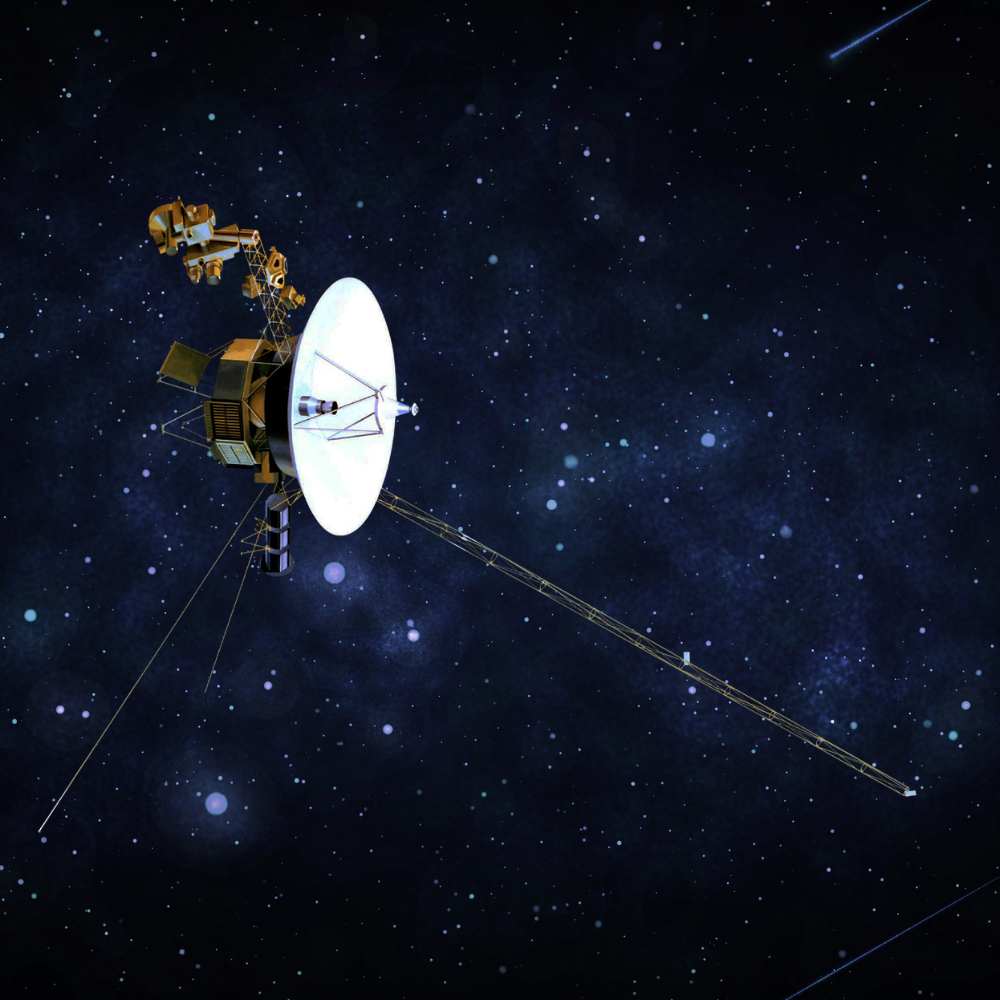
Voyager 1 is not just a spacecraft—it is a milestone in human history. Launched in 1977, long before personal computers and the internet became commonplace, Voyager 1 has traveled farther than any other object made by humans. More than four decades later, it continues to communicate with Earth from the depths of interstellar space.
Originally designed for a planetary flyby mission lasting only a few years, Voyager 1 far exceeded every expectation. It transformed from a planetary explorer into an interstellar scout, carrying humanity’s presence beyond the protective bubble of the heliosphere.
Voyager 1 represents a rare combination of engineering precision, scientific ambition, and long-term vision. It is proof that even limited technology, when guided by careful planning, can reach cosmic distances.
Why Voyager 1 Was Launched
In the early 1970s, astronomers identified a rare celestial alignment: Jupiter, Saturn, Uranus, and Neptune would line up in a way that allowed a spacecraft to visit all of them using gravity assists. This alignment occurs only once every 176 years.
NASA seized the opportunity.
The mission concept—originally called the Grand Tour—was ambitious and risky. Due to budget constraints, it was split into two spacecraft: Voyager 1 and Voyager 2.
Voyager 1’s primary objectives were:
Study Jupiter’s atmosphere, moons, and magnetic field
Study Saturn, its rings, and its largest moon Titan
Test long-duration deep-space navigation and communication
No one at the time expected Voyager 1 to become an interstellar probe.
Launch and Early Journey
Voyager 1 was launched on September 5, 1977, just 16 days after Voyager 2. Despite its later launch, Voyager 1 took a faster trajectory, allowing it to overtake its twin and become the most distant spacecraft.
Key Early Milestones
1977: Launch and cruise phase
1979: Jupiter flyby
1980: Saturn flyby
Post-1980: Interstellar Mission Phase
The spacecraft used gravity assist maneuvers, stealing a small amount of momentum from planets to accelerate itself without using additional fuel. This technique allowed Voyager 1 to reach escape velocity from the Solar System.
Jupiter Encounter – A Giant Revealed
Voyager 1 reached Jupiter in March 1979, delivering unprecedented data and images.
Major discoveries included:
Detailed views of Jupiter’s turbulent atmosphere
Confirmation of active volcanism on Io, the first observed outside Earth
Discovery of faint rings around Jupiter
New insights into Europa, Ganymede, and Callisto
The detection of active volcanoes on Io reshaped planetary science, proving that moons could be geologically active even far from the Sun.
Saturn Encounter – A Strategic Choice
Voyager 1’s path was carefully adjusted to pass close to Titan, Saturn’s largest moon. This decision meant sacrificing a potential visit to Uranus and Neptune—but it paid off scientifically.
Saturn Discoveries
Detailed structure of Saturn’s rings
Complex ring gaps and shepherd moons
Thick nitrogen-rich atmosphere on Titan
Evidence of organic chemistry on Titan
After its Titan flyby in November 1980, Voyager 1 was placed on a trajectory that would take it out of the planetary plane and eventually out of the Solar System.
At this moment, Voyager 1 officially became a mission without a return—its destiny was the stars.
From Planetary Probe to Interstellar Explorer
Once Voyager 1 completed its planetary mission, NASA faced a decision: turn it off, or keep listening.
The choice was clear.
Voyager 1 entered the Voyager Interstellar Mission (VIM), repurposed to study:
The outer heliosphere
Solar wind behavior at extreme distances
Interaction between the Sun and interstellar space
In the decades that followed, Voyager 1 crossed key boundaries:
Termination Shock
Heliosheath
Heliopause
Each crossing revealed a Solar System far more dynamic and complex than previously imagined.
The Golden Record – Humanity’s Message to the Cosmos
Mounted on Voyager 1 is one of humanity’s most symbolic artifacts: the Golden Record.
It contains:
Greetings in 55 human languages
Sounds of Earth (wind, rain, heartbeat)
Music from multiple cultures
Images explaining human biology, mathematics, and geography
The record is not a communication device—it is a time capsule. Its purpose is not to guarantee discovery, but to represent humanity at a moment in history.
Voyager 1 may outlive Earth itself.
Distance, Speed, and Longevity
Voyager 1 is traveling at approximately 17 kilometers per second relative to the Sun. Even at this speed, interstellar distances are vast.
It will take ~40,000 years to pass near another star
It will continue drifting through the Milky Way for billions of years
Powered by radioactive decay, Voyager 1’s instruments are slowly shutting down one by one. Yet as long as even a single signal can be sent, it remains humanity’s farthest voice.
Crossing the Heliopause – Leaving the Sun’s Realm
For decades, the heliopause existed only in theory. Scientists expected a clear boundary where the Sun’s influence would finally end—but no one knew exactly what Voyager 1 would experience when it reached that frontier.
In August 2012, Voyager 1 crossed a critical threshold at a distance of about 121 astronomical units from the Sun. At the time, mission scientists hesitated to announce the event. The reason was simple: the boundary did not behave exactly as expected.
What Voyager 1 Detected
Instead of a dramatic physical transition, Voyager 1 observed:
A sharp drop in solar energetic particles
A sudden increase in galactic cosmic rays
A stronger, more stable magnetic field
Plasma dominated by interstellar rather than solar origin
These signatures confirmed that Voyager 1 had crossed into interstellar space, marking the first time a human-made object had ever done so.
The heliopause turned out to be a subtle but decisive plasma boundary, not a shock or wall.
Life Beyond the Heliosphere
Once beyond the heliopause, Voyager 1 entered the local interstellar medium (LISM)—the sparse environment between stars.
This region is characterized by:
Extremely low particle density
Higher exposure to galactic radiation
Magnetic fields shaped by the Milky Way
Plasma originating from ancient stellar events
Voyager 1’s instruments revealed that interstellar space is not empty. It is filled with low-energy plasma waves and charged particles that carry information about the galaxy’s structure and history.
One of the most surprising discoveries was the density of interstellar plasma, measured indirectly through plasma oscillations triggered by solar outbursts propagating outward.
Instruments That Made History
Voyager 1 was equipped with 11 scientific instruments at launch. Over time, power constraints forced NASA to shut down many of them. Still, a select few continue to operate.
Key Active or Historic Instruments
Magnetometer (MAG)
Measures magnetic field strength and directionCosmic Ray Subsystem (CRS)
Detects high-energy particles from galactic sourcesPlasma Wave Subsystem (PWS)
Measures plasma density via oscillations
These instruments allowed scientists to distinguish between solar-dominated space and interstellar space with high confidence.
The longevity of these systems remains one of the greatest engineering achievements in space exploration.
Communication Across Interstellar Distances
Communicating with Voyager 1 is one of the most extreme technical challenges ever undertaken.
Signal Reality
One-way signal time: over 22 hours
Transmit power: about 23 watts (less than a refrigerator light bulb)
Data rate: only a few bits per second
Signals are received using NASA’s Deep Space Network (DSN)—a global system of massive radio antennas in California, Spain, and Australia.
Every command sent to Voyager 1 must be precise. There is no room for error, no possibility of real-time correction.
Yet despite these limitations, Voyager 1 continues to respond.
The Pale Blue Dot Moment
In 1990, at the request of astronomer Carl Sagan, Voyager 1 turned its camera back toward the Solar System for one final look.
From more than 6 billion kilometers away, it captured the iconic image known as “Pale Blue Dot.”
Earth appeared as a tiny speck suspended in a sunbeam.
This image was not scientifically necessary—but it became philosophically transformative. It reframed humanity’s place in the universe and remains one of the most powerful images ever taken.
After this moment, Voyager 1’s cameras were permanently shut down to conserve power.
System Failures and Recoveries
Operating for more than four decades inevitably brought technical challenges.
Voyager 1 has experienced:
Gyroscope and thruster degradation
Data corruption events
Power limitations due to RTG decay
Yet NASA engineers repeatedly managed to restore functionality—sometimes reviving hardware thought to be permanently lost.
These recoveries demonstrate not only robust spacecraft design, but also institutional memory and documentation practices from the 1970s that allowed modern engineers to understand and control legacy systems.
Why Voyager 1 Still Matters Scientifically
Voyager 1 continues to deliver unique data unavailable from any other mission.
Its ongoing measurements help scientists:
Map the interstellar magnetic field
Understand cosmic ray propagation
Study the Sun’s long-term interaction with the galaxy
No replacement mission currently exists at similar distances. Voyager 1 remains our only direct probe of interstellar space.
How Long Will Voyager 1 Keep Working?
Voyager 1 is powered by radioisotope thermoelectric generators (RTGs), which convert heat from the decay of plutonium-238 into electricity. This power source was chosen specifically for long-duration missions far from the Sun, where solar panels are useless.
However, radioactive decay is unavoidable.
Power Reality
Power output decreases by about 4 watts per year
Instruments are being shut down one by one to conserve energy
Priority is given to systems that can still return meaningful interstellar data
Current projections suggest that Voyager 1 may continue limited scientific operations until the late 2020s or early 2030s. After that, it will likely fall silent—not due to failure, but due to lack of power.
Even then, Voyager 1 will continue its journey.
What Happens After Contact Is Lost?
When Voyager 1 can no longer transmit or receive signals, it will become a silent interstellar artifact.
Key points:
It will not stop moving
It will not power down in a dramatic way
It will simply drift onward, inert but intact
With no atmosphere, erosion, or collisions expected for immense timescales, Voyager 1 could remain physically recognizable for billions of years, long after Earth itself may no longer exist.
In that sense, Voyager 1 is humanity’s longest-lasting creation.
Voyager 1’s Ultimate Fate in the Milky Way
Voyager 1 is not heading toward any specific star.
Its trajectory will:
Carry it through the local interstellar medium
Gradually orbit the center of the Milky Way
Potentially pass near other star systems in tens of thousands of years
Estimates suggest that in about 40,000 years, Voyager 1 may pass within a few light-years of another star system—but space is vast, and direct encounters are extremely unlikely.
It will wander the galaxy as a message without a sender.
Voyager 1 vs Voyager 2 – A Brief Comparison
| Feature | Voyager 1 | Voyager 2 |
|---|---|---|
| Launch Date | Sept 5, 1977 | Aug 20, 1977 |
| Farthest Distance | Yes | No |
| Interstellar Entry | 2012 | 2018 |
| Planet Flybys | Jupiter, Saturn | Jupiter, Saturn, Uranus, Neptune |
| Plasma Data at Heliopause | Indirect | Direct |
| Current Status | Active (limited) | Active (limited) |
Together, they form one of the most successful mission pairs in space history.
Frequently Asked Questions (FAQ)
Is Voyager 1 still sending data?
Yes, but at extremely low data rates. Only a few instruments remain active, and communication is slow due to distance and power limits.
Is Voyager 1 outside the Solar System?
Yes—by the heliospheric definition. It is beyond the heliopause, in interstellar space. However, it is still gravitationally bound to the Sun.
Can Voyager 1 ever return?
No. It is on a one-way trajectory out of the planetary plane and will never return to the inner Solar System.
Could aliens find Voyager 1?
The probability is extremely low. Space is vast, and Voyager 1 is very small. The Golden Record is symbolic rather than practical communication.
Why didn’t NASA turn it off after the planetary mission?
Because Voyager 1 entered regions of space never explored before. Every additional year of data provided new science at minimal additional cost.
Related Topics for Universe Map
Voyager 2
Heliopause
Heliosphere
Interstellar Medium
Golden Record
Deep Space Network
Pale Blue Dot
These topics together explain humanity’s first step beyond the Sun’s domain.
Final Perspective
Voyager 1 is not powerful by modern standards. Its computer memory is tiny, its instruments are primitive compared to today’s technology, and its signal is barely detectable from Earth.
Yet it has gone farther than anything else we have ever built.
Voyager 1 represents a rare moment when humanity planned not just for years, but for generations. It is a scientific instrument, a cultural artifact, and a philosophical statement—proof that even a small species on a small planet can reach the space between stars.
Long after its signal fades, Voyager 1 will continue to carry the story of Earth through the Milky Way.