





Voyager 2
Humanity’s Grand Tour of the Outer Solar System
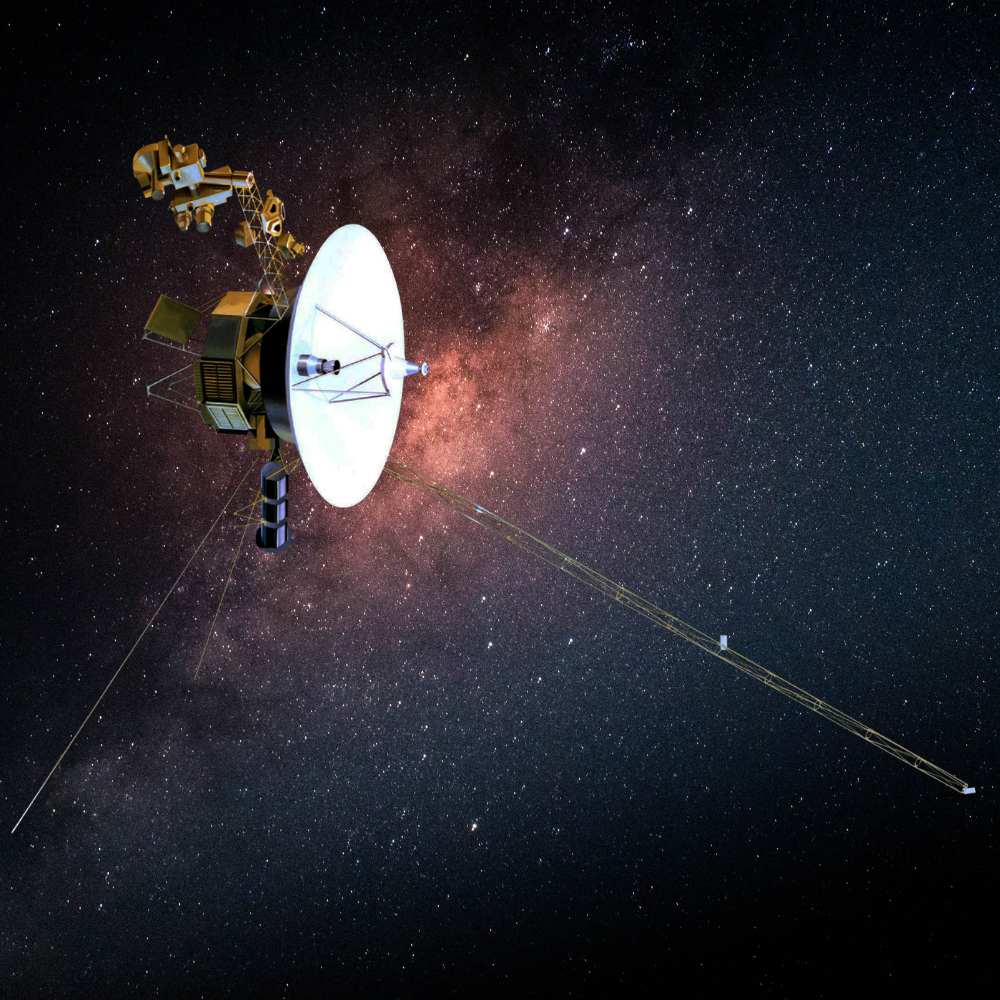
Quick Reader
| Attribute | Details |
|---|---|
| Mission Name | Voyager 2 |
| Mission Type | Robotic interstellar space probe |
| Agency | NASA |
| Launch Date | 20 August 1977 |
| Launch Site | Cape Canaveral, Florida |
| Launch Vehicle | Titan IIIE–Centaur |
| Mission Status | Active (Interstellar Mission) |
| Power Source | Radioisotope Thermoelectric Generators (RTGs) |
| Primary Mission | Flyby exploration of outer planets |
| Unique Achievement | Only spacecraft to visit Uranus and Neptune |
| Current Location | Interstellar space |
| Communication | NASA Deep Space Network |
| Scientific Instruments | 11 onboard instruments (some inactive) |
| Mission Duration | 1977 – present |
Introduction to Voyager 2 – A Journey Beyond Imagination
Voyager 2 is one of humanity’s most ambitious scientific achievements — a robotic explorer sent not just to study planets, but to redefine the boundaries of the Solar System itself. Launched in 1977, Voyager 2 was designed to take advantage of a rare planetary alignment that occurs once every 176 years, allowing a single spacecraft to visit multiple giant planets using gravity assists.
What followed was the most comprehensive exploration of the outer Solar System ever conducted by a single mission. Voyager 2 transformed distant points of light into real worlds with atmospheres, rings, storms, moons, and magnetic fields — many seen clearly for the first time.
Today, Voyager 2 continues its silent journey through interstellar space, carrying with it the scientific legacy of Earth.
Why Voyager 2 Was Launched
During the 1970s, astronomers identified a rare configuration in which Jupiter, Saturn, Uranus, and Neptune would align in a way that enabled a spacecraft to visit all four using gravitational slingshots.
The Grand Tour Concept
This alignment made possible:
Multiple planetary flybys with minimal fuel usage
Faster travel times to distant worlds
A once-in-a-lifetime mission opportunity
NASA designed two spacecraft — Voyager 1 and Voyager 2 — to ensure mission success even if one failed.
Voyager 2 was launched first, but on a slower trajectory that allowed it to visit more planets.
Voyager 2 vs Voyager 1 – Key Differences
Although nearly identical in design, the two Voyager spacecraft followed different paths.
| Feature | Voyager 2 | Voyager 1 |
|---|---|---|
| Launch Date | 20 Aug 1977 | 5 Sep 1977 |
| Planet Visits | Jupiter, Saturn, Uranus, Neptune | Jupiter, Saturn |
| Trajectory | Slower, multi-planet tour | Faster, direct exit |
| Unique Achievement | Only probe to visit Uranus & Neptune | First to enter interstellar space |
Voyager 2 became the ultimate planetary explorer.
Jupiter Encounter – A Turbulent Giant Revealed
Voyager 2 reached Jupiter in July 1979, revealing the gas giant in unprecedented detail.
Major Discoveries at Jupiter
Detailed images of Jupiter’s cloud bands and storms
Confirmation of the Great Red Spot as a massive, long-lived storm
Discovery of volcanic activity on Io
Detection of Jupiter’s strong magnetic field
Voyager 2’s observations confirmed that Jupiter is a dynamic, violent world rather than a static gas ball.
Jupiter Encounter – A Turbulent Giant Revealed
Voyager 2 reached Jupiter in July 1979, revealing the gas giant in unprecedented detail.
Major Discoveries at Jupiter
Detailed images of Jupiter’s cloud bands and storms
Confirmation of the Great Red Spot as a massive, long-lived storm
Discovery of volcanic activity on Io
Detection of Jupiter’s strong magnetic field
Voyager 2’s observations confirmed that Jupiter is a dynamic, violent world rather than a static gas ball.
Engineering a Spacecraft for Decades
Voyager 2 was built to survive conditions never tested before.
Spacecraft Design Highlights
Redundant systems for long-term reliability
Radiation-hardened electronics
Autonomous fault detection and correction
RTG power allowing operation far from the Sun
Its survival for nearly half a century is a testament to human engineering.
Instruments Onboard Voyager 2
Voyager 2 carried 11 scientific instruments, including:
Imaging Science System (ISS)
Infrared Interferometer Spectrometer (IRIS)
Plasma Science Experiment
Magnetometer
Cosmic Ray Subsystem
Some instruments have since been turned off to conserve power, but several continue to operate.
Why Voyager 2 Matters
Voyager 2 fundamentally changed planetary science by:
Turning unknown worlds into mapped systems
Revealing the diversity of moons and atmospheres
Establishing baseline data still used today
Paving the way for future missions
Without Voyager 2, Uranus and Neptune would still be largely mysterious.
Uranus Encounter – A World Tilted on Its Side
In January 1986, Voyager 2 became the first — and so far the only — spacecraft to visit Uranus. What it found reshaped scientific understanding of ice giant planets.
A Planet with an Extreme Tilt
Uranus is tilted by about 98 degrees, causing it to rotate almost on its side. Voyager 2 revealed:
Extreme seasonal variations
An unusual magnetic field tilted and offset from the planet’s center
A surprisingly bland-looking atmosphere at visible wavelengths
Despite its calm appearance, Uranus is a highly complex world beneath the clouds.
Discoveries at Uranus
Rings and Moons
Voyager 2 discovered:
New narrow rings composed of dark particles
Ten previously unknown moons
Complex gravitational interactions shaping ring structure
Major moons studied included Miranda, Ariel, Umbriel, Titania, and Oberon.
Miranda – A Moon That Defied Expectations
Miranda shocked scientists with its bizarre surface:
Giant cliffs up to 20 km high
Patchwork terrain with sharp boundaries
Signs of past tectonic activity
Miranda appeared geologically broken and reassembled, suggesting intense internal processes early in its history.
Uranus’s Magnetic Field
Voyager 2 revealed that Uranus has:
A magnetic axis tilted 59 degrees from its rotation axis
A magnetic field offset from the planet’s center
A chaotic, corkscrew-shaped magnetosphere
This challenged existing models of planetary magnetism and suggested that ice giants generate magnetic fields differently than gas giants.
Neptune Encounter – The Final Planetary Flyby
In August 1989, Voyager 2 completed its last planetary encounter at Neptune, transforming it from a blurry disk into a dynamic world.
Neptune’s Violent Atmosphere
Voyager 2 discovered:
The Great Dark Spot, a massive storm system
Wind speeds exceeding 2,000 km/h, the fastest in the Solar System
Rapid atmospheric changes
Despite receiving very little solar energy, Neptune turned out to be one of the most active planets observed.
Triton – A Captured World
Neptune’s largest moon, Triton, proved to be one of the most fascinating discoveries of the entire mission.
Voyager 2 revealed:
Nitrogen geysers erupting from the surface
A retrograde orbit, suggesting capture
An extremely cold but active surface
Triton became a prime candidate for subsurface oceans and future exploration.
Rings of Neptune
Voyager 2 confirmed:
Neptune has faint, incomplete ring arcs
Rings shaped by nearby moons
Highly dynamic ring systems
These discoveries overturned assumptions that Neptune’s rings were uniform.
The End of the Planetary Tour
After Neptune, Voyager 2 had completed humanity’s only full reconnaissance of the outer planets.
At this point:
All primary mission objectives were achieved
The spacecraft still had power and functioning instruments
A new mission phase began
Voyager 2 was retasked for interstellar exploration.
Transition to the Voyager Interstellar Mission
With its planetary mission complete, Voyager 2 was redirected to study:
The heliosphere
Solar wind interactions
The boundary between the Sun’s influence and interstellar space
This phase extended Voyager 2’s scientific life far beyond original expectations.
Why Uranus and Neptune Matter Today
Voyager 2 remains the only source of close-up data for Uranus and Neptune.
Its findings:
Define current ice giant models
Influence exoplanet research
Drive future mission proposals
Modern astronomy still relies on Voyager 2’s data for these distant worlds.
Crossing into Interstellar Space
Voyager 2’s most historic milestone came decades after its launch. In November 2018, it became the second human-made object to cross the heliopause — the boundary where the Sun’s solar wind is finally overpowered by the interstellar medium.
What Is the Heliopause?
The heliopause marks the outer edge of the heliosphere, a vast bubble created by the Sun’s charged particles.
Voyager 2 provided the first direct, in-situ measurements of:
Plasma density outside the heliosphere
Magnetic field strength and orientation in interstellar space
Particle behavior at the solar system’s boundary
Unlike Voyager 1, Voyager 2 still had a functioning plasma instrument, allowing it to measure conditions on both sides of the heliopause.
Scientific Discoveries Beyond the Solar System
In interstellar space, Voyager 2 continues to collect unique data.
Key Measurements
Increased plasma density compared to the heliosphere
A more stable magnetic field than expected
Evidence that the heliosphere is compressed and asymmetric
These findings reshaped models of how stars interact with the surrounding galaxy.
Current Status of Voyager 2
Voyager 2 remains operational, though gradually losing power as its radioisotope generators decay.
Active Systems
Magnetometer
Plasma Wave Subsystem
Cosmic Ray Subsystem
Other instruments have been powered down to conserve energy.
Communication Challenges
Voyager 2 communicates via:
NASA’s Deep Space Network
A data rate measured in bits per second
Signal travel time of more than 18 hours one way
Each transmission is a whisper from beyond the Solar System.c
Current Status of Voyager 2
Voyager 2 remains operational, though gradually losing power as its radioisotope generators decay.
Active Systems
Magnetometer
Plasma Wave Subsystem
Cosmic Ray Subsystem
Other instruments have been powered down to conserve energy.
Communication Challenges
Voyager 2 communicates via:
NASA’s Deep Space Network
A data rate measured in bits per second
Signal travel time of more than 18 hours one way
Each transmission is a whisper from beyond the Solar System.
The Golden Record – A Message to the Cosmos
Voyager 2 carries a Golden Record, a time capsule designed to communicate the story of Earth to any potential extraterrestrial intelligence.
Contents of the Golden Record
Sounds of Earth (wind, thunder, animals)
Music from multiple cultures and eras
Greetings in 55 languages
Images depicting human life, science, and nature
The record includes instructions etched in symbolic language, designed to be understandable by scientifically literate beings.
Voyager 2 vs Voyager 1 – Final Comparison
| Feature | Voyager 2 | Voyager 1 |
|---|---|---|
| Planetary Visits | 4 planets | 2 planets |
| Uranus & Neptune | Yes | No |
| Plasma Instrument | Active at heliopause | Inactive |
| Interstellar Entry | 2018 | 2012 |
| Current Distance | Slightly closer | Slightly farther |
Together, the two Voyagers provide a three-dimensional view of the Solar System’s boundary.
Why Voyager 2 Is One of Humanity’s Greatest Achievements
Voyager 2 stands apart because:
It visited every giant planet accessible by gravity assist
It remains active nearly 50 years after launch
It transformed unknown worlds into mapped systems
It is humanity’s ambassador to interstellar space
No mission before or since has matched its breadth and longevity.
Voyager 2’s Place in the Universe Map
Voyager 2 connects:
Planetary science
Heliospheric physics
Interstellar medium research
Human cultural expression
It marks the transition from a Solar System–focused civilization to an interstellar-aware one.
Frequently Asked Questions (FAQ)
What is Voyager 2?
Voyager 2 is a NASA robotic space probe launched in 1977 to explore the outer Solar System. It is the only spacecraft to have visited Jupiter, Saturn, Uranus, and Neptune, and it is currently operating in interstellar space.
Is Voyager 2 still active?
Yes. Voyager 2 is still active and transmitting scientific data, although several instruments have been shut down to conserve power.
When did Voyager 2 leave the Solar System?
Voyager 2 entered interstellar space in November 2018 after crossing the heliopause, the boundary of the Sun’s influence.
What makes Voyager 2 different from Voyager 1?
Voyager 2 is the only spacecraft to visit Uranus and Neptune, and it carried a functioning plasma instrument when crossing the heliopause, allowing direct interstellar plasma measurements.
How far is Voyager 2 from Earth now?
Voyager 2 is more than 130 astronomical units away from Earth, with radio signals taking over 18 hours to travel one way.
How is Voyager 2 powered so far from the Sun?
Voyager 2 uses radioisotope thermoelectric generators (RTGs), which convert heat from radioactive decay into electricity, allowing it to operate far beyond the reach of solar power.
Will Voyager 2 ever stop working?
Yes. As its power supply continues to weaken, all instruments will eventually shut down. However, the spacecraft itself will continue drifting through interstellar space indefinitely.
Does Voyager 2 carry a message from Earth?
Yes. Voyager 2 carries the Golden Record, containing sounds, music, images, and greetings from Earth intended for potential extraterrestrial intelligence.
Final Thoughts
Voyager 2 is not just a spacecraft — it is a story of foresight, engineering excellence, and scientific courage. Built with 1970s technology, it continues to answer questions its designers never imagined.
Long after Earth’s cities have changed, long after today’s languages have evolved, Voyager 2 will still be traveling between the stars — carrying a record of who we were and how far we dared to go.