




Termination Shock
Where the Solar Wind Begins to Slow
Quick Reader
| Attribute | Details |
|---|---|
| Name | Termination Shock |
| Type | Plasma shock boundary |
| Defines | Transition of solar wind from supersonic to subsonic |
| Location | ~80–100 AU from the Sun (variable) |
| Part of | Heliosphere |
| Lies Between | Solar wind region and heliosheath |
| Discovery (in-situ) | Voyager 1 (2004), Voyager 2 (2007) |
| Nature | Shock wave (not a solid boundary) |
| Shape | Asymmetric |
| Scientific Importance | Solar–interstellar interaction, plasma physics |
| Beyond It | Heliosheath → Heliopause |
Introduction – The First Warning at the Edge of the Sun’s Domain
Long before the Sun completely loses its influence to interstellar space, there is a region where its power begins to fail. This region is known as the termination shock.
The termination shock is not the end of the Solar System, nor is it the boundary of the heliosphere. Instead, it marks the point where the solar wind—once supersonic—slows down abruptly for the first time due to pressure from the surrounding interstellar medium.
This invisible shock wave represents the Solar System’s first line of resistance against the galaxy. It is where the Sun’s outward push meets growing opposition from interstellar plasma, magnetic fields, and cosmic pressure.
Understanding the termination shock is essential for understanding how stars interact with their galactic environment—and how planetary systems remain shielded from deep-space radiation.
What Is the Termination Shock?
The termination shock is a plasma shock wave formed when the solar wind slows from supersonic to subsonic speeds.
Inside most of the Solar System, the solar wind travels at speeds of:
~400 km/s (slow solar wind)
~800 km/s (fast solar wind)
As this flow expands outward, it eventually encounters increasing resistance from the interstellar medium. When it can no longer maintain supersonic speed, it undergoes a sudden deceleration—creating the termination shock.
Key characteristics:
Not a physical surface
Not fixed in location
Defined by abrupt changes in plasma speed, density, and temperature
It behaves much like shock waves produced by supersonic aircraft—but on a cosmic scale.
Why Does the Solar Wind Slow Down?
The solar wind does not stop because it runs out of energy. It slows because external pressure increases.
Major opposing forces include:
Interstellar plasma pressure
Interstellar magnetic fields
Neutral atoms entering the heliosphere
Cosmic-ray pressure
As distance from the Sun increases:
Solar wind density decreases
Solar magnetic control weakens
Interstellar influence grows stronger
When these forces balance unfavorably for the solar wind, a shock forms.
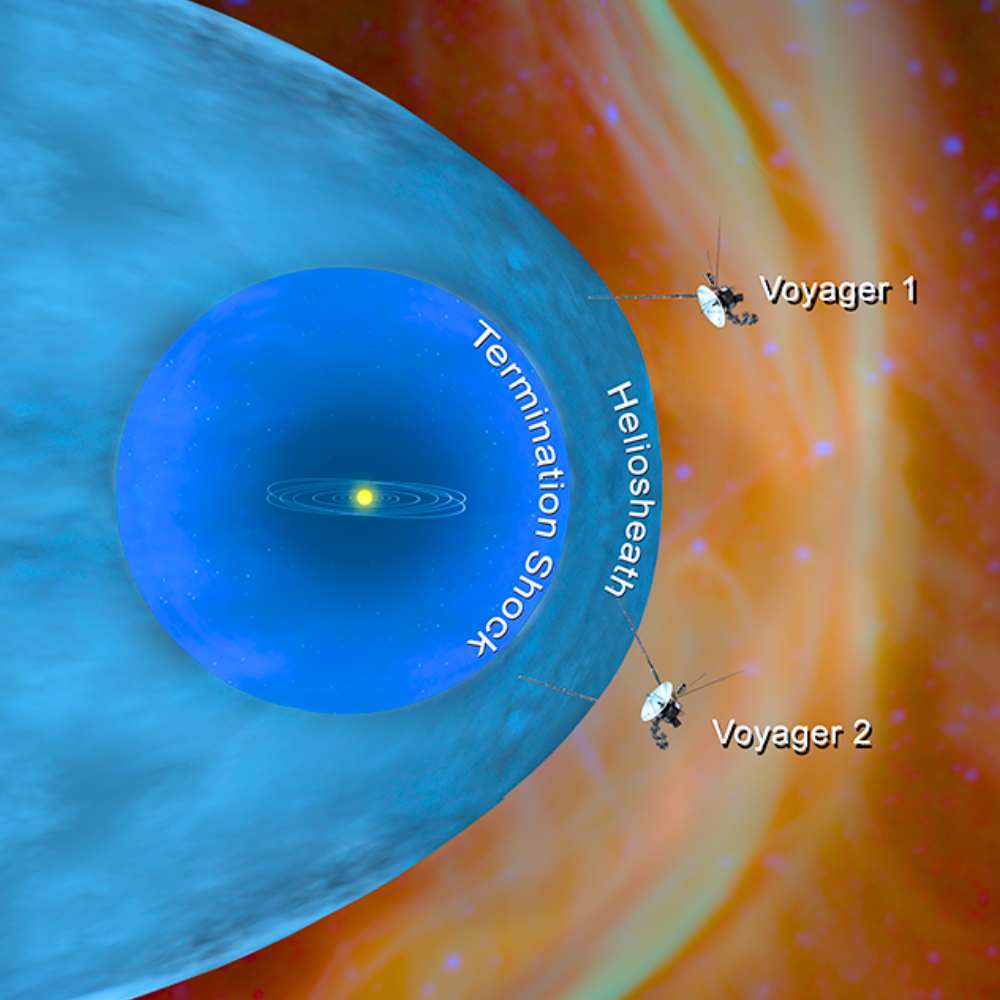
Position of the Termination Shock in the Heliosphere
The termination shock is the inner boundary of the heliosheath and lies well inside the heliopause.
The sequence is:
Solar Wind Region
Termination Shock
Heliosheath
Heliopause
Interstellar Space
This layered structure shows that the Sun’s influence fades gradually, not abruptly.
Is the Termination Shock at a Fixed Distance?
No. Like other heliospheric boundaries, the termination shock is dynamic.
Its distance from the Sun varies due to:
Solar activity cycles
Solar wind strength
Interstellar medium density
Direction relative to the Sun’s motion
Estimated distances:
Voyager 1: ~94 AU (2004)
Voyager 2: ~84 AU (2007)
The difference between these measurements revealed that the termination shock is asymmetric, compressed on one side and extended on another.
Shape – Why the Termination Shock Is Not Spherical
Early models assumed a spherical heliosphere. Voyager data proved otherwise.
The termination shock is:
Closer in some directions
Farther out in others
Reasons include:
The Sun’s motion through the galaxy
Directional interstellar magnetic pressure
Variations in solar wind output
This asymmetry mirrors the heliosphere’s overall comet-like shape, with a blunt “nose” and an extended tail.
Voyager Discoveries – First Direct Detection
The termination shock was theorized for decades before being directly detected.
Voyager 1
Crossed the termination shock in December 2004
Detected sudden drops in solar wind speed
Observed increases in energetic particle intensity
Voyager 2
Crossed the termination shock in August 2007
Provided direct plasma measurements
Confirmed shock behavior predicted by theory
Together, these crossings validated decades of heliospheric models.
What Changes at the Termination Shock?
Crossing the termination shock produces clear physical changes:
Solar wind speed drops sharply
Plasma temperature increases
Particle density rises
Magnetic fields become more turbulent
Beyond this point, solar wind flow becomes chaotic and compressed—entering the heliosheath.
This marks the transition from orderly expansion to turbulent interaction.
Why the Termination Shock Matters
The termination shock plays a key role in:
Regulating energetic particle populations
Shaping cosmic-ray propagation
Controlling energy transfer in the heliosphere
It also serves as a natural laboratory for studying collisionless shocks, which are common throughout the universe—in supernova remnants, stellar winds, and galaxy clusters.
Plasma Behavior Beyond the Termination Shock
Once the solar wind crosses the termination shock, it enters a fundamentally different regime. The once fast, orderly flow becomes subsonic, compressed, and turbulent.
Key plasma changes include:
Significant loss of bulk flow speed
Increase in plasma temperature
Enhanced magnetic turbulence
Formation of energetic particle populations
In this region, plasma behavior is dominated not by smooth expansion, but by chaotic interactions with interstellar pressure.
The Heliosheath – A Turbulent Buffer Zone
The region immediately beyond the termination shock is called the heliosheath.
Characteristics of the Heliosheath
Extends tens of astronomical units outward
Filled with slowed, heated solar wind plasma
Highly turbulent and unstable
Acts as a transition buffer before the heliopause
The heliosheath is where the Sun’s wind makes its last stand before surrendering to interstellar dominance.
Energetic Particle Acceleration at the Shock
One of the most important roles of the termination shock is particle acceleration.
Anomalous Cosmic Rays (ACRs)
At the termination shock:
Neutral interstellar atoms enter the heliosphere
Become ionized by solar radiation
Are picked up by the solar wind
Accelerated to high energies at the shock
These particles form a population known as anomalous cosmic rays, which differ from galactic cosmic rays in both origin and energy.
Voyager observations confirmed that the termination shock is a major accelerator of these particles.
Collisionless Shock Physics
Unlike shocks in air or water, the termination shock is a collisionless shock.
This means:
Particles rarely collide directly
Energy transfer occurs via electromagnetic fields
Plasma waves mediate interactions
Collisionless shocks are common across the universe, making the termination shock a nearby laboratory for astrophysical plasma physics.
Comparing the Termination Shock to Other Cosmic Shocks
The termination shock shares properties with:
- Supernova remnant shocks
- Bow shocks around stars
- Shocks in galaxy clusters
But it differs in scale and energy.
| Feature | Termination Shock | Supernova Shock |
|---|---|---|
| Energy | Moderate | Extreme |
| Speed | Hundreds km/s | Thousands km/s |
| Environment | Solar plasma | Explosive debris |
| Study Access | Direct (Voyager) | Remote only |
Because it is accessible, the termination shock allows direct testing of shock theories used across astrophysics.
Directional Differences and Asymmetry
Voyager 1 and 2 crossed the termination shock at different distances and angles.
This revealed:
Compression on one side of the heliosphere
Expansion on the opposite side
Strong influence of interstellar magnetic fields
The shock’s position shifts over time, responding to solar cycles and external pressure.
Role in Cosmic Ray Modulation
The termination shock plays a key role in shaping cosmic radiation inside the Solar System.
Effects include:
Partial acceleration of particles
Scattering and redistribution of cosmic rays
Contribution to heliospheric radiation shielding
By slowing and randomizing particle motion, the shock indirectly affects radiation levels near Earth.
Unresolved Scientific Questions
Despite direct measurements, key mysteries remain:
Why does particle acceleration vary with location?
How thick is the shock transition zone?
How does solar activity reshape the shock over decades?
Answering these questions requires long-term observation and future missions.
Termination Shock vs Heliopause – Clearing a Common Misconception
One of the most common misunderstandings in heliospheric science is confusing the termination shock with the heliopause. Although they are closely related, they represent very different physical transitions.
| Feature | Termination Shock | Heliopause |
|---|---|---|
| Nature | Shock wave | Plasma boundary |
| Solar Wind Speed | Supersonic → Subsonic | Drops to near zero |
| Role | First slowdown of solar wind | End of solar wind dominance |
| Location | ~80–100 AU | ~120–125 AU |
| Beyond It | Heliosheath | Interstellar medium |
In simple terms:
- The termination shock is where the solar wind begins to fail
- The heliopause is where it finally loses
Both are essential parts of the heliosphere’s layered defense against the galaxy.
Is the Termination Shock a Permanent Feature?
The termination shock is not fixed or permanent in a rigid sense. Its position and strength evolve continuously.
Factors Influencing Its Behavior
11-year solar activity cycle
Long-term changes in solar wind output
Variations in interstellar medium pressure
Direction of interstellar magnetic fields
During periods of strong solar activity, the termination shock moves outward. During quieter phases, it retreats inward. This dynamic behavior makes it a living boundary rather than a static line.
What Lies Immediately Beyond the Termination Shock?
Beyond the termination shock lies the heliosheath, a region that can extend for tens of astronomical units.
Within the heliosheath:
Solar wind plasma becomes hotter and denser
Magnetic fields are tangled and turbulent
Particle motion is chaotic rather than radial
This region acts as a buffer zone, absorbing and redistributing energy before the solar wind reaches the heliopause.
Without the termination shock and heliosheath, the heliosphere would collapse inward under galactic pressure.
Future Missions to Study the Termination Shock
Voyager 1 and 2 provided invaluable but limited data. They crossed the termination shock at only two locations and at different times.
Future Scientific Goals
Map the termination shock in three dimensions
Track its movement over multiple solar cycles
Study particle acceleration in greater detail
Understand its interaction with interstellar magnetic fields
Proposed missions such as NASA’s Interstellar Probe aim to travel far beyond the heliosphere, providing continuous, high-resolution measurements of all heliospheric boundaries—including the termination shock.
Why the Termination Shock Matters Beyond the Solar System
The termination shock is not just important for heliophysics—it has universal relevance.
Similar shock structures exist:
Around other stars (astrospheric termination shocks)
In stellar wind bubbles
In supernova remnants
In galactic outflows
By studying the termination shock up close, scientists refine models used to understand energetic processes across the universe.
Frequently Asked Questions (FAQ)
Is the termination shock visible?
No. It is invisible and detectable only through changes in plasma properties measured by spacecraft instruments.
Can the termination shock disappear?
Not under current conditions. As long as the Sun emits a solar wind and moves through interstellar space, the termination shock will exist—though its position may change.
Did Voyager stop at the termination shock?
No. Voyager spacecraft passed through the termination shock, then the heliosheath, and later the heliopause.
Is the termination shock the edge of the Solar System?
No. It is an internal boundary within the heliosphere. The heliopause marks the outer edge of solar wind influence.
Related Topics for Universe Map
Solar Wind
Heliosphere
Heliosheath
Heliopause
Voyager 1 and Voyager 2
Interstellar Medium
Together, these topics explain how the Sun interacts with the galaxy on the largest scales.
Final Perspective
The termination shock is the Solar System’s first great barrier—a warning sign that the Sun’s influence is no longer absolute. It marks the moment when the solar wind slows, compresses, and prepares for its final confrontation with interstellar space.
Without the termination shock, the heliosphere would be weaker, Earth would be more exposed to cosmic radiation, and our understanding of stellar wind physics would be far poorer.
Though invisible and distant, the termination shock is a cornerstone of our cosmic neighborhood—one that defines how far the Sun’s power can truly reach.