







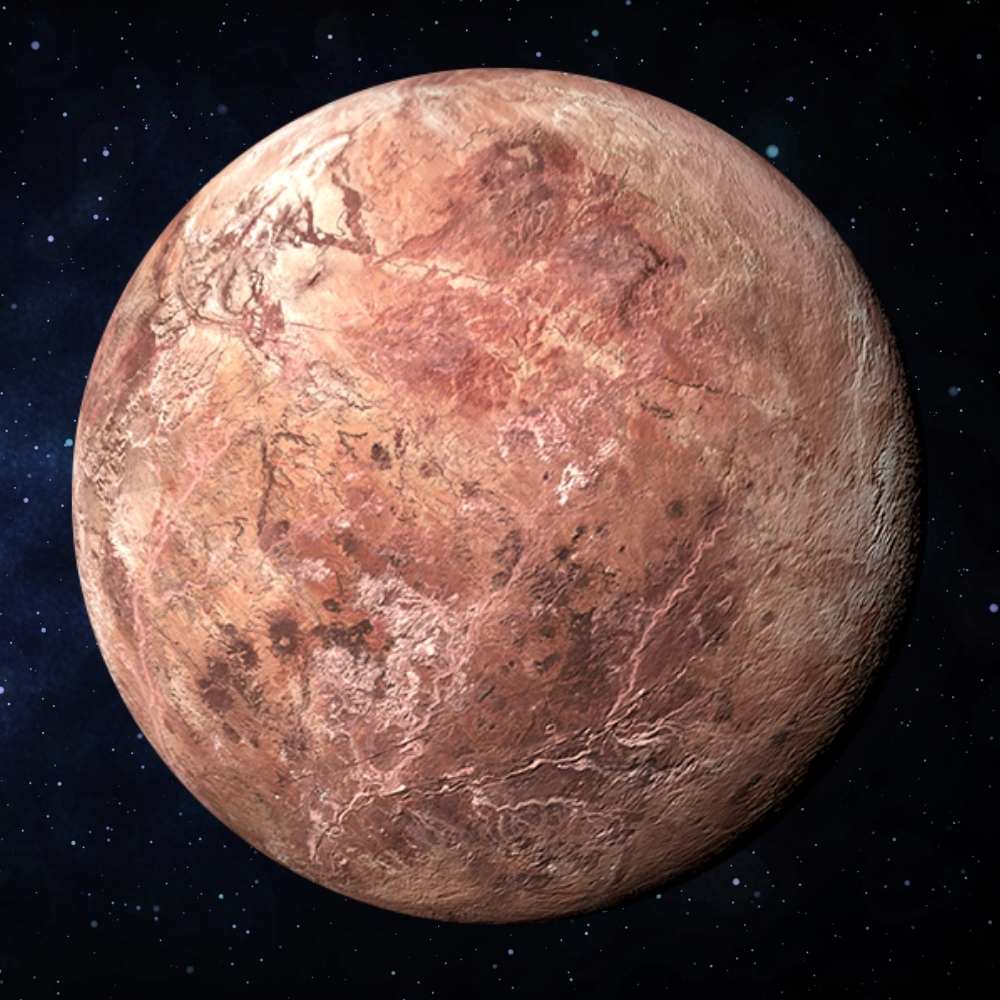
Makemake
The Bright, Icy Dwarf Planet of the Kuiper Belt
Quick Reader
| Attribute | Details |
|---|---|
| Name | Makemake |
| Classification | Dwarf planet |
| Region | Kuiper Belt (classical KBO) |
| Discovery | 2005 |
| Discoverers | Mike Brown, Chad Trujillo, David Rabinowitz |
| Discovery Site | Palomar Observatory |
| Distance from Sun | ~45–53 AU (elliptical orbit) |
| Orbital Period | ~305 years |
| Diameter | ~1,430 km |
| Albedo | Very high (bright surface) |
| Atmosphere | Extremely thin / transient |
| Moons | 1 confirmed (MK2) |
| Naming Origin | Rapa Nui (Easter Island) mythology |
Introduction – A World That Redefined the Solar System
Hidden far beyond Neptune, orbiting quietly in the deep freeze of the Kuiper Belt, lies Makemake—one of the brightest and most intriguing dwarf planets ever discovered.
Makemake is not as famous as Pluto, nor as massive as Eris, yet it played a decisive role in one of the most important moments in modern astronomy: the redefinition of what it means to be a planet.
Discovered in 2005, Makemake challenged astronomers to rethink the outer Solar System. It revealed that Pluto was not unique, but part of a much larger population of icy worlds—each with its own story, chemistry, and evolutionary path.
Makemake stands out not because of size alone, but because of its extraordinarily reflective surface, its puzzling atmosphere, and its place among the classical Kuiper Belt objects.
Discovery of Makemake – The Same Year Everything Changed
Makemake was discovered in 2005, the same year as Eris and only a few years after Sedna. Together, these discoveries shattered the long-held view of the Solar System’s outer boundary.
The discovery was made using:
Ground-based telescopes
Wide-field sky surveys
Careful analysis of slow-moving objects against background stars
At the time of discovery, Makemake was temporarily designated 2005 FY9.
Its size and brightness immediately suggested that it was comparable to Pluto—raising uncomfortable questions for planetary classification.
Why Makemake Forced a Redefinition of Planets
By the early 2000s, astronomers faced a growing problem:
If Pluto was a planet, then:
Eris should also be a planet
Makemake should be a planet
Haumea should be a planet
This would dramatically increase the number of planets.
Makemake became a central example in debates that led to the International Astronomical Union (IAU) redefining the term “planet” in 2006.
Under the new definition:
Makemake was classified as a dwarf planet
Pluto was reclassified
A new category of Solar System bodies was formally recognized
Makemake was not demoted—it helped create an entirely new class.
Naming and Mythological Significance
Makemake is named after a creator deity in the mythology of the Rapa Nui people of Easter Island.
In Rapa Nui tradition:
Makemake is associated with creation and fertility
The name reflects themes of origin and renewal
The choice was symbolic:
Makemake helped reshape how planets are “created” in definition
It represents a rebirth of Solar System classification
Unlike Greco-Roman names used for most planets, Makemake’s name reflects the IAU’s effort to diversify astronomical naming traditions.
Orbit – A Classical Kuiper Belt Resident
Makemake orbits the Sun at an average distance of about 45 AU, placing it firmly within the classical Kuiper Belt.
Orbital Characteristics
Orbital period: ~305 years
Low orbital inclination compared to Eris
Moderately eccentric orbit
Unlike Eris or Sedna, Makemake is not a scattered disk object. Its relatively stable orbit suggests it formed near its current location and was not violently displaced by Neptune’s migration.
This makes Makemake a key reference object for studying undisturbed Kuiper Belt evolution.
Size, Shape, and Rotation
Makemake is one of the largest known dwarf planets, though slightly smaller than Pluto and Eris.
Key physical traits:
Diameter: ~1,430 km
Shape: Likely slightly elongated
Rotation period: ~22.8 hours
Its rapid rotation suggests:
A rigid, icy body
No significant tidal interactions
Lack of large, nearby moons (until recently)
Makemake’s size places it near the threshold for hydrostatic equilibrium, meaning it is nearly—but not perfectly—spherical.
A Remarkably Bright Surface
One of Makemake’s most striking features is its extreme brightness.
Its surface reflects a large fraction of incoming sunlight, making it one of the brightest objects in the Kuiper Belt.
This brightness is likely caused by:
Frozen methane ice
Ethane and nitrogen traces
Fresh, relatively uncontaminated ice
Unlike darker Kuiper Belt objects, Makemake’s surface appears to be chemically young, possibly refreshed by seasonal processes.
Atmosphere – Present, Gone, or Seasonal?
Makemake does not have a permanent atmosphere like Pluto—but that does not mean it has none at all.
Evidence suggests:
A temporary atmosphere may form near perihelion
Gases such as nitrogen and methane may briefly sublimate
The atmosphere likely collapses and freezes as Makemake moves away from the Sun
This makes Makemake an example of a seasonally breathing world, where surface and atmospheric states change over centuries.
Why Makemake Is Scientifically Important
Makemake matters because it helps scientists understand:
How icy worlds retain or lose atmospheres
Surface chemistry under extreme cold
Differences between classical and scattered Kuiper Belt objects
Why Pluto-like worlds are common, not rare
It bridges the gap between Pluto and smaller Kuiper Belt bodies.
Makemake’s Moon – MK2 and What It Reveals
For many years after its discovery, Makemake appeared to be moonless, unlike Pluto or Eris. That changed in 2016, when astronomers identified a small satellite using observations from the Hubble Space Telescope.
The moon was provisionally named S/2015 (136472) 1, and is commonly referred to as MK2.
Key Properties of MK2
Extremely dark compared to Makemake
Small size (likely a few hundred kilometers at most)
Close, stable orbit
The discovery of MK2 was crucial because moons allow mass measurements. By tracking MK2’s orbit, astronomers can calculate Makemake’s mass and density—something that was previously uncertain.
Why MK2 Is So Dark
One of the most intriguing aspects of MK2 is its very low albedo. This contrasts sharply with Makemake’s bright, reflective surface.
Possible explanations include:
MK2 lacks volatile ices that refresh Makemake’s surface
Long-term radiation exposure has darkened its surface
MK2 may be composed of more rock and organic material
This brightness contrast suggests that Makemake and MK2 may have different surface histories, even if they formed together.
Formation of the Makemake System
The leading hypothesis for MK2’s origin is a giant impact.
Supporting evidence:
Single, small moon
Near-circular orbit
Similar formation models to Pluto–Charon and Eris–Dysnomia
In this scenario:
A large object collided with proto-Makemake
Debris entered orbit
That debris later coalesced into MK2
However, unlike Pluto–Charon, the impact was likely less energetic, producing a much smaller satellite.
Surface Composition – What Makemake Is Made Of
Spectroscopic observations reveal that Makemake’s surface is dominated by volatile ices.
Major Surface Components
Methane ice (CH₄) – dominant
Ethane (C₂H₆) – produced by radiation processing
Possible nitrogen (N₂) in small amounts
These compounds explain Makemake’s:
High albedo
Red–orange coloration
Seasonal surface changes
Unlike Pluto, Makemake appears to have very little nitrogen, which helps explain why it cannot sustain a thick atmosphere.
Why Makemake’s Atmosphere Is So Thin
Atmosphere retention depends on:
Gravity
Temperature
Volatile inventory
Makemake sits near a critical threshold.
Compared to Pluto:
Slightly lower gravity
Less nitrogen ice
Colder average temperatures
As a result:
Any atmosphere that forms is extremely thin
Gases likely freeze onto the surface as Makemake moves away from perihelion
Makemake represents a transitional world—large enough to host volatile ices, but too small to keep them airborne for long.
Internal Structure – Differentiated or Mixed?
Although Makemake has never been visited by a spacecraft, its size allows some informed speculation about its interior.
Likely structure:
Rocky core
Thick mantle of water ice
Volatile-rich outer layers
Makemake may be partially differentiated, meaning heavier materials sank inward early in its history. However, internal heat today is likely negligible.
Unlike icy moons with tidal heating, Makemake is a cold, geologically inactive world.
Makemake Compared with Other Dwarf Planets
Makemake vs Pluto
Makemake: brighter, thinner atmosphere
Pluto: darker regions, active geology, thicker atmosphere
Pluto has multiple moons; Makemake has only one known
Makemake vs Eris
Eris: more massive, more distant, thicker frozen nitrogen layers
Makemake: closer, brighter, more volatile-poor
Makemake vs Haumea
Haumea: fast-rotating, elongated, rocky
Makemake: rounder, volatile-rich, slower rotation
These comparisons show that dwarf planets are not a single category, but a diverse family of worlds.
Why Makemake Is a Key Transitional Object
Makemake occupies a crucial middle ground:
Between Pluto-like worlds with atmospheres
And smaller Kuiper Belt objects with none
Studying Makemake helps scientists understand:
Where atmospheric retention fails
How surface chemistry evolves
Why some icy worlds remain bright while others darken
It provides a natural laboratory for studying threshold effects in planetary evolution.
Long-Term Evolution of Makemake
Makemake is not a static world. Over hundreds of years, its environment changes slowly but meaningfully as it moves along its elongated orbit.
Seasonal Cycles on a Century Scale
Near perihelion, surface methane may partially sublimate
Thin, transient atmospheres may briefly form
Frost migration can refresh bright surface regions
As Makemake moves farther from the Sun:
Volatile gases freeze back onto the surface
Any atmosphere collapses completely
Surface chemistry becomes radiation-dominated
These slow cycles likely explain why Makemake remains unusually bright compared to many Kuiper Belt objects.
Could Makemake Have Been Geologically Active?
Makemake shows no evidence of current geological activity, but its early history may have been different.
In its youth:
Residual heat from formation may have softened internal ice
Impacts could have reshaped surface regions
Differentiation may have occurred
Today, however:
No tidal heating
No cryovolcanism detected
No active resurfacing beyond volatile frost cycles
Makemake is best described as geologically dormant, preserving ancient conditions.
Future Observation and Exploration Possibilities
Makemake has never been visited by a spacecraft, and no mission is currently approved. Still, future technologies may change this.
What Future Telescopes Can Do
James Webb Space Telescope (JWST): refined surface chemistry
Extremely Large Telescope (ELT): improved size and shape measurements
Long-term monitoring of seasonal brightness changes
A dedicated Kuiper Belt orbiter or flyby mission would revolutionize our understanding—but would require decades of travel time.
Frequently Asked Questions (FAQ)
Is Makemake larger than Pluto?
No. Pluto is slightly larger in diameter and significantly more massive.
Why is Makemake so bright?
Its surface is dominated by fresh methane ice that reflects sunlight efficiently.
Does Makemake have an atmosphere?
Only a very thin, temporary one near perihelion. Most of the time, it has no atmosphere.
How many moons does Makemake have?
One confirmed moon: MK2.
Can Makemake support life?
No. It is extremely cold, airless most of the time, and geologically inactive.
Makemake’s Role in Redefining the Outer Solar System
Makemake’s importance lies not in dramatic features, but in its context.
It showed astronomers that:
Pluto-like worlds are common
Size alone does not define a planet
The Kuiper Belt is a complex, structured region
Makemake helped transform the Solar System from a tidy planetary list into a dynamic population of diverse worlds.
Related Topics for Universe Map
Dwarf Planets
Pluto
Eris
Haumea
Kuiper Belt
MK2 (Makemake’s Moon)
Together, these topics map the icy frontier beyond Neptune.
Final Perspective
Makemake is a reminder that the Solar System does not end neatly at Neptune. Beyond lies a realm of frozen worlds—each with unique chemistry, history, and behavior.
Bright yet distant, simple yet scientifically rich, Makemake stands as a bridge between Pluto and the countless smaller bodies of the Kuiper Belt. It represents a class of worlds that forced astronomers to rethink planetary identity itself.
In understanding Makemake, we understand not just a dwarf planet—but the evolving story of how we define our cosmic neighborhood.