




Namaka
The Chaotic Inner Moon of Haumea
Quick Reader
| Attribute | Details |
|---|---|
| Name | Namaka |
| Parent Body | Haumea (dwarf planet) |
| Type | Natural satellite |
| Discovery Date | 2005 |
| Discoverers | Mike Brown and team |
| Discovery Method | Ground-based telescopic observations |
| Orbital Distance | ~25,700 km (average) |
| Orbital Period | ~18 days |
| Estimated Diameter | ~150–200 km |
| Shape | Irregular |
| Surface Composition | Water ice (likely mixed with darker material) |
| Surface Color | Neutral to slightly reddish |
| Atmosphere | None |
| Naming Origin | Hawaiian sea goddess Namaka |
| Scientific Importance | Orbital dynamics, tidal evolution, collisional history |
Introduction to Namaka – A Moon Defined by Instability
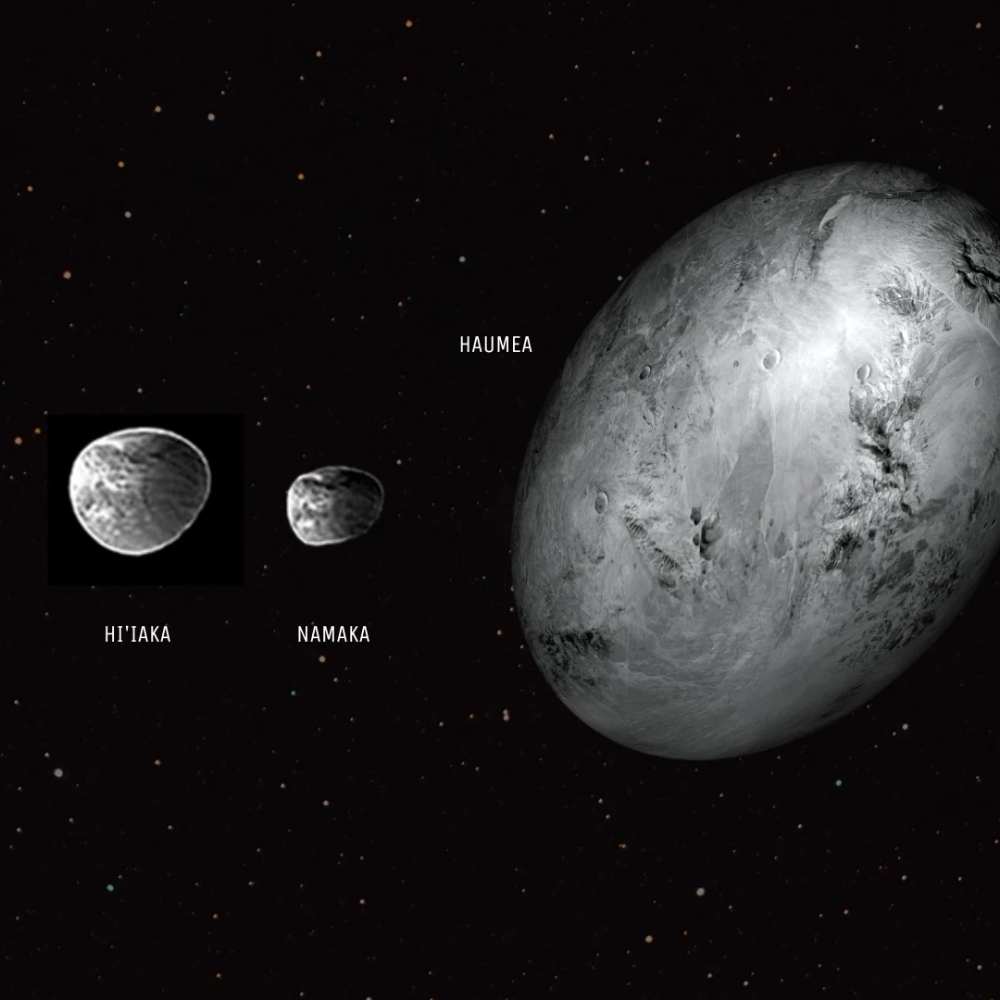
Namaka is the smaller, inner moon of the dwarf planet Haumea, and one of the most dynamically unusual satellites known in the Kuiper Belt. Unlike its larger sibling Hiʻiaka, which follows a wide and stable orbit, Namaka moves along a tilted, evolving, and chaotic path that continues to puzzle astronomers.
Discovered in 2005, Namaka quickly gained attention not because of its size, but because of its unexpected orbital behavior. Its motion suggests that the Haumea system is not a quiet remnant of the early Solar System, but a complex and still-evolving gravitational system shaped by violent origins.
Namaka acts as a living dynamical laboratory, showing how moons can continue to evolve long after their formation.
Discovery of Namaka
Namaka was identified shortly after the discovery of Haumea’s larger moon, Hiʻiaka. At the time, Haumea was still known by its provisional designation 2003 EL₆₁.
Key discovery details:
Detected using high-resolution ground-based telescopes
Initially designated as “S2”
Confirmed through repeated observations and orbital tracking
Its proximity to Haumea and faintness made Namaka significantly harder to detect than Hiʻiaka.
Naming and Mythological Context
Namaka is named after Namakaokahaʻi, a Hawaiian sea goddess and sister to Pele and Hiʻiaka in Hawaiian mythology.
The name reflects:
A family relationship within the Haumea system
Cultural recognition tied to Hawaiian discovery sites
The dynamic and sometimes turbulent nature of Namaka’s orbit
This mythological naming mirrors the gravitational interactions observed between Haumea’s moons.
Orbit of Namaka – A Highly Inclined Path
Namaka’s orbit is one of its most striking features.
Orbital characteristics include:
Average distance of about 25,700 km from Haumea
Orbital period of roughly 18 days
Strong inclination relative to Haumea’s equator and Hiʻiaka’s orbit
Unlike most moons, Namaka’s orbit is not aligned with its parent’s equatorial plane, indicating a disturbed dynamical history.
Resonances and Orbital Evolution
Namaka’s motion shows evidence of past or ongoing orbital resonances with Hiʻiaka.
These interactions:
Exchange angular momentum between the moons
Cause long-term changes in inclination and eccentricity
Drive chaotic orbital evolution
Such behavior is rare among known moon systems and suggests the Haumea system has not fully settled even after billions of years.
Size and Physical Properties
Namaka is estimated to be 150–200 km in diameter, making it significantly smaller than Hiʻiaka.
Implications of its size:
Likely irregular in shape
Limited gravitational self-compression
Minimal internal heat
Namaka is probably a rubble-rich fragment rather than a differentiated body.
Surface Composition
Although less well studied than Hiʻiaka, Namaka’s surface likely contains:
Water ice
Darker, radiation-processed materials
Fewer exposed crystalline ice features
Its proximity to Haumea and smaller size may have resulted in greater surface alteration over time.
Formation – A Fragment of a Violent Past
Like Hiʻiaka, Namaka almost certainly formed from debris generated by a giant impact that stripped icy material from Haumea.
In this scenario:
Haumea’s rapid rotation was induced by the collision
Debris formed a disk around Haumea
Moons accreted from this debris
Namaka represents a smaller, inner remnant of this catastrophic event.
Why Namaka Matters
Namaka is scientifically important because it:
Demonstrates chaotic moon dynamics in the Kuiper Belt
Provides constraints on Haumea’s mass and shape
Preserves evidence of long-term tidal evolution
Shows how collisional systems can remain unstable
Namaka reminds astronomers that moon systems can be dynamic long after their formation.
Namaka vs Hiʻiaka – Stability Versus Chaos
Although Namaka and Hiʻiaka share a common origin, their present-day behavior could not be more different. Together, they form one of the most dynamically intriguing moon systems in the Solar System.
Key Differences Between Haumea’s Two Moons
| Feature | Namaka | Hiʻiaka |
|---|---|---|
| Relative Size | Smaller (≈150–200 km) | Larger (≈300–350 km) |
| Orbital Distance | Inner (~25,700 km) | Outer (~49,500 km) |
| Orbital Period | ~18 days | ~49 days |
| Inclination | High, tilted | Low, near-equatorial |
| Orbital Stability | Chaotic, evolving | Long-term stable |
Namaka’s inclined, shifting orbit contrasts sharply with Hiʻiaka’s calm and orderly motion, highlighting how gravitational interactions can dramatically diverge outcomes within the same system.
Orbital Resonances and Gravitational Interactions
Namaka’s chaotic behavior is not random. It is driven by strong gravitational coupling with both Haumea and Hiʻiaka.
Resonance-Driven Evolution
Numerical models indicate that:
Namaka and Hiʻiaka passed through mean-motion resonances in the past
These resonances pumped up Namaka’s orbital inclination and eccentricity
Angular momentum was exchanged repeatedly between the moons
Such interactions can destabilize orbits over long timescales, explaining why Namaka’s orbit looks dynamically “excited” today.
Tidal Effects and Energy Dissipation
Namaka’s proximity to Haumea makes tidal forces far more significant than for Hiʻiaka.
Possible tidal consequences include:
Gradual orbital evolution
Dissipation of orbital energy as heat
Long-term changes in inclination
While Namaka is too small to sustain ongoing geological activity, tidal effects likely played a major role in shaping its current orbit shortly after formation.
Internal Structure and Physical Nature
Namaka’s small size strongly limits its internal complexity.
Likely characteristics:
Ice-rich composition with embedded rocky fragments
Little to no internal differentiation
No long-term heat source
Namaka is best understood as a re-accumulated fragment rather than a fully evolved moon.
Surface Evolution in a Chaotic Orbit
Namaka’s surface has likely experienced more disturbance than Hiʻiaka’s.
Contributing factors include:
Stronger tidal stress early in its history
Frequent gravitational perturbations
Greater exposure to radiation due to orbital variations
As a result, Namaka’s surface may be darker, more mixed, and less pristine than that of its larger sibling.
Why Namaka’s Orbit Still Matters Today
Namaka’s present orbit is not just a relic of the past — it continues to evolve.
Its motion provides:
Constraints on Haumea’s mass distribution
Evidence for non-spherical gravity fields
Real-world tests of long-term orbital chaos models
Few moon systems allow astronomers to directly observe such complex gravitational evolution.
Namaka in the Broader Kuiper Belt Context
Namaka is unusual not just within the Haumea system, but across the Kuiper Belt as a whole.
It demonstrates that:
Moon systems beyond Neptune can be dynamically active
Collisional families can remain unsettled for billions of years
Orbital chaos is not limited to inner Solar System satellites
Namaka expands our understanding of how small moons behave in low-gravity, multi-body environments.
Scientific Importance of Namaka
Namaka is important because it:
Provides a rare example of long-term orbital chaos
Helps reconstruct Haumea’s collisional history
Tests models of tidal evolution and resonance trapping
Complements Hiʻiaka by showing the opposite dynamical extreme
Together, Namaka and Hiʻiaka form a natural experiment in satellite dynamics.
The Long-Term Fate of Namaka
Namaka’s future is far less predictable than that of its larger sibling Hiʻiaka. Its inclined and dynamically excited orbit means it is still subject to slow but persistent gravitational evolution.
Over very long timescales:
Orbital inclination may continue to oscillate
Resonant interactions could weaken or strengthen
The orbit may gradually stabilize, but never fully circularize
Despite its chaotic behavior, current models suggest Namaka is not at risk of imminent ejection or collision. It is expected to remain bound to Haumea for billions of years, albeit on an evolving path.
Could Namaka Ever Be Explored by a Spacecraft?
Like Hiʻiaka, Namaka is not a direct target for any planned space mission.
Exploration challenges include:
Extreme distance in the Kuiper Belt
Small size and low gravity
Limited scientific return compared to larger bodies
However, if a future mission were to visit the Haumea system, Namaka would offer valuable opportunities to study:
Tidal evolution in small moons
Surface alteration due to orbital chaos
Collisional debris composition
Namaka would be an ideal comparative target alongside Hiʻiaka.
What Namaka Teaches Us About Moon Dynamics
Namaka is a rare example of a moon whose orbital chaos is still observable today.
It demonstrates that:
Moon systems can remain dynamically active for billions of years
Resonance crossings leave permanent orbital signatures
Tidal evolution does not always lead to calm, circular orbits
Namaka challenges the assumption that satellite systems always settle into stable configurations.
Namaka as Evidence of a Violent Kuiper Belt
The Haumea system, with Namaka at its core, reveals that the Kuiper Belt was once a place of intense activity.
Namaka’s properties support the idea that:
Giant impacts occurred beyond Neptune
Debris disks formed around dwarf planets
Moon systems emerged from chaotic beginnings
Namaka is not a captured object — it is a survivor of planetary-scale violence.
Frequently Asked Questions (FAQ)
What is Namaka?
Namaka is the smaller, inner moon of the dwarf planet Haumea. It is an icy satellite formed from debris produced by a massive collision early in the Solar System’s history.
Why is Namaka’s orbit considered chaotic?
Namaka’s orbit is highly inclined and dynamically excited due to past resonant interactions with Haumea’s larger moon, Hiʻiaka. These interactions caused long-term changes in its inclination and eccentricity.
Is Namaka larger or smaller than Hiʻiaka?
Namaka is significantly smaller than Hiʻiaka. Namaka is estimated to be about 150–200 km in diameter, while Hiʻiaka is roughly twice that size.
Does Namaka have crystalline water ice like Hiʻiaka?
Namaka likely contains water ice, but there is less evidence for extensive crystalline ice on its surface. Its smaller size and chaotic orbit may have led to greater surface alteration over time.
Does Namaka have an atmosphere?
No. Namaka is far too small and cold to retain any atmosphere.
Can Namaka’s orbit stabilize in the future?
Namaka’s orbit may evolve and partially settle over extremely long timescales, but it is unlikely to ever become as stable or low-inclination as Hiʻiaka’s orbit.
Why is Namaka important to astronomy?
Namaka provides a rare real-world example of long-term orbital chaos in a moon system, helping scientists test models of tidal evolution, resonance interactions, and satellite formation.
Namaka’s Place in the Universe Map
Within the Universe Map framework, Namaka represents:
The chaotic end-member of moon evolution
A key constraint on Haumea’s mass and shape
A natural laboratory for orbital dynamics in low-gravity systems
It complements Hiʻiaka by showing how dramatically different outcomes can arise from the same collisional origin.
Final Thoughts
Namaka may be small and faint, but it carries an outsized scientific legacy. Its tilted, evolving orbit preserves the dynamical memory of a catastrophic impact that reshaped Haumea and scattered debris across the Kuiper Belt.
In the deep cold beyond Neptune, Namaka continues its restless dance — a reminder that even the most distant moon systems are shaped by motion, instability, and time.