








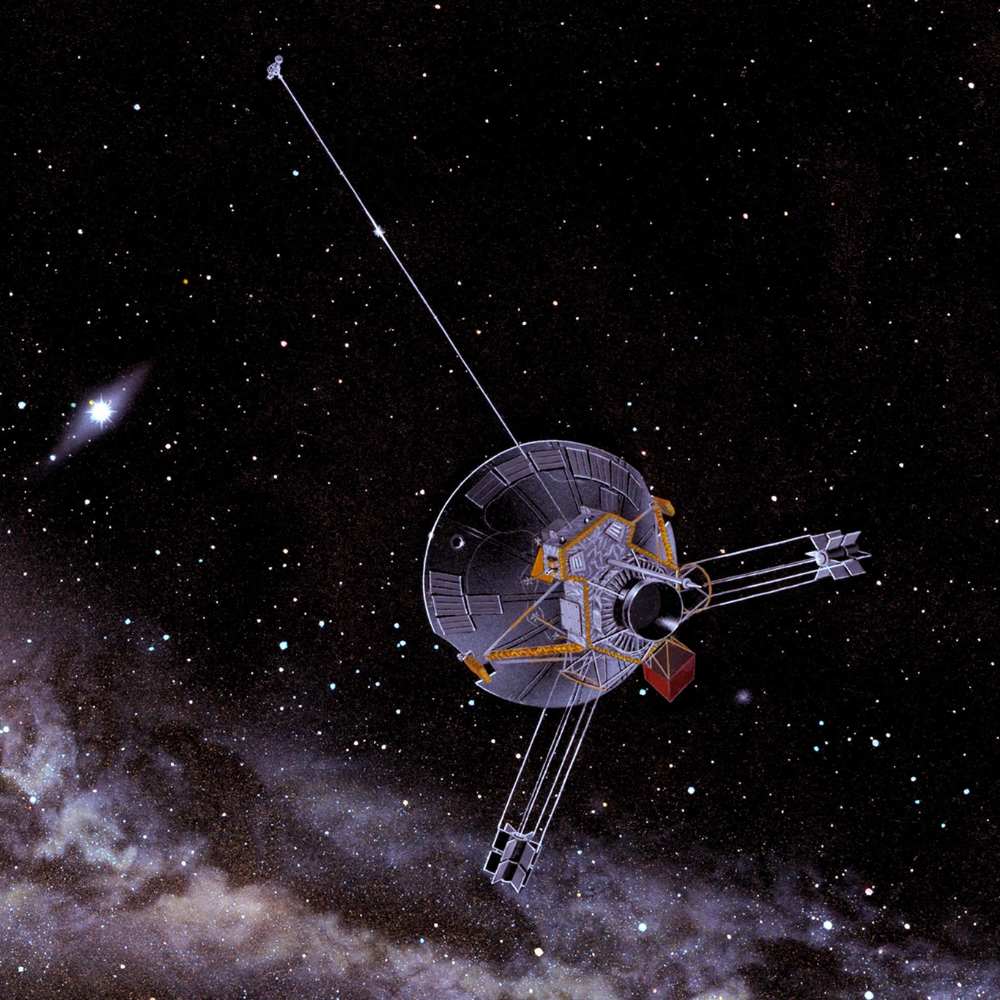
Pioneer 11
The First Mission to Saturn
Quick Reader
| Attribute | Details |
|---|---|
| Name | Pioneer 11 |
| Mission Type | Interplanetary → Interstellar precursor probe |
| Launch Date | April 5, 1973 |
| Launch Site | Cape Canaveral, Florida |
| Operator | NASA / Ames Research Center |
| Primary Targets | Jupiter and Saturn |
| Jupiter Flyby | December 1974 |
| Saturn Flyby | September 1979 |
| Historic Firsts | First spacecraft to visit Saturn |
| Final Signal | September 30, 1995 |
| Current Status | Inactive, drifting outward |
| Power Source | Radioisotope Thermoelectric Generators (RTGs) |
| Symbolic Payload | Pioneer Plaque |
Introduction – The Mission That Dared to Go Further
If Pioneer 10 proved that Jupiter could be reached safely, Pioneer 11 answered a far more dangerous question:
Can a spacecraft survive Saturn?
Launched one year after Pioneer 10, Pioneer 11 was designed to push even deeper into the outer Solar System. It became the first human-made object to encounter Saturn, navigating through intense radiation, unknown ring hazards, and extreme gravitational forces.
Pioneer 11 was not just a follow-up mission—it was a bold escalation. Its success paved the way for Voyager, Cassini, and every Saturn mission that followed.
Why Pioneer 11 Was Needed
After Pioneer 10’s success at Jupiter, NASA faced a critical choice:
Stop at Jupiter
Or risk sending a spacecraft to Saturn—an even more complex and hazardous target
At the time, Saturn’s environment was poorly understood:
Ring particle density was unknown
Radiation levels were uncertain
Gravitational field was imperfectly mapped
Pioneer 11 was tasked with risk reduction—its mission was to scout the danger.
If Pioneer 11 failed, future Saturn missions might never be approved.
Launch and Mission Design
Pioneer 11 was launched on April 5, 1973, using an Atlas-Centaur rocket. Like Pioneer 10, it was built for durability, not sophistication.
Design Philosophy
Minimal onboard computing
Heavy radiation shielding
Redundant systems
Simple, reliable instrumentation
The spacecraft was optimized for:
Long-duration survival
High-radiation environments
One-way exploration
It carried the same Pioneer Plaque as Pioneer 10—humanity’s second deliberate message to the galaxy.
The Journey to Jupiter
Pioneer 11 followed a different trajectory than Pioneer 10, deliberately designed to set up a future Saturn encounter.
Key Objectives Before Jupiter
Measure solar wind at large distances
Study interplanetary magnetic fields
Test deep-space communication
By late 1974, Pioneer 11 approached Jupiter—its first major test.
Jupiter Flyby – December 1974
Pioneer 11 passed Jupiter on December 2, 1974, at a distance of about 43,000 km from the cloud tops—much closer than Pioneer 10.
Major Discoveries at Jupiter
Detailed mapping of Jupiter’s magnetic field
Confirmation of extreme radiation belts
Improved measurements of Jupiter’s mass
Discovery of new details in the magnetosphere
But Pioneer 11’s most important role at Jupiter was navigation, not discovery.
The Gravity Assist That Changed Everything
Using Jupiter’s immense gravity, Pioneer 11 executed a precisely planned maneuver that:
Redirected its trajectory
Increased its velocity
Aimed it directly toward Saturn
This was the first time gravity assist was used to target Saturn.
Without this maneuver:
Pioneer 11 would have escaped the Solar System like Pioneer 10
Saturn would have remained unreachable
This single maneuver proved that multi-planet exploration was feasible.
The “Saturn Targeting Trajectory”
Pioneer 11’s post-Jupiter path placed it on what engineers called the Saturn targeting trajectory.
This path:
Passed through regions of intense radiation
Required unprecedented navigation precision
Tested spacecraft shielding to its limits
The success of this phase directly influenced Voyager mission planning.
Entering Unknown Territory
Between Jupiter and Saturn, Pioneer 11 traveled through regions never before explored by spacecraft.
During this cruise phase, it continued to collect data on:
Cosmic rays
Solar wind decay
Heliospheric structure
Each data packet expanded humanity’s understanding of deep space.
Why Pioneer 11 Matters So Far
Even before reaching Saturn, Pioneer 11 had already achieved several historic milestones:
First spacecraft to use Jupiter gravity assist toward Saturn
Closest early flyby of Jupiter
First to deliberately risk Saturn’s ring plane
But its greatest challenge was still ahead.
The Saturn Flyby – September 1979
On September 1, 1979, Pioneer 11 reached Saturn, becoming the first spacecraft in history to visit the ringed giant. This encounter was among the riskiest maneuvers ever attempted in early space exploration.
At the time, scientists did not know:
How dense Saturn’s rings were
Whether ring particles could destroy a spacecraft
The true strength of Saturn’s radiation belts
Pioneer 11 was sent first precisely because it was considered expendable compared to later, more ambitious missions.
Crossing the Ring Plane – A Calculated Risk
One of Pioneer 11’s most daring moments was its ring-plane crossing.
Why This Was Dangerous
Saturn’s rings appeared solid in telescopes
Particle size distribution was unknown
High-velocity impacts could be catastrophic
Pioneer 11 was deliberately aimed to pass inside the ring system, threading a narrow gap between Saturn and its rings.
What Happened
The spacecraft survived the crossing
Dust particle density was far lower than feared
No critical damage occurred
This single success cleared the way for Voyager and Cassini, which later performed much closer and more complex ring encounters.
Discoveries at Saturn
Although Pioneer 11 carried a modest instrument suite, it delivered critical firsts.
Saturn’s Magnetic Field
Pioneer 11:
Detected Saturn’s magnetic field directly
Measured its strength and orientation
Confirmed it was weaker than Jupiter’s but still powerful
This helped scientists understand how gas giants generate magnetic fields.
Radiation Environment
Pioneer 11 found:
Radiation belts weaker than Jupiter’s
Manageable levels for future spacecraft
Clear boundaries of hazardous regions
This data directly influenced Voyager shielding design.
Ring Structure Insights
While it could not image rings in detail, Pioneer 11:
Measured ring particle distribution indirectly
Confirmed gaps and density variations
Provided the first in-situ constraints on ring mass
These findings transformed Saturn’s rings from a visual spectacle into a physical system scientists could model.
Titan and Saturn’s Moons
Pioneer 11 also made important observations of Titan, Saturn’s largest moon.
Key findings:
Titan’s atmosphere was thick and opaque
Composition was nitrogen-rich
Surface could not be seen optically
This discovery shaped future mission priorities, directly leading to Voyager’s Titan flyby and later the Cassini–Huygens mission.
Gravity Assist at Saturn – A One-Way Exit
After its Saturn encounter, Pioneer 11 used Saturn’s gravity to alter its trajectory once again.
This maneuver:
Tilted its orbit far above the ecliptic plane
Sent it on an escape path out of the Solar System
Made Pioneer 11 an interstellar precursor probe
Unlike Voyager, Pioneer 11 was not aimed toward any additional planets. Its role beyond Saturn was to explore deep space.
Post-Saturn Mission – Into the Outer Darkness
Beyond Saturn, Pioneer 11 continued to operate for over a decade.
Scientific Objectives
Measure solar wind weakening
Track cosmic ray intensity
Study heliospheric structure
As distance increased:
Signal strength decreased
Power output declined
Instruments were gradually shut down
Yet Pioneer 11 continued to return valuable data long after its primary mission ended.
Engineering Lessons from Pioneer 11
Pioneer 11 taught mission planners crucial lessons:
Ring-plane crossings are survivable
Saturn’s environment is navigable
Gravity assists are reliable and powerful
Long-duration RTG-powered missions are viable
These lessons directly enabled:
Voyager 1 and 2
Cassini–Huygens
Long-term outer Solar System exploration
Why Pioneer 11 Was a Turning Point
Pioneer 11 transformed Saturn from a dangerous unknown into a reachable world.
Without it:
Voyager missions might have been delayed or canceled
Cassini may never have been approved
Saturn exploration could have remained theoretical
Pioneer 11 absorbed the risk so future missions could succeed.
The End of Contact – Pioneer 11 Falls Silent
As Pioneer 11 traveled farther from the Sun, its power and communication capability steadily declined.
Last confirmed signal: September 30, 1995
Distance from the Sun at last contact: ~44 AU
Data rate at end: extremely low
By the mid-1990s:
RTG power had dropped below operational thresholds
Instruments could no longer be supported
Commands could not be reliably received
At that moment, Pioneer 11 became a silent interstellar traveler.
Pioneer 11’s Current Trajectory
Pioneer 11 is moving outward on a path that takes it above the plane of the Solar System, unlike Pioneer 10 and the Voyagers.
Trajectory Highlights
Direction: Toward the constellation Aquila
Speed: ~11 km/s relative to the Sun
Will not approach any nearby star closely for tens of thousands of years
Its trajectory gives scientists a unique perspective on the heliosphere’s vertical structure.
Pioneer 11 vs Pioneer 10 – Twin Pathfinders
Although similar in design, Pioneer 10 and Pioneer 11 played different roles.
| Feature | Pioneer 10 | Pioneer 11 |
|---|---|---|
| Launch Year | 1972 | 1973 |
| Jupiter Flyby | 1973 | 1974 |
| Saturn Flyby | No | Yes |
| Ring Plane Crossing | No | Yes |
| Final Signal | 2003 | 1995 |
| Direction | Taurus | Aquila |
Together, they opened the gateway to the outer Solar System.
Did Pioneer 11 Leave the Solar System?
By some definitions, Pioneer 11 is still within the Sun’s gravitational influence. However:
It is on an escape trajectory
It will never return to the planetary region
It is moving toward interstellar space
Like Pioneer 10, Pioneer 11 is best described as an interstellar precursor, not yet beyond the heliopause.
Frequently Asked Questions (FAQ)
Was Pioneer 11 more dangerous than Pioneer 10?
Yes. Pioneer 11 faced greater risks due to Saturn’s rings and poorly understood environment.
Did Pioneer 11 take pictures of Saturn?
No high-resolution images. Its instruments focused on particles, fields, and radiation rather than detailed imaging.
Why didn’t Pioneer 11 go to Uranus or Neptune?
Its trajectory and limited propulsion did not allow additional planetary targeting.
Is Pioneer 11 still transmitting?
No. It has been silent since 1995.
Why was Pioneer 11 necessary if Voyager followed?
Pioneer 11 reduced risk. Voyager missions depended on Pioneer 11’s Saturn data for safe planning.
Pioneer 11’s Legacy
Pioneer 11 was not glamorous, but it was essential.
It:
Proved Saturn was navigable
Measured ring hazards firsthand
Enabled Voyager’s Grand Tour
Opened the path to Cassini
Without Pioneer 11, Saturn might have remained an unreachable mystery.
Related Topics for Universe Map
Pioneer 10
Voyager 1 and Voyager 2
Saturn
Saturn’s Rings
Titan
Cassini–Huygens Mission
Together, these missions tell the story of humanity’s cautious, step-by-step expansion into deep space.c
Final Perspective
Pioneer 11 was the Solar System’s scout—sent ahead not to gather glory, but to face danger.
It flew through unknown radiation, crossed Saturn’s ring plane, and emerged with knowledge that reshaped mission planning forever. Its reward was not fame, but legacy.
Long after its signal faded, Pioneer 11 continues its silent journey—carrying humanity’s courage beyond the planets and into the darkness between the stars.