











Pluto
From Ninth Planet to Kuiper Belt Icon
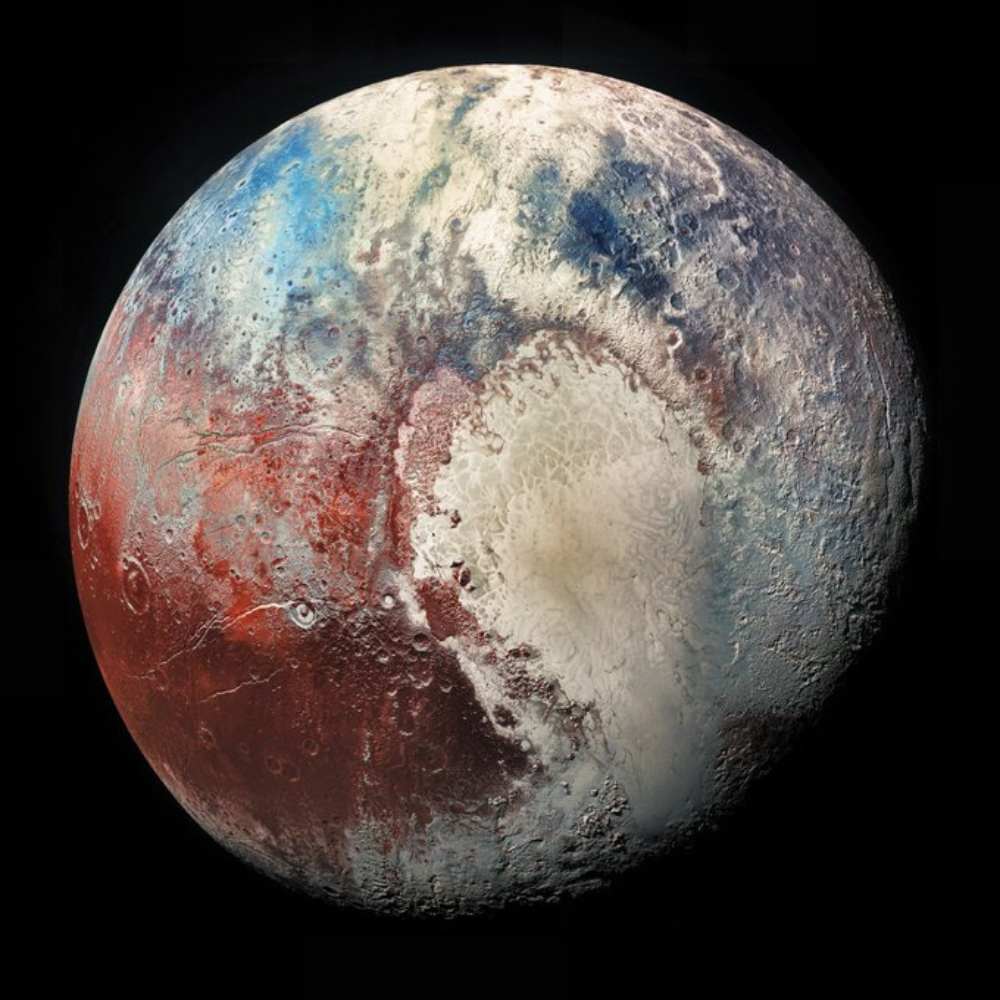
Quick Reader
| Attribute | Details |
|---|---|
| Official Name | 134340 Pluto |
| Classification | Dwarf Planet |
| Discovery Date | 18 February 1930 |
| Discoverer | Clyde Tombaugh |
| Discovery Location | Lowell Observatory |
| Distance from Sun | ~29.7 AU (perihelion) to ~49.3 AU (aphelion) |
| Orbital Period | ~248 Earth years |
| Orbital Resonance | 3:2 resonance with Neptune |
| Diameter | ~2,377 km |
| Mass | ~0.18% of Earth |
| Density | ~1.86 g/cm³ |
| Surface Composition | Nitrogen ice, methane ice, water ice |
| Atmosphere | Thin, seasonal |
| Moons | 5 (Charon, Nix, Hydra, Kerberos, Styx) |
| Largest Moon | Charon |
| Flyby Mission | New Horizons (2015) |
| Location | Kuiper Belt |
Introduction to Pluto – The World That Refused to Be Simple
Pluto is one of the most complex and misunderstood objects in the Solar System. Once celebrated as the ninth planet, later reclassified as a dwarf planet, Pluto ultimately emerged as something far more important: the gateway to the Kuiper Belt.
Discovered in 1930, Pluto spent over 75 years as a planet in textbooks and public imagination. But scientific progress revealed that Pluto is not an isolated oddity — it is part of a vast population of icy worlds beyond Neptune.
Pluto’s story is not about loss of status. It is about gaining context.
Discovery of Pluto
Pluto was discovered by Clyde Tombaugh while searching for a hypothetical “Planet X” believed to be disturbing Neptune’s orbit.
Key discovery points:
Detected through photographic plate comparison
Extremely faint and slow-moving
Much smaller than initially expected
Although Pluto did not turn out to be Planet X, its discovery opened an entirely new chapter in planetary science.
Why Pluto Was Always Different
Even before its reclassification, Pluto stood apart from the eight classical planets.
Unusual traits included:
Highly eccentric orbit
Strong orbital inclination
Long orbital period
Small size and low mass
Pluto sometimes comes closer to the Sun than Neptune, yet remains dynamically stable due to orbital resonance.
Pluto’s Orbit – A Resonant Survivor
Pluto follows a 3:2 orbital resonance with Neptune.
This means:
Pluto completes 2 orbits for every 3 of Neptune
The two bodies never collide
Gravitational interactions remain stable
This resonance is a hallmark of Kuiper Belt dynamics and one of the first clues that Pluto belonged to a larger population.
Pluto’s True Home – The Kuiper Belt
The discovery of the Kuiper Belt in the 1990s changed everything.
Pluto was revealed to be:
One of the largest Kuiper Belt objects
A resonant member of a vast icy disk
Representative, not exceptional
Pluto is now understood as the largest-known resonant Kuiper Belt dwarf planet, not an isolated planet at the edge of the Solar System.
Size, Mass, and Internal Structure
Pluto is smaller than Earth’s Moon but larger than most Kuiper Belt objects.
Key physical traits:
Diameter of ~2,377 km
Significant rocky core
Thick icy mantle
This mixed composition gives Pluto enough gravity to be spherical and geologically active.
Surface Composition – A World of Ice
Pluto’s surface is dominated by volatile ices.
Major components include:
Nitrogen ice
Methane ice
Carbon monoxide ice
Water ice as bedrock
These ices migrate seasonally, reshaping Pluto’s surface over time.
A Surprisingly Active World
Despite its distance, Pluto is not frozen in time.
Even before the New Horizons flyby, hints suggested:
Seasonal atmosphere formation
Surface renewal
Possible internal heat
Pluto challenged the idea that small, distant worlds are geologically dead.
Why Pluto Matters
Pluto is important because it:
Redefined planetary classification
Led to the discovery of the Kuiper Belt
Demonstrates complexity in small worlds
Bridges planets and planetesimals
Pluto is not a demoted planet — it is a prototype.
The New Horizons Flyby – Pluto Revealed
On 14 July 2015, NASA’s New Horizons spacecraft transformed Pluto from a distant blur into a richly detailed world. What it revealed overturned decades of assumptions about small, icy bodies.
The flyby showed that Pluto is:
Geologically complex
Actively resurfaced
Structurally diverse across regions
Rather than a frozen relic, Pluto emerged as a dynamic planet-like world.
Sputnik Planitia – The Beating Heart of Pluto
One of the most striking discoveries was Sputnik Planitia, a vast, heart-shaped basin filled with nitrogen ice.
Key features include:
Size comparable to Texas
Composed primarily of nitrogen, carbon monoxide, and methane ice
No visible impact craters, indicating a very young surface
This region is likely driven by internal heat, causing nitrogen ice to convect like slow-moving glaciers.
Mountains Made of Ice
Pluto hosts towering mountain ranges, some rising over 3–4 km high.
These mountains are made of:
Water ice acting as bedrock
Extremely rigid material at Pluto’s temperatures
Their presence indicates that Pluto’s crust is strong and that geological uplift has occurred relatively recently in its history.
Evidence of Cryovolcanism
Several surface features suggest Pluto may experience cryovolcanism — eruptions of icy material rather than molten rock.
Possible cryovolcanic indicators:
Large domes with central depressions
Smooth plains inconsistent with impact processes
Ammonia-rich water ice acting as antifreeze
If confirmed, cryovolcanism would require a long-lived internal heat source.
Pluto’s Interior – More Than Ice
Pluto’s density and geology suggest a layered internal structure.
Likely components include:
A rocky core
A thick water-ice mantle
Surface layers of volatile ices
Models indicate that Pluto may host a subsurface ocean, insulated by ice and kept warm by radioactive decay.
Pluto’s Thin but Active Atmosphere
Pluto has a tenuous, seasonal atmosphere that forms when it approaches the Sun.
Atmospheric properties:
Primarily nitrogen, with methane and carbon monoxide
Extends hundreds of kilometers above the surface
Forms hazes that scatter sunlight
As Pluto moves away from the Sun, this atmosphere gradually freezes and collapses back onto the surface.
Atmospheric Escape and Interaction with Space
New Horizons detected that Pluto’s atmosphere is slowly escaping into space.
Key observations:
Escape rate lower than expected
Interaction with solar wind
Atmospheric loss over billions of years
Despite this loss, Pluto retains enough volatiles to remain active today.
The Pluto–Charon Binary System
Pluto and its largest moon Charon form a unique binary system.
Distinctive traits:
The barycenter lies outside Pluto
Both bodies are tidally locked
Their sizes are unusually similar
This makes Pluto–Charon more like a double dwarf planet system than a planet–moon pair.
Smaller Moons and System Dynamics
Pluto has four smaller moons: Nix, Hydra, Kerberos, and Styx.
These moons:
Follow nearly circular orbits
Are likely remnants of a giant impact
Exhibit chaotic rotations
Together, they form a dynamically intricate satellite system.
Why Part 2 Changed Pluto Forever
Before New Horizons, Pluto was theoretical.
After the flyby:
Pluto became a geological world
Small bodies were recognized as complex
The Kuiper Belt gained planetary relevance
Pluto forced scientists to expand the definition of what makes a world active.
The Long-Term Future of Pluto
Pluto’s future is governed by slow, predictable cycles rather than dramatic change. Its highly eccentric orbit causes extreme seasonal variations that unfold over centuries.
Over long timescales:
Pluto’s atmosphere will repeatedly freeze and reform
Surface ices will migrate between hemispheres
Geological activity will gradually decline as internal heat dissipates
Even so, Pluto is expected to remain geologically interesting for hundreds of millions of years.
Will Pluto Ever Become Geologically Dead?
Pluto still retains internal heat from:
Radioactive decay in its rocky core
Insulating layers of ice
This heat likely sustains:
Nitrogen ice convection
Possible subsurface ocean stability
Long-lived surface renewal
Pluto may eventually cool, but it will not become a simple frozen rock anytime soon.
Pluto and the Definition of a Planet
Pluto’s reclassification in 2006 was not a demotion, but a scientific correction.
The IAU definition requires a planet to:
Orbit the Sun
Be nearly spherical
Clear its orbital neighborhood
Pluto fails the third criterion because it shares its region with many Kuiper Belt objects.
This distinction clarified:
The difference between planets and planet populations
The structure of the outer Solar System
Why Pluto belongs to a broader class of worlds
Pluto did not lose importance — it gained context.
Pluto as a Prototype Dwarf Planet
Pluto is now understood as:
The most complex known dwarf planet
A benchmark for icy world geology
A reference point for Kuiper Belt evolution
Many objects once thought insignificant are now recognized as planetary worlds in their own right, thanks to Pluto.
Pluto’s Influence on Modern Planetary Science
Pluto changed how scientists think about:
Small-body geology
Atmospheric physics at low temperatures
Subsurface oceans beyond habitable zones
Its discovery and exploration expanded planetary science beyond the classical eight planets.
Frequently Asked Questions (FAQ)
Is Pluto still considered a planet?
No. Pluto is officially classified as a dwarf planet, but it remains one of the most scientifically important bodies in the Solar System.
Why was Pluto reclassified?
Pluto was reclassified because it does not clear its orbital neighborhood and shares its region with many Kuiper Belt objects.
Is Pluto geologically active?
Yes. New Horizons revealed glaciers, convection cells, mountains, and possible cryovolcanic features.
Does Pluto have an atmosphere?
Yes. Pluto has a thin, seasonal atmosphere primarily composed of nitrogen, with methane and carbon monoxide.
How many moons does Pluto have?
Pluto has five moons: Charon, Nix, Hydra, Kerberos, and Styx.
Is Pluto the largest dwarf planet?
Pluto is the largest known dwarf planet by volume, but Eris is more massive.
Could humans ever visit Pluto?
A crewed mission is extremely unlikely due to distance and travel time, but future robotic missions are possible.
Is Pluto part of the Kuiper Belt?
Yes. Pluto is a resonant Kuiper Belt object and one of the largest members of that region.
Pluto’s Place in the Universe Map
In the Universe Map framework, Pluto represents:
The bridge between planets and Kuiper Belt objects
Proof that small worlds can be complex
The catalyst for redefining Solar System structure
Pluto anchors the transition from the planetary realm to the distant icy frontier.
Final Thoughts
Pluto’s story is not about being downgraded. It is about discovery, context, and evolution of knowledge. From a faint dot on photographic plates to a richly textured world with glaciers and hazes, Pluto has continually challenged expectations.
Far beyond Neptune, Pluto continues its slow journey around the Sun — not as a failed planet, but as one of the most revealing worlds ever explored.