











Charon
The Binary Partner That Redefined Pluto
Quick Reader
| Attribute | Details |
|---|---|
| Official Name | Charon |
| Parent Body | Pluto |
| Type | Natural satellite |
| Discovery Date | 22 June 1978 |
| Discoverer | James W. Christy |
| Discovery Location | U.S. Naval Observatory |
| Diameter | ~1,212 km |
| Mass Ratio (Pluto–Charon) | ~1:8 |
| Orbital Period | ~6.4 Earth days |
| Rotation | Tidally locked (mutual) |
| Surface Composition | Water ice, ammonia compounds |
| Surface Color | Neutral gray |
| Atmosphere | None (possible transient exosphere) |
| Orbital Feature | Barycenter outside Pluto |
| Geological Activity | Past tectonics and cryovolcanism |
Introduction to Charon – More Than a Moon
Charon is not an ordinary moon. It is so large relative to Pluto that together they form a binary dwarf planet system—the only one of its kind known in the Solar System.
Discovered in 1978, Charon instantly transformed scientific understanding of Pluto. Before Charon, Pluto’s mass was poorly constrained. With Charon’s orbit measured, astronomers could finally calculate Pluto’s true mass—and realized it was far smaller than once believed.
Charon is not a subordinate companion. It is a co-equal partner that reshaped Pluto’s identity and revealed the complex nature of Kuiper Belt worlds.
Discovery of Charon
Charon was discovered by James W. Christy while examining photographic images of Pluto. He noticed a recurring “bulge” that changed position over time.
Key discovery insights:
The bulge was not an imaging artifact
It followed a regular orbital pattern
It indicated a large companion body
This discovery allowed precise measurement of Pluto’s mass for the first time.
Why Pluto and Charon Form a Binary System
Unlike typical planet–moon systems, the barycenter (center of mass) of Pluto and Charon lies outside Pluto’s surface.
This happens because:
Charon is exceptionally large relative to Pluto
The mass ratio is unusually high
Both bodies orbit a shared point in space
As a result, Pluto and Charon orbit each other, not one around the other.
Orbital Dance – Perfect Synchronization
Pluto and Charon are mutually tidally locked.
This means:
Each always shows the same face to the other
One Pluto day equals one Charon orbit
The same hemispheres face each other forever
This perfect synchronization is unique among known planetary systems.
Size, Mass, and Internal Structure
Charon is about half the diameter of Pluto and much less dense.
Key implications:
Charon contains more water ice relative to rock
Pluto has a larger rocky core
Their compositions suggest a violent origin
This compositional contrast supports the idea that Charon formed from Pluto’s icy mantle.
Surface Composition – A World of Water Ice
Charon’s surface is dominated by:
Crystalline water ice
Ammonia-bearing compounds
Minimal volatile ices like nitrogen
Unlike Pluto, Charon does not experience seasonal ice migration.
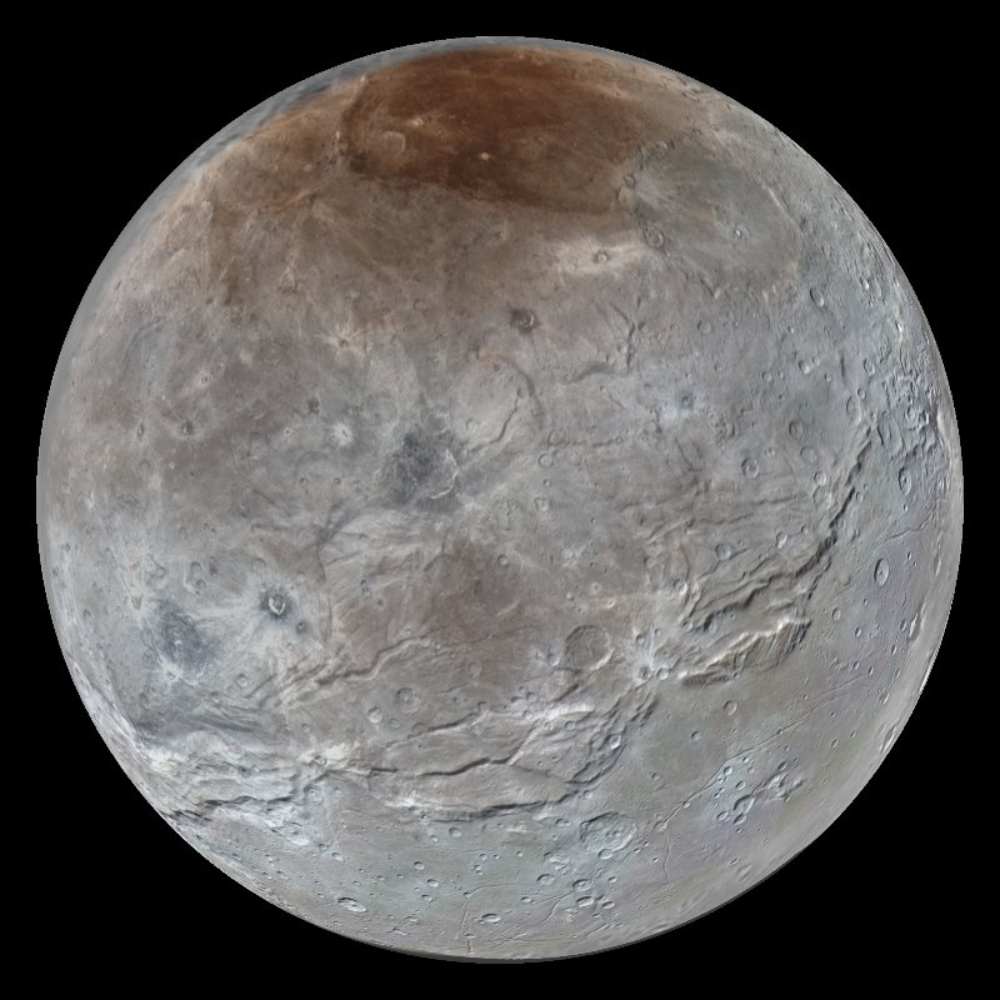
A Stark Visual Contrast with Pluto
New Horizons images revealed dramatic differences:
Pluto is colorful and geologically active
Charon is gray, fractured, and ancient
Charon’s surface preserves an earlier era of Solar System history.
Formation – The Giant Impact Hypothesis
The leading theory suggests:
Pluto suffered a massive impact early in its history
Debris from the collision formed Charon
Smaller moons formed from remaining debris
This process mirrors Earth–Moon formation, scaled to Kuiper Belt conditions.
Why Charon Matters
Charon is scientifically important because it:
Enabled accurate measurement of Pluto’s mass
Defined the binary dwarf planet concept
Preserves ancient Kuiper Belt geology
Reveals impact-driven moon formation beyond Neptune
Charon is a cornerstone for understanding how complex systems form in the outer Solar System.
Charon’s Global Geology – A World Shaped by Internal Change
When New Horizons mapped Charon in 2015, it revealed a surface that is far from simple. Although Charon lacks Pluto’s volatile-driven activity, it preserves clear evidence of ancient internal evolution.
Charon’s surface is dominated by:
Vast plains
Deep fractures and canyons
Heavily cratered terrains
These features indicate that Charon was once geologically active, even if it is largely inactive today.
Serenity Chasma – A Canyon System on a Global Scale
One of Charon’s most dramatic features is Serenity Chasma, a massive canyon system stretching more than 1,600 km across the moon.
Key characteristics:
Depths up to 7–9 km in places
Comparable in scale to the Valles Marineris on Mars
Extends across much of Charon’s surface
This canyon system likely formed when Charon’s interior expanded, cracking the icy crust apart.
Internal Expansion and a Frozen Ocean
The leading explanation for Charon’s tectonic features involves internal differentiation.
Scientific models suggest:
Charon once contained a subsurface ocean
As the ocean froze, water expanded
The expanding interior fractured the crust
This process explains both the scale and global nature of Charon’s tectonic features.
Vulcan Planitia – Evidence of Cryovolcanism
South of Serenity Chasma lies Vulcan Planitia, a broad, smooth region with relatively few impact craters.
Its characteristics suggest:
Cryovolcanic resurfacing
Flow of water–ammonia mixtures
Relatively young surface compared to surrounding terrains
If confirmed, this would mean Charon once erupted liquid water–based material onto its surface.
Why Ammonia Matters
Ammonia has been detected on Charon’s surface and plays a critical role.
Ammonia:
Lowers the freezing point of water
Allows liquid to persist longer
Supports cryovolcanic activity in cold environments
Its presence strengthens the case for a long-lived subsurface ocean early in Charon’s history.
Why Ammonia Matters
Ammonia has been detected on Charon’s surface and plays a critical role.
Ammonia:
Lowers the freezing point of water
Allows liquid to persist longer
Supports cryovolcanic activity in cold environments
Its presence strengthens the case for a long-lived subsurface ocean early in Charon’s history.
Color and Surface Processing
Charon’s surface is mostly neutral gray, but with a notable reddish region near its north pole.
This coloration is likely caused by:
Methane escaping from Pluto’s atmosphere
Deposition onto Charon’s surface
Radiation processing into complex organics
This shows that even without an atmosphere, Charon is chemically influenced by Pluto.
Charon vs Other Icy Moons
Charon differs from moons like Europa or Enceladus.
Unlike them:
Charon is isolated from tidal heating
Geological activity was short-lived
Surface processes are now dormant
Charon represents a middle ground between active icy moons and completely inert bodies.
Why Charon’s Geology Matters
Charon proves that:
Small icy worlds can undergo major internal evolution
Subsurface oceans are not limited to large moons
Cryovolcanism can occur far from the Sun
It expands the range of environments where complex geology is possible.
The Long-Term Future of Charon
Charon’s geological activity has largely ended, but its future remains stable and predictable. Locked in a tight binary dance with Pluto, Charon will continue to orbit in perfect synchronization for billions of years.
Over very long timescales:
Charon will remain tidally locked with Pluto
Its orbit will stay stable due to mutual gravity
No significant resurfacing is expected
Charon is now a geological archive, preserving the conditions of the early Kuiper Belt.
Will Charon Ever Become Active Again?
Charon lacks the ongoing energy sources needed for renewed activity.
Key limitations include:
No significant tidal heating
No thick atmosphere to drive surface change
Diminishing internal heat
Any past subsurface ocean has likely frozen completely. While chemical traces may remain locked in ice, large-scale geological processes are not expected to restart.
What Charon Teaches Us About Binary Worlds
Charon provides the clearest example of a true binary dwarf planet system.
From Charon, scientists learn that:
Binary formation via giant impacts is possible beyond Neptune
Mass ratios strongly influence orbital architecture
Moons can shape the identity of their primary bodies
Without Charon, Pluto would not be understood the way it is today.
Charon’s Influence on Pluto’s Evolution
Charon has deeply affected Pluto’s history.
Its presence:
Slowed Pluto’s rotation
Stabilized Pluto’s axial tilt
Influenced internal heat distribution
The Pluto–Charon system evolved together, not independently.
Charon in the Context of the Kuiper Belt
Charon is one of the largest known satellites in the Kuiper Belt and among the few studied up close.
It demonstrates that:
Moon systems can be complex even far from the Sun
Large impacts shaped dwarf planet systems
Binary configurations may be common in distant planetary systems
Charon bridges the study of moons and dwarf planets.
Frequently Asked Questions (FAQ)
Is Charon just a moon?
Technically yes, but dynamically no. Because the center of mass lies outside Pluto, Pluto and Charon form a binary dwarf planet system.
How did Charon form?
Charon likely formed from debris produced by a massive impact involving Pluto early in Solar System history.
Does Charon have an atmosphere?
Charon does not have a permanent atmosphere, though it may host a very thin, temporary exosphere.
Was Charon ever geologically active?
Yes. Evidence from canyons and smooth plains suggests tectonic activity and possible cryovolcanism billions of years ago.
Why is Charon gray while Pluto is colorful?
Charon lacks volatile ices like nitrogen and methane. Its surface is dominated by water ice, which does not migrate seasonally like Pluto’s surface materials.
What is Serenity Chasma?
Serenity Chasma is a massive canyon system on Charon, likely formed when its interior expanded as a subsurface ocean froze.
Does Charon affect Pluto today?
Yes. Charon and Pluto remain tidally locked, influencing each other’s rotation and long-term stability.
Is Charon unique in the Solar System?
Yes. No other known moon–planet pair forms such a clear binary system.
Charon’s Place in the Universe Map
Within the Universe Map framework, Charon represents:
The clearest example of a binary dwarf planet system
Proof that moons can rival their primaries in importance
A fossil record of early Kuiper Belt geology
Charon transforms Pluto from a lone world into a complex system.
Final Thoughts
Charon may lack Pluto’s glaciers and hazes, but its importance runs just as deep. It is the partner that revealed Pluto’s true nature, the witness to a colossal ancient impact, and the key to understanding binary worlds.
Far beyond Neptune, Pluto and Charon continue their eternal dance — not as planet and moon, but as two worlds bound together in balance.