











Hydra
The Outermost Moon of Pluto
Quick Reader
| Attribute | Details |
|---|---|
| Name | Hydra |
| Type | Natural satellite (moon) |
| Parent Body | Pluto |
| Discovery Year | 2005 |
| Discoverers | Hubble Space Telescope team |
| Orbital System | Pluto–Charon binary |
| Mean Diameter | ~51 km |
| Shape | Highly irregular, elongated |
| Orbital Distance | ~64,700 km from Pluto |
| Orbital Period | ~38 days |
| Rotation | Chaotic (tumbling) |
| Surface Composition | Water ice |
| Albedo | High (bright surface) |
| Naming Origin | Greek mythology (multi-headed serpent) |
Introduction – The Far Sentinel of the Pluto System
At the outer edge of Pluto’s intricate moon system orbits Hydra, the most distant known moon of Pluto. Though small and faint, Hydra plays a crucial role in revealing how complex and dynamic dwarf-planet satellite systems can be.
Like its sibling moon Nix, Hydra does not rotate calmly. Instead, it spins in a chaotic, unpredictable manner, making it one of the best natural examples of chaotic rotation ever observed.
Hydra is not merely a companion to Pluto—it is a relic of a primordial collision, preserving information about how the Pluto–Charon system was born.
Discovery of Hydra – Completing Pluto’s Inner Family
Hydra was discovered in 2005, alongside Nix, using images from the Hubble Space Telescope.
Before this discovery:
Pluto was known to have only one moon (Charon)
The system appeared simple and binary
Hydra’s detection instantly changed that understanding, proving Pluto hosts a multi-moon system more similar to a miniature planetary system than a simple dwarf planet.
Discovery Highlights
Instrument: Hubble Space Telescope
Method: Time-series imaging
Discovered simultaneously with Nix
Hydra was identified as a faint moving object whose orbit was clearly tied to the Pluto–Charon barycenter.
Naming and Mythological Meaning
Hydra is named after the Lernaean Hydra, a serpent from Greek mythology with multiple heads.
The name follows Pluto’s mythological theme:
Pluto → god of the underworld
Charon → ferryman of souls
Hydra → monstrous guardian
The choice reflects Hydra’s multiplicity and complexity, mirroring its unpredictable rotation and elongated shape.
Orbit – The Outermost Path
Hydra is the outermost of Pluto’s small moons, orbiting far beyond Nix, Kerberos, and Styx.
Orbital Characteristics
Average distance: ~64,700 km
Orbital period: ~38 days
Nearly circular orbit
Slight inclination relative to Charon’s orbit
Like all of Pluto’s small moons, Hydra orbits the Pluto–Charon barycenter, not Pluto alone. This places it in a dynamically complex gravitational environment.
Size and Shape – An Elongated Fragment
Hydra is slightly larger than Nix and noticeably more elongated.
Key physical traits:
Mean diameter ~51 km
Strongly elongated shape
Very low gravity
Its shape suggests:
No internal melting
No geological reshaping
Preservation of early Solar System structure
Hydra likely formed as a collision fragment, never large enough to become spherical.
Surface Composition – Bright Ice in the Kuiper Belt
Despite its distance and small size, Hydra has a surprisingly bright surface.
Observations from New Horizons revealed:
Dominant water-ice composition
Lack of methane, nitrogen, or carbon monoxide ice
Relatively clean, reflective surface
This brightness contrasts with many Kuiper Belt objects and suggests Hydra’s surface has avoided heavy darkening over billions of years.
Rotation – Extreme Chaotic Tumbling
Hydra’s rotation is even more extreme than Nix’s.
It:
Spins rapidly
Changes rotational axis over time
Exhibits strong chaotic tumbling
Why Hydra’s Rotation Is So Chaotic
Small mass and weak gravity
Highly irregular shape
Continuous gravitational torque from Pluto and Charon
Hydra’s rotation is not predictable long-term, making it a benchmark object in rotational dynamics studies.
Formation – Born from a Giant Impact
The leading theory for Hydra’s origin is the Pluto–Charon giant impact.
Formation Scenario
A massive collision created Charon
Debris formed a disk around Pluto
Small moons—including Hydra—accreted from this debris
This explains:
Similar surface composition across moons
Near-coplanar orbits
Lack of atmospheres
Hydra is essentially a fossil shard from Pluto’s violent formation.
Why Hydra Is Scientifically Important
Hydra helps scientists understand:
Moon formation around binary bodies
Stability of distant satellites
Chaotic rotation mechanics
Evolution of debris disks
Its position at the system’s edge makes it especially valuable for studying long-term orbital stability.
Hydra Compared with Pluto’s Other Small Moons
Pluto’s small moons—Styx, Nix, Kerberos, and Hydra—share a common origin, but Hydra occupies a distinctive place due to its size, distance, and extreme rotational behavior.
Hydra vs Nix
Hydra is slightly larger and more elongated
Hydra orbits farther from the Pluto–Charon barycenter
Both exhibit chaotic rotation
Both have bright, water-ice–dominated surfaces
Hydra’s greater distance reduces tidal damping even further, making its tumbling more extreme than Nix’s.
Hydra vs Kerberos
Kerberos is darker and likely richer in non-icy material
Hydra is much brighter and more reflective
Kerberos is smaller and more irregular
This contrast suggests different surface evolution paths, despite likely forming from the same debris disk.
Hydra vs Styx
Styx is the smallest and innermost of the four
Styx experiences stronger gravitational perturbations
Hydra’s orbit is more stable over long timescales
Hydra’s location makes it a useful test case for the outer stability limits of the Pluto system.
Insights from the New Horizons Flyby
The New Horizons encounter in 2015 provided the first resolved images of Hydra.
Key Observational Results
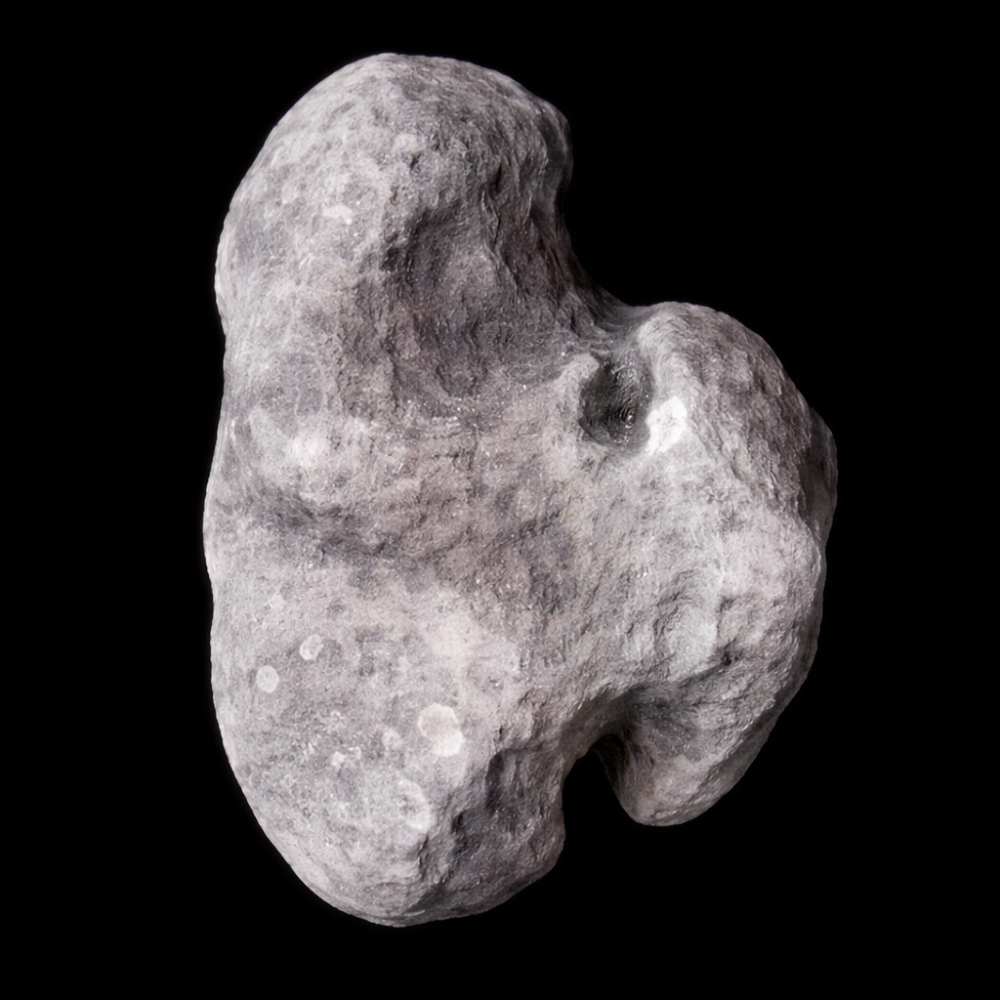
Strongly elongated, blocky shape
Bright surface with sharp contrasts
No detectable atmosphere
No signs of geological activity
Hydra appeared as a cold, inert body, preserving its ancient structure with minimal modification.
Why Is Hydra So Bright?
Hydra’s high albedo remains one of its most intriguing features.
Possible explanations include:
Surface dominated by clean water ice
Very low contamination by dark organic material
Limited exposure to collisional gardening
Because the Pluto system lies deep in the Kuiper Belt:
Impact rates are low
Radiation processing is slower
Fresh ice may remain exposed for very long periods
Hydra may therefore represent a pristine icy fragment rather than a heavily weathered body.
Orbital Resonances in the Pluto System
Hydra is part of a remarkable near-resonant orbital pattern with Charon and the other small moons.
Approximate resonance chain:
Styx: ~3:1 with Charon
Nix: ~4:1
Kerberos: ~5:1
Hydra: ~6:1
These are near resonances, not exact ones, but they strongly suggest coordinated orbital evolution following the Pluto–Charon impact.
This resonance structure contributes to long-term orbital stability while simultaneously promoting chaotic rotation.
Why Hydra Never Became Tidally Locked
Most moons eventually show the same face to their parent body. Hydra does not—and never will.
Reasons include:
Extremely small mass
Large distance from the central barycenter
Irregular shape causing uneven torques
Gravitational pull from two central bodies
As a result, tidal forces are too weak to slow and synchronize Hydra’s spin.
Chaotic Rotation as a Scientific Laboratory
Hydra is one of the clearest real-world examples of chaotic rotation predicted by celestial mechanics.
Studying Hydra helps scientists:
Test nonlinear rotation models
Understand torque-driven chaos
Apply results to asteroids and exomoons
Hydra’s behavior confirms that deterministic systems can produce unpredictable motion over long timescales.
Is Hydra Geologically Dead?
All available evidence indicates yes.
Hydra shows:
No internal heat
No tectonics
No cryovolcanism
No resurfacing processes
Its surface is shaped almost entirely by:
Micrometeoroid impacts
Radiation exposure
Passive space weathering
Hydra is best described as a primordial relic, not an active world.
Long-Term Orbital Stability
Despite its chaotic rotation, Hydra’s orbit is remarkably stable.
Simulations suggest:
Hydra will remain bound for billions of years
Orbital changes are extremely slow
Ejection or collision is highly unlikely
This stability shows that chaos in rotation does not imply chaos in orbit.
Why Hydra Matters Beyond Pluto
Hydra’s importance extends far beyond the Pluto system.
It helps scientists understand:
Satellite formation around binary bodies
Survival of small moons in complex gravity fields
Dynamics of debris disks
Potential behavior of moons in circumbinary exoplanet systems
Hydra serves as a scaled-down analog for much larger astrophysical systems.
The Future of Hydra
Hydra’s environment is one of the coldest and quietest in the Solar System. With no atmosphere, no internal heat, and very weak external forces acting upon it, Hydra’s future will be defined by stability rather than change.
Long-Term Outlook
Hydra will remain bound to the Pluto–Charon system for billions of years
Its chaotic tumbling will continue indefinitely
Surface evolution will be extremely slow
Unlike inner moons that experience tidal decay, Hydra’s distant orbit protects it from significant orbital migration.
Will Hydra’s Chaotic Rotation Ever Stabilize?
Almost certainly not.
For a moon to become tidally locked, it must lose rotational energy through strong tidal interactions. Hydra lacks the necessary conditions.
Why Stabilization Is Unlikely
Very small mass and low gravity
Large orbital distance from the barycenter
Irregular, elongated shape
Competing gravitational torques from both Pluto and Charon
As a result, Hydra’s spin state remains permanently chaotic—a stable orbit paired with unstable rotation.
Could Hydra Break Apart or Escape?
Current models suggest Hydra is structurally and orbitally secure.
Tidal forces are too weak to disrupt it
Collision probability is extremely low in the Kuiper Belt
Orbital resonances act to confine its motion
Only an exceptionally rare, large impact could significantly alter Hydra’s fate—and such events are exceedingly unlikely today.
Frequently Asked Questions (FAQ)
Is Hydra larger than Nix?
Yes. Hydra is slightly larger and more elongated than Nix.
Why is Hydra brighter than Kerberos?
Hydra’s surface appears dominated by clean water ice, while Kerberos may be coated with darker material or have a different impact history.
Does Hydra have seasons or an atmosphere?
No. Hydra has no atmosphere and experiences only minimal temperature variation.
Can Hydra be seen from Earth?
No. Hydra is far too small and distant to be observed with Earth-based telescopes.
Is Hydra unique?
Hydra is one of the clearest known examples of extreme chaotic rotation in a natural satellite.
Hydra’s Role in Planetary Science
Hydra represents a rare combination of properties:
Small size
Stable orbit in a binary system
Persistent chaotic rotation
Bright, ice-dominated surface
Because of this, Hydra is frequently used to test:
Models of rotational chaos
Post-impact debris evolution
Long-term stability of small moons
Its behavior confirms that complex dynamics are not limited to large planets or stars.
Related Topics for Universe Map
Pluto
Charon
Nix
Styx
Kerberos
Kuiper Belt
Binary Planet Systems
Together, these objects show that even a dwarf planet can host a richly structured and dynamically complex system.
Final Perspective
Hydra is a quiet sentinel at the edge of Pluto’s domain—small, distant, and frozen in time. Yet beneath its stillness lies perpetual motion: a moon that never settles, never locks, and never repeats its spin in quite the same way.
Its existence reminds us that the Solar System’s most fascinating physics often plays out on the smallest stages. In Hydra’s endless tumble, we see the lasting imprint of Pluto’s violent birth and the delicate balance that followed.
Far beyond Neptune, Hydra continues its silent orbit—an enduring relic of chaos preserved by cold.