







Neptune
The Blue Giant at the Edge of the Planetary Realm
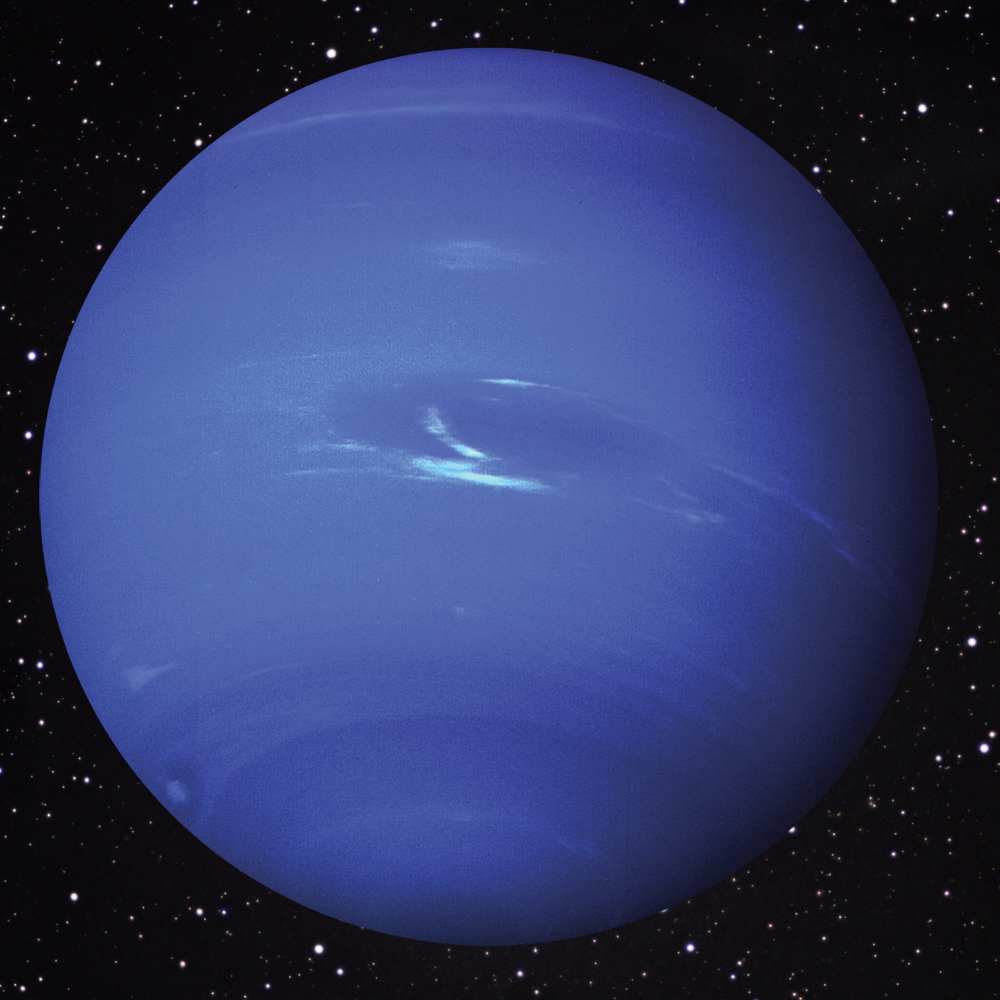
Quick Reader
| Attribute | Details |
|---|---|
| Official Name | Neptune |
| Planet Type | Ice Giant |
| Discovery Date | 23 September 1846 |
| Discoverers | Johann Galle & Heinrich d’Arrest (prediction by Urbain Le Verrier, John Couch Adams) |
| Distance from Sun | ~30.1 AU (average) |
| Orbital Period | ~164.8 Earth years |
| Diameter | ~49,244 km |
| Mass | ~17 Earth masses |
| Density | ~1.64 g/cm³ |
| Atmosphere | Hydrogen, helium, methane |
| Surface Color | Deep blue |
| Rotation Period | ~16 hours |
| Moons | 14 known |
| Largest Moon | Triton |
| Ring System | Faint, dusty rings |
| Spacecraft Visit | Voyager 2 (1989) |
Introduction to Neptune – The Mathematical Planet
Neptune is the most distant planet in the Solar System, marking the boundary between the classical planets and the Kuiper Belt beyond. Unlike every other planet, Neptune was discovered through mathematics before observation, a triumph of celestial mechanics that stands as one of science’s greatest predictive successes.
Cold, massive, and violently dynamic, Neptune is not a quiet outer planet. It is a world of supersonic winds, giant storms, and deep atmospheric mystery, hiding an active interior beneath a serene blue appearance.
Neptune is where the familiar planetary system ends—and the icy frontier begins.
Discovery of Neptune – Found Before It Was Seen
Neptune’s discovery is unique in planetary history.
Astronomers noticed that Uranus’s orbit showed unexplained deviations. Two mathematicians independently proposed the existence of an unseen planet whose gravity was disturbing Uranus.
Key moments:
Urbain Le Verrier (France) predicted Neptune’s position mathematically
John Couch Adams (England) reached similar conclusions
Johann Galle confirmed Neptune’s existence through telescope observation in 1846
Neptune was found within one degree of its predicted position, proving the power of Newtonian gravity.
Why Neptune Is an Ice Giant, Not a Gas Giant
Although Neptune resembles Jupiter and Saturn in appearance, its internal structure is fundamentally different.
Neptune is classified as an ice giant because:
Most of its mass consists of water, ammonia, and methane “ices”
It contains less hydrogen and helium than gas giants
Its mantle is composed of dense, supercritical fluids
This distinction separates Neptune (and Uranus) from Jupiter and Saturn.
Neptune’s Deep Blue Atmosphere
Neptune’s striking blue color comes from methane in its atmosphere.
Methane:
Absorbs red wavelengths of sunlight
Reflects blue wavelengths
Enhances contrast in atmospheric features
However, methane alone cannot explain Neptune’s deep color, suggesting additional atmospheric chemistry at work.
The Most Violent Winds in the Solar System
Neptune hosts the fastest winds ever recorded on any planet.
Measured wind speeds reach:
Over 2,000 km/h
Faster than the planet’s own rotation
These winds:
Power massive storms
Indicate strong internal heat flow
Reveal an active and energetic interior
Neptune radiates more heat than it receives from the Sun, fueling its extreme weather.c
Giant Storms – The Great Dark Spots
Voyager 2 discovered massive storm systems on Neptune, including the Great Dark Spot.
Storm characteristics:
Comparable in size to Earth
Rotating, high-pressure systems
Appear and disappear over years
Unlike Jupiter’s Great Red Spot, Neptune’s storms are temporary, suggesting a rapidly changing atmosphere.
Internal Structure – A Hidden Powerhouse
Beneath Neptune’s atmosphere lies a layered interior.
Likely structure:
Rocky core
Thick mantle of superheated water–ammonia–methane fluid
Thin outer hydrogen–helium envelope
This structure explains Neptune’s strong magnetic field and internal heat.
Neptune’s Magnetic Field – Tilted and Offset
Neptune’s magnetic field is highly unusual.
Key traits:
Tilted ~47 degrees from the rotation axis
Offset from the planet’s center
Rapidly varying magnetic environment
This suggests the magnetic field is generated in the icy mantle, not the core.
Rings and Inner Moons
Neptune has a faint ring system and numerous small inner moons.
The rings:
Are dusty and dark
Contain arcs instead of continuous rings
Are shaped by gravitational interactions with moons
These features add to Neptune’s dynamic complexity.
Why Neptune Matters
Neptune is crucial because it:
Marks the outer boundary of classical planets
Drives Kuiper Belt dynamics through gravity
Demonstrates extreme atmospheric physics
Serves as a model for ice giants around other stars
Many exoplanets discovered resemble Neptune more than Earth or Jupiter.
Triton – Neptune’s Captured Moon
Neptune’s most remarkable satellite is Triton, a world so unusual that it likely did not form alongside Neptune at all.
Key facts about Triton:
Orbits Neptune in a retrograde direction
Larger than Pluto’s moon Charon
Composed of nitrogen ice, water ice, and rock
Triton’s backward orbit strongly suggests it was captured from the Kuiper Belt, rather than forming in place.
A Violent Capture Event
The capture of Triton was not gentle. When Triton was captured:
Neptune’s original moon system was likely destroyed
Orbital energy was dissipated through extreme tidal forces
Triton’s orbit gradually circularized
This event reshaped Neptune’s satellite system and may explain why its inner moons are small and irregular.
Active Geology on Triton
Voyager 2 revealed that Triton is geologically active, despite its extreme cold.
Observed features include:
Nitrogen geysers erupting from the surface
Smooth plains with few craters
Young surface regions indicating recent activity
Triton is one of the coldest yet most active worlds ever observed.
Triton’s Thin Atmosphere
Triton possesses a very thin atmosphere composed mainly of nitrogen.
Characteristics:
Forms seasonally as nitrogen ice sublimates
Pressure far lower than Earth’s atmosphere
Supports plume activity and surface transport
Triton’s atmosphere further supports the idea that it was once a Kuiper Belt dwarf planet–like object.
Neptune’s Other Moons
Beyond Triton, Neptune hosts a diverse collection of smaller moons.
Notable inner moons:
Naiad, Thalassa, Despina, Galatea
Small, irregular shapes
Closely tied to Neptune’s rings
Outer irregular moons:
Likely captured objects
Highly inclined and eccentric orbits
This mixed population reflects Neptune’s turbulent past.
Voyager 2 – Humanity’s Only Visit
Neptune has been visited by only one spacecraft: Voyager 2 in 1989.
Major discoveries included:
Supersonic winds
Active storms
Triton’s geysers
Complex ring arcs
Voyager 2 transformed Neptune from a distant dot into a dynamic world.
Neptune’s Role in Shaping the Kuiper Belt
Neptune is the primary architect of the Kuiper Belt’s structure.
Its gravity:
Trapped objects into orbital resonances
Scattered bodies outward into the scattered disk
Influenced the formation of detached objects
Without Neptune, the Kuiper Belt would not exist in its current form.
Neptune and Planetary Migration
Planetary migration models show that:
Neptune formed closer to the Sun
It migrated outward early in Solar System history
This migration reshaped the outer Solar System
Neptune’s movement explains:
Pluto’s resonant orbit
The structure of the Kuiper Belt
The existence of scattered and detached objects
Why Neptune Is a Gateway Planet
Neptune stands at a transition point.
Inside Neptune:
Stable planetary orbits
Dominant planets
Beyond Neptune:
Kuiper Belt objects
Scattered disk bodies
Detached worlds
Neptune marks the boundary between planets and planetesimals.
Scientific Importance of Neptune
Neptune is essential because it:
Controls the outer Solar System’s architecture
Hosts extreme atmospheric physics
Links planets to Kuiper Belt populations
Serves as a model for ice giants across the galaxy
Many exoplanetary systems contain Neptune-like worlds, making Neptune globally relevant.
The Long-Term Future of Neptune
Neptune’s future is shaped by slow, predictable evolution rather than dramatic change. Far from the Sun, it experiences minimal external disturbance and retains significant internal heat.
Over very long timescales:
Neptune’s atmosphere will gradually cool
Storm activity may weaken as internal heat declines
Orbital stability will remain intact for billions of years
Neptune is expected to remain the Solar System’s outermost planet until the Sun enters its red giant phase.
Will Neptune Ever Lose Its Atmosphere?
Neptune’s strong gravity ensures long-term atmospheric retention.
Key factors:
High escape velocity
Cold upper atmosphere
Large planetary mass
Unlike small icy worlds, Neptune will not lose its atmosphere to space in any meaningful way. Its gaseous envelope is stable on cosmic timescales.
Neptune and the Definition of a Planetary Boundary
Neptune marks a structural boundary, not a gravitational one.
Inside Neptune’s orbit:
Planets dominate orbital dynamics
Beyond Neptune:
Resonances and scattering dominate
Kuiper Belt objects and scattered disk bodies prevail
Neptune defines where planetary dominance ends and debris-disk dynamics begin.
Neptune’s Role in Exoplanet Science
Neptune has become one of the most important reference planets in modern astronomy.
Reasons include:
Neptune-sized exoplanets are extremely common
Many exoplanets have similar mass and density
Atmospheric models often use Neptune as a baseline
Understanding Neptune directly informs how astronomers interpret distant planetary systems.
Why Neptune Still Holds Mysteries
Despite its importance, Neptune remains poorly explored.
Open questions include:
Why Neptune emits more internal heat than Uranus
The exact composition of its deep mantle
The full dynamics of its magnetic field
Long-term storm formation mechanisms
With only one flyby in history, Neptune is among the least understood major planets.
Future Missions to Neptune
Several mission concepts have been proposed, though none are approved yet.
Proposed goals include:
Orbital mapping of Neptune’s atmosphere
Detailed study of Triton
Investigation of magnetic field dynamics
A dedicated Neptune orbiter would revolutionize understanding of ice giants and Kuiper Belt interactions.
Frequently Asked Questions (FAQ)
Is Neptune the farthest planet from the Sun?
Yes. Since Pluto’s reclassification as a dwarf planet, Neptune is officially the most distant planet in the Solar System.
Why is Neptune blue?
Neptune’s blue color is caused primarily by methane in its atmosphere, which absorbs red light and reflects blue wavelengths, along with additional atmospheric chemistry that deepens the color.
Does Neptune have solid ground?
No. Neptune does not have a solid surface. Beneath its atmosphere lies a dense, supercritical mantle of water, ammonia, and methane, followed by a rocky core.
Why are Neptune’s winds so fast?
Neptune radiates more internal heat than it receives from the Sun. This internal energy drives extreme atmospheric circulation, producing winds exceeding 2,000 km/h.
Is Triton a former dwarf planet?
Triton is widely believed to be a captured Kuiper Belt object and may once have been similar to dwarf planets like Pluto.
Has Neptune been visited by spacecraft?
Yes. Voyager 2 flew past Neptune in 1989. No other spacecraft has visited Neptune since.
Does Neptune influence the Kuiper Belt today?
Yes. Neptune’s gravity continues to shape Kuiper Belt resonances, scattered disk orbits, and long-term dynamical evolution.
Neptune’s Place in the Universe Map
Within the Universe Map framework, Neptune represents:
The final classical planet
The gateway to the Kuiper Belt
The architect of the outer Solar System
A prototype for common exoplanets
Neptune connects planetary science, debris-disk dynamics, and galactic context.
Final Thoughts
Neptune is not merely the last planet—it is a transition world. Cold yet violent, distant yet influential, it defines the boundary between orderly planetary systems and the vast icy frontier beyond.
Long after inner worlds change and debates fade, Neptune will continue to orbit in deep blue silence—guarding the edge of the Solar System and shaping everything beyond it.