











Orcus
The Anti-Pluto of the Kuiper Belt
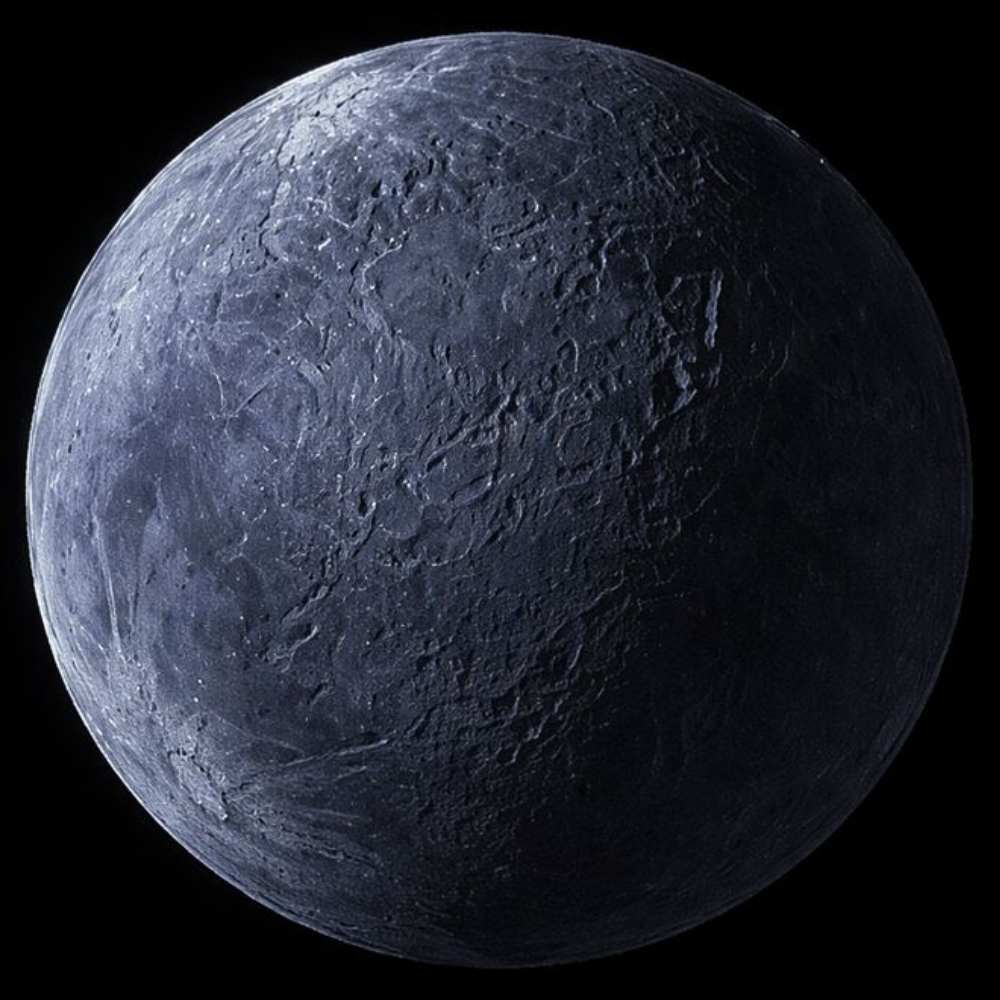
Quick Reader
| Attribute | Details |
|---|---|
| Official Designation | (90482) Orcus |
| Classification | Large Kuiper Belt Object / Dwarf planet candidate |
| Discovery Date | 17 February 2004 |
| Discoverers | Michael E. Brown, Chad Trujillo, David Rabinowitz |
| Discovery Survey | Palomar Observatory (Caltech) |
| Average Distance from Sun | ~39.2 AU |
| Orbital Period | ~245 Earth years |
| Orbital Resonance | 3:2 resonance with Neptune |
| Estimated Diameter | ~910–960 km |
| Density | ~1.5–1.6 g/cm³ (estimated) |
| Surface Composition | Water ice, possible ammonia |
| Surface Color | Neutral to slightly reddish |
| Known Moon | Vanth |
| Dynamical Class | Plutino (like Pluto) |
| Location | Kuiper Belt |
Introduction to Orcus – Pluto’s Quiet Twin
Orcus is one of the most intriguing large objects in the Kuiper Belt, often described as “Pluto’s anti-twin.” While Pluto is visually dramatic and geologically active, Orcus is quieter, colder, and more restrained—yet dynamically and structurally similar in key ways.
Like Pluto, Orcus:
Orbits the Sun in a 3:2 resonance with Neptune
Resides in the inner Kuiper Belt
Hosts a large moon (Vanth)
But unlike Pluto, Orcus lacks volatile-driven surface activity, offering scientists a contrasting example of how similar worlds can evolve very differently.
Orcus helps answer a critical question:
What happens to Pluto-like worlds when volatile ices are scarce?
Discovery of Orcus
Orcus was discovered in 2004 during systematic searches for large trans-Neptunian objects beyond Neptune.
Key discovery details:
Identified as a slow-moving point of light
Initially estimated to be Pluto-sized
Later refined to a smaller but still significant body
Its orbital properties immediately placed it in the Plutino population, a dynamically important class of Kuiper Belt objects.
Why Orcus Is Called the “Anti-Pluto”
The nickname “anti-Pluto” is not poetic—it is scientific.
Orcus mirrors Pluto dynamically but contrasts it physically:
Same orbital resonance with Neptune
Similar orbital distance
Similar system architecture (large moon)
Yet:
Orcus is darker and less volatile-rich
Shows no evidence of atmospheric cycles
Appears geologically inactive today
This contrast makes Orcus a natural control case for understanding Pluto.
Orcus’s Orbit – Locked with Neptune
Orcus completes two orbits around the Sun for every three orbits of Neptune.
This resonance:
Prevents close encounters with Neptune
Ensures long-term orbital stability
Is a signature of early planetary migration
Orcus’s orbit preserves a fossil record of Neptune’s outward movement during the early Solar System.
Size, Mass, and Internal Composition
Orcus is large enough to be:
Nearly spherical
Internally differentiated
Based on density estimates:
Orcus likely contains a rocky core
Surrounded by a thick icy mantle
Less volatile-rich than Pluto
Its size places it firmly among dwarf planet candidates, even if it has not been formally classified as one.
Surface Composition – Water Ice Dominance
Spectroscopic observations show that Orcus’s surface is dominated by crystalline water ice.
Important implications:
Water ice requires internal heating to crystallize
Suggests past thermal activity
Points to possible ancient subsurface processes
Traces of ammonia may also be present, which could have acted as antifreeze early in Orcus’s history.
Does Orcus Have an Atmosphere?
No evidence suggests that Orcus has ever sustained a significant atmosphere.
Reasons include:
Lower abundance of nitrogen and methane
Smaller size compared to Pluto
Weaker ability to retain volatiles
This absence makes Orcus a stable, relatively unchanged Kuiper Belt world.
Orcus as a Dwarf Planet Candidate
Orcus meets two of the three main criteria for dwarf planet status:
Orbits the Sun
Is nearly spherical
The remaining criterion—clearing its orbital neighborhood—is not met, as is typical for Kuiper Belt objects.
Regardless of formal classification, Orcus is treated scientifically as a dwarf planet–scale world.
Why Orcus Matters in Planetary Science
Orcus is important because it:
Represents Pluto-like worlds without volatile activity
Anchors the study of Plutinos
Hosts a large, system-defining moon (Vanth)
Preserves early Kuiper Belt conditions
Orcus helps scientists separate dynamical effects from surface and internal evolution.
Why Orcus Matters (Big-Picture Context)
Orcus shows that Pluto is not unique—but neither is it typical. By studying Orcus, astronomers can identify which features of Pluto are common outcomes of Kuiper Belt formation and which are special cases driven by volatile chemistry.
The Orcus–Vanth System – A Near-Binary Relationship
Orcus is not a solitary Kuiper Belt object. Its large moon Vanth fundamentally changes how the system must be understood. Together, Orcus and Vanth form one of the most mass-balanced systems beyond Neptune, second only to Pluto–Charon in importance.
Vanth is unusually large relative to Orcus, making the system borderline binary rather than a simple primary–satellite pair. This relationship allows astronomers to treat Orcus not as an isolated object, but as part of a dynamical system.
What Vanth Reveals About Orcus’s Mass
Vanth’s orbit provides the only reliable way to measure Orcus’s mass.
From orbital data, scientists can:
Calculate the total mass of the Orcus–Vanth system
Derive Orcus’s bulk density
Infer internal composition
Results indicate that Orcus is denser than pure ice, confirming a rock–ice mixture rather than a loosely bound icy body.
Formation of the Orcus–Vanth System
Two main formation scenarios are considered, but evidence strongly favors one.
Giant Impact Origin (Leading Model)
In this scenario:
Orcus experienced a massive collision early in Solar System history
Debris from its icy mantle reassembled into Vanth
Angular momentum increased, producing a wide satellite
This model naturally explains:
Vanth’s large size
The near-circular orbit
The system’s angular momentum
Capture Scenario (Less Likely)
A capture origin would require:
A third body to remove orbital energy
Precise conditions to avoid ejection
Such scenarios are statistically unlikely in the Kuiper Belt, making capture a weaker explanation.
Tidal Evolution and Orbital Stability
The Orcus–Vanth system shows clear signs of long-term tidal evolution.
Key indicators include:
Low orbital eccentricity
Stable orbital period
Likely synchronous rotation of Vanth
Over billions of years:
Orcus’s rotation slowed
Vanth’s orbit stabilized
The system approached tidal equilibrium
This evolution mirrors what is seen in more extreme form in the Pluto–Charon system.
Internal Structure of Orcus
Density estimates suggest Orcus is internally differentiated.
Likely structure:
Rocky core
Thick water-ice mantle
Depleted volatile layer near the surface
Unlike Pluto, Orcus likely lost or never retained large quantities of nitrogen and methane, limiting atmospheric and surface activity.
Evidence for Ancient Thermal Activity
Spectroscopic detection of crystalline water ice is significant.
Why this matters:
Crystalline ice forms at higher temperatures
Radiation converts crystalline ice to amorphous ice over time
Its presence implies internal heating in the past
Possible heat sources include:
Radioactive decay
Residual heat from formation
Heat generated during the Orcus–Vanth impact
Orcus vs Pluto – Same Class, Different Outcomes
Although Orcus and Pluto share orbital resonance with Neptune, their evolutionary paths diverged.
Key contrasts:
Pluto retained volatile ices and atmosphere
Orcus did not
Pluto remains geologically active; Orcus does not
This divergence highlights how small differences in composition can lead to dramatically different planetary outcomes.
Orcus and Neptune’s Migration
Orcus’s 3:2 resonance is a direct result of Neptune’s outward migration.
This implies:
Orcus was trapped during Neptune’s movement
Its current orbit preserves early Solar System dynamics
Plutinos represent a fossil population
Orcus is therefore a dynamical time capsule.
Why Orcus Is a Reference Object
Orcus serves as a reference point for:
Pluto-like but volatile-poor bodies
Understanding limits of dwarf planet activity
Studying impact-formed satellite systems
Without Orcus, Pluto would appear unique. With Orcus, Pluto becomes contextualized.
Why Orcus Matters (Interpretive View)
Orcus demonstrates that orbital similarity does not guarantee evolutionary similarity. Two objects can share the same dynamical history yet diverge completely due to composition and thermal evolution. This insight is essential for interpreting both Kuiper Belt populations and Neptune-sized exoplanets.
The Long-Term Future of Orcus
Orcus is expected to remain a stable and quiet Kuiper Belt world for billions of years. Its orbit is dynamically protected by Neptune’s 3:2 resonance, ensuring long-term stability even as the Solar System slowly evolves.
Over very long timescales:
Orcus’s orbit will remain locked in resonance
No atmosphere will develop
Geological activity will not restart
Orcus will persist as a cold, inactive relic of early Solar System history.
Will Orcus Ever Become Geologically Active Again?
There is no known mechanism that could reactivate Orcus.
Key limiting factors:
Insufficient internal heat
No tidal heating source
Lack of volatile ices to drive surface renewal
Any internal ocean or cryovolcanic activity Orcus once had likely froze solid billions of years ago. Today, Orcus is best described as thermally and geologically dormant.
Is Orcus a True Dwarf Planet?
Scientifically, Orcus satisfies most physical criteria for dwarf planet status.
It:
Orbits the Sun
Is nearly spherical
Has sufficient mass for internal differentiation
However, like all Kuiper Belt objects:
It has not cleared its orbital neighborhood
As a result, Orcus is widely regarded as a dwarf planet candidate, even if not formally designated by the IAU.
Orcus and the Diversity of Dwarf Planets
Orcus plays a critical role in defining dwarf planet diversity.
By comparing Orcus with Pluto, Eris, and Haumea, scientists learn that:
Size alone does not determine activity
Volatile retention is a key differentiator
Internal heat history varies widely
Orcus represents the volatile-poor end of the dwarf planet spectrum.
What Orcus Teaches Us About the Kuiper Belt
Orcus demonstrates that the Kuiper Belt is not a uniform population.
Its properties reveal that:
Objects with similar orbits can evolve very differently
Early collisions shaped many large bodies
Neptune’s migration left long-lasting signatures
Orcus helps map the physical diversity hidden within shared dynamical classes.
Orcus as a Bridge Between Pluto and Smaller KBOs
Orcus occupies an important middle ground.
It is:
Larger and more complex than most Kuiper Belt objects
Less active and volatile-rich than Pluto
Structurally informative due to its moon Vanth
This makes Orcus a transition object, linking dramatic worlds like Pluto to quieter icy bodies.
Frequently Asked Questions (FAQ)
What is Orcus?
Orcus is a large Kuiper Belt object and dwarf planet candidate located beyond Neptune, dynamically similar to Pluto but physically less active.
Why is Orcus called the “anti-Pluto”?
Orcus shares Pluto’s orbital resonance with Neptune but lacks Pluto’s volatile-driven activity, making it a contrasting example of Pluto-like worlds.
Does Orcus have an atmosphere?
No. Orcus shows no evidence of a present or past atmosphere.
How large is Orcus?
Orcus is estimated to be about 910–960 km in diameter, making it one of the larger known Kuiper Belt objects.
What role does Vanth play?
Vanth allows astronomers to measure Orcus’s mass and density and suggests the system formed through a giant impact.
Is Orcus geologically active today?
No. There is no evidence of current geological or cryovolcanic activity.
Is Orcus unique?
No. Orcus represents a class of large, volatile-poor Kuiper Belt objects that contrast with more active dwarf planets like Pluto.
Orcus’s Place in the Universe Map
Within the Universe Map framework, Orcus represents:
The quiet counterpart to Pluto
A benchmark for volatile-poor dwarf planets
Evidence of impact-formed satellite systems
A preserved record of early Kuiper Belt evolution
Orcus gives essential context to the diversity of worlds beyond Neptune.
Final Thoughts
Orcus may never host glaciers, storms, or an atmosphere—but its importance lies in what it reveals through contrast. By existing as a Pluto-like object without Pluto’s dramatic behavior, Orcus helps scientists separate what is typical from what is exceptional in the Kuiper Belt.
Far beyond Neptune, Orcus continues its silent orbit—not as a forgotten world, but as a key reference point for understanding how icy planets evolve at the edge of the Solar System.