







Ariel
Uranus’s Bright and Geologically Complex Moon
Quick Reader
| Attribute | Details |
|---|---|
| Name | Ariel |
| Parent Planet | Uranus |
| Moon Type | Large regular icy satellite |
| Discovery Year | 1851 |
| Discoverer | William Lassell |
| Mean Diameter | ~1,158 km |
| Rank | 4th largest moon of Uranus |
| Average Orbital Distance | ~191,000 km |
| Orbital Period | ~2.52 Earth days |
| Orbital Direction | Prograde (same direction as Uranus’s rotation) |
| Shape | Nearly spherical |
| Surface Composition | Water ice with darker carbon-rich material |
| Albedo | High (brightest major Uranian moon) |
| Geological Features | Faults, canyons, ridges, smooth plains |
| Atmosphere | None detected |
| Likely Internal Structure | Rocky core + icy mantle |
Key Points
- Ariel has the brightest surface of Uranus’s major moons
- It shows strong evidence of past geological activity
- Surface features suggest internal heating and resurfacing
- Ariel may once have contained a subsurface ocean
Introduction – The Most Active-Looking Moon of Uranus
Among Uranus’s major moons, Ariel stands out immediately.
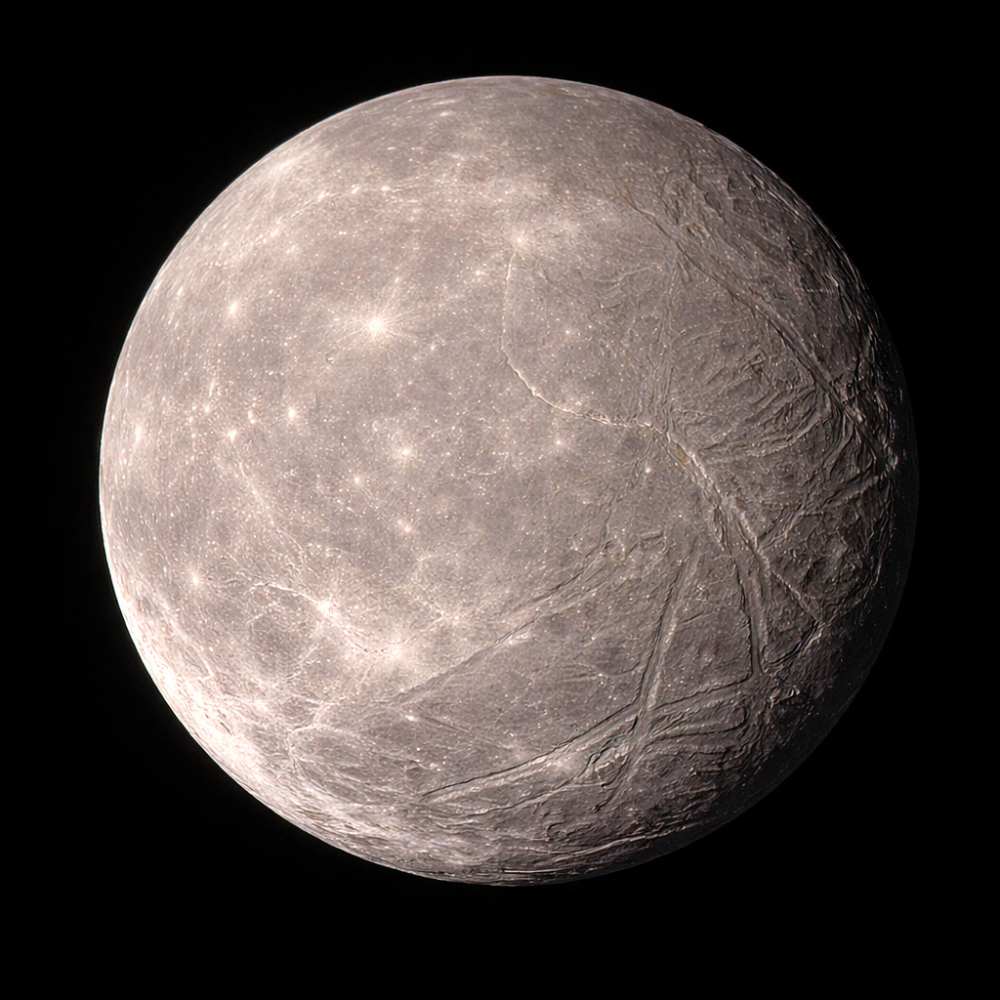
While moons like Umbriel appear dark and heavily cratered, Ariel looks bright, fractured, and geologically young. Its surface is crisscrossed with deep canyons, wide fault valleys, and smooth plains that suggest significant internal activity in the past.
Ariel is not the largest moon of Uranus—but it may be the one that best preserves evidence of how icy moons evolve when internal heat briefly comes alive.
Discovery – Part of Uranus’s Early Moon System
Ariel was discovered in 1851 by William Lassell, the same astronomer who discovered Umbriel.
At the time:
Uranus was known to have only a few moons
No surface details were visible
Ariel was identified purely by its motion
Its true nature would remain unknown until spacecraft exploration more than a century later.
Orbit – A Stable, Regular Satellite
Ariel follows a regular, orderly orbit around Uranus.
Orbital Characteristics
Nearly circular orbit
Low inclination
Prograde motion
These features indicate that Ariel likely formed around Uranus, rather than being captured like Triton.
Ariel orbits within Uranus’s equatorial plane, making it a classic example of a regular icy satellite.
Size and Density – A Differentiated World
Ariel is large enough for gravity to have shaped it into a near-spherical body.
Its density suggests:
A mixture of rock and ice
Internal differentiation
A rocky core beneath an icy mantle
This internal structure allowed Ariel to retain heat early in its history, enabling geological activity.
Surface Brightness – Why Ariel Is So Reflective
Ariel has the highest albedo of Uranus’s major moons.
This brightness likely comes from:
Clean water-ice surfaces
Relatively young terrain
Past resurfacing events
Fewer impact craters mean less darkening from space weathering, keeping Ariel brighter than its neighbors.
Surface Features – Evidence of Geological Activity
Ariel’s surface is one of the most complex in the Uranian system.
Major Features
Extensive fault systems
Deep canyons (chasmata)
Smooth plains with fewer craters
Linear grooves and ridges
Some canyons stretch hundreds of kilometers, suggesting large-scale crustal stretching.
How Did These Features Form?
The most widely accepted explanation involves internal expansion and freezing.
Possible process:
Ariel’s interior warmed early on
Subsurface ice partially melted
Internal expansion cracked the crust
Later cooling refroze the interior
This cycle would produce:
Tectonic fractures
Surface renewal
Reduced crater counts
Voyager 2 – Our Only Close Look
All detailed observations of Ariel come from Voyager 2, which flew past Uranus in 1986.
Voyager 2 revealed:
Bright, youthful terrain
Extensive fault networks
Surprisingly low crater density
However:
Only about 40% of Ariel’s surface was imaged
Many regions remain unseen
This leaves open the possibility that Ariel’s geological story is even richer than currently known.
Comparison with Umbriel – A Tale of Two Moons
Ariel and Umbriel are similar in size—but radically different in appearance.
| Feature | Ariel | Umbriel |
|---|---|---|
| Surface Brightness | Very bright | Very dark |
| Crater Density | Low to moderate | High |
| Geological Activity | Evident | Minimal |
| Surface Age | Relatively young | Ancient |
This contrast suggests different internal histories, despite similar origins.
Why Ariel Is Scientifically Important
Ariel helps scientists understand:
How internal heat affects icy moons
Why some moons resurface while others do not
The role of tidal interactions in moon evolution
Early thermal evolution of Uranus’s satellite system
Ariel represents a transitional icy moon—active in the past, quiet today.
Internal Heating – Why Ariel Was Active
Ariel’s fractured and youthful surface raises an obvious question:
where did the energy come from?
Unlike moons close to Jupiter or Saturn, Ariel does not experience strong tidal heating today. However, evidence suggests that early in its history, Ariel may have had access to several temporary heat sources.
Possible Sources of Internal Heat
Radioactive decay within a rocky core
Residual heat from formation
Past orbital resonances with other Uranian moons
These processes may have briefly raised internal temperatures high enough to melt subsurface ice.
Orbital Resonances – A Temporary Energy Boost
Early in the Uranian system’s evolution, Ariel may have passed through orbital resonances with moons like Umbriel or Titania.
During these periods:
Gravitational interactions flexed Ariel’s interior
Mechanical energy was converted into heat
Internal melting became possible
Once Ariel moved out of resonance, this heating would have diminished, leaving behind a geologically active—but eventually frozen—world.
Subsurface Ocean – Did Ariel Once Have One?
Based on its size, composition, and surface features, Ariel is considered a candidate for a past subsurface ocean.
Supporting clues include:
Evidence of crustal extension
Smooth plains suggesting resurfacing
Differentiated internal structure
However:
No ocean is believed to exist today
Any liquid layer likely froze long ago
Ariel may therefore represent a fossil ocean world, preserving the scars of an ancient interior sea.
Tectonic Features – Cracks in an Icy Shell
Ariel’s surface is dominated by tectonic structures.
Key Features
Chasmata – deep fault valleys
Graben systems – parallel fractures
Linear ridges – signs of crustal stress
Some canyons are tens of kilometers wide and hundreds of kilometers long, indicating global-scale deformation.
These features are consistent with:
Internal expansion
Ice melting and refreezing
Crustal stretching
Surface Age – Younger Than Expected
Crater counts show that large parts of Ariel’s surface are relatively young.
Fewer craters than Umbriel
Smoother plains in several regions
Evidence of resurfacing events
This suggests that Ariel experienced widespread geological renewal after its initial formation.
Comparison with Europa and Other Icy Moons
Although Ariel is much smaller and colder, it shares some similarities with Europa.
| Feature | Ariel | Europa |
|---|---|---|
| Internal Heat | Past | Ongoing |
| Subsurface Ocean | Possible (past) | Confirmed |
| Surface Fractures | Yes | Yes |
| Tidal Heating | Weak | Strong |
Ariel shows what can happen when geological activity fades, leaving behind frozen tectonic scars.
Why Ariel Is Different from Titania and Oberon
Titania and Oberon are larger than Ariel, yet appear more heavily cratered.
This suggests:
Ariel’s heating history was more intense or prolonged
Orbital resonances affected Ariel differently
Internal composition differences mattered
Ariel’s unique balance of size and heat may have placed it in a narrow window where resurfacing could occur.
Magnetic and Environmental Effects
Uranus has a highly tilted and offset magnetic field.
Ariel’s interaction with this environment may:
Affect surface chemistry
Influence space weathering
Modify ice properties over time
However, these effects are minor compared to internal processes.
Why Ariel Is a Key Target for Future Missions
Despite its scientific importance, Ariel has been visited only once.
Future missions to Uranus could:
Map Ariel’s unseen hemisphere
Search for compositional variations
Measure internal structure
Clarify its geological history
Ariel is often cited as one of the highest-priority Uranian moons for future exploration.
Ariel’s Long-Term Evolution – A Quiet World Today
At present, Ariel appears geologically inactive. There is no evidence of active volcanism, tectonics, or an atmosphere. Its surface is shaped primarily by slow processes such as micrometeoroid impacts and radiation exposure.
However, the features carved into Ariel’s crust tell a story of a much more dynamic past.
Ariel seems to have passed through a brief but significant phase of internal heating—enough to fracture its surface and renew large regions—before cooling and freezing into its current state.
Could Ariel Become Active Again?
Under current conditions, renewed activity on Ariel is unlikely.
Reasons include:
Weak tidal interactions today
Lack of significant internal heat sources
Long-term cooling of the interior
Unless Ariel experiences:
A major orbital change
A new resonance with another moon
…it is expected to remain dormant for the foreseeable future.
Ariel’s Role in the Uranian Moon System
Ariel occupies a unique position among Uranus’s moons.
Brighter and younger-looking than Umbriel
More fractured than Titania or Oberon
Less massive, but possibly more geologically expressive
This suggests that size alone does not determine geological activity—timing and orbital history matter just as much.
Frequently Asked Questions (FAQ)
Is Ariel the brightest moon of Uranus?
Yes. Ariel has the highest albedo among Uranus’s major moons.
Does Ariel have an atmosphere?
No permanent atmosphere has been detected.
Could Ariel have supported a subsurface ocean?
Possibly in the past, but no ocean is believed to exist today.
Why does Ariel have so many fractures?
Crustal stretching caused by internal heating and ice expansion is the most likely explanation.
Has Ariel been explored by spacecraft?
Yes, but only briefly by Voyager 2 in 1986.
Ariel Compared with Other Uranian Moons
| Moon | Surface Brightness | Geological Activity |
|---|---|---|
| Ariel | High | Evidence of past activity |
| Umbriel | Low | Minimal |
| Titania | Moderate | Limited |
| Oberon | Dark | Ancient, heavily cratered |
Ariel’s youthful appearance makes it stand out in this otherwise subdued system.
Why Ariel Matters in Planetary Science
Ariel demonstrates that:
Small icy moons can undergo internal evolution
Geological activity does not require extreme tidal forces
Early orbital conditions can shape long-term outcomes
It serves as a case study for how temporary heating can permanently alter a moon’s surface.
Related Topics for Universe Map
Uranus
Umbriel
Titania
Oberon
Icy moon geology
Subsurface oceans
Together, these objects help explain the diversity of icy worlds in the outer Solar System.
Final Perspective
Ariel is not dramatic today—but its surface quietly records a time when the interior of this small moon came alive.
In its deep canyons and smooth plains, Ariel preserves evidence of internal forces that once reshaped its crust. Though frozen now, it stands as a reminder that even modest icy worlds can experience profound change when conditions briefly allow.
As future missions return to Uranus, Ariel may yet reveal new details—filling in the missing chapters of its geological story.