









Uranus
The Sideways Ice Giant That Redefined Planetary Extremes
Quick Reader
| Attribute | Details |
|---|---|
| Official Name | Uranus |
| Planet Type | Ice Giant |
| Discovery Date | 13 March 1781 |
| Discoverer | William Herschel |
| Average Distance from Sun | ~19.2 AU |
| Orbital Period | ~84 Earth years |
| Axial Tilt | ~98° (extreme) |
| Diameter | ~50,724 km |
| Mass | ~14.5 Earth masses |
| Density | ~1.27 g/cm³ |
| Atmosphere | Hydrogen, helium, methane |
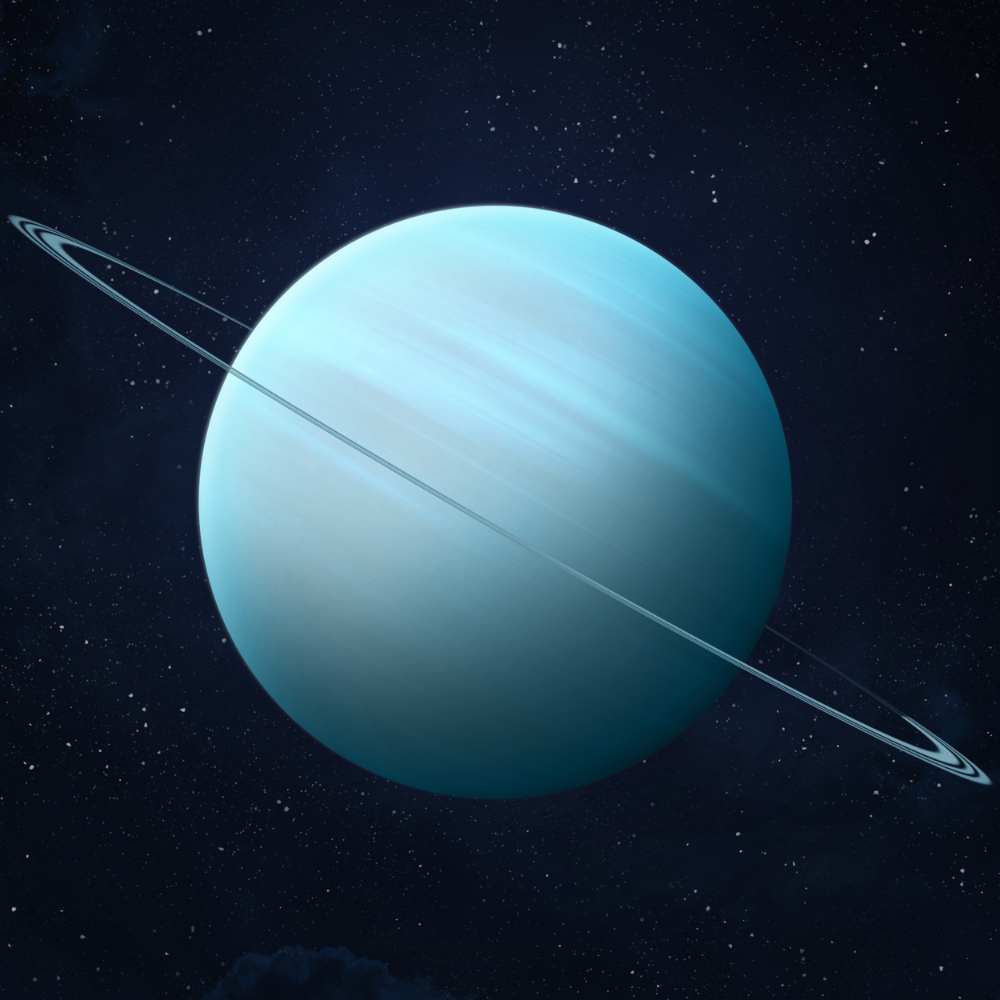
| Color | Pale blue-green |
| Rotation Period | ~17 hours |
| Rings | 13 known rings |
| Major Moons | Titania, Oberon, Ariel, Umbriel, Miranda |
| Spacecraft Visit | Voyager 2 (1986) |
Introduction to Uranus – The Planet That Rolls Around the Sun
Uranus is the most physically unconventional planet in the Solar System. Unlike every other planet, Uranus rotates on its side, with an axial tilt of about 98 degrees, causing it to roll around the Sun rather than spin upright.
This extreme tilt creates:
Seasons lasting over 20 Earth years
Polar regions that face the Sun continuously
An environment unlike any other planet
Uranus challenges nearly every assumption about how planets form, rotate, and evolve.
Discovery of Uranus – The First Modern Planet
Uranus holds a special place in astronomical history. It was the first planet discovered with a telescope, marking the expansion of the known Solar System beyond Saturn.
Key discovery points:
Initially mistaken for a star
Recognized as a planet through motion tracking
Doubled the known size of the Solar System overnight
Uranus transformed astronomy from classical observation to modern planetary science.
Why Uranus Is an Ice Giant, Not a Gas Giant
Although Uranus appears similar to Jupiter and Saturn, its internal composition is fundamentally different.
Uranus is classified as an ice giant because:
Most of its mass consists of water, ammonia, and methane ices
It contains relatively little hydrogen and helium
Its mantle exists in a dense, supercritical fluid state
This places Uranus in the same category as Neptune, distinct from gas giants.
Uranus’s Extreme Axial Tilt – The Core Mystery
Uranus’s sideways rotation is its defining feature.
Consequences of the tilt:
One pole faces the Sun for decades
The equator experiences extreme seasonal transitions
Atmospheric circulation behaves differently than on other planets
The leading explanation is a giant collision early in Uranus’s history, though alternative models involving multiple impacts also exist.
Atmosphere of Uranus – Calm on the Surface, Complex Beneath
Uranus’s atmosphere is composed mainly of hydrogen and helium, with methane absorbing red light and giving the planet its blue-green color.
Key atmospheric traits:
Less visible storm activity than Neptune
Subtle cloud bands and hazes
Seasonal atmospheric changes linked to axial tilt
Despite its calm appearance, Uranus hosts complex atmospheric dynamics beneath its upper layers.
Internal Structure – A Cold and Unusual Interior
Uranus has one of the strangest internal energy profiles in the Solar System.
Its structure likely includes:
A small rocky core
A thick icy mantle
A thin hydrogen–helium envelope
Unlike Neptune, Uranus emits very little internal heat, a mystery that remains unsolved.
Why Uranus Emits So Little Heat
Most giant planets radiate more heat than they receive from the Sun. Uranus does not.
Possible explanations:
Heat trapped by layered internal structure
Energy lost during a giant impact
Suppressed convection within the mantle
Understanding Uranus’s heat deficit is a key goal of future missions.
Rings of Uranus – Dark and Narrow
Uranus possesses a faint ring system unlike Saturn’s.
Ring characteristics:
Narrow and sharply defined
Composed of dark, radiation-processed material
Likely young and dynamically evolving
These rings are shaped by nearby moons and provide clues to Uranus’s gravitational environment.
Uranus’s Moon System – A Tilted Family
Uranus hosts a diverse system of moons that orbit in alignment with its extreme tilt.
Major moons include:
Titania (largest)
Oberon
Ariel
Umbriel
Miranda
These moons preserve evidence of internal activity, impacts, and early system evolution.
Why Uranus Matters in Planetary Science
Uranus is important because it:
Represents a common exoplanet type
Challenges models of planetary formation
Hosts extreme axial dynamics
Bridges gas giants and smaller icy worlds
Many exoplanets discovered resemble Uranus in size and composition.
Why Uranus Matters (Big-Picture Context)
Uranus demonstrates that planetary systems are not required to be orderly or symmetric. A single violent event can reshape a planet’s rotation, internal structure, atmosphere, and satellite system—producing worlds that defy expectations yet remain stable for billions of years.
Uranus’s Major Moons – A System Shaped by Catastrophe
Uranus is surrounded by a group of large icy moons whose orbits are aligned with the planet’s extreme axial tilt. This alignment suggests that the entire Uranian system was reshaped together, most likely by a catastrophic event early in its history.
The five major moons are:
Titania (largest)
Oberon
Ariel
Umbriel
Miranda
Each moon preserves a different chapter of Uranus’s past, making the system a natural laboratory for studying post-impact evolution.
Geological Diversity Among Uranian Moons
Despite forming around the same planet, Uranus’s moons display striking differences.
Ariel shows extensive resurfacing and fault systems, indicating the most geological activity
Umbriel is dark and ancient, preserving early bombardment
Titania shows large tectonic canyons from internal expansion
Oberon appears heavily cratered and geologically quiet
Miranda displays extreme faulting and patchwork terrain
This diversity suggests that internal heat, size, and orbital history played different roles across the system.
Miranda – A Moon That Breaks the Rules
Miranda deserves special mention.
Key anomalies:
Massive cliff structures
Mixed terrains stitched together
Evidence of partial reassembly
Miranda may have been shattered and reformed after a major impact or intense tidal episode, highlighting how violent Uranus’s past may have been.
Uranus vs Neptune – Ice Giants Compared
Although Uranus and Neptune are similar in size and composition, they behave very differently.
| Feature | Uranus | Neptune |
|---|---|---|
| Axial Tilt | ~98° (sideways) | ~28° |
| Internal Heat | Very low | High |
| Atmospheric Activity | Relatively calm | Extremely active |
| Visible Storms | Rare | Frequent |
| Magnetic Field | Highly tilted | Highly tilted |
| Appearance | Pale blue-green | Deep blue |
Interpretation:
Uranus and Neptune demonstrate that similar planets can evolve into radically different worlds, likely due to differences in early impacts and internal structure.
Uranus’s Magnetic Field – Off-Center and Tilted
Uranus has one of the strangest magnetic fields in the Solar System.
Key characteristics:
Tilted ~59° from the rotation axis
Offset from the planet’s center
Rapidly changing interaction with the solar wind
This unusual geometry suggests the magnetic field is generated in the icy mantle, not the core.
Seasonal Extremes on Uranus
Because of its axial tilt, Uranus experiences the most extreme seasons of any planet.
Seasonal effects include:
One hemisphere in constant sunlight for decades
The opposite hemisphere in prolonged darkness
Atmospheric circulation that changes over decades
Voyager 2 observed Uranus during a solstice, which may explain its unusually calm appearance at the time.
Voyager 2 – A Single, Limited Encounter
Uranus has been visited by only one spacecraft: Voyager 2 in 1986.
Major contributions:
Discovery of additional moons and rings
First measurements of magnetic field
Initial atmospheric data
Limitations:
Snapshot during a single season
No long-term climate data
Many processes left unexplained
Much of what we think we know about Uranus may reflect timing rather than true behavior.
Why Uranus Remains Poorly Understood
Open questions include:
Why Uranus emits so little internal heat
Whether it once had stronger atmospheric activity
How its moons were restructured after tilt formation
Whether layered convection traps internal energy
These uncertainties make Uranus one of the highest-priority planets for future exploration.
Why Uranus Matters (Interpretive Perspective)
Uranus shows that planetary evolution is not always gradual. A single event can permanently alter a planet’s orientation, climate system, and satellites—producing a stable yet deeply unconventional world. Understanding Uranus helps scientists recognize similar outcomes in exoplanetary systems.
The Long-Term Future of Uranus
Uranus is expected to remain a stable but unconventional planet for billions of years. Its extreme axial tilt, unusual interior, and weak internal heat output will continue to define its behavior far into the future.
Over very long timescales:
Uranus’s sideways orientation will remain unchanged
Seasonal cycles will continue to dominate atmospheric behavior
No dramatic increase in internal heat is expected
Uranus is not evolving toward chaos—it has already reached a stable, unusual equilibrium.
Will Uranus Ever Become More Active?
There is no strong evidence that Uranus will develop Neptune-like activity.
Limiting factors include:
Suppressed internal heat flow
Possible layered convection preventing heat escape
Lack of strong atmospheric energy input
Unless Uranus’s internal structure changes significantly, it will remain comparatively calm among the ice giants.
Uranus vs Neptune – Why One Is Quiet and the Other Is Wild
Although Uranus and Neptune are often grouped together, their differences are profound.
| Feature | Uranus | Neptune |
|---|---|---|
| Internal Heat Output | Very low | High |
| Axial Tilt | ~98° | ~28° |
| Atmospheric Winds | Moderate | Extreme (fastest in Solar System) |
| Storm Activity | Subtle, rare | Frequent and intense |
| Likely Early History | Massive tilt-causing impact | More gradual evolution |
Interpretation:
Uranus and Neptune show that early history matters more than size or composition. A single catastrophic event may explain why Uranus is quiet while Neptune is violent.
Uranus and Exoplanet Science
Uranus-sized planets are among the most common exoplanets discovered so far.
Studying Uranus helps scientists:
Interpret atmospheres of distant ice giants
Understand tilted exoplanets with extreme seasons
Model magnetic fields generated in icy mantles
Without Uranus, many exoplanet observations lack a reliable physical reference.
Why Uranus Missions Are Scientifically Critical
Uranus has been visited only once, and that single flyby left major gaps.
A dedicated Uranus mission could:
Measure internal heat flow accurately
Map atmospheric changes across seasons
Study moons like Titania and Miranda in detail
Resolve the origin of Uranus’s axial tilt
Uranus is now widely considered a top-priority target in planetary science.
Frequently Asked Questions (FAQ)
Why does Uranus rotate on its side?
The most likely explanation is a massive collision early in its history, though multiple-impact scenarios are also possible.
Is Uranus colder than Neptune?
Yes. Despite being closer to the Sun, Uranus emits far less internal heat, making it colder overall than Neptune.
Does Uranus have a solid surface?
No. Beneath its atmosphere lies a dense, supercritical mantle of water, ammonia, and methane, followed by a rocky core.
Why does Uranus look less active than Neptune?
Uranus’s internal heat flow is weak, limiting atmospheric energy and storm formation.
How many moons does Uranus have?
Uranus has 27 known moons, with five major ones dominating the system.
Has Uranus been fully explored?
No. Only Voyager 2 has visited Uranus, providing a brief and seasonally biased snapshot.
Uranus’s Place in the Universe Map
Within the Universe Map framework, Uranus represents:
The most extreme planetary axial tilt
A quiet ice giant shaped by catastrophe
A bridge between Solar System planets and common exoplanets
A reminder that planetary systems can remain stable after violent events
Uranus defines the outer limit of “normal” planetary behavior.
Final Thoughts
Uranus is not dramatic in the way Jupiter or Neptune are—but it is far more unsettling. Its sideways rotation, missing heat, and oddly calm atmosphere suggest a planet permanently altered by ancient violence.
Far from the Sun, Uranus continues its slow, tilted journey—quietly challenging everything we think we know about how planets are supposed to behave.