






Rhea
Saturn’s Second-Largest Moon and a Frozen Relic
Quick Reader
| Attribute | Details |
|---|---|
| Name | Rhea |
| Parent Planet | Saturn |
| Moon Type | Large regular icy satellite |
| Discovery Year | 1672 |
| Discoverer | Giovanni Domenico Cassini |
| Mean Diameter | ~1,528 km |
| Rank | 2nd largest moon of Saturn |
| Average Orbital Distance | ~527,000 km |
| Orbital Period | ~4.52 Earth days |
| Orbital Direction | Prograde |
| Shape | Nearly spherical |
| Surface Composition | Water ice with dark rocky material |
| Albedo | High (bright icy surface) |
| Geological Activity | Inactive today |
| Atmosphere | Extremely tenuous (exosphere) |
| Internal Structure | Rocky core + icy mantle |
Key Points
- Rhea is Saturn’s second-largest moon, larger than Iapetus
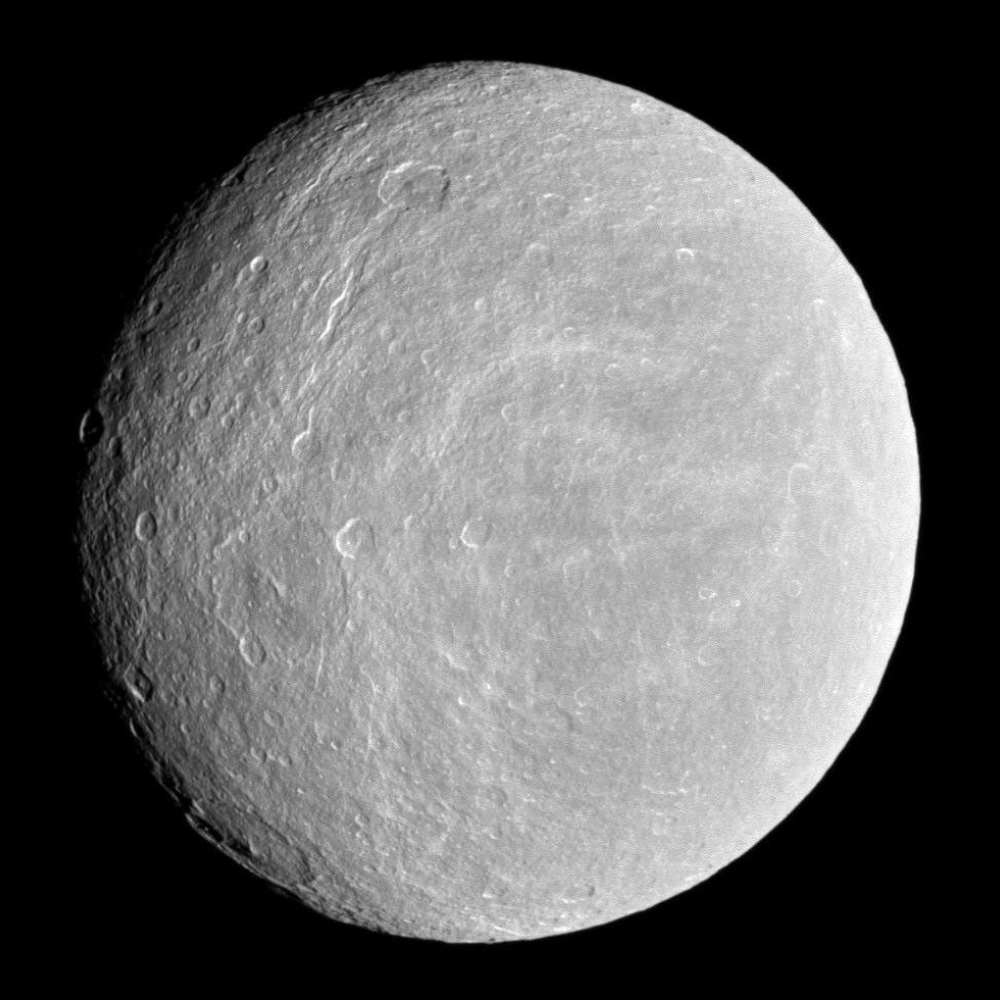
- Its surface is bright, heavily cratered, and ancient
- Rhea shows little evidence of recent geological activity
- A very thin oxygen–carbon dioxide exosphere has been detected
- Rhea represents a classic icy moon that cooled early
Introduction – A Quiet Giant in Saturn’s System
Among Saturn’s many moons, Rhea is easy to overlook.
It lacks Titan’s thick atmosphere, Enceladus’s geysers, or Iapetus’s dramatic two-tone surface. Yet Rhea is Saturn’s second-largest moon, and its importance lies in what it does not show.
Rhea is a frozen, ancient world, preserving conditions from an early stage of Saturn’s moon system. In planetary science, such objects are invaluable—they act as reference points, helping scientists understand how icy moons evolve when internal activity fades early.
Discovery – One of Cassini’s Early Finds
Rhea was discovered in 1672 by Giovanni Domenico Cassini, the same astronomer who identified Iapetus, Dione, and Tethys.
At the time:
Telescopes revealed only points of light
No surface details were visible
Moons were identified by their orbital motion
Rhea’s true nature would remain hidden until spacecraft exploration centuries later.
Orbit – A Stable, Regular Satellite
Rhea follows a stable, nearly circular orbit around Saturn.
Orbital Characteristics
Prograde motion
Low inclination
Moderate distance from Saturn
These features indicate that Rhea:
Formed within Saturn’s original circumplanetary disk
Was not captured later
Experienced predictable orbital evolution
Rhea’s orbit places it between Dione and Titan.
Size and Density – A Typical Icy Moon
Rhea is large enough to be nearly spherical, but not massive enough to sustain long-term internal heat.
Key traits:
Mixture of water ice and rock
Density lower than Titan’s
Differentiated interior likely present
This composition suggests:
A rocky core
An icy mantle
Early internal heating followed by rapid cooling
Surface Appearance – Bright and Heavily Cratered
Rhea’s surface is among the brightest in the Saturnian system, dominated by water ice.
Surface Characteristics
High crater density
Large impact basins
Bright ejecta blankets
Few smooth plains
This indicates that:
Rhea’s surface is very old
Little resurfacing has occurred
Most geological activity ended billions of years ago
Rhea’s appearance contrasts strongly with Enceladus and Dione.
Impact History – A Record of the Past
Rhea’s heavily cratered surface preserves a long impact history.
Large craters date back to the early Solar System
Smaller impacts accumulated over time
Few signs of crater erasure
This makes Rhea an excellent object for studying:
Impact rates in the outer Solar System
Long-term surface evolution on icy bodies
Tectonic Features – Subtle and Ancient
Although Rhea is mostly inactive, it does show limited tectonic features.
Observed structures include:
Long, linear fractures
Shallow scarps
Ancient fault systems
These features likely formed:
During early internal cooling
As the interior contracted
Before the crust fully rigidized
They are far less dramatic than Ariel’s or Dione’s tectonics.
Voyager and Cassini – Revealing Rhea’s Nature
Rhea was imaged by:
Voyager 1 and 2 (1980–1981)
Cassini (2004–2017)
Cassini provided:
High-resolution global maps
Detailed crater counts
Measurements of composition and density
These observations confirmed that Rhea is a geologically quiet moon.
Why Rhea Is Scientifically Important
Rhea helps scientists understand:
What icy moons look like after cooling
How surfaces evolve without active resurfacing
The baseline state of large icy satellites
It serves as a control object when comparing active moons like Enceladus or Titan.
Internal Structure – A Moon That Cooled Too Early
Rhea’s size places it in an important middle ground among icy moons.
It is:
Large enough to be spherical
Too small to retain long-term internal heat
Likely Internal Composition
Rocky core at the center
Icy mantle surrounding the core
Thick, rigid outer ice shell
Early in its history, heat from:
Radioactive decay
Accretion during formation
may have briefly warmed Rhea’s interior. However, this heat was lost relatively quickly, preventing sustained geological activity.
Why Rhea Lacks Strong Geological Activity
Unlike Enceladus or even Dione, Rhea shows no signs of recent resurfacing.
Key reasons include:
Weak tidal interactions with Saturn
Lack of orbital resonances that could generate heating
Early interior cooling
Once Rhea’s internal heat dissipated, its crust became thick and rigid, locking the surface into a long-term inactive state.
The Discovery of Rhea’s Exosphere
One of the most surprising discoveries about Rhea came from the Cassini mission.
Cassini detected a very thin exosphere composed mainly of:
Oxygen (O₂)
Carbon dioxide (CO₂)
How Is This Exosphere Formed?
Charged particles from Saturn’s magnetosphere strike the surface
Water ice molecules are broken apart
Oxygen and carbon dioxide are released
This process is known as radiolysis.
Rhea’s exosphere is:
Extremely tenuous
Not breathable
Constantly being replenished and lost
It does not qualify as a true atmosphere, but it is scientifically significant.
Why the Exosphere Matters
Rhea’s exosphere shows that:
Even inactive icy moons can interact chemically with their environment
Surface ice is not chemically inert
Magnetospheric processes can create transient atmospheres
This has implications for other icy moons and even icy bodies beyond Saturn.
Surface Features – More Than Just Craters
While Rhea is heavily cratered, careful observation reveals additional details.
Notable Surface Elements
Bright ray systems from recent impacts
Subtle albedo variations
Linear features linked to ancient tectonics
These features indicate:
A long, complex surface history
Gradual modification rather than dramatic change
Comparison with Dione – Similar Size, Different Outcomes
Rhea and Dione are comparable in size, yet their surfaces tell different stories.
| Feature | Rhea | Dione |
|---|---|---|
| Geological Activity | Minimal | Limited but evident |
| Surface Age | Very old | Mixed ages |
| Brightness | Very bright | Moderate |
| Tectonics | Subtle | Prominent fractures |
This contrast suggests that small differences in orbital history and internal composition can lead to very different evolutionary paths.
Did Rhea Ever Have a Subsurface Ocean?
Current evidence suggests that Rhea never sustained a long-lived subsurface ocean.
Reasons include:
Insufficient tidal heating
Rapid early cooling
Thick, rigid ice shell
However, brief episodes of partial melting early in Rhea’s history cannot be entirely ruled out.
Rhea and Saturn’s Rings – Any Connection?
Rhea orbits well outside Saturn’s main ring system.
It does not shepherd rings
It does not contribute material directly
Its surface shows no clear ring-related effects
Rhea’s evolution appears largely independent of Saturn’s rings, unlike moons such as Pan or Atlas.
Why Rhea Is Often Overlooked – And Why It Shouldn’t Be
Rhea lacks dramatic features, but this is precisely why it is important.
It represents:
A baseline icy moon
An end-state of satellite cooling
A contrast to active moons
Understanding Rhea helps scientists identify what conditions are required for activity—and what happens when those conditions are absent.
Rhea’s Long-Term Future – Stability Over Drama
Rhea’s future is expected to be quiet and predictable.
With:
No significant internal heat source
Weak tidal forces from Saturn
A thick, rigid icy crust
Rhea will continue to evolve only through slow surface processes such as micrometeoroid impacts and radiation exposure.
On geological timescales, Rhea is effectively frozen in time.
Could Rhea Ever Become Active Again?
Under current Solar System conditions, renewed activity on Rhea is extremely unlikely.
For activity to resume, Rhea would require:
A major change in orbital resonance
Strong tidal heating
A large external disturbance
No such scenarios are expected. Rhea has already passed the window in which internal activity was possible.
Rhea’s Place Among Saturn’s Moons
Rhea occupies a clear role within Saturn’s satellite system.
Larger and more massive than Iapetus
Less geologically complex than Dione
Far more inactive than Enceladus or Titan
This makes Rhea a reference moon—a body that shows how icy satellites behave once internal energy is gone.
Frequently Asked Questions (FAQ)
Is Rhea larger than Iapetus?
Yes. Rhea is slightly larger in diameter and mass than Iapetus.
Does Rhea have an atmosphere?
No true atmosphere. It has an extremely thin exosphere composed mainly of oxygen and carbon dioxide.
Why is Rhea so heavily cratered?
Because it has experienced very little resurfacing since early Solar System history.
Is Rhea geologically dead?
Yes, by all current evidence, Rhea is geologically inactive today.
Has Rhea ever shown signs of rings?
Early reports suggested possible rings, but later observations confirmed no permanent ring system exists around Rhea.
Rhea Compared with Other Icy Moons
| Moon | Activity Level | Notable Feature |
|---|---|---|
| Enceladus | Active | Geysers and subsurface ocean |
| Dione | Limited | Tectonic fractures |
| Rhea | Inactive | Ancient cratered surface |
| Iapetus | Inactive | Albedo dichotomy + ridge |
| Titan | Active | Thick atmosphere |
Rhea’s simplicity makes it a valuable comparison object.
Why Rhea Matters in Planetary Science
Rhea helps scientists:
Understand the end-stage evolution of icy moons
Measure long-term impact rates
Study surface chemistry driven by radiation
Compare inactive and active satellites
It provides context—showing what remains once geological energy fades.
Related Topics for Universe Map
Saturn
Enceladus
Dione
Iapetus
Icy moon evolution
Exospheres in the outer Solar System
Together, these topics map the full range of icy moon behavior.
Final Perspective
Rhea may not command attention with dramatic eruptions or towering ridges, but its value lies in its silence.
As a large moon that cooled early and changed little afterward, Rhea preserves a record of ancient conditions in Saturn’s system. It shows what most icy moons eventually become once internal heat is exhausted—a stable, cratered world shaped by time rather than energy.
In the story of the outer Solar System, Rhea is not a chapter of action—but a baseline against which all others are measured.