











Hylonome
The Centaur That Reveals How Fragile Small Worlds Can Be
Quick Reader
| Attribute | Details |
|---|---|
| Official Designation | (10370) Hylonome |
| Classification | Centaur object |
| Discovery Date | 27 February 1995 |
| Discoverer | Spacewatch Project |
| Orbital Region | Between Saturn and Uranus |
| Semi-major Axis | ~25.2 AU |
| Orbital Period | ~126 Earth years |
| Diameter | ~200–300 km (estimated) |
| Surface Composition | Ices, organics, dark material |
| Activity | No confirmed cometary activity |
| Rings | Possible (unconfirmed) |
| Dynamical Stability | Very low (highly unstable orbit) |
| Notable Feature | Extremely chaotic future trajectory |
Introduction to Hylonome – A Quiet but Unstable Centaur
Hylonome is a Centaur object that occupies one of the most dynamically dangerous regions of the Solar System. Unlike active Centaurs such as Chiron, Hylonome appears quiet and inactive—but its future is far more violent.
What makes Hylonome scientifically important is not what it is doing today, but what it is predicted to become.
Discovery and Naming
Hylonome was discovered in 1995 by the Spacewatch Project, a survey designed to track moving objects in the outer Solar System.
The name Hylonome comes from Greek mythology:
A centaur figure
Associated with tragedy and sudden loss
This name is especially fitting given Hylonome’s predicted orbital fate.
Orbital Characteristics – Living on Borrowed Time
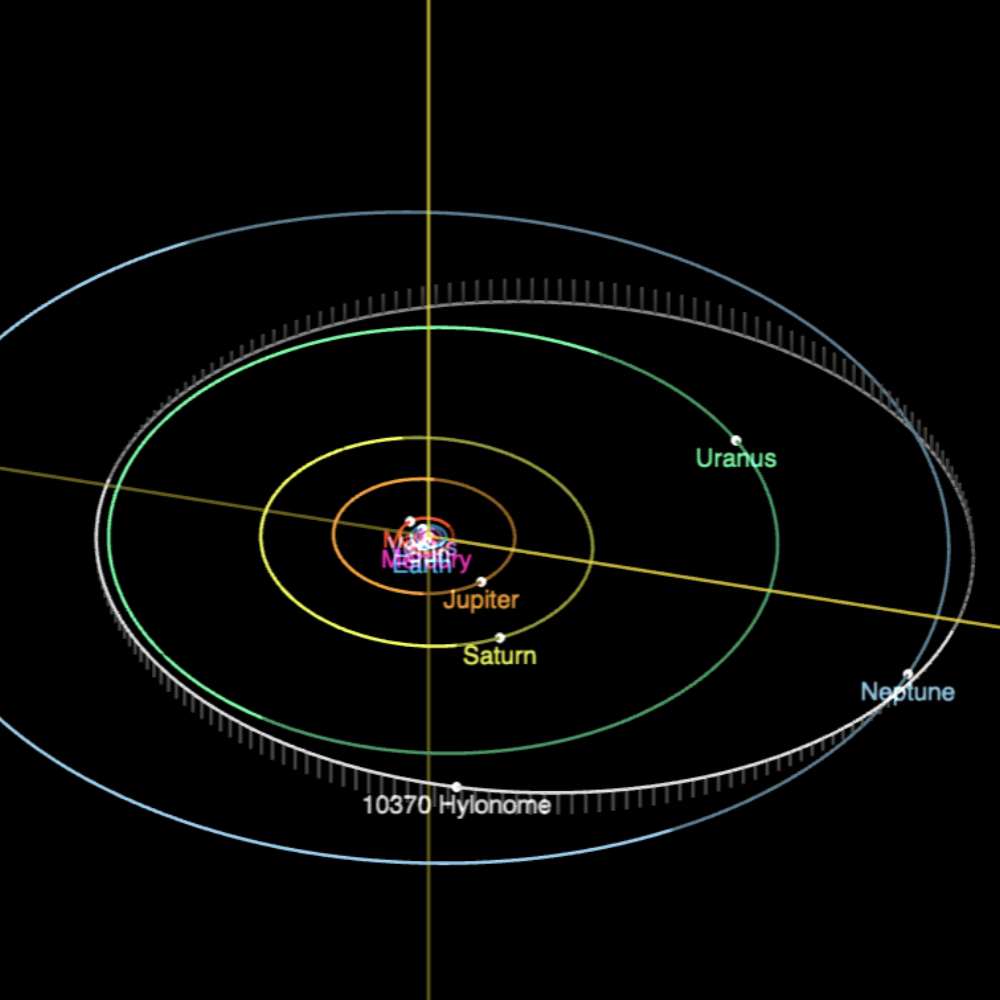
Hylonome’s orbit lies between Saturn and Uranus, a region dominated by strong gravitational perturbations.
Key orbital traits:
High sensitivity to planetary encounters
Strong chaos in long-term simulations
Rapid orbital evolution on astronomical timescales
Among known Centaurs, Hylonome is considered one of the most unstable.
Why Hylonome Is Classified as a Centaur
Centaurs are objects that:
Orbit between the giant planets
Are dynamically temporary
Likely originate in the Kuiper Belt
Hylonome fits this profile precisely, acting as a short-lived migrant rather than a permanent resident.
Size and Physical Nature
Although exact measurements are uncertain, Hylonome is estimated to be hundreds of kilometers wide, placing it among the larger Centaurs.
This suggests:
Significant ice content
A primitive interior
Minimal thermal processing
Hylonome likely preserves material from the early Solar System.
A Centaur Without Activity—For Now
Unlike Chiron:
Hylonome shows no confirmed coma
No detected outgassing
No observed dust production
This does not mean Hylonome will remain inactive. Orbital evolution could expose it to stronger solar heating in the future.
Extreme Dynamical Instability – What Makes Hylonome Special
Numerical simulations indicate that Hylonome has:
A very short dynamical lifetime
A high probability of close planetary encounters
One of the fastest predicted orbital transitions among Centaurs
In simulations, Hylonome frequently:
Gets scattered inward
Is ejected from the Solar System
Or collides with a giant planet
Hylonome as a Case Study in Orbital Chaos
Hylonome is often used in research as an example of extreme orbital chaos.
It helps scientists:
Test models of planetary scattering
Understand Centaur population turnover
Estimate comet delivery rates
Hylonome represents the fragility of small bodies in the outer Solar System.
Why Hylonome Matters in Planetary Science
Hylonome is important because it:
Demonstrates how short-lived Centaur orbits can be
Shows that inactivity does not equal stability
Helps model the transition from Kuiper Belt object to comet
Hylonome teaches that dynamical fate matters as much as physical composition.
Why Hylonome Matters (Big-Picture Context)
Hylonome shows that the Solar System is not a calm clockwork. Even today, gravity reshuffles small worlds, erasing some and transforming others. By studying Hylonome, astronomers witness instability as an active force—constantly reshaping the population of minor bodies.
Hylonome vs Other Centaurs – Why It Is Exceptionally Unstable
Not all Centaurs behave the same way. Some persist for tens of millions of years, while others—like Hylonome—exist on extremely short dynamical timescales.
Hylonome vs Chiron vs Chariklo (Comparative View)
| Feature | Hylonome | Chiron | Chariklo |
|---|---|---|---|
| Diameter (approx.) | 200–300 km | 200–220 km | ~250 km |
| Orbital Stability | Extremely low | Moderate | Relatively higher |
| Cometary Activity | None observed | Confirmed episodic | None |
| Rings | Possible (unconfirmed) | Possible | Confirmed |
| Dynamical Lifetime | Very short | Short | Longer |
| Scientific Role | Chaos benchmark | Transition prototype | Ring physics |
Interpretation:
Hylonome is not notable for activity or structure—it is notable for how quickly it is expected to change or disappear.
Why Hylonome Is Considered the Most Unstable Known Centaur
Orbital simulations repeatedly rank Hylonome among the least stable Centaurs ever studied.
Key reasons:
Repeated close encounters with Saturn and Uranus
Strong sensitivity to small gravitational perturbations
Rapid divergence of orbital solutions
Even tiny changes in initial conditions lead to vastly different futures, a hallmark of true orbital chaos.
What “Dynamical Lifetime” Really Means
When astronomers say Hylonome has a short dynamical lifetime, they mean:
Its orbit cannot remain similar for long
Predictability breaks down quickly
Long-term survival in its current region is unlikely
For Hylonome, this lifetime may be as short as a few million years, or even less.
Possible Future Paths for Hylonome
Hylonome’s future is not singular—it is probabilistic.
The main scenarios include:
Inward scattering, potentially turning it into a comet
Ejection from the Solar System into interstellar space
Collision with a giant planet
Fragmentation due to tidal or thermal stress
All outcomes represent transformation or loss, not permanence.
Why Hylonome Has Not Become Active Yet
Despite its instability, Hylonome remains inactive today.
Likely reasons:
Current distance from the Sun limits heating
Volatiles remain buried beneath the surface
No recent close solar approach
Activity may begin only after significant orbital changes.
Hylonome and the Centaur Population Turnover
Centaurs are not long-lived populations.
Hylonome helps scientists:
Estimate how quickly Centaurs are replaced
Model how often Kuiper Belt objects migrate inward
Understand how comet reservoirs are replenished
Hylonome represents rapid turnover, not slow evolution.
Why Hylonome Is a Favorite in Dynamical Studies
Researchers frequently use Hylonome because:
Its orbit highlights extreme instability
It stresses numerical models
It defines the lower bound of Centaur survival
In many studies, Hylonome functions as a control case for chaos.
Hylonome vs Kuiper Belt Objects – A Sharp Contrast
| Feature | Hylonome | Typical Kuiper Belt Object |
|---|---|---|
| Orbital Stability | Very low | High |
| Planetary Encounters | Frequent | Rare |
| Lifetime | Millions of years | Billions of years |
| Evolution Speed | Rapid | Slow |
This contrast shows what happens after an object leaves the Kuiper Belt.
Why Hylonome Matters Beyond Its Size
Hylonome matters not because it is large or active, but because it demonstrates:
How quickly Solar System structure can change
How fragile transitional orbits are
How gravity dominates small-body evolution
It is a warning case—not an exception.
Why Hylonome Matters (Big-Picture Context)
Hylonome proves that instability is not rare—it is fundamental. The Solar System constantly removes, reshapes, and redistributes small bodies. By studying Hylonome, astronomers learn how order emerges from chaos, and how temporary many “objects” truly are.
The Most Likely Fate of Hylonome
Hylonome’s future is defined by instability. Long-term numerical simulations consistently show that objects on Hylonome-like orbits do not survive in their current state.
The most probable outcomes are:
Ejection from the Solar System due to repeated gravitational encounters
Inward migration, potentially transforming Hylonome into a short-period comet
Collision with a giant planet
Fragmentation caused by tidal stress during close encounters
What matters most is that Hylonome will not remain a Centaur for long.
How Soon Could Hylonome Change?
In astronomical terms, “soon” means millions—not billions—of years.
For Hylonome:
Orbital predictability degrades rapidly
Small perturbations produce large future differences
Its current orbit is statistically short-lived
Compared to Kuiper Belt objects that persist for billions of years, Hylonome exists on borrowed time.
From Quiet Centaur to Active Comet?
Hylonome is inactive today, but this does not guarantee a quiet future.
If scattered inward:
Solar heating may activate buried volatiles
Outgassing could begin suddenly
A coma and tail may form
Many Jupiter-family comets are thought to have passed through a Hylonome-like phase.
Why Hylonome Has No Stable “End State”
Unlike planets or large moons, Hylonome has no equilibrium configuration.
Key reasons:
Too small to stabilize its orbit
Too exposed to giant-planet gravity
Too dynamically sensitive
Hylonome is not evolving toward a final form—it is passing through a phase.
Hylonome’s Role in Solar System Evolution
Hylonome helps scientists understand:
How material moves inward from the Kuiper Belt
How comet populations are replenished
How gravitational chaos shapes small-body reservoirs
Without objects like Hylonome, models of Solar System evolution would miss a critical transitional link.
Hylonome vs Stable Small Bodies – Evolutionary Contrast
| Feature | Hylonome | Stable Kuiper Belt Object |
|---|---|---|
| Orbital Predictability | Very low | High |
| Planetary Encounters | Frequent | Rare |
| Lifetime | Short (astronomical) | Very long |
| Evolutionary Role | Transitional | Primordial archive |
This contrast shows how dramatically environment determines destiny.
Frequently Asked Questions (FAQ)
What exactly is Hylonome?
Hylonome is a Centaur object—an icy body orbiting between Saturn and Uranus with an extremely unstable orbit.
Is Hylonome a comet?
No. It is not currently classified as a comet, but it may become one in the future.
Why is Hylonome considered so unstable?
Because its orbit is strongly affected by repeated close encounters with giant planets, leading to rapid orbital chaos.
Does Hylonome show any activity?
No confirmed cometary activity has been observed so far.
Could Hylonome leave the Solar System?
Yes. Ejection is one of the most likely long-term outcomes.
Why do scientists study such unstable objects?
Because they reveal how the Solar System actively reshapes itself, even today.
Hylonome’s Place in the Universe Map
Within the Universe Map framework, Hylonome represents:
Extreme dynamical instability
A short-lived transitional object
A bridge between the Kuiper Belt and comet populations
A real-time example of orbital chaos
Hylonome is best understood not as a destination, but as a process in motion.
Final Thoughts
Hylonome is quiet, dark, and distant—but it is one of the most revealing objects in the outer Solar System. It teaches a crucial lesson: stability is rare, and change is constant.
By studying Hylonome, astronomers see the Solar System not as a finished structure, but as an evolving system where gravity continuously rewrites the map.