










Umbriel
Uranus’s Darkest Moon and a Fossil of the Early Solar System
Quick Reader
| Attribute | Details |
|---|---|
| Name | Umbriel |
| Parent Planet | Uranus |
| Type | Natural satellite |
| Discovery Date | 24 October 1851 |
| Discoverer | William Lassell |
| Diameter | ~1,169 km |
| Rank | 3rd largest moon of Uranus |
| Mean Density | ~1.39 g/cm³ |
| Orbital Distance | ~266,000 km |
| Orbital Period | ~4.1 Earth days |
| Rotation | Tidally locked |
| Surface Composition | Water ice mixed with dark carbon-rich material |
| Albedo | Very low (darkest major Uranian moon) |
| Geological Activity | Minimal / ancient |
| Spacecraft Visit | Voyager 2 (1986) |
Introduction to Umbriel – The Dark Memory of Uranus
Umbriel is the darkest and most ancient-looking of Uranus’s major moons. While some moons preserve evidence of resurfacing or internal activity, Umbriel appears almost unchanged since the early history of the Solar System.
Its surface tells a story of:
Early heavy bombardment
Minimal internal heating
Long-term geological silence
Umbriel is not a moon shaped by renewal—it is a moon shaped by preservation.
Discovery and Naming
Umbriel was discovered in 1851 by William Lassell, who also discovered Ariel.
The name Umbriel comes from:
A shadowy spirit in Alexander Pope’s The Rape of the Lock
A fitting reference to darkness and obscurity
Among Uranus’s moons, Umbriel most closely lives up to its name.
Orbital Characteristics and Tidal Locking
Umbriel orbits Uranus in a nearly circular, equatorial orbit and is tidally locked.
Key orbital traits:
Always shows the same face to Uranus
Experiences weak tidal heating
Stable, long-term orbital configuration
This lack of tidal stress is one reason Umbriel remained geologically inactive.
Size and Internal Structure
Umbriel is large enough to be spherical but smaller than Titania and Oberon.
Its density suggests:
A mixture of rock and ice
Less internal differentiation than Titania
Limited retained heat
Umbriel likely never developed a long-lived subsurface ocean.
The Darkest Major Moon of Uranus
Umbriel has the lowest albedo of Uranus’s major moons.
Reasons include:
Surface rich in carbonaceous material
Radiation-processed organics
Ancient, space-weathered terrain
This extreme darkness indicates Umbriel’s surface has been exposed and unrenewed for billions of years.
Surface Features – Craters Over Everything
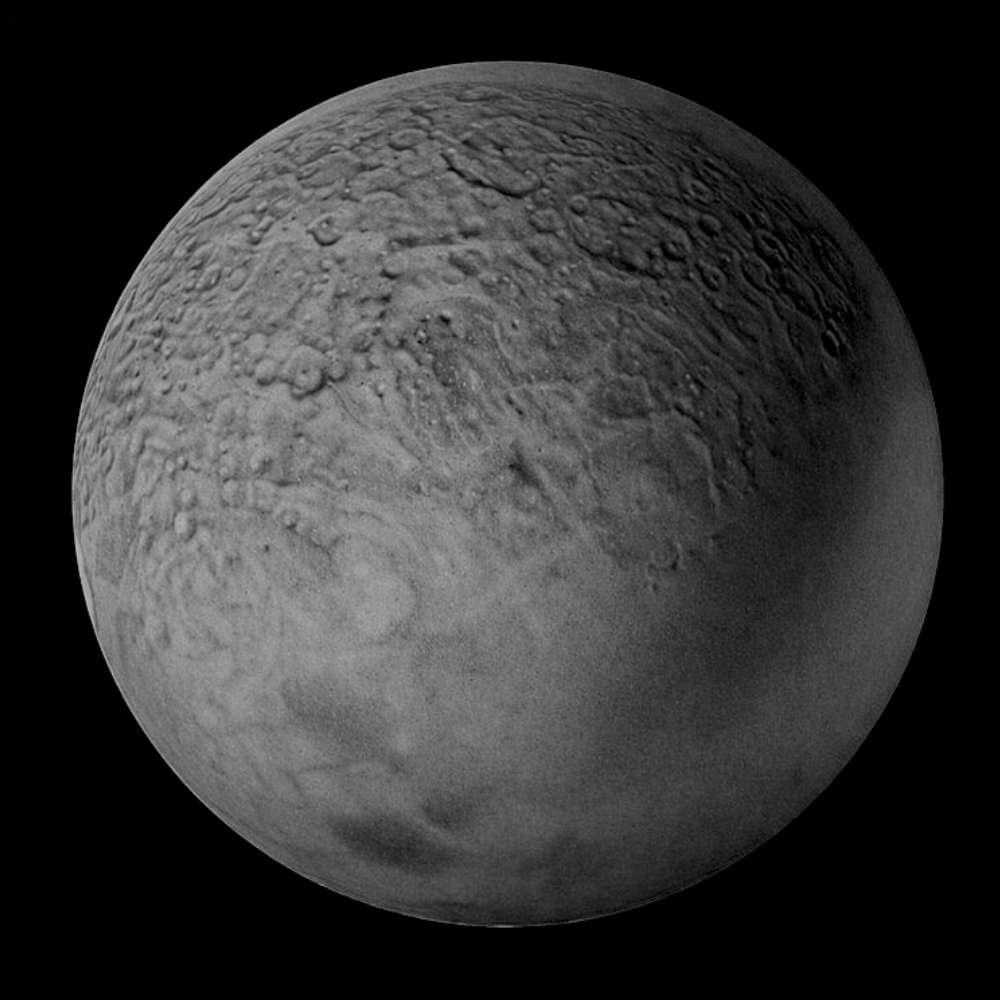
Umbriel’s surface is dominated by:
Large impact craters
Overlapping crater chains
Minimal smooth plains
This crater saturation suggests Umbriel has not experienced significant resurfacing since early Solar System history.
The Bright Ring in Wunda Crater
One exception stands out: Wunda crater.
Unique features:
A bright ring of material inside a dark crater
Possibly fresh ice exposed by impact
Or frost deposited from internal release
Wunda crater is one of the few signs that Umbriel may have experienced localized internal processes.
Lack of Tectonics and Cryovolcanism
Unlike Ariel or Titania:
Umbriel shows almost no large-scale fractures
No canyon systems
No confirmed cryovolcanic flows
This absence reinforces Umbriel’s role as a geological fossil.
Umbriel Compared to Other Uranian Moons (Context)
Early comparisons show:
Ariel → active and resurfaced
Titania → tectonically fractured
Oberon → ancient but brighter
Umbriel → darkest and most inert
Umbriel represents the cold, inactive end-member of the Uranian system.
Why Umbriel Matters in Planetary Science
Umbriel is important because it:
Preserves early impact history
Shows the effects of minimal internal heat
Acts as a control case for icy moon evolution
Helps separate primordial features from later activity
Umbriel answers a critical question:
What happens when a moon never wakes up?
Why Umbriel Matters (Big-Picture Context)
Umbriel shows that not all worlds evolve toward complexity. Some remain frozen in time, preserving the earliest chapters of Solar System history. By studying Umbriel, scientists gain a baseline—revealing what change looks like by understanding what never changed.
Why Umbriel Stayed Inactive While Other Moons Evolved
Umbriel’s defining trait is what did not happen. Unlike Ariel or Titania, Umbriel shows no clear evidence of large-scale internal heating, tectonics, or resurfacing.
Key reasons Umbriel remained inactive:
Low tidal heating due to its orbital configuration
Smaller size compared to Titania, limiting heat retention
Early heat loss, preventing long-term internal activity
Umbriel likely cooled quickly after formation, locking in its early surface.
Umbriel vs Ariel vs Titania – Evolutionary Comparison
This comparison highlights how similar moons followed very different paths.
| Feature | Umbriel | Ariel | Titania |
|---|---|---|---|
| Relative Brightness | Very dark | Bright | Moderate |
| Geological Activity | Minimal | Strong resurfacing | Ancient tectonics |
| Surface Age | Very old | Younger | Mixed |
| Tectonic Features | Rare | Extensive faults | Large canyons |
| Internal Heating | Very weak | Moderate (past) | Moderate (past) |
Interpretation:
Umbriel represents the inactive end-state, while Ariel and Titania show what happens when internal heat persists longer.
Surface Composition and Radiation Effects
Umbriel’s surface is dominated by dark, carbon-rich material mixed with water ice.
Over billions of years:
Charged particles from Uranus’s magnetosphere altered surface chemistry
Ice darkened through radiation processing
Organic residues accumulated
This explains why Umbriel is darker than even Oberon, despite similar ages.
Crater Saturation – Reading the Impact Record
Umbriel’s surface is close to crater saturation, meaning:
New impacts often overlap older ones
Little to no resurfacing erased early craters
Impact history remains largely intact
This makes Umbriel an excellent record of early Solar System bombardment.
The Mystery of Wunda Crater Revisited
Wunda crater remains Umbriel’s most intriguing anomaly.
Possible explanations for its bright ring:
Fresh ice exposed by a relatively recent impact
Cryogenic frost deposited from internal release
Material excavated from a brighter subsurface layer
While localized, Wunda suggests Umbriel was not entirely inert at all times.
Voyager 2 – A One-Sided View
All detailed knowledge of Umbriel comes from Voyager 2’s 1986 flyby.
Limitations include:
Only one hemisphere imaged at high resolution
Poor coverage of polar regions
No long-term monitoring
It is possible that unseen regions contain features not yet observed.
Could Umbriel Hide a Subsurface Ocean?
Current evidence suggests no long-lived subsurface ocean.
Reasons include:
Low density and small size
Lack of tectonic evidence
Minimal tidal heating
If liquid water ever existed, it was likely short-lived and early.
Umbriel vs Oberon – Darkness vs Brightness
Although similar in size, Umbriel and Oberon differ strongly in appearance.
| Feature | Umbriel | Oberon |
|---|---|---|
| Albedo | Very low | Higher |
| Surface Color | Dark gray | Moderately bright |
| Crater Visibility | Extreme | Clear but less saturated |
| Geological Activity | Minimal | Minimal but less dark |
Umbriel’s darkness suggests stronger radiation processing or different surface composition.
Why Umbriel Is Scientifically Valuable
Umbriel acts as a baseline moon.
Scientists use it to:
Compare active vs inactive icy moons
Identify primordial surface features
Separate early impacts from later geology
Without Umbriel, understanding Uranus’s moon system would be incomplete.
Why Umbriel Matters (Big-Picture Context)
Umbriel proves that inactivity is itself a result. Not all worlds evolve toward complexity—some preserve the Solar System’s earliest conditions almost untouched. Umbriel allows scientists to see the difference between evolution and endurance.
The Long-Term Future of Umbriel
Umbriel’s future is defined by stability and preservation. With no significant internal heat source and a stable, circular orbit, Umbriel is unlikely to experience any major geological change for the remainder of the Solar System’s lifetime.
Over very long timescales:
Its orbit around Uranus will remain stable
No new tectonic features are expected to form
Impact cratering will continue slowly and randomly
Umbriel will continue to age as a frozen record of early history, not an evolving world.
Will Umbriel Ever Become Geologically Active?
There is no known mechanism that could reactivate Umbriel.
Key limitations:
Extremely weak tidal heating
Insufficient size to retain long-term internal heat
No orbital eccentricity to generate stress
Any internal activity Umbriel once had ended billions of years ago. Today, it is thermally and geologically dormant.
Umbriel vs Other Inactive Icy Moons – A Broader Context
Umbriel belongs to a wider class of inactive icy moons across the Solar System.
| Feature | Umbriel | Oberon | Rhea |
|---|---|---|---|
| Parent Planet | Uranus | Uranus | Saturn |
| Geological Activity Today | None | None | None |
| Surface Age | Very old | Very old | Very old |
| Albedo | Very low | Moderate | High |
| Tectonic Features | Rare | Limited | Limited |
Interpretation:
Umbriel represents the darkest and most inert extreme of large icy moons.
Why Umbriel Is Important for Future Uranus Missions
Future missions to Uranus will not focus only on the planet.
Umbriel is valuable because it can:
Serve as a control case for moon evolution
Provide baseline data on radiation-darkened ice
Help calibrate crater-count dating methods
Studying Umbriel alongside Ariel and Titania allows scientists to reconstruct the full evolutionary range of the Uranian system.
Frequently Asked Questions (FAQ)
What is Umbriel?
Umbriel is the third-largest moon of Uranus and the darkest of its major moons.
Why is Umbriel so dark?
Its surface is rich in carbonaceous material and has been heavily altered by radiation, with little resurfacing to expose fresh ice.
Does Umbriel have an atmosphere?
No. Umbriel has no detectable atmosphere.
Is Umbriel geologically active?
No. Umbriel shows no evidence of current or recent geological activity.
What is Wunda crater?
Wunda is a large impact crater on Umbriel with a distinctive bright ring, possibly formed by exposed ice or localized frost deposition.
Has Umbriel been fully explored?
No. Only one hemisphere was imaged in detail by Voyager 2, leaving large regions unexplored.
Umbriel’s Place in the Universe Map
Within the Universe Map framework, Umbriel represents:
A geologically fossilized icy moon
The darkest end-member of the Uranian system
A baseline for comparing active and inactive worlds
A preserved record of early Solar System impacts
Umbriel helps define what non-evolution looks like.
Final Thoughts
Umbriel is not dramatic, not active, and not renewing itself—but that is exactly why it matters. Its surface preserves the earliest conditions of the outer Solar System with minimal alteration, offering scientists a rare, unfiltered view into the past.
Among Uranus’s moons, Umbriel stands as the quiet archivist—a world that never changed enough to forget where it came from.