







Oberon
Uranus’s Dark, Ancient, and Heavily Cratered Moon
Quick Reader
| Attribute | Details |
|---|---|
| Name | Oberon |
| Parent Planet | Uranus |
| Moon Type | Large regular icy satellite |
| Discovery Year | 1787 |
| Discoverer | William Herschel |
| Mean Diameter | ~1,523 km |
| Rank | 2nd largest moon of Uranus |
| Average Orbital Distance | ~583,500 km |
| Orbital Period | ~13.46 Earth days |
| Orbital Direction | Prograde |
| Shape | Nearly spherical |
| Surface Composition | Water ice mixed with dark, carbon-rich material |
| Albedo | Low to moderate (dark surface) |
| Geological Activity | Inactive today |
| Tectonic Features | Ancient faults, scarps, impact-related fractures |
| Internal Structure | Rocky core + icy mantle |
| Atmosphere | None detected |
Key Points
- Oberon is the second-largest moon of Uranus
- It has one of the darkest and most heavily cratered surfaces in the Uranian system
- Most surface features are ancient and well preserved
- Limited tectonic activity occurred early, then ceased
- Oberon represents a geologically frozen end-state icy moon
Introduction – The Outer Guardian of Uranus’s Moons
Oberon orbits farther from Uranus than any of the planet’s other major moons. This distance shaped its entire history.
Unlike Ariel, which shows signs of resurfacing, or Titania, which bears large tectonic scars, Oberon looks old, dark, and largely untouched. Its surface preserves a record of early Solar System impacts with very little modification afterward.
Oberon is not dramatic—but it is honest. It shows what happens when an icy moon cools early and remains quiet for billions of years.
Discovery – A Product of Early Telescopic Astronomy
Oberon was discovered in 1787 by William Herschel, during the same observations that revealed Titania.
At the time:
Uranus had only recently been discovered
Moons appeared as faint points of light
No surface details were visible
Oberon would remain mysterious until spacecraft exploration nearly two centuries later.
Orbit – Distant and Weakly Heated
Oberon follows a regular, prograde orbit, but it lies far from Uranus compared to other major moons.
Orbital Implications
Weak tidal forces from Uranus
Minimal internal heating
Early thermal shutdown
This distance is a major reason why Oberon lacks the resurfacing seen on Ariel.
Size and Density – A Differentiated Icy World
Oberon is large enough to be fully spherical and internally differentiated.
Its density suggests:
A rocky central core
A thick icy mantle
An early period of internal warmth
However, this heat was short-lived, and Oberon cooled faster than moons closer to Uranus.
Surface Appearance – Dark, Cratered, and Ancient
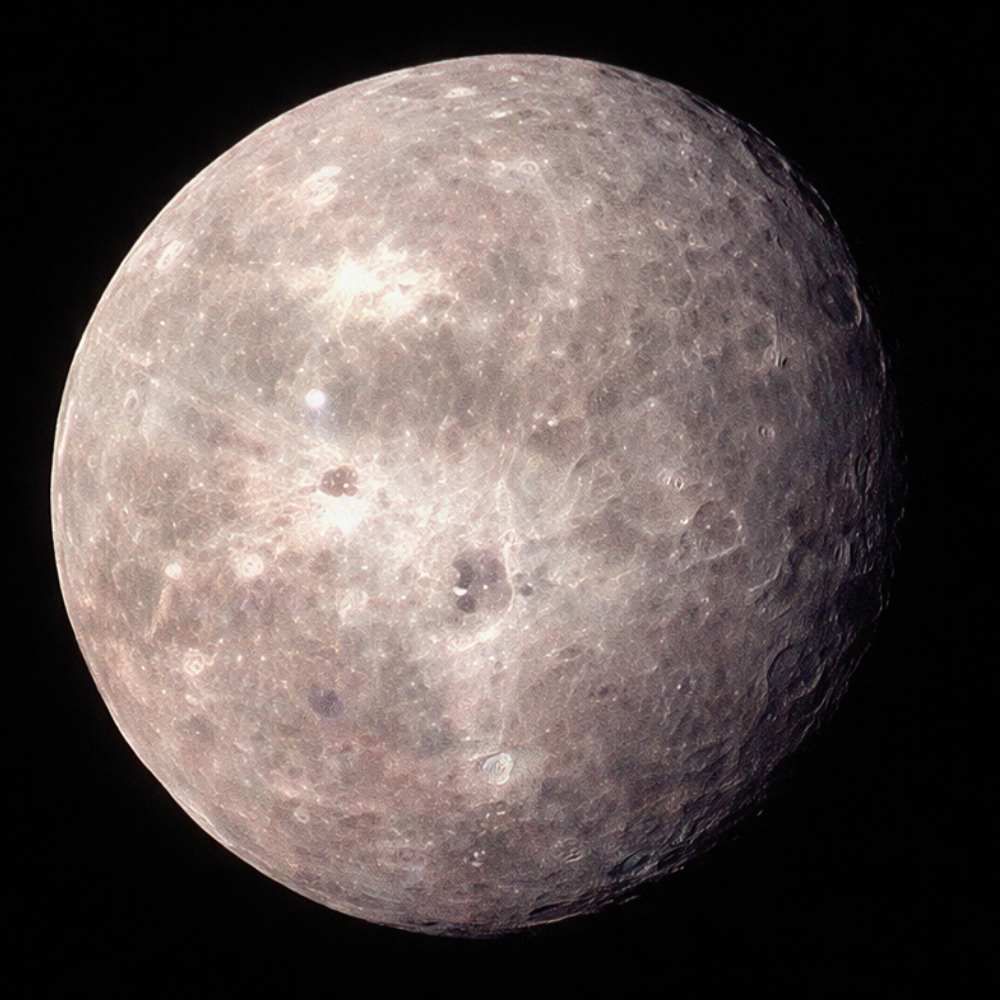
Oberon’s surface is among the darkest of Uranus’s major moons.
Surface Characteristics
High crater density
Large, ancient impact basins
Dark material mixed with water ice
Minimal smooth plains
This indicates:
Very limited resurfacing
Long-term surface stability
Preservation of early impact history
Oberon is essentially a geological archive.
Impact History – A Record of Early Violence
Oberon’s heavily cratered surface suggests:
Intense bombardment early in Solar System history
Few later events that erased craters
Some craters show:
Central peaks
Terraced walls
Bright ejecta contrasting with dark terrain
These features allow scientists to study impact processes on icy crusts.
Tectonic Features – Subtle but Real
Although Oberon is mostly inactive, it does show limited tectonic evidence.
Observed features include:
Long scarps
Fault-like structures
Possible graben formed early
These likely resulted from:
Interior cooling and contraction
Crustal stress during early evolution
Unlike Ariel or Titania, these features are ancient and inactive.
Voyager 2 – A Partial View
All detailed images of Oberon come from Voyager 2, which flew past Uranus in 1986.
Voyager 2 revealed:
Dark, cratered terrain
Large impact features
Limited tectonic structures
However:
Only about 40% of Oberon’s surface was imaged
Much of the moon remains unseen
This leaves open questions about global uniformity.
Comparison with Titania and Ariel
| Feature | Oberon | Titania | Ariel |
|---|---|---|---|
| Surface Brightness | Dark | Moderate | Bright |
| Crater Density | High | Moderate | Low |
| Geological Activity | Minimal | Limited | Significant |
| Surface Age | Very old | Mixed | Relatively young |
Oberon represents the most ancient-looking of Uranus’s major moons.
Why Oberon Is Scientifically Important
Oberon helps scientists understand:
The long-term outcome of icy moon cooling
Impact preservation in low-activity environments
How distance from a planet affects moon evolution
It provides a baseline comparison for more active icy moons.
Internal Evolution – Heat That Didn’t Last
Oberon’s interior tells a familiar story for distant icy moons: early warmth followed by rapid cooling.
Shortly after formation, Oberon likely experienced:
Heat from accretion
Radioactive decay within a rocky core
This was enough to:
Differentiate the interior
Create a rocky core and icy mantle
But unlike moons closer to their planet, Oberon lacked long-term tidal heating. Once its initial heat dissipated, the interior cooled permanently.
Why Oberon Never Became Geologically Active
Several factors worked against sustained activity on Oberon:
Key Limitations
Large orbital distance → weak tidal forces
No strong orbital resonances with other moons
Moderate size → limited heat retention
Without a continuous energy source, Oberon’s crust thickened early, preventing magma-like ice flows or large-scale resurfacing.
This explains why Oberon lacks:
Cryovolcanic plains
Young tectonic systems
Evidence of subsurface oceans
Early Tectonics – Cracks from Cooling
Although Oberon is mostly inactive today, its surface preserves fossil tectonics.
Observed Structures
Long scarps and fault lines
Possible graben (down-dropped crustal blocks)
Fractures cutting across ancient terrain
These features likely formed when:
The interior cooled and contracted
Stress built up in the outer ice shell
The crust fractured to release pressure
Once formed, these structures remained frozen in place.
Large Impact Basins – Reshaping Without Resurfacing
Oberon hosts several large impact craters and basins, some spanning hundreds of kilometers.
Key observations:
No evidence of basin infill
Crater rims remain sharp
Minimal tectonic modification
This indicates that:
Impacts reshaped Oberon’s surface mechanically
But did not trigger internal melting or resurfacing
Oberon absorbed impacts—but did not respond geologically.
Comparison with Rhea and Iapetus
Oberon shares similarities with some of Saturn’s moons.
| Feature | Oberon | Rhea | Iapetus |
|---|---|---|---|
| Geological Activity | Minimal | Minimal | Minimal |
| Surface Age | Very old | Very old | Very old |
| Albedo | Dark | Bright | Extreme contrast |
| Dominant Process | Impacts | Impacts | Thermal migration |
This comparison shows that Oberon belongs to a class of frozen, inactive large moons.
Why Oberon Is Darker Than Titania
Oberon’s darker surface likely reflects:
Higher concentration of carbon-rich material
Less resurfacing to expose fresh ice
Long-term space weathering
Titania, by contrast:
Experienced more internal activity
Exposed brighter ice through tectonics
The difference highlights how small thermal differences can lead to major surface contrasts.
Environmental Effects – Space Weathering Over Time
Over billions of years, Oberon’s surface has been modified by:
Solar and cosmic radiation
Micrometeoroid bombardment
Magnetospheric particle interactions
These processes:
Darken surface ice
Alter chemical composition
Reduce surface reflectivity
Without resurfacing, these effects accumulate continuously.
Why Oberon Is Often Overlooked
Oberon lacks:
Active geology
Atmosphere
Dramatic visual features
But this simplicity is exactly what makes it valuable.
Oberon represents:
A baseline icy moon
The natural end-state of satellite cooling
A control case for planetary science
Oberon’s Long-Term Future – Frozen Permanence
Oberon has already reached its final evolutionary state.
With:
No measurable internal heat source
Weak tidal interactions
A thick, rigid ice shell
Oberon’s future will be dominated by extremely slow surface processes rather than active geology.
Over billions of years:
New impact craters will slowly accumulate
Existing features will remain largely unchanged
Surface darkening will continue through space weathering
In practical terms, Oberon will look much the same far into the future.
Could Oberon Ever Become Active Again?
Under current and foreseeable conditions, the answer is almost certainly no.
To reignite geological activity, Oberon would need:
Strong tidal heating
A major orbital change
A new resonance with another large moon
No such scenarios are expected in the Uranian system.
Oberon’s window for internal activity closed billions of years ago.
Oberon’s Role in the Uranian Moon System
Among Uranus’s major moons:
Ariel shows the most resurfacing
Titania shows limited tectonics
Umbriel is dark and heavily cratered
Oberon is the most ancient-looking
This progression reflects:
Distance from Uranus
Declining tidal influence
Early thermal shutdown
Oberon anchors the inactive end of the Uranian spectrum.
Frequently Asked Questions (FAQ)
Is Oberon larger than Titania?
No. Titania is Uranus’s largest moon. Oberon is the second largest.
Does Oberon have an atmosphere?
No. No atmosphere or exosphere has been detected.
Why is Oberon so heavily cratered?
Because it has experienced little to no resurfacing since early Solar System history.
Has Oberon ever had a subsurface ocean?
Current evidence suggests it is unlikely that Oberon ever sustained a long-lived subsurface ocean.
Has Oberon been fully mapped?
No. Voyager 2 imaged only about 40% of its surface.
Oberon Compared with Other Icy Moons
| Moon | Geological State | Surface Style |
|---|---|---|
| Ariel | Past active | Fractured, bright |
| Titania | Limited activity | Tectonic scars |
| Umbriel | Inactive | Dark, cratered |
| Oberon | Inactive | Dark, ancient |
| Rhea | Inactive | Bright, cratered |
Oberon fits firmly among the frozen relics of the Solar System.
Why Oberon Matters in Planetary Science
Oberon demonstrates that:
Large moons can cool early and remain inactive
Distance from a planet strongly affects evolution
Impact records can survive billions of years
It helps scientists distinguish between:
Internally driven geology
Externally modified surfaces
Few moons preserve such a clear record of what happens when energy runs out.
Related Topics for Universe Map
Uranus
Titania
Ariel
Umbriel
Rhea
Icy moon evolution
These topics together map the full range of icy moon behavior.
Final Perspective
Oberon is not a world of movement or change—it is a world of memory.
Its dark, cratered surface preserves the earliest violent chapter of the Solar System, largely untouched by later processes. In its silence, Oberon tells us how most icy moons eventually end up: cold, stable, and shaped by time rather than energy.
As future missions return to Uranus, Oberon may not surprise us—but it will anchor our understanding of how icy worlds evolve when activity fades.