










Elatus
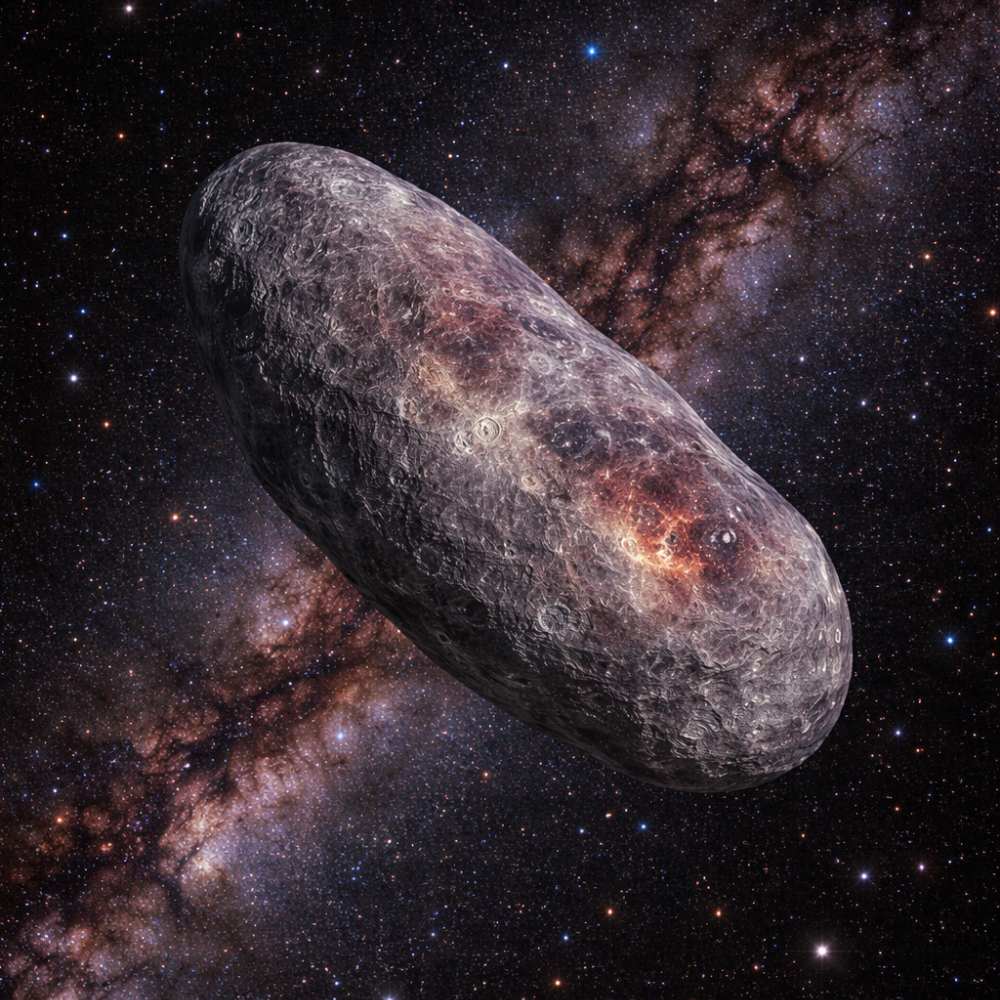
Elatus is a small Centaur in the outer Solar System. Its elongated orbit carries it from inside Saturn’s average orbital distance to a region between Saturn and Uranus. The object is extremely dark, distinctly red in reflected light and probably irregular in shape. Because Centaurs occupy unstable orbits, Elatus helps astronomers study how small bodies move through the region of the giant planets.
Quick Reader
| Attribute | Details |
|---|---|
| Official Name | (31824) Elatus |
| Provisional Designation | 1999 UG5 |
| Object Type | Centaur |
| Discovery Date | 29 October 1999 |
| Discovery Survey | Catalina Sky Survey |
| Perihelion | About 7.3 AU |
| Aphelion | About 16.3 AU |
| Orbital Period | About 40.6 Earth years |
| Eccentricity | About 0.38 |
| Inclination | About 5.2° |
| Estimated Diameter | Roughly 50–57 km |
| Geometric Albedo | About 0.05 |
| Candidate Rotation Period | About 26.5 hours |
| Surface Colour | Very red |
| Confirmed Activity | None |
What Is Elatus?
Elatus, officially numbered (31824), is a Centaur: a small Solar System body whose orbit lies among the giant planets. The term mainly describes its dynamical class; it does not mean that Elatus is an active comet.
Elatus travels around the Sun at an average distance of about 11.8 astronomical units. One astronomical unit, or AU, is the average distance between Earth and the Sun. Its orbit is much more elongated than Earth’s, so its distance from the Sun changes substantially during each revolution.
Many Centaurs are thought to have originated farther from the Sun before gravitational scattering moved them inward. Their present orbits are generally temporary on Solar System timescales because encounters with giant planets can gradually alter their paths.
Discovery and Name
Elatus was discovered on 29 October 1999 by the Catalina Sky Survey at Mount Lemmon Observatory in Arizona. It first received the provisional designation 1999 UG₅.
The object was later numbered 31824 and named Elatus after a Centaur from Greek mythology. Small bodies in the Centaur population are commonly named after mythological Centaurs or related figures. JPL’s Small-Body Database and the Minor Planet Center maintain the official orbital and designation records for objects such as Elatus.
The Orbit of Elatus
Elatus moves from about 7.3 AU at perihelion, its closest point to the Sun, to about 16.3 AU at aphelion, its farthest point. Saturn’s average orbital distance is roughly 9.6 AU, while Uranus orbits at about 19.2 AU. Elatus therefore travels from inside Saturn’s average orbital distance to the region between Saturn and Uranus.
Its semi-major axis is about 11.8 AU, its eccentricity is about 0.38 and its orbital inclination is about 5.2 degrees. It takes approximately 40.6 Earth years to complete one orbit. Published physical studies list orbital values consistent with these rounded figures.
The path is not permanently stable. Repeated gravitational interactions, particularly with Saturn, can alter a Centaur’s orbit. Its exact long-term future cannot be predicted with certainty because small uncertainties grow during extended numerical simulations.
Size and Albedo
Elatus is too distant to have its diameter measured directly from a detailed image. Astronomers estimate its size by combining visible brightness with thermal-infrared observations.
A thermal analysis using Spitzer data produced an effective diameter of approximately 49.8 kilometres, with an uncertainty of about ten kilometres, and a geometric albedo near 0.049. WISE/NEOWISE observations produced a diameter estimate of about 57 kilometres and an albedo near 0.05. It is therefore reasonable to describe Elatus as roughly 50–57 kilometres wide.
“Effective diameter” does not prove that the object is spherical. It represents the diameter of a sphere producing a comparable thermal signal.
A Very Dark, Red Surface
Elatus reflects only about 5% of visible sunlight under the standard geometric-albedo definition, making it a very dark object.
It is also distinctly red in astronomical colour measurements. This means its surface reflects proportionally more light at longer visible wavelengths, not that it would appear bright red to the human eye. A realistic appearance would probably be dark reddish-brown.
Photometric measurements found strongly red colour indices, and the researchers described Elatus as a remarkably red Centaur. However, colour alone cannot establish a unique chemical composition. Different combinations of dark material, mineral grains, radiation-processed compounds and ice may produce overlapping spectral effects.
Surface Composition
Near-infrared observations provide evidence that water ice is present on the surface of Elatus. Its spectrum contains absorption features associated with water ice, although the available data do not reveal the exact amount, distribution or physical state of that ice.
The visible and near-infrared spectrum can be reproduced using mixtures that include water ice and dark carbon-rich material. However, such spectral models are not unique. They show which materials could explain the observations, not a complete chemical inventory of the surface.
The surface may include:
- Water ice
- Dark carbon-rich material
- Radiation-processed organic compounds
- Dust and mineral grains
Only water ice has direct spectral support among these components. The precise nature of the material responsible for the red colour and very low albedo remains uncertain.
Is Elatus an Active Centaur?
Elatus has shown no confirmed cometary activity.
During the 2001 lightcurve observations, researchers examined whether its changing brightness could have been caused by a coma. Images collected over several hours showed Elatus as a point-like source comparable to nearby stars, with no detectable extended coma. The observed brightness variation was therefore interpreted as rotational rather than cometary.
This makes Elatus an inactive Centaur based on current observations. The term “inactive” describes its observed state; it does not prove that the object has never released gas or dust.
Some Centaurs become active when changes in their orbits expose volatile materials to greater solar heating. Elatus could potentially develop activity if its perihelion were moved significantly closer to the Sun, but no such future behaviour can be predicted with certainty.
Origin of Elatus
Elatus probably originated beyond the giant planets.
Modern dynamical studies indicate that the scattered disk is the principal source of most prograde Centaurs and other giant-planet-crossing bodies. Objects can escape from trans-Neptunian populations through gravitational interactions, enter the region of the giant planets and temporarily occupy Centaur-like orbits.
Elatus may have followed this general pathway, but its exact birthplace cannot be reconstructed. Centaur trajectories are chaotic, and small uncertainties in their present orbital measurements grow when simulations are extended millions of years into the past.
It is therefore accurate to describe Elatus as a probable inward-scattered outer Solar System object, rather than claiming that it formed at one known location.
Future Orbit
The present orbit of Elatus is temporary on astronomical timescales.
Encounters and repeated gravitational perturbations from the giant planets can change a Centaur’s eccentricity, inclination and distance from the Sun. Population studies show that Centaurs may move into different giant-planet-crossing orbits, become Jupiter-family comets, travel outward again or eventually be ejected from the planetary region.
These are population-level possibilities, not a prediction of the exact fate of Elatus. Its eventual path depends on the timing and geometry of future planetary encounters.
Elatus is not currently an Earth-crossing object. Its perihelion remains far beyond Earth’s orbit, so it poses no known present impact threat.
Why Elatus Is Important
Elatus is valuable because it connects several areas of outer Solar System research.
Tracing the Movement of Small Bodies
Its orbit helps astronomers study how objects migrate from trans-Neptunian regions into the space controlled by the giant planets.
Studying Centaur Surfaces
Elatus combines an extremely low albedo with a strongly red spectral slope and evidence of water ice. This unusual combination helps researchers compare the effects of radiation, impacts and solar heating on Centaur surfaces.
Understanding Cometary Evolution
Centaurs are often considered an intermediate dynamical population between trans-Neptunian objects and some short-period comets. Elatus currently appears inactive, making it useful for comparison with active Centaurs.
Preserving Primitive Material
Its ice and dark surface materials may preserve information about small bodies that formed in the cold outer Solar System. However, the surface has also been altered by radiation and its changing thermal environment.
Observing Elatus
Elatus appears as a faint point of light rather than a resolved world. Astronomers study it indirectly using:
- Astrometry to calculate its orbit
- Photometry to measure brightness and colour
- Lightcurves to investigate rotation and shape
- Spectroscopy to search for surface materials
- Thermal-infrared observations to estimate diameter and albedo
The estimated diameter depends partly on thermal models. Its proposed shape and rotation period are also based on brightness changes rather than direct images. These limitations explain why several physical properties remain approximate.
What Remains Unknown?
Astronomers have not yet determined:
- The exact shape of Elatus
- Its definitive rotation period
- Its spin-axis orientation
- Its mass and density
- Its internal structure
- The detailed composition of its red surface
- The amount and distribution of water ice
- Whether it has ever experienced cometary activity
- Its exact formation region
- Its eventual orbital fate
No spacecraft has visited Elatus, so all present knowledge comes from remote observations.
Frequently Asked Questions
How large is Elatus?
Thermal measurements suggest an effective diameter of approximately 50–57 kilometres. The true dimensions may differ if the object is significantly elongated.
How long is a year on Elatus?
Elatus completes one orbit around the Sun in approximately 40.6 Earth years.
How long is a day on Elatus?
A double-peaked interpretation of its lightcurve suggests a candidate rotation period of about 26.5 hours. The result is not considered completely secure.
Is Elatus an asteroid or a comet?
Elatus is best described as an inactive Centaur and numbered minor planet. It has no confirmed coma, but its dynamical population is connected with icy outer Solar System bodies and possible cometary precursors.
Is there water on Elatus?
Spectroscopic observations support the presence of water ice on its surface. There is no evidence of liquid surface water.
Does Elatus have a moon or rings?
No moon or ring system has been confirmed around Elatus.
Has Elatus been visited by a spacecraft?
No spacecraft has visited Elatus.
Conclusion
Elatus is a small, dark and unusually red Centaur travelling on an elongated orbit through Saturn’s region of the Solar System.
Its estimated size, low reflectivity, possible elongated shape and evidence of surface water ice provide important clues about its physical nature. Its unstable orbit suggests that it may have migrated inward from a trans-Neptunian source population and that its present location is only one stage of a longer dynamical journey.
Many details remain unknown because Elatus has never been observed at close range. Even so, it offers astronomers a useful example of how primitive icy bodies evolve as they move between the distant outer Solar System and the realm of the giant planets.