




Kaʻepaokaʻawela
The Retrograde Co-Orbital Moving Against Jupiter
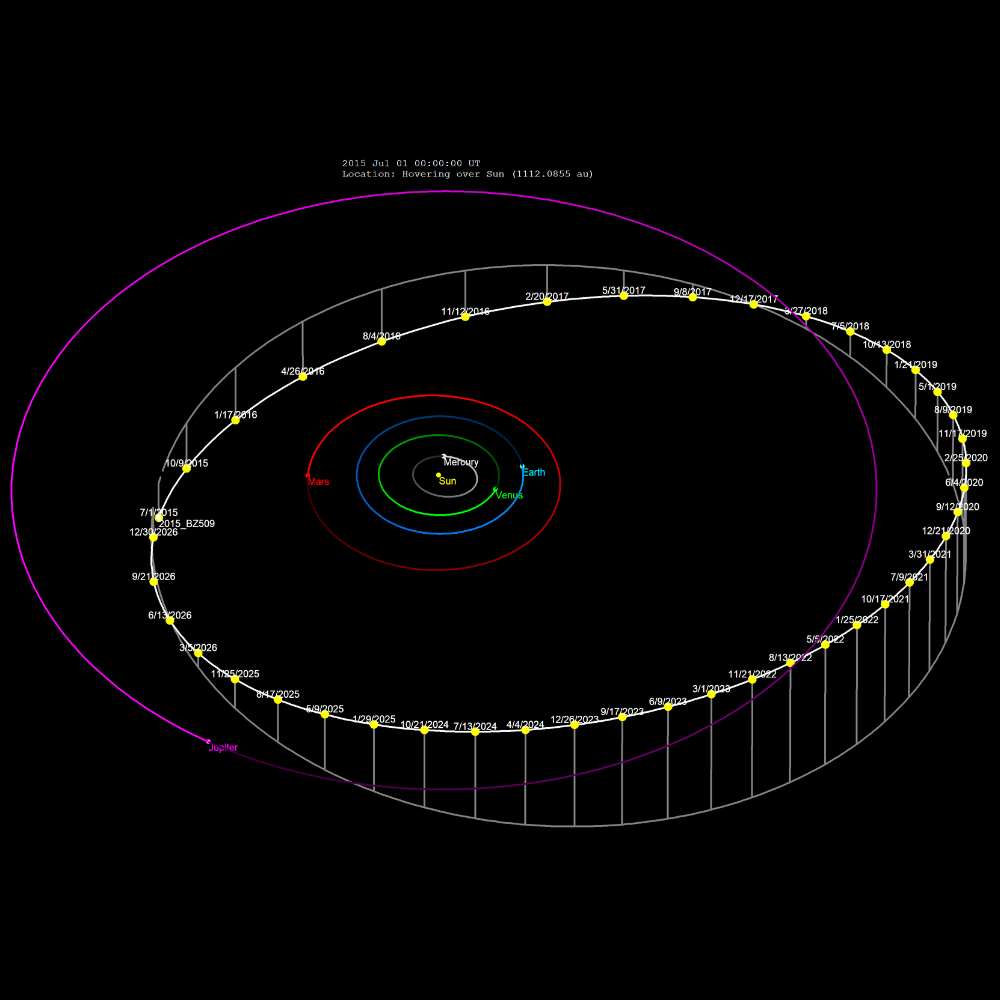
Quick Reader
| Attribute | Details |
|---|---|
| Official Designation | 514107 Kaʻepaokaʻawela |
| Provisional Name | 2015 BZ₅₀₉ |
| Object Type | Retrograde Jupiter Trojan |
| Discovery Year | 2014 (announced 2017) |
| Discoverers | Pan-STARRS survey team |
| Orbital Relationship | Co-orbital with Jupiter |
| Lagrange Region | Near Jupiter’s L4/L5 region |
| Orbital Direction | Retrograde (opposite to planets) |
| Orbital Period | ~11.9 Earth years (similar to Jupiter) |
| Inclination | ~163° |
| Estimated Diameter | ~3–4 km |
| Surface Type | Dark, primitive |
| Orbital Stability | Long-lived (millions to billions of years) |
| Origin Hypothesis | Possibly extrasolar (interstellar) |
Key Points
- Kaʻepaokaʻawela is the first known retrograde Trojan of Jupiter
- It orbits the Sun opposite to all major planets
- Despite its odd motion, it is remarkably stable
- It may be a captured interstellar object
- Its Hawaiian name means “mischievous opposite-moving companion”
Introduction – A Body That Breaks the Rules
Most objects in the Solar System follow a simple rule:
they orbit the Sun in the same direction as the planets.
Kaʻepaokaʻawela does not.
This small, dark object moves backward, on a steeply tilted path, yet somehow remains locked in a stable orbital dance with Jupiter—something that should not happen under classical expectations.
Its discovery forced astronomers to confront a startling possibility:
some Solar System objects may not have formed here at all.
What Makes Kaʻepaokaʻawela So Unusual?
Kaʻepaokaʻawela combines several rare features into one object:
Retrograde orbit
Co-orbital resonance with Jupiter
Long-term dynamical stability
Possible interstellar origin
Individually, these traits are uncommon. Together, they are almost unheard of.
Discovery – Hidden in Plain Sight
Kaʻepaokaʻawela was first detected in 2014 by the Pan-STARRS survey but initially cataloged as an ordinary minor planet.
Only later did detailed orbital analysis reveal:
Its extreme inclination
Its retrograde motion
Its resonance with Jupiter
In 2017, follow-up studies confirmed that this was not a temporary coincidence—it was a stable dynamical configuration.
Understanding Retrograde Orbits
A retrograde orbit means:
The object moves opposite the Sun’s rotation direction
Inclination exceeds 90°
Kaʻepaokaʻawela’s inclination of ~163° places it almost upside-down relative to the planetary plane.
Such orbits are:
Hard to produce in the Solar System
Usually unstable
Often associated with captured objects
This immediately raised questions about its origin.
Co-Orbital with Jupiter – But Backward
Despite its backward motion, Kaʻepaokaʻawela:
Shares Jupiter’s orbital period
Remains near Jupiter’s orbital path
Is protected by a 1:–1 resonance
This resonance prevents close encounters with Jupiter, allowing the object to survive for millions of years or longer.
This type of configuration was once thought impossible.
Stability – Why It Hasn’t Been Ejected
Numerical simulations show that Kaʻepaokaʻawela:
Avoids direct encounters with Jupiter
Oscillates safely within resonance
Is surprisingly resistant to perturbations
Its retrograde motion actually reduces gravitational chaos, making the orbit more stable than expected.
Counterintuitively, moving backward helps it survive.
Size and Physical Nature
Kaʻepaokaʻawela is small, likely only a few kilometers across.
This implies:
Weak gravity
Irregular shape
No atmosphere
Its surface is likely:
Dark and primitive
Rich in carbonaceous material
Similar to dormant comet nuclei
Direct compositional measurements are still lacking.
The Interstellar Hypothesis – Did It Come from Another Star?
One of the most fascinating ideas about Kaʻepaokaʻawela is that it may be extrasolar in origin.
Supporting arguments include:
Retrograde, high-inclination orbit
Difficulty forming such an orbit locally
Long-term stability after capture
Models suggest it could have been:
Captured during the Sun’s birth cluster
Trapped by Jupiter early in Solar System history
If true, Kaʻepaokaʻawela would be a fossil interstellar visitor, far older than ʻOumuamua.
Why Kaʻepaokaʻawela Matters
Kaʻepaokaʻawela matters because it:
Expands the definition of Trojan objects
Challenges classical Solar System formation models
Provides evidence for early interstellar exchange
Shows that stable retrograde resonances are possible
It represents a new dynamical class of small bodies.
Dynamical Simulations – How a Backward Trojan Can Exist
Once Kaʻepaokaʻawela’s unusual orbit was recognized, astronomers ran extensive numerical simulations to test whether such a configuration could survive.
The results were surprising.
What the Models Show
The object occupies a 1:–1 retrograde resonance with Jupiter
It avoids close encounters despite crossing Jupiter’s orbital region
The resonance remains stable for millions to billions of years
Instead of destabilizing the orbit, the retrograde motion actually reduces repeated gravitational kicks, allowing long-term survival.
Why Retrograde Resonances Can Be Stable
In prograde motion, repeated encounters tend to amplify chaos. Retrograde motion changes that interaction.
Key stabilizing factors:
Higher relative velocities during encounters
Shorter interaction times
Less efficient energy transfer
This makes retrograde resonances:
Rarer
Harder to form
But potentially more stable once established
Kaʻepaokaʻawela is the first confirmed example of this effect.
Comparison with Classical Jupiter Trojans
| Feature | Classical Jupiter Trojans | Kaʻepaokaʻawela |
|---|---|---|
| Orbital Direction | Prograde | Retrograde |
| Inclination | Low | Extreme (~163°) |
| Stability | Billions of years | Millions–billions of years |
| Origin | Primordial Solar System | Possibly extrasolar |
| Population | Thousands | One confirmed |
This comparison shows that Kaʻepaokaʻawela is not just an odd Trojan—it is a fundamentally different kind.
Relationship to Centaurs and Comets
Although it shares some traits with Centaurs, Kaʻepaokaʻawela does not fit neatly into that category.
Centaurs usually have unstable, planet-crossing orbits
Kaʻepaokaʻawela’s orbit is protected by resonance
Centaurs often evolve quickly into comets
Kaʻepaokaʻawela appears dynamically long-lived
It may represent a separate population altogether.
The Interstellar Capture Scenario – How It Might Have Happened
The most compelling explanation for Kaʻepaokaʻawela’s orbit involves early Solar System capture.
Proposed Sequence
The Sun formed in a dense stellar cluster
Interstellar objects passed close to the young Solar System
Jupiter’s strong gravity enabled capture
Retrograde resonance locked the object in place
This would have occurred billions of years ago, long before the planets settled into their current configuration.
Why Capture Had to Happen Early
Capturing an interstellar object today is extremely unlikely.
Early conditions were different:
The Sun’s birth cluster was dense
Relative velocities were lower
Planetary orbits were still evolving
These conditions made permanent capture possible—something rarely achievable today.
Kaʻepaokaʻawela may be a survivor from that era.
Why Its Orbit Is So Rare
Kaʻepaokaʻawela’s configuration requires:
Precise timing
Specific encounter geometry
Long-term resonance locking
Most captured objects would:
Be ejected quickly
Fall into the Sun
Become unstable Centaurs
Only a tiny fraction would survive in a configuration like this.
What Kaʻepaokaʻawela Tells Us About the Early Solar System
Its existence implies that:
The Solar System exchanged material with nearby stars
Not all small bodies formed locally
Jupiter played a key role as a gravitational gatekeeper
Kaʻepaokaʻawela is direct evidence that the Solar System was not isolated at birth.
Observational Challenges
Studying Kaʻepaokaʻawela is difficult because:
It is small and faint
No cometary activity enhances visibility
Its orbit keeps it far from Earth
As a result:
Composition is inferred indirectly
Surface properties are poorly constrained
Size estimates remain uncertain
Future large telescopes may improve this picture.
Do Other Uranus Trojans Exist?
Probably—but only briefly.
Dynamical models predict that:
Temporary Uranus Trojans should be continuously captured and lost
At any given time, only a handful may exist
Most are small, faint, and hard to detect
This explains why:
Searches found none for decades
Only one has been confidently confirmed so far
Uranus Trojans are not absent—they are ephemeral.
The Long-Term Fate of Kaʻepaokaʻawela
Unlike most small bodies on unusual orbits, Kaʻepaokaʻawela is not a short-lived visitor.
Long-term integrations indicate that:
Its retrograde 1:–1 resonance with Jupiter is remarkably durable
The object can remain in its current configuration for millions to billions of years
Close encounters with Jupiter are naturally avoided by the resonance geometry
In other words, Kaʻepaokaʻawela is not merely passing through—it is dynamically at home, despite its alien motion.
Could Kaʻepaokaʻawela Ever Escape?
Escape is possible, but unlikely in the near future.
Potential destabilizing factors include:
Large-scale changes in Jupiter’s orbit (very unlikely today)
Strong perturbations from Saturn over extremely long timescales
Rare chaotic resonance overlap events
Absent such disturbances, Kaʻepaokaʻawela’s orbit appears self-protecting, making it one of the most stable retrograde small bodies known.
Is Kaʻepaokaʻawela Truly Interstellar?
The interstellar-origin hypothesis remains unproven but compelling.
Why the Hypothesis Persists
Its orbit is extremely difficult to produce through standard Solar System scattering
Retrograde, high-inclination capture is more consistent with external origin
Stability suggests capture occurred very early, when conditions allowed it
However:
No direct compositional evidence confirms extrasolar chemistry
Similar orbits could, in theory, arise from rare internal processes
For now, Kaʻepaokaʻawela is best described as a strong interstellar candidate, not a confirmed one.
How Kaʻepaokaʻawela Differs from ʻOumuamua and Borisov
| Feature | Kaʻepaokaʻawela | ʻOumuamua | 2I/Borisov |
|---|---|---|---|
| Origin | Possibly extrasolar | Confirmed interstellar | Confirmed interstellar |
| Bound to Sun | Yes | No | No |
| Orbital Stability | Long-term | One-time passage | One-time passage |
| Discovery Type | Trojan resonance | Hyperbolic flyby | Active comet |
Kaʻepaokaʻawela may represent a third category: an interstellar object that became permanently captured.
Why This Object Redefines Solar System Boundaries
Kaʻepaokaʻawela forces a broader view of what the Solar System contains.
It implies that:
The Solar System may harbor ancient extrasolar material
Planetary systems can exchange solid bodies
Jupiter played a central role as a gravitational filter and captor
Rather than being a closed system, the Solar System appears to be porous, especially during its early history.
Frequently Asked Questions (FAQ)
Is Kaʻepaokaʻawela a Trojan asteroid?
Yes—but unlike classical Trojans, it is a retrograde co-orbital companion of Jupiter.
Does it orbit Jupiter directly?
No. It orbits the Sun, sharing Jupiter’s orbital period through resonance.
Is it dangerous to Earth?
No. Its orbit does not cross Earth’s path.
Could there be more objects like this?
Possibly. Detection is difficult, and similar objects may remain undiscovered.
Why is its name Hawaiian?
The name follows Pan-STARRS naming conventions and reflects its unusual, opposite-direction motion.
Kaʻepaokaʻawela in the Context of Planetary Science
Kaʻepaokaʻawela connects multiple fields:
Trojan dynamics
Interstellar object capture
Early Solar System evolution
Resonant orbital mechanics
It shows that exotic orbits are not always unstable—sometimes they are the most enduring.
Kaʻepaokaʻawela in the Context of Planetary Science
Kaʻepaokaʻawela connects multiple fields:
Trojan dynamics
Interstellar object capture
Early Solar System evolution
Resonant orbital mechanics
It shows that exotic orbits are not always unstable—sometimes they are the most enduring.
Final Perspective
Kaʻepaokaʻawela is a quiet object on a loud orbit.
Moving backward through the Solar System, locked in step with Jupiter, it defies the assumptions that once defined planetary order. Whether it formed here or arrived from another star, its existence proves that stability does not always mean conformity.
Kaʻepaokaʻawela reminds us that the Solar System is not just a family of planets—but a historical crossroads, where material from distant stars may still circle the Sun today.