







Dione
Saturn’s Icy Moon with a Hidden Past
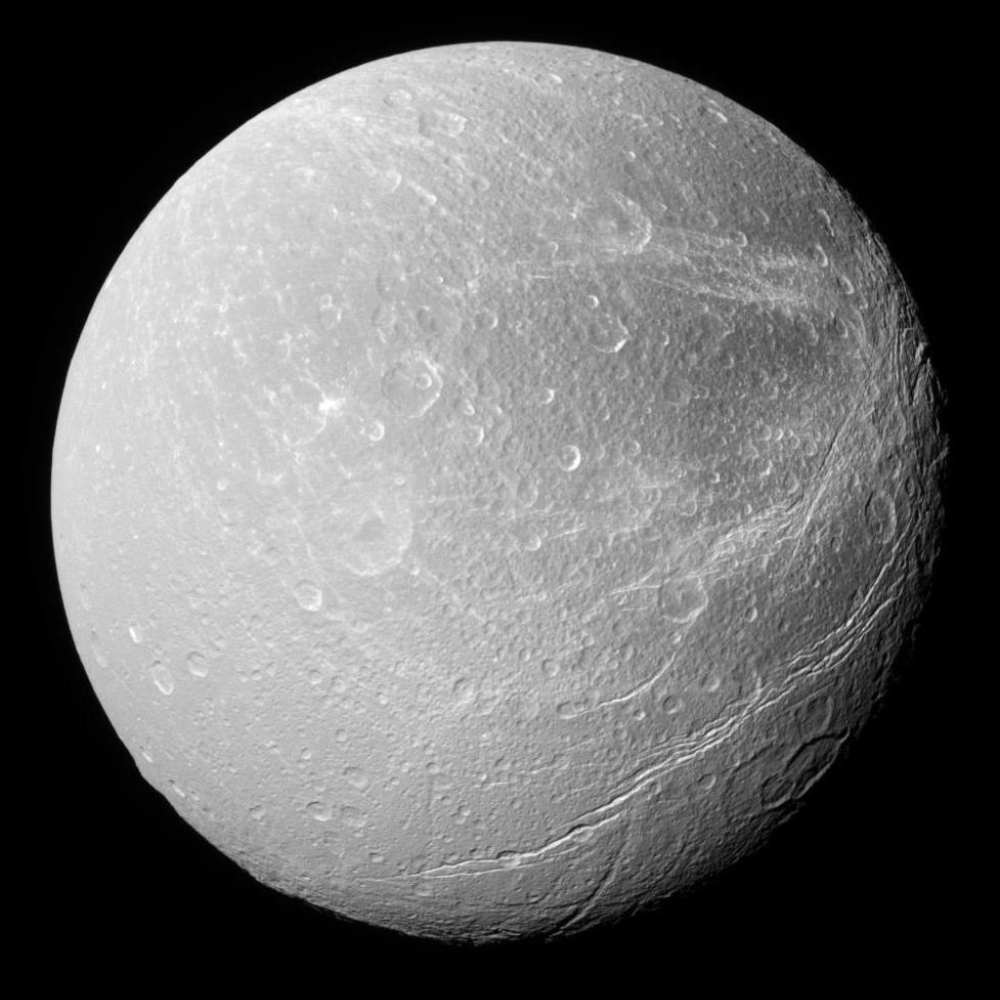
Quick Reader
| Attribute | Details |
|---|---|
| Name | Dione |
| Parent Planet | Saturn |
| Type | Natural satellite |
| Discovery Date | 21 March 1684 |
| Discoverer | Giovanni Domenico Cassini |
| Diameter | ~1,123 km |
| Rank | 4th largest moon of Saturn |
| Mean Density | ~1.48 g/cm³ |
| Orbital Distance | ~377,400 km |
| Orbital Period | ~2.7 Earth days |
| Rotation | Tidally locked |
| Surface Composition | Water ice, rock, dark material |
| Albedo | Relatively bright |
| Geological Activity | Ancient (no current activity) |
| Subsurface Ocean | Possible (past or present) |
| Major Mission Data | Cassini spacecraft |
Introduction to Dione – A Moon That Looks Quiet but Was Not
At first glance, Dione appears to be a calm, heavily cratered icy moon. But beneath this quiet surface lies evidence of a more active and dynamic past. Subtle tectonic features, internal differentiation, and gravity data suggest that Dione may once have been far more geologically alive than it is today.
Dione represents a middle ground between inert moons like Rhea and active worlds like Enceladus.
Discovery and Naming
Dione was discovered in 1684 by Giovanni Domenico Cassini, who also discovered several of Saturn’s major moons.
The name Dione comes from Greek mythology:
A Titaness
Associated with fertility and life
This name is fitting for a moon that may once have hosted internal liquid layers.
Orbital Characteristics and Tidal Locking
Dione orbits Saturn in a nearly circular orbit and is tidally locked, always showing the same face to its planet.
Key orbital traits:
Short orbital period (~2.7 days)
Stable resonance environment
Weak but persistent tidal forces
These tidal interactions may have contributed to early internal heating, even if they are weak today.
Size and Internal Structure
Dione is large enough to be internally differentiated.
Its density suggests:
A rocky core
An icy mantle
Possible liquid layer between them
This structure places Dione in the same internal class as moons capable of hosting subsurface oceans, at least in the past.
Surface Composition – Ice Dominates, but Not Alone
Dione’s surface is composed mainly of water ice, giving it a relatively high albedo. However, darker material is also present, likely delivered by:
Micrometeorite impacts
Dust from outer Saturnian moons
This combination produces a surface that is bright but textured, not pristine.
The Leading and Trailing Hemispheres
Dione shows a strong hemispherical contrast.
Leading hemisphere: brighter, more heavily cratered
Trailing hemisphere: darker, smoother in places
This contrast is shaped by:
Magnetospheric particle bombardment
Dust accumulation
Orbital motion through Saturn’s environment
Tectonic Features – Fossils of Internal Stress
One of Dione’s most important discoveries was its network of:
Bright ice cliffs
Linear fractures
Ancient fault scarps
These features indicate tectonic stretching early in Dione’s history, likely caused by internal expansion or orbital evolution.
Dione vs Rhea – First Contextual Comparison
Even though Dione and Rhea are similar in size, their histories differ.
| Feature | Dione | Rhea |
|---|---|---|
| Bright Ice Features | Present | Rare |
| Tectonic Fractures | Yes | Minimal |
| Internal Differentiation | Likely | Uncertain |
| Geological Complexity | Moderate | Low |
Dione shows more internal processing than Rhea, despite similar environments.
Why Dione Matters in Planetary Science
Dione is important because it:
Preserves evidence of early internal heating
Bridges active and inactive icy moons
Helps model ocean loss in medium-sized moons
Provides context for Enceladus’s activity
Dione answers a key question:
What happens after an icy moon cools down?
Why Dione Matters (Big-Picture Context)
Dione shows that geological activity does not need to last forever to matter. Even brief episodes of internal heating can permanently reshape a moon. By studying Dione, scientists learn how icy worlds transition from active interiors to frozen, stable shells.
Evidence for a Subsurface Ocean – What Cassini Revealed
For many years, Dione was considered geologically inactive. That view changed after Cassini gravity and magnetic field measurements suggested that Dione may still contain a deep internal liquid layer.
Key evidence includes:
Subtle variations in Dione’s gravity field
Measured tidal deformation larger than expected for a fully solid body
Induced magnetic signatures consistent with a conductive layer
These observations point to a possible subsurface ocean, buried beneath tens of kilometers of ice.
How Could Dione Maintain Liquid Water?
Dione does not have dramatic tidal heating like Enceladus, but it may retain liquid water due to a combination of factors:
Residual heat from early formation
Long-term radioactive decay in the rocky core
Past orbital resonances with other moons
Possible antifreeze compounds such as ammonia
This suggests Dione’s ocean—if present—is ancient and stable, not violently active.
Dione vs Enceladus vs Tethys – Comparative Evolution
This comparison shows how small differences in size and heating lead to very different outcomes.
| Feature | Dione | Enceladus | Tethys |
|---|---|---|---|
| Diameter | ~1,123 km | ~504 km | ~1,062 km |
| Current Activity | None observed | Active geysers | None |
| Subsurface Ocean | Possible | Confirmed | Unlikely |
| Tidal Heating | Weak | Strong | Very weak |
| Surface Age | Mixed | Young (south pole) | Very old |
Interpretation:
Dione may represent a quiet ocean world, while Enceladus is an eruptive one and Tethys a frozen relic.
The Bright Ice Cliffs – Ancient “Wispy Terrain”
Dione’s most distinctive features are its bright, linear markings, once called wispy terrain.
Modern understanding shows these are:
Ice cliffs and fault scarps
Formed by tectonic extension
Likely produced during early internal expansion
These features are not young—but they permanently record Dione’s active past.
Internal Differentiation – A Layered Moon
Dione’s density strongly suggests internal differentiation.
Likely internal structure:
Rocky core
High-pressure ice layers
Possible liquid water ocean
Rigid icy crust
This layered structure explains both the gravity data and the tectonic surface features.
Why Dione Is Not Active Today
Despite possible liquid water at depth, Dione shows no surface activity.
Reasons include:
Thick ice shell preventing fractures from reaching the surface
Weak present-day tidal stress
Loss of orbital resonances that once generated heat
Dione appears to have crossed the threshold from active to dormant.
Dione’s Interaction with Saturn’s Environment
Dione’s trailing hemisphere is affected by:
Charged particle bombardment
Deposition of dark material from outer moons
These processes slowly alter surface chemistry but do not drive geology.
Dione vs Rhea Revisited – Why One Is More Complex
Although similar in size, Dione shows greater complexity than Rhea because:
Dione likely differentiated earlier
Dione experienced stronger early heating
Rhea cooled faster and remained inert
This contrast highlights how small early differences create lasting divergence.
Why Dione Is a Key Target for Ocean World Studies
Dione is important because it:
Expands the category of potential ocean worlds
Shows that oceans can exist without surface geysers
Helps define the lower-energy end of ocean moon physics
Dione suggests that many icy moons may hide oceans without obvious surface clues.
Why Dione Matters (Big-Picture Context)
Dione demonstrates that habitability indicators are not always visible. An icy moon can look ancient and inactive while still hiding liquid water below. By studying Dione, scientists learn to recognize subtle signals of internal oceans—both in our Solar System and around other stars.
The Long-Term Future of Dione
Dione’s future is defined by gradual cooling and long-term stability. Even if a subsurface ocean still exists today, it is likely slowly freezing as internal heat continues to dissipate.
Over very long timescales:
Any remaining liquid layer will thicken into solid ice
Surface geology will remain largely unchanged
Impact cratering will continue at a very slow rate
Dione is transitioning from a once-active icy world into a fully fossilized moon.
Will Dione Ever Become Active Again?
There is no known mechanism that could restart large-scale geological activity on Dione.
Key constraints:
Weak present-day tidal heating
Loss of orbital resonances that once provided energy
Thick ice shell isolating the interior
Unlike Enceladus, Dione lacks a pathway for interior heat to reach the surface. Its active phase appears to be permanently over.
Dione vs Other Dormant Ocean Candidates
Dione belongs to a subtle class of moons that may host—or once hosted—internal oceans without dramatic surface expressions.
| Feature | Dione | Rhea | Callisto |
|---|---|---|---|
| Evidence for Past Ocean | Possible | Weak | Strong (past) |
| Current Activity | None | None | None |
| Surface Age | Mixed | Very old | Very old |
| Ice Shell Thickness | Thick | Very thick | Very thick |
| Ocean Visibility | Indirect | Unlikely | Ancient |
Interpretation:
Dione represents a quiet ocean-world candidate, where internal water may persist without surface renewal.
Why Dione Is Important for Future Saturn Missions
Future missions to the Saturn system will not focus only on Enceladus.
Dione is valuable because it can:
Help determine how long subsurface oceans survive
Reveal how ice shells shut down geological activity
Provide context for Enceladus’s extreme behavior
Studying Dione allows scientists to understand ocean loss, not just ocean creation.
Frequently Asked Questions (FAQ)
What is Dione?
Dione is the fourth-largest moon of Saturn and a mid-sized icy satellite with evidence of past geological activity.
Does Dione have a subsurface ocean?
Possibly. Cassini data suggests a deep internal liquid layer, but it is likely thickly buried and inactive.
Is Dione geologically active today?
No. There is no evidence of current surface activity.
How is Dione different from Enceladus?
Enceladus has strong tidal heating and active geysers, while Dione shows only ancient tectonic features.
Why does Dione have bright ice cliffs?
These features formed during early tectonic stretching, likely caused by internal expansion as Dione cooled.
Has Dione been fully explored?
No. Cassini provided detailed data, but many aspects of Dione’s interior remain uncertain.
Dione’s Place in the Universe Map
Within the Universe Map framework, Dione represents:
A transitional icy moon between active and inert worlds
Evidence that oceans can exist without surface eruptions
A record of early internal heating in the Saturn system
A key comparison point for Enceladus and Rhea
Dione defines the low-energy end of ocean-world evolution.
Final Thoughts
Dione teaches an important lesson: activity does not need to be dramatic to matter. Even brief episodes of internal heating can leave permanent marks, shaping a moon’s structure long after visible activity ends.
Quiet today and ancient in appearance, Dione remains one of Saturn’s most valuable moons—not for what it does now, but for what it remembers.