








Callisto
The Ancient, Undisturbed Moon of Jupiter
Quick Reader
| Attribute | Details |
|---|---|
| Object Name | Callisto |
| Parent Planet | Jupiter |
| Object Type | Icy moon (Galilean satellite) |
| Discovery | 1610 |
| Discoverer | Galileo Galilei |
| Mean Radius | ~2,410 km |
| Diameter | ~4,821 km (almost Mercury-sized) |
| Orbital Distance | ~1.88 million km from Jupiter |
| Orbital Period | ~16.7 Earth days |
| Rotation | Tidally locked |
| Surface Age | ~4 billion years |
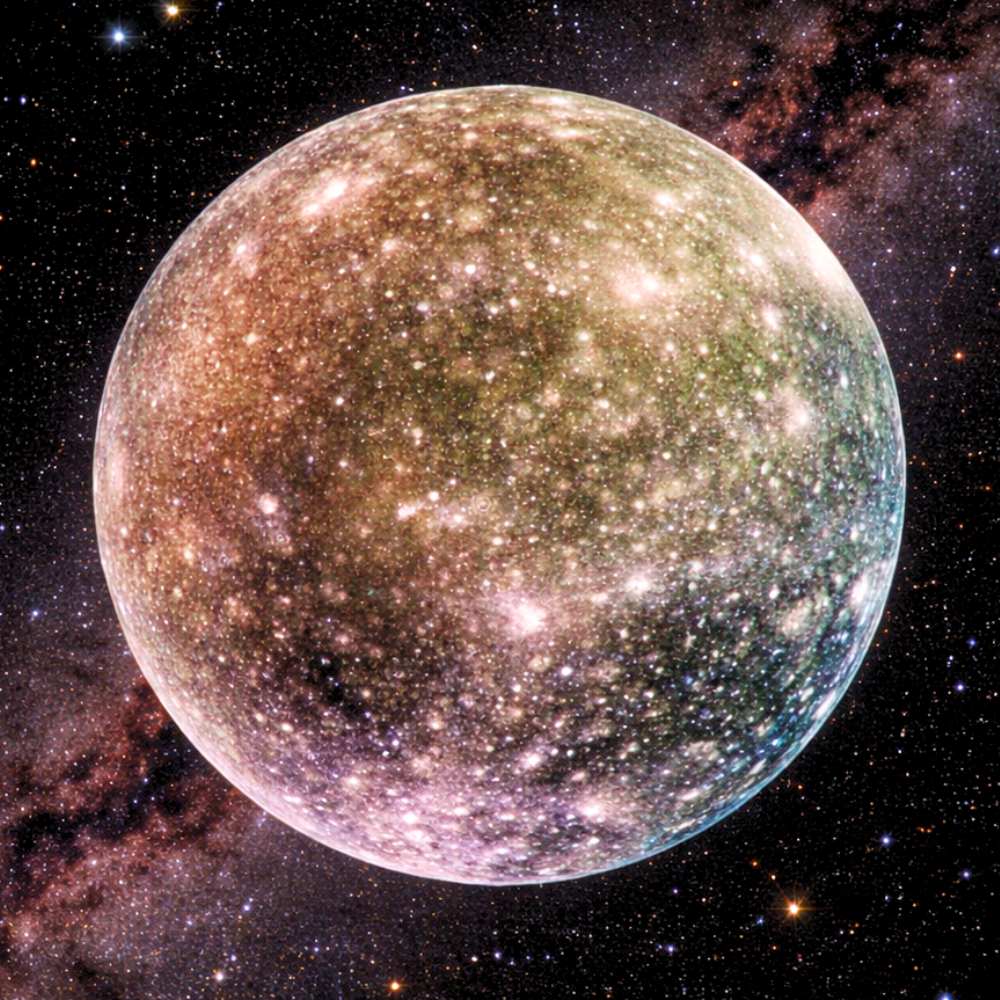
| Surface Feature | Most heavily cratered object in Solar System |
| Internal Structure | Differentiated (partial) |
| Subsurface Ocean | Possible (deep, saline) |
| Magnetic Field | Induced (from ocean) |
| Radiation Exposure | Low (outside main radiation belts) |
| Geological Activity | None observed |
Key Points
- Callisto is the oldest and least altered large moon in the Solar System
- It preserves a fossil record of early Solar System impacts
- Unlike Europa or Ganymede, it shows no active geology
- It may still hide a deep subsurface ocean, despite its inactive surface
- Considered one of the safest moons for future human missions
Introduction – A Moon Frozen in Time
Among Jupiter’s four great moons, Callisto stands apart.
While Io burns with volcanoes, Europa cracks with ice, and Ganymede reshapes itself internally, Callisto remains almost unchanged—a battered world that has quietly orbited Jupiter for more than four billion years.
Its surface tells a story no other large moon can tell:
what the early Solar System looked like before geological recycling erased the evidence.
Callisto is not dramatic.
It is not active.
But scientifically, it is priceless.
What Is Callisto?
Callisto is the outermost of the Galilean moons, discovered by Galileo Galilei in 1610.
It is nearly the size of Mercury, yet fundamentally different in nature.
Callisto is composed primarily of:
Water ice
Rocky material
Carbon-rich compounds
Unlike many large moons, it never fully melted or reorganized itself.
As a result, its interior and surface preserve ancient conditions.
A Surface That Never Healed
Callisto’s most defining feature is its surface.
It is:
The most heavily cratered large body in the Solar System
Covered in overlapping impact scars
Largely unchanged since the Late Heavy Bombardment
Major surface characteristics include:
Multi-ring impact basins
Vast crater fields with no resurfacing
Dark, dusty ice mixed with rock
Unlike Europa or Ganymede:
No tectonic cracks
No resurfaced plains
No volcanic or cryovolcanic features
Once a crater formed on Callisto, it stayed.
Why Callisto Has No Geological Activity
Callisto’s inactivity is not accidental—it is structural.
Key reasons:
It orbits far from Jupiter
Experiences minimal tidal heating
Lacks strong internal energy sources
Without tidal flexing:
Ice does not melt and resurface
Internal convection is weak
Geological renewal never begins
This makes Callisto a geological dead world, but a historical archive.
Internal Structure – Surprisingly Complex
For a long time, scientists believed Callisto was completely undifferentiated.
New data suggests otherwise.
Evidence indicates:
A partially differentiated interior
A rocky core mixed with ice
A thick ice shell above a deeper layer
Most intriguingly, measurements from the Galileo spacecraft revealed:
An induced magnetic field
Best explained by a salty subsurface ocean
This ocean, if confirmed, would lie:
Hundreds of kilometers beneath the surface
Locked between high-pressure ice layers
Unlike Europa’s ocean, Callisto’s would be deep, isolated, and cold.
Does Callisto Have an Ocean?
Current evidence suggests:
A subsurface ocean is possible but unconfirmed
Salts increase electrical conductivity
The induced magnetic field matches ocean models
However:
The ice shell is very thick
No surface features connect to the ocean
No energy source drives interaction
Callisto may host one of the most inaccessible oceans in the Solar System.
Callisto vs Other Galilean Moons (Early Comparison)
| Feature | Io | Europa | Ganymede | Callisto |
|---|---|---|---|---|
| Geological Activity | Extreme | Active | Moderate | None |
| Tidal Heating | Very strong | Strong | Moderate | Weak |
| Surface Age | Young | Young | Mixed | Ancient |
| Subsurface Ocean | No | Confirmed | Confirmed | Possible |
| Radiation Level | Extreme | High | Moderate | Low |
Callisto is the outlier—quiet, distant, and preserved.
Why Callisto Matters Scientifically
Callisto matters because it:
Preserves the impact history of the outer Solar System
Acts as a control sample for moon evolution
Helps scientists understand why some worlds evolve and others don’t
Provides clues about early Jupiter-system formation
It shows that size alone does not determine activity—environment does.
Formation and Origin – Why Callisto Is Different
Callisto formed alongside Jupiter’s other large moons, yet its evolutionary path diverged early.
All four Galilean moons likely originated from a circumplanetary disk of gas, ice, and rock surrounding Jupiter during its formation. However, Callisto formed in a region where conditions were fundamentally different.
Key formation factors:
Greater distance from Jupiter
Lower temperatures in the disk
Slower accumulation of material
Because of this slow growth:
Heat from impacts dissipated instead of building up
Radioactive heating remained weak
Global melting never occurred
Callisto never experienced the internal reset that reshaped Ganymede or Europa.
Why Callisto Never Fully Differentiated
Differentiation requires heat—enough to separate rock from ice and create layers.
Callisto lacked that heat.
Critical differences from Ganymede:
Less tidal heating
Slower accretion rate
Lower internal pressure
As a result:
Rock and ice remained partially mixed
Convection never became efficient
Internal evolution stalled early
Callisto represents a failed differentiation pathway—a large moon that stayed primitive.
Impact History – A Record of Solar System Violence
Callisto’s surface is a time capsule.
Its craters record:
The Late Heavy Bombardment
Billions of years of outer Solar System impacts
Collision rates of early planetesimals
Major basins such as Valhalla and Asgard reveal:
Multi-ring impact structures
Shock waves traveling through icy crust
Crater relaxation over geologic time
Unlike other moons, these scars were never erased.
Callisto allows scientists to reconstruct early Solar System impact dynamics with unmatched clarity.
Callisto’s Unique Place in Jupiter’s System
Callisto occupies a quiet orbital zone.
Its distance from Jupiter means:
Minimal tidal stress
Reduced gravitational flexing
Lower radiation exposure
This positioning has major consequences:
Surface chemistry remains stable
Ice is not constantly reworked
Radiation-driven alteration is limited
Among Jupiter’s moons, Callisto is the most environmentally stable.
Radiation Environment – A Surprisingly Safe World
Jupiter’s radiation belts are lethal to most spacecraft.
Callisto lies largely outside the most intense zones.
This results in:
Lower particle bombardment
Reduced surface sputtering
Longer survival times for equipment
Because of this, Callisto is often cited as:
The best candidate for future human missions in the Jupiter system
A potential staging ground for exploration of Europa and Ganymede
Safety, not activity, makes Callisto strategically important.
Is Callisto Habitable?
Habitability depends on three ingredients:
Liquid water
Energy
Chemical interaction
Callisto may possess water—but the other two are questionable.
Challenges include:
Extremely thick ice shell
Weak internal heat
Limited contact between ocean and surface
If life exists, it would be:
Deep
Isolated
Chemically limited
Callisto represents a low-energy ocean world, very different from Europa’s dynamic environment.
Callisto vs Ganymede – Same Size, Different Fate
Despite similar size, Callisto and Ganymede evolved in opposite directions.
| Feature | Ganymede | Callisto |
|---|---|---|
| Differentiation | Full | Partial |
| Magnetic Field | Intrinsic | Induced |
| Surface Renewal | Moderate | None |
| Internal Heat | Significant | Weak |
| Geological Evolution | Active | Frozen |
This contrast shows how location and timing can outweigh size in planetary evolution.
The Long-Term Future of Callisto
Callisto’s future looks very much like its past.
Because it experiences:
Minimal tidal heating
Weak internal energy sources
Stable orbital conditions
its surface and interior are expected to remain largely unchanged for billions of years.
Unlike Europa or Io, Callisto will not undergo cycles of resurfacing or internal renewal.
It will continue to accumulate impact scars, slowly darkening as space weathering progresses.
Callisto is not evolving—it is enduring.
Could Callisto Ever Become Active?
Under current conditions, geological revival is extremely unlikely.
For activity to resume, Callisto would require:
A dramatic change in Jupiter’s orbital configuration
Strong tidal interactions that do not exist today
Significant internal heat generation
None of these scenarios are plausible on Solar System timescales.
Callisto’s frozen state is effectively permanent.
Callisto and Human Exploration
Among all of Jupiter’s moons, Callisto is often considered the most practical target for human exploration.
Key advantages:
Low radiation environment
Stable surface conditions
Long orbital periods allowing predictable operations
Potential roles include:
A crewed orbital station
A surface science outpost
A staging ground for robotic missions to Europa
While not scientifically dramatic, Callisto offers operational safety unmatched in the Jovian system.
Scientific Value in a Quiet World
Callisto’s greatest value lies in what it has not done.
It has not:
Melted globally
Recycled its crust
Erased its early history
This makes it:
A benchmark for early Solar System conditions
A control sample for icy moon evolution
A record of impact processes in the outer Solar System
Without Callisto, models of moon formation would lack a crucial reference point.
Callisto in the Context of Ocean Worlds
Callisto challenges assumptions about habitability.
It demonstrates that:
Liquid water alone is not enough
Energy availability is critical
Geological isolation limits chemical cycling
If Callisto has an ocean, it is likely:
Deep
Stable
Chemically quiet
This contrasts sharply with Europa, where surface–ocean interaction drives astrobiological interest.
Callisto defines the low-activity end of ocean world possibilities.
Frequently Asked Questions (FAQ)
Is Callisto a dead moon?
Geologically, yes. Internally, it may still be complex.
Does Callisto have an ocean?
Possibly. Evidence suggests a deep, salty subsurface ocean, but confirmation is still pending.
Why is Callisto so heavily cratered?
Because it never resurfaced. Once impacts occurred, nothing erased them.
Is Callisto safer than Europa?
Yes. Radiation levels are significantly lower, making it safer for spacecraft and humans.
Could life exist on Callisto?
Highly unlikely, but not impossible. Any life would be deep, isolated, and energy-limited.
Callisto’s Role in Universe Map
Callisto connects several major themes:
Moon formation pathways
Tidal heating vs orbital distance
Ocean worlds and habitability limits
Impact history of the Solar System
Related topics for Universe Map readers:
Europa
Ganymede
Io
Jupiter’s magnetosphere
Ocean worlds
Together, these objects show how a single planet can host radically different moons.
Final Perspective
Callisto is a world that refused to change.
While other moons burned, cracked, and reshaped themselves, Callisto remained cold, distant, and untouched—quietly preserving a record of the Solar System’s violent youth.
It reminds us that evolution is not guaranteed.
In planetary systems, as in nature, some worlds advance, some transform, and some simply endure.
Callisto’s value lies not in what it became—but in what it never lost.