









Io
The Most Volcanically Active World in the Solar System
Quick Reader
| Attribute | Details |
|---|---|
| Object Type | Rocky moon of Jupiter |
| Discovery | 1610 |
| Discoverer | Galileo Galilei |
| Mean Radius | ~1,821 km |
| Diameter | ~3,643 km |
| Orbital Distance | ~421,700 km from Jupiter |
| Orbital Period | ~1.77 Earth days |
| Rotation | Synchronous (tidally locked) |
| Density | ~3.53 g/cm³ |
| Composition | Silicate rock, iron/iron sulfide core |
| Surface Ice | Sulfur and sulfur dioxide frost (not water ice) |
| Atmosphere | Extremely thin (SO₂-dominated, volcanic) |
| Surface Age | Very young (constantly resurfaced) |
| Heat Source | Extreme tidal heating from Jupiter |
| Notable Features | Lava lakes, plumes, paterae, sulfur plains |
| Volcanic Activity | Most intense known in the Solar System |
| Magnetic Interaction | Strong coupling with Jupiter’s magnetosphere |
Key Highlights (Why Io Is Unique)
- The most volcanically active body ever observed
- Surface is continuously reshaped by eruptions
- Heat output exceeds Earth’s internal heat by several times
- No water ice despite being in the outer Solar System
- Acts as a plasma source for Jupiter’s magnetosphere
- Demonstrates tidal heating at its extreme limit
Introduction – A World That Should Not Be This Hot
Io should be frozen.
Orbiting far from the Sun, among Jupiter’s icy moons, it exists in a region where water ice dominates planetary surfaces. Yet Io is the opposite:
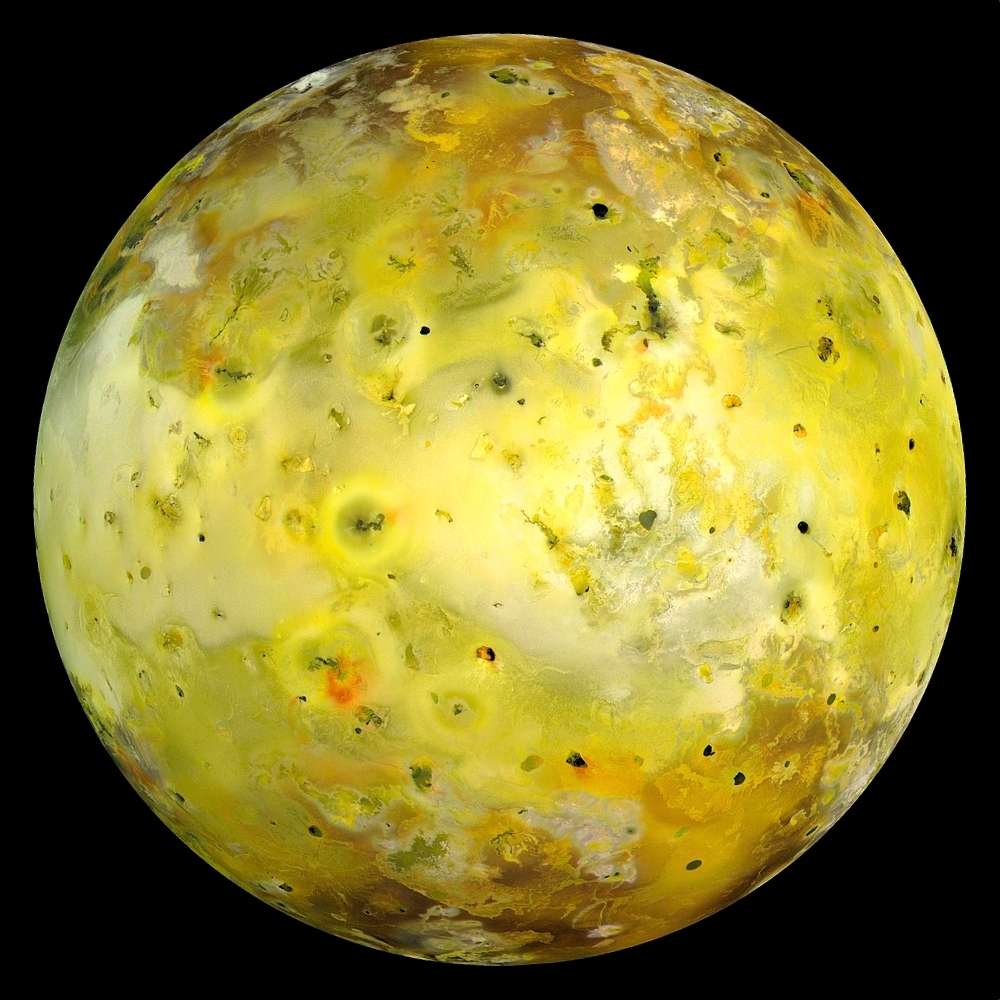
a blazing, sulfur-stained world covered in lava flows and explosive volcanoes.
Its surface is so active that impact craters rarely survive. Entire landscapes are erased and rebuilt on timescales of years to decades. Io is not merely geologically active—it is geologically overwhelmed.
To understand Io is to understand the raw power of gravity itself.
A Rocky Moon in an Icy Neighborhood
Unlike Europa, Ganymede, and Callisto, Io is almost entirely rocky.
This difference is crucial.
High density confirms a silicate-rich interior
A metallic core enables electrical conductivity
Lack of water ice prevents heat buffering
As a result, Io responds violently to tidal stress rather than absorbing it.
Io behaves more like a small terrestrial planet than an icy moon.
Tidal Heating – Gravity as a Furnace
Io’s extreme activity is not driven by radioactive decay.
It is driven by tidal heating.
Io is locked in a powerful orbital resonance with Europa and Ganymede, which:
Maintains orbital eccentricity
Prevents Io’s orbit from circularizing
Forces continuous flexing of its interior
As Io moves closer to and farther from Jupiter:
Its shape is distorted by up to 100 meters
Internal friction generates enormous heat
Rock melts deep beneath the surface
This process turns gravity into energy.
Volcanoes Beyond Earth’s Limits
Io hosts hundreds of active volcanic centers.
Key volcanic characteristics:
Lava temperatures exceeding 1,600 K
Lava flows hundreds of kilometers long
Eruption plumes rising over 400 km high
Persistent lava lakes that refill repeatedly
Some eruptions are:
More energetic than any eruption on Earth
Long-lived, lasting years or decades
Capable of altering hemispheric-scale terrain
Io is not just active—it is hyperactive.
A Surface That Cannot Remember
Most planetary surfaces preserve history.
Io does not.
Because of constant resurfacing:
Impact craters are rare
Surface ages are among the youngest in the Solar System
Geological features are temporary
Io’s surface is a perpetual present, constantly rewritten by fire.
Atmosphere – Born from Fire
Io’s atmosphere is:
Extremely thin
Composed mainly of sulfur dioxide
Continuously replenished by volcanic eruptions
It collapses and reforms depending on:
Sunlight
Volcanic output
Orbital position
This atmosphere is not stable—it is event-driven.
Io and Jupiter – A Violent Relationship
Io’s influence extends beyond itself.
Volcanic material from Io:
Escapes into space
Forms a plasma torus around Jupiter
Feeds Jupiter’s powerful auroras
Io is both shaped by Jupiter—and actively shapes Jupiter’s space environment in return.
Why Io Matters
Io represents the extreme end of planetary energy transfer.
It shows:
How tidal heating can dominate planetary evolution
Why orbital dynamics matter as much as composition
That habitability is not just about distance from a star
Io is a warning and a lesson:
too much energy can be as destructive as too little.
Inside Io – A Moon Built for Violence
Io’s surface chaos begins deep inside.
Evidence from gravity measurements, magnetic interactions, and heat flow indicates that Io is fully differentiated, much like a small terrestrial planet.
Internal structure:
Metallic iron or iron-sulfide core
Thick silicate mantle
Partially molten asthenosphere
Thin, constantly recycled crust
This structure allows:
Efficient heat generation
Rapid magma transport
Continuous volcanic resurfacing
Io is essentially a planetary-scale magma engine.
A Magma Ocean Beneath the Surface
Multiple spacecraft observations suggest that Io may host a global magma layer.
Supporting evidence:
Strong induced magnetic field
Consistent heat flow patterns
Electrical conductivity signatures
This molten layer likely:
Sits beneath the lithosphere
Allows magma to migrate laterally
Feeds volcanoes across the globe
Unlike Earth’s mantle, Io’s magma system is always active, never dormant.
Why Io Has No Water
Io’s lack of water is one of its defining features.
Possible explanations:
Early heating drove off volatile compounds
Jupiter’s radiation stripped lighter molecules
Volcanic degassing favored sulfur over water
Any early ice was lost during intense tidal heating
Without water:
No ice shell formed
No subsurface ocean exists
Lava behaves differently than on Earth
Io is a dry world powered by fire, not fluid water.
Volcanism Compared to Earth
Io’s volcanism exceeds terrestrial limits.
Key differences:
Higher eruption temperatures
Lower viscosity magma
Longer lava flows
Less atmospheric resistance
On Earth, volcanism is episodic.
On Io, it is continuous and global.
Io demonstrates volcanism driven not by internal heat alone, but by orbital mechanics.
Europa vs Io – A Study in Extremes
Europa and Io share a resonance—but not a fate.
Key contrasts:
Europa channels tidal energy into melting ice
Io channels tidal energy into melting rock
Europa may host life-supporting oceans
Io is too hostile for stability
This contrast shows how composition determines outcome when energy is applied.
Surface Chemistry – A Sulfur World
Io’s surface is coated with:
Sulfur allotropes
Sulfur dioxide frost
Volcanic ash and silicates
These materials:
Create vivid red, yellow, and black regions
Change color with temperature
Sublimate and redeposit rapidly
Io’s appearance is a chemical map of ongoing activity.
How Io Challenges Moon Formation Models
Io should not exist in its current state for billions of years—yet it does.
Challenges include:
Maintaining extreme heat over long timescales
Preventing orbital circularization
Explaining long-term resonance stability
Io forces scientists to refine:
Tidal dissipation models
Moon–planet coupling theories
Energy balance calculations
It is a stress test for planetary physics.
The Long-Term Fate of Io – Can This Inferno Last Forever?
Io’s extreme activity feels eternal—but it is not.
Numerical models suggest that Io’s volcanic intensity is sustained by a delicate balance between:
Orbital resonance with Europa and Ganymede
Continuous tidal deformation by Jupiter
Internal dissipation of mechanical energy
As long as this resonance persists, Io will remain volcanically alive.
However, over very long timescales:
Orbital configurations may slowly evolve
Tidal heating efficiency may change
Volcanic output could fluctuate
Io’s future is not extinction—but modulation.
Will Io Ever Cool Down?
Complete cooling is unlikely in the near future.
Reasons include:
Strong gravitational forcing from Jupiter
Stable multi-moon resonance
Continuous energy input far exceeding radiogenic heat
Unlike Earth, Io does not rely on internal heat reserves.
Its energy source is external and renewable.
Only a major disruption—such as resonance breakdown—would significantly reduce activity.
Could Io Ever Be Habitable?
No.
Despite its internal energy, Io fails every requirement for habitability:
No stable liquid water
No protective atmosphere
Extreme radiation exposure
Constant surface destruction
Io demonstrates that energy alone does not create life.
Balance matters.
Frequently Asked Questions (FAQ)
Is Io the most active volcanic body known?
Yes. Its heat output and eruption frequency exceed all other known planetary bodies.
Does Io have plate tectonics like Earth?
No. Io’s surface is recycled by volcanism, not moving plates.
Why doesn’t Io have an ocean like Europa?
Because its composition is rocky and its heat melts rock instead of ice.
Can humans ever land on Io?
Extremely unlikely due to radiation, instability, and continuous eruptions.
Does Io affect Jupiter itself?
Yes. Io supplies charged particles that power Jupiter’s auroras.
Io in the Context of Planetary Science
Io connects multiple disciplines:
Orbital mechanics
Volcanology
Magnetospheric physics
Comparative planetology
It proves that gravity can be a dominant geological force, rivaling radioactive decay.
Final Perspective
Io is not chaotic by accident.
It is a world shaped by relentless gravitational precision, locked in an orbital dance that transforms motion into fire. Where Earth releases heat slowly, Io releases it violently.
Io reminds us that planetary environments are not defined by distance from the Sun alone—but by the invisible forces that bind worlds together.