



Jupiter
The Giant That Shaped the Solar System
Quick Reader
| Attribute | Details |
|---|---|
| Object Name | Jupiter |
| Object Type | Gas giant planet |
| Position from Sun | 5th planet |
| Mean Radius | ~69,911 km |
| Diameter | ~139,820 km |
| Mass | ~318 Earth masses |
| Composition | Hydrogen, helium (with heavy elements) |
| Core | Likely dense core (rock + metal + ices) |
| Rotation Period | ~9.9 hours |
| Orbital Period | ~11.86 Earth years |
| Moons | 95+ confirmed (as of current counts) |
| Ring System | Faint, dusty rings |
| Magnetic Field | Strongest of any planet |
| Gravity Influence | Dominant in outer Solar System |
| Role | Planetary architect and protector |
Key Highlights
- Jupiter is the largest and most massive planet in the Solar System
- It shaped the formation and fate of planets, asteroids, and comets
- Its gravity acts as both shield and disruptor
- Jupiter is a failed star, but a successful system builder
- Without Jupiter, the Solar System would look radically different
Introduction – The Planet That Defines the System
Jupiter is not just another planet.
It is the structural anchor of the Solar System.
Containing more mass than all other planets combined, Jupiter’s gravity has sculpted orbital paths, redirected comets, stabilized regions of space, and prevented planets from forming where they otherwise might have.
To understand the Solar System, one must first understand Jupiter.
What Is Jupiter?
Jupiter is a gas giant, composed primarily of hydrogen and helium—the same materials that make up the Sun.
However, unlike the Sun:
Jupiter lacks sufficient mass to ignite nuclear fusion
It radiates heat from gravitational contraction, not fusion
It exists in a permanent state between planet and star
This is why Jupiter is often described as a failed star—not because it failed scientifically, but because it stopped growing at just the wrong moment.
Jupiter’s Immense Scale
Jupiter’s size is difficult to visualize.
Key comparisons:
Over 1,300 Earths could fit inside Jupiter by volume
Jupiter’s gravity dominates millions of kilometers of space
Its Hill sphere controls vast regions of the asteroid belt
If Jupiter were hollow, it could contain every other planet inside it—with room to spare.
Internal Structure – Not Just Gas
Despite its gaseous appearance, Jupiter is highly structured internally.
Scientists believe Jupiter consists of:
An outer atmosphere of hydrogen and helium
A deep layer of metallic hydrogen under extreme pressure
A dense core composed of rock, metal, and heavy elements
Recent data from the Juno mission suggests:
The core may be diffuse rather than solid
Heavy elements are mixed upward into the mantle
Jupiter formed through complex, energetic processes
This challenges older models of simple core formation.
Jupiter’s Atmosphere – A Living System
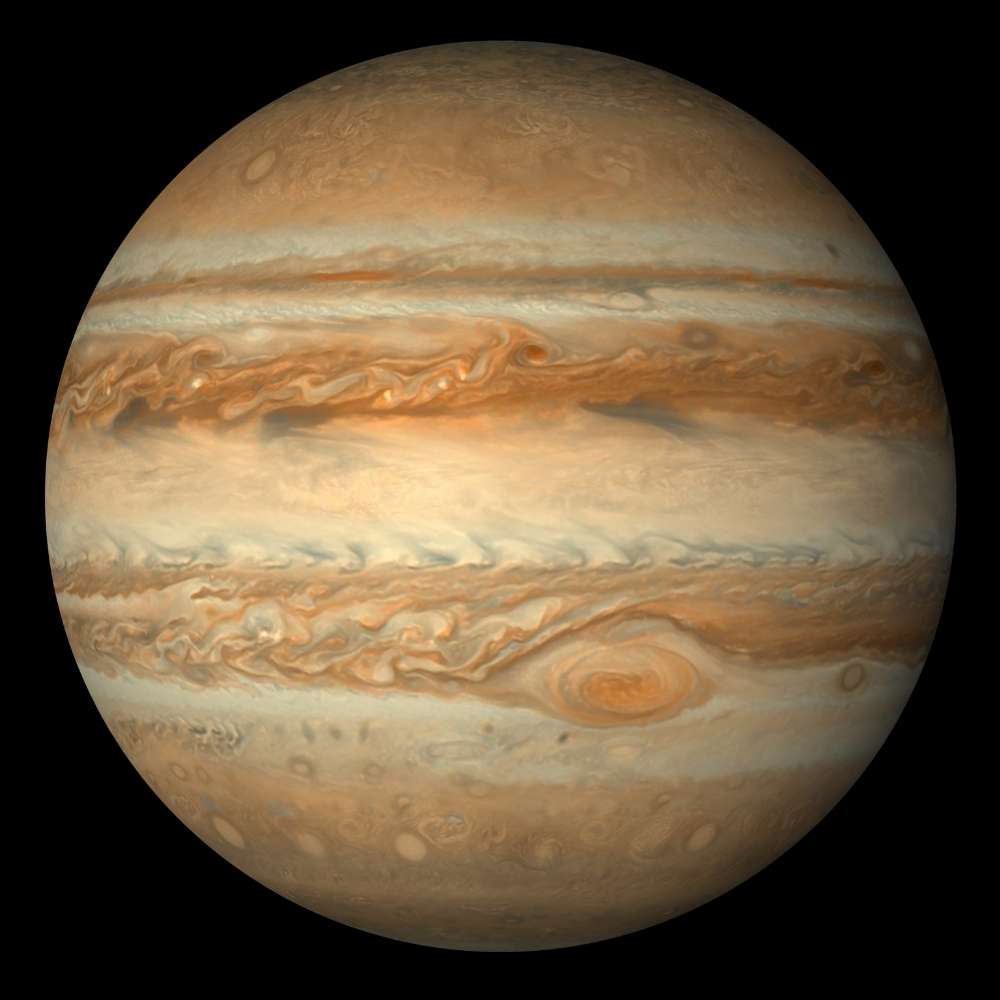
Jupiter’s atmosphere is the most dynamic planetary atmosphere in the Solar System.
It features:
Powerful jet streams
Persistent storm systems
Multi-colored cloud bands
Lightning storms larger than Earth
The most famous feature is the Great Red Spot, a storm larger than Earth that has persisted for centuries.
Jupiter’s atmosphere behaves more like a fluid engine than a static shell.
Rotation – The Fastest Planet
Jupiter rotates faster than any other planet.
Consequences of rapid rotation:
Extreme equatorial bulging
Strong Coriolis forces
Banded atmospheric structure
A day on Jupiter lasts less than 10 hours, yet a year lasts nearly 12 Earth years.
This imbalance drives its violent weather systems.
Jupiter’s Gravity – The Solar System’s Gatekeeper
Jupiter’s gravitational influence is unmatched.
It:
Shapes the asteroid belt
Controls Trojan asteroid populations
Redirects long-period comets
Scatters or ejects objects from the Solar System
Jupiter acts as both:
A shield, deflecting impactors away from the inner planets
A threat, sending objects inward under the wrong conditions
Its role is complex—not purely protective.
Why Jupiter Matters More Than Any Other Planet
Jupiter’s presence explains:
Why Mars is small
Why no planet formed between Mars and Jupiter
Why the inner Solar System survived early chaos
Why certain asteroid families exist
Jupiter is the architect of planetary order.
Remove Jupiter, and the Solar System collapses into a different configuration entirely.
Formation History – How Jupiter Came First
Jupiter did not form like the other planets.
It formed early, fast, and violently.
Current models suggest that Jupiter began forming within the first few million years of the Solar System’s existence, while the protoplanetary disk of gas and dust was still present.
Key formation stages:
A solid core formed from rock and ice
The core rapidly grew to several Earth masses
Gravitational runaway began
Jupiter captured enormous amounts of hydrogen and helium
This rapid growth allowed Jupiter to become dominant before the inner planets were fully formed.
Core Accretion vs Disk Instability
Two main theories explain Jupiter’s birth.
Core Accretion Model
A rocky–icy core formed first
Gas accumulated once the core reached critical mass
Slower but widely supported
Disk Instability Model
Parts of the gas disk collapsed directly
Planet formed rapidly without a large solid core
Faster but less supported
Evidence from the Juno mission favors a hybrid scenario, where:
Jupiter formed through core accretion
But experienced violent mixing and impacts during growth
This explains Jupiter’s diffuse core and uneven heavy-element distribution.
Jupiter’s Migration – The Grand Tack Hypothesis
Jupiter did not stay where it formed.
According to the Grand Tack hypothesis:
Jupiter formed beyond the current asteroid belt
Migrated inward toward Mars’ orbit
Later reversed direction after Saturn formed
Moved outward to its present position
This migration reshaped the entire inner Solar System.
Why Jupiter’s Migration Matters
Jupiter’s movement explains several major mysteries.
It explains:
Why Mars is unusually small
Why the asteroid belt never formed a planet
Why Earth avoided excessive bombardment
Why volatile-rich material reached the inner planets
Without Jupiter’s migration, Earth may never have become habitable.
Jupiter as a Planetary Sculptor
Jupiter’s gravity reorganized Solar System material.
Its effects include:
Clearing large regions of the protoplanetary disk
Scattering planetesimals inward and outward
Trapping objects in stable resonances
This led to:
The formation of Trojan asteroids
The structure of the asteroid belt
Long-term orbital stability of major planets
Jupiter did not just grow—it rearranged everything around it.
Jupiter and the Delivery of Water to Earth
One of Jupiter’s most important indirect roles may be linked to Earth’s oceans.
Jupiter likely:
Redirected water-rich asteroids from the outer Solar System
Prevented excessive comet bombardment
Regulated the timing of impacts
This balance allowed Earth to gain water without being destroyed.
Jupiter’s influence may be one of the hidden reasons life became possible on Earth.
Early Jupiter vs Modern Jupiter
Early Jupiter was more chaotic.
Differences include:
Stronger interactions with the gas disk
Rapid orbital changes
Higher collision rates
Over time:
The gas disk dissipated
Orbits stabilized
Jupiter became the long-term gravitational anchor
Modern Jupiter is calmer—but its early actions still define the Solar System today.
Why Jupiter Is Called the Solar System’s Architect
Jupiter earns this title because it:
Formed first among the giant planets
Controlled material distribution
Dictated where planets could and could not form
Stabilized long-term orbital architecture
In planetary systems across the galaxy, Jupiter-like giants often determine whether Earth-like planets can exist at all.
Jupiter’s Magnetic Field – The Solar System’s Strongest
Jupiter possesses the most powerful planetary magnetic field ever observed.
Key characteristics:
Generated by liquid metallic hydrogen deep inside
About 20,000 times stronger than Earth’s magnetic field
Extends millions of kilometers into space
Jupiter’s magnetosphere is so large that, if visible from Earth, it would appear larger than the Moon in the night sky.
This magnetic dominance makes Jupiter more like a small star with planets than a typical planet.
The Jovian Magnetosphere – A Violent Environment
Jupiter’s magnetosphere traps enormous amounts of charged particles.
Its effects include:
Extreme radiation belts
Constant particle acceleration
Intense auroras at the poles
These radiation belts are:
Deadly to unshielded spacecraft
Stronger than any other planetary radiation environment
This is why missions to Europa and Io face severe engineering challenges.
Auroras – Jupiter’s Polar Powerhouses
Jupiter’s auroras are the most energetic in the Solar System.
They are powered by:
The planet’s rapid rotation
Solar wind interactions
Volcanic material from Io
Unlike Earth’s auroras, Jupiter’s:
Are nearly constant
Emit in ultraviolet and infrared
Can be hundreds of times brighter
These auroras reveal how Jupiter transfers energy through its magnetic system.
Jupiter’s Ring System – Subtle but Real
Although famous for Saturn’s rings, Jupiter also has rings.
Jupiter’s rings are:
Thin
Dusty
Faint
They consist mainly of:
Microscopic particles
Ejected material from small inner moons
Unlike Saturn’s rings:
They are not icy
They are not long-lived
They require constant replenishment
Jupiter’s rings are a byproduct of its moon system.
Jupiter as a Miniature Planetary System
Jupiter behaves like a small Solar System of its own.
It hosts:
Dozens of moons
Multiple orbital resonances
Complex gravitational interactions
The Galilean moons alone demonstrate:
Volcanic worlds (Io)
Ocean worlds (Europa)
Magnetic moons (Ganymede)
Fossil worlds (Callisto)
Jupiter shows how planetary systems scale down.
Orbital Resonances – Jupiter’s Invisible Control
Jupiter controls orbital stability through resonances.
Examples include:
Kirkwood gaps in the asteroid belt
Trojan asteroid populations
Laplace resonance among Io, Europa, and Ganymede
Resonances:
Prevent collisions
Maintain long-term stability
Shape orbital architecture
They are one of Jupiter’s most powerful invisible tools.
Jupiter’s Role in Planetary Defense
Jupiter influences impact risk across the Solar System.
It can:
Deflect comets away from the inner planets
Capture or eject long-period objects
Occasionally redirect objects inward
This dual role means Jupiter is:
Not a perfect shield
But a major regulator of impact frequency
Earth’s long-term survival is partly tied to Jupiter’s presence.
Why Jupiter Is Unlike Any Other Planet
Jupiter stands apart because it:
Dominates mass distribution
Controls gravitational structure
Shapes planetary evolution
Hosts extreme physical processes
It is not simply the largest planet—it is the organizing force of the Solar System.
The Long-Term Future of Jupiter
Jupiter is one of the most stable objects in the Solar System.
Over the next billions of years:
Jupiter will slowly radiate away internal heat
Its atmosphere will gradually cool and contract
Its orbit will remain largely unchanged
Jupiter will not become a star, nor will it collapse.
It will continue to exist as a massive gas giant long after the Sun leaves the main sequence.
In the far future, Jupiter may outlive the inner planets.
Jupiter’s Fate When the Sun Evolves
When the Sun becomes a red giant:
Inner planets may be destroyed or engulfed
Jupiter will likely survive, though altered
Possible outcomes include:
Heating of its upper atmosphere
Loss of some outer gases
Changes to its moon system
After the Sun sheds its outer layers and becomes a white dwarf, Jupiter will remain—possibly as the dominant object in a reduced planetary system.
Jupiter Beyond the Solar System – A Cosmic Template
Jupiter provides a reference model for gas giants across the galaxy.
Studies of exoplanets show:
Many Jupiter-like planets migrate significantly
Some become “hot Jupiters”
Giant planets strongly influence system architecture
Jupiter demonstrates that:
Giant planets shape habitability zones
Their timing of formation is critical
Their migration history determines planetary survival
Understanding Jupiter helps interpret thousands of exoplanet systems.
Jupiter and the Search for Life
Jupiter itself is not habitable.
However, it plays an indirect role in astrobiology.
Jupiter:
Hosts moons with subsurface oceans
Regulates impact rates on inner planets
Influences the delivery of water and organics
Europa, Ganymede, and possibly Callisto are key targets for life-search missions because of Jupiter’s gravitational influence.
Life around Jupiter may exist because of, not despite, the giant planet.
Frequently Asked Questions (FAQ)
Is Jupiter a failed star?
Yes, in composition—but not in function. It lacks the mass needed for fusion.
Does Jupiter protect Earth?
Partially. Jupiter both deflects and redirects objects, acting as a regulator rather than a perfect shield.
Why is Jupiter so massive?
It formed early and captured gas before the protoplanetary disk dissipated.
Could Jupiter ever become a star?
No. It would need at least 80 times its current mass.
How important is Jupiter to the Solar System?
Fundamental. Without Jupiter, the Solar System’s structure would be entirely different.
Jupiter’s Role in Universe Map
Jupiter connects multiple core themes:
Planetary formation
Gravitational architecture
Gas giant physics
Moon systems
Habitability regulation
Related Universe Map topics include:
Saturn
Gas giants
Exoplanet systems
Asteroid belt
Jovian moons
Jupiter serves as a central node in understanding planetary systems.
Final Perspective
Jupiter is not merely the largest planet—it is the organizer of order.
Its gravity shaped worlds before they fully formed, guided material across vast distances, and created the conditions under which Earth could become stable and life-bearing.
In many ways, Jupiter is the silent engineer of our existence.
To study Jupiter is to study how planetary systems survive chaos.