




Jupiter Greek Camp
The Leading L4 Swarm of Jupiter’s Trojan Asteroids
Quick Reader
| Attribute | Details |
|---|---|
| Object Type | Trojan asteroids (subgroup) |
| Primary Association | Jupiter |
| Orbital Location | Sun–Jupiter L4 Lagrange point |
| Orbital Position | ~60° ahead of Jupiter in its orbit |
| Orbital Stability | Extremely stable (billions of years) |
| Naming Convention | Heroes from the Greek camp of the Trojan War |
| Discovery Era | Early 20th century onward |
| Population Size | Slightly larger than Trojan (L5) group |
| Typical Size Range | ~1 km to >200 km |
| Largest Members | 588 Achilles, 911 Agamemnon, 624 Hektor* (naming exception) |
| Composition | Dark, primitive (D-type, P-type) |
| Surface Albedo | Very low |
| Scientific Importance | Fossils of early Solar System dynamics |
*Note: Naming conventions have rare historical exceptions.
Key Highlights
- Occupy Jupiter’s leading L4 gravitational equilibrium point
- Represent one half of the Jupiter Trojan population
- Slightly more numerous than their trailing counterparts
- Extremely ancient and dynamically stable
- Preserve primordial material from early Solar System history
Introduction – The Asteroids That Lead a Giant Planet
Jupiter does not travel alone.
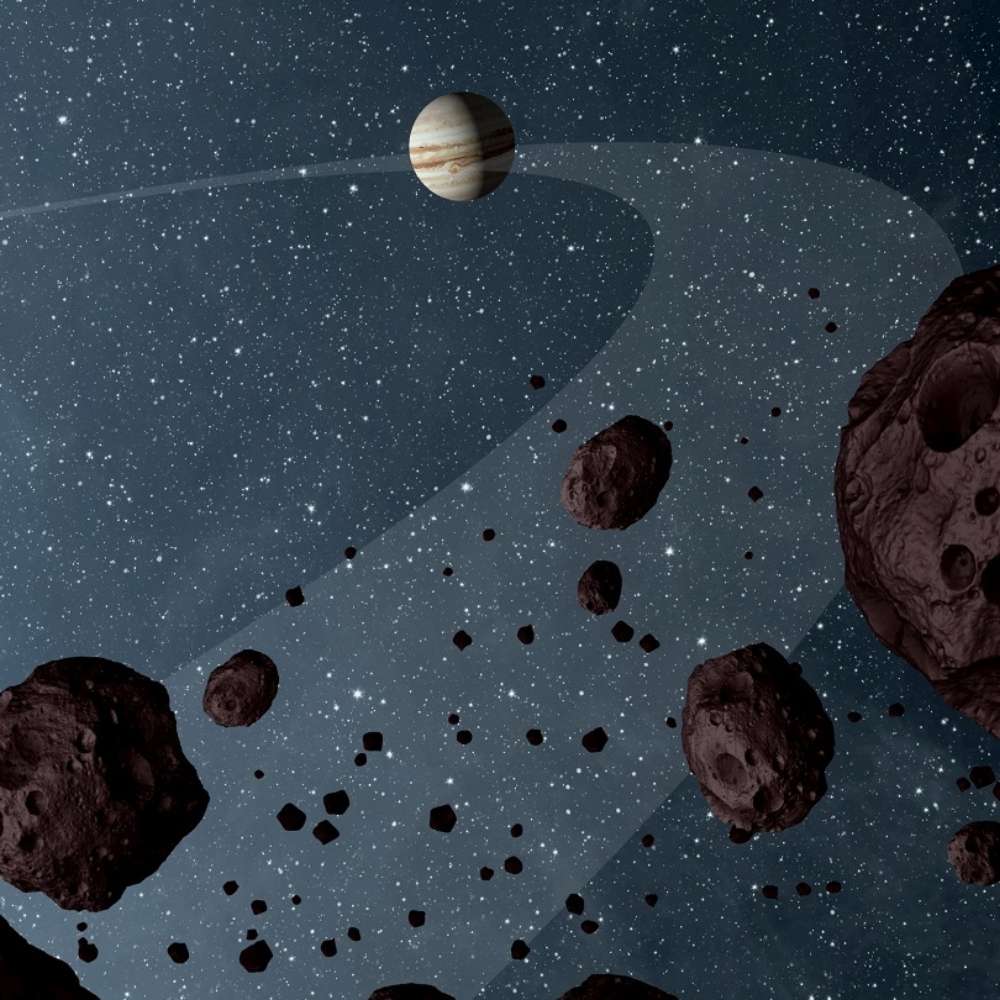
As it moves around the Sun, a vast swarm of small bodies travels with it—locked into a gravitational rhythm that has lasted for billions of years. Among these companions is the Jupiter Greek group, a population of asteroids that permanently lead Jupiter in its orbit.
They are not satellites.
They are not debris.
They are co-orbital partners, occupying one of the most stable configurations in celestial mechanics.
The Jupiter Greeks are among the oldest surviving structures in the Solar System.
What Are Jupiter Greeks?
Jupiter Greeks are a subgroup of Jupiter Trojan asteroids located at the L4 Lagrange point of the Sun–Jupiter system.
Key defining traits:
Orbit the Sun, not Jupiter
Share Jupiter’s orbital period (~11.86 Earth years)
Remain clustered ~60° ahead of Jupiter
Execute slow oscillations around L4
This configuration allows them to remain gravitationally stable for billions of years, despite Jupiter’s immense mass.
L4 Lagrange Point – Why the Greeks Stay Stable
The L4 point exists because of a precise balance:
Jupiter’s gravity
The Sun’s gravity
The asteroid’s orbital motion
At L4, these forces create a stable equilibrium.
Small disturbances do not eject objects—instead, they cause gentle looping motions known as tadpole or horseshoe orbits.
This makes the L4 region a gravitational sanctuary, not a trap.
Why Are They Called “Greeks”?
By long-standing astronomical convention:
Objects at L4 are named after Greek heroes
Objects at L5 are named after Trojan heroes
This naming scheme comes from Homer’s Iliad and reflects a symbolic division rather than a physical difference.
Examples of Greek-camp Trojans include:
Achilles
Ajax
Nestor
Diomedes
The names help astronomers immediately identify which side of Jupiter’s orbit an object belongs to.
Population Asymmetry – Why Are Greeks More Numerous?
One of the enduring puzzles of Trojan studies is that the Greek (L4) swarm contains more objects than the Trojan (L5) swarm.
Observations show:
L4 has ~10–20% more known objects
Size distributions are otherwise similar
Compositions appear broadly consistent
Possible explanations include:
Slight dynamical differences during early capture
Observational bias (still debated)
Subtle gravitational effects over long timescales
No single explanation is fully confirmed, making this an active research question.
Physical Characteristics – Dark and Primitive
Jupiter Greeks are among the darkest bodies in the Solar System.
Their properties indicate:
Carbon-rich surfaces
Low reflectivity
Minimal thermal processing
High preservation of primordial material
Spectral analysis links many Greeks to outer Solar System reservoirs, rather than inner main-belt origins.
They are time capsules, not collision fragments.
Did Jupiter Greeks Form Near Jupiter?
Modern models suggest they did not.
Leading theories indicate:
Greeks formed far from the Sun
Likely originated near or beyond the giant planets
Were captured during Jupiter’s early migration
During this chaotic phase:
Jupiter’s orbit shifted
Gravitational resonances swept through the disk
Small bodies were captured into L4 and L5
The Greeks are survivors of that planetary reshuffling.
Why Jupiter Greeks Matter
Jupiter Greeks are scientifically important because they:
Preserve material from the Solar System’s formation era
Constrain models of giant planet migration
Demonstrate long-term co-orbital stability
Provide targets for direct exploration
They are not just asteroids—they are structural evidence of how the Solar System assembled.
Jupiter Greeks vs Jupiter Trojans vs Main Belt Asteroids
Although the term Jupiter Trojans includes both Greeks (L4) and Trojans (L5), it is important to separate dynamical location from population identity.
Comparative Context
| Feature | Jupiter Greeks (L4) | Jupiter Trojans (L5) | Main Belt Asteroids |
|---|---|---|---|
| Orbital Relationship | Co-orbital with Jupiter | Co-orbital with Jupiter | Independent solar orbits |
| Orbital Position | ~60° ahead of Jupiter | ~60° behind Jupiter | Between Mars and Jupiter |
| Long-Term Stability | Extremely high | Extremely high | Moderate |
| Typical Composition | D-type, P-type | D-type, P-type | S, C, M-types |
| Surface Processing | Minimal | Minimal | Strong (collisional) |
| Formation Region | Likely outer Solar System | Likely outer Solar System | Inner Solar System |
| Scientific Role | Migration fossil | Migration fossil | Collisional evolution record |
This comparison highlights a key point:
Jupiter Greeks are not “asteroid belt refugees.”
They represent a separate evolutionary lineage.
Capture During Planetary Migration – Why Greeks Exist at All
The existence of Jupiter Greeks requires an explanation beyond simple formation.
Modern dynamical models suggest the following sequence:
The giant planets formed in a compact configuration
Jupiter migrated inward slightly, Saturn outward
Resonances destabilized vast regions of small bodies
Some objects were temporarily trapped near L4 and L5
As migration slowed, these objects became permanently bound
This capture process explains:
Wide inclination ranges
High orbital eccentricities
Mixed size distribution
Long-term stability
Without migration, the Greeks should not exist in their current numbers.
Why the Greeks Survived While Others Were Lost
Capture alone is not enough. Survival requires stability.
Jupiter Greeks survived because:
L4 is dynamically stable for mass ratios like Sun–Jupiter
Objects experience restoring forces, not runaway drift
Collisional rates are relatively low
Jupiter shields them from strong external perturbations
Once captured, Greeks entered a protected dynamical niche.
This is why many Greeks have remained intact since the Solar System’s earliest era.
Binary Jupiter Greeks – Clues from Paired Worlds
Several Jupiter Greeks exist as binary systems, where two bodies orbit a common center of mass.
Why this matters:
Binary formation requires low-velocity environments
High-speed collisions tend to destroy binaries
Binaries are common in the outer Solar System
This strongly suggests that:
Greeks formed in colder, quieter regions
They were gently captured, not violently scattered
Their internal structures are likely porous
Binary Greeks act as fingerprints of their birthplace.
Internal Structure – Not Solid Rock
Observations and density estimates indicate that many Jupiter Greeks are:
Low density
Highly porous
Weakly consolidated
This implies:
Accretion from small particles
Limited thermal processing
Minimal differentiation
Rather than solid monoliths, Greeks are better described as primordial aggregates—bodies that never experienced planet-scale heating.
Why Greeks Are So Dark
The extreme darkness of Jupiter Greeks is not incidental.
Likely causes include:
Carbon-rich organic compounds
Radiation-processed surface material
Long-term exposure without resurfacing
Their low albedo suggests surfaces rich in complex organics, possibly similar to those found in distant Kuiper Belt objects.
Greeks preserve chemistry that predates the planets.
The L4–L5 Asymmetry Problem Revisited
The population imbalance between L4 (Greeks) and L5 (Trojans) remains unresolved.
Leading hypotheses include:
Asymmetric capture during migration
Slight differences in long-term stability
Historical observational bias
Early perturbations from Saturn
What matters is not the answer—but the implication:
Even subtle gravitational effects can leave permanent population fingerprints lasting billions of years.
Why Jupiter Greeks Are Central to Planet Formation Models
Jupiter Greeks help scientists:
Reconstruct giant planet migration paths
Constrain timing of Solar System instability
Identify original formation zones of small bodies
Test dynamical simulations against reality
They are model validators, not just objects of interest.
Exploring the Jupiter Greeks – Lucy’s Journey to the Leading Swarm
The Jupiter Greeks are no longer just theoretical relics.
They are now targets of direct exploration.
NASA’s Lucy mission is designed to study multiple Jupiter Trojan asteroids, with a strong focus on the Greek (L4) swarm.
Lucy’s objectives include:
Measuring size, shape, and density
Mapping surface geology and composition
Studying binary systems
Testing predictions of planetary migration models
By visiting multiple Greeks, Lucy treats the swarm as a population, not a curiosity.
Why Direct Exploration Is Essential
Remote observations reveal only surface properties.
Close flybys allow scientists to:
Determine internal structure through gravity measurements
Identify layering, fractures, and rubble-pile characteristics
Compare spectral data with Kuiper Belt objects
Test whether Greeks are truly primitive
These measurements will decide whether current formation models are correct—or incomplete.
The Long-Term Future of Jupiter Greeks
Jupiter Greeks are among the most stable small-body populations known.
Simulations show:
Most Greeks will remain bound for billions of years
Only slow leakage from L4 occurs
Catastrophic destabilization requires major planetary rearrangement
Unless the Solar System undergoes another instability, the Greek swarm will outlast most other small-body populations.
Frequently Asked Questions (FAQ)
Are Jupiter Greeks moons of Jupiter?
No. They orbit the Sun, not Jupiter, while sharing Jupiter’s orbital period.
Can Jupiter Greeks collide with Jupiter?
Extremely unlikely due to the stabilizing dynamics of L4.
Are Greeks and Trojans physically different?
They appear compositionally similar; differences are primarily orbital.
Why study Greeks if they are inactive?
Because they preserve unaltered material from the Solar System’s birth.
Will Lucy land on a Greek asteroid?
No. Lucy performs close flybys only.
Jupiter Greeks in the Architecture of the Solar System
Jupiter Greeks occupy a rare position:
Co-orbital with a giant planet
Stable over cosmic timescales
Chemically primitive
Dynamically informative
They represent frozen structure, not ongoing process.
Final Perspective
Jupiter Greeks are quiet companions to a giant planet—but their silence is deceptive.
Locked at a gravitational equilibrium point, they have survived every major upheaval the Solar System has experienced. In their darkness and stability lies a record of planetary migration, capture, and survival.
To understand how the Solar System assembled, one must look not only at planets—but at the objects that never moved again once they found the right place.