



3753 Cruithne
Earth’s Most Misunderstood Cosmic Companion
Quick Reader
| Attribute | Details |
|---|---|
| Object Name | 3753 Cruithne |
| Object Type | Near-Earth Asteroid (Apollo group) |
| Discovery | 1986 |
| Discoverer | Duncan Waldron (UK Schmidt Telescope) |
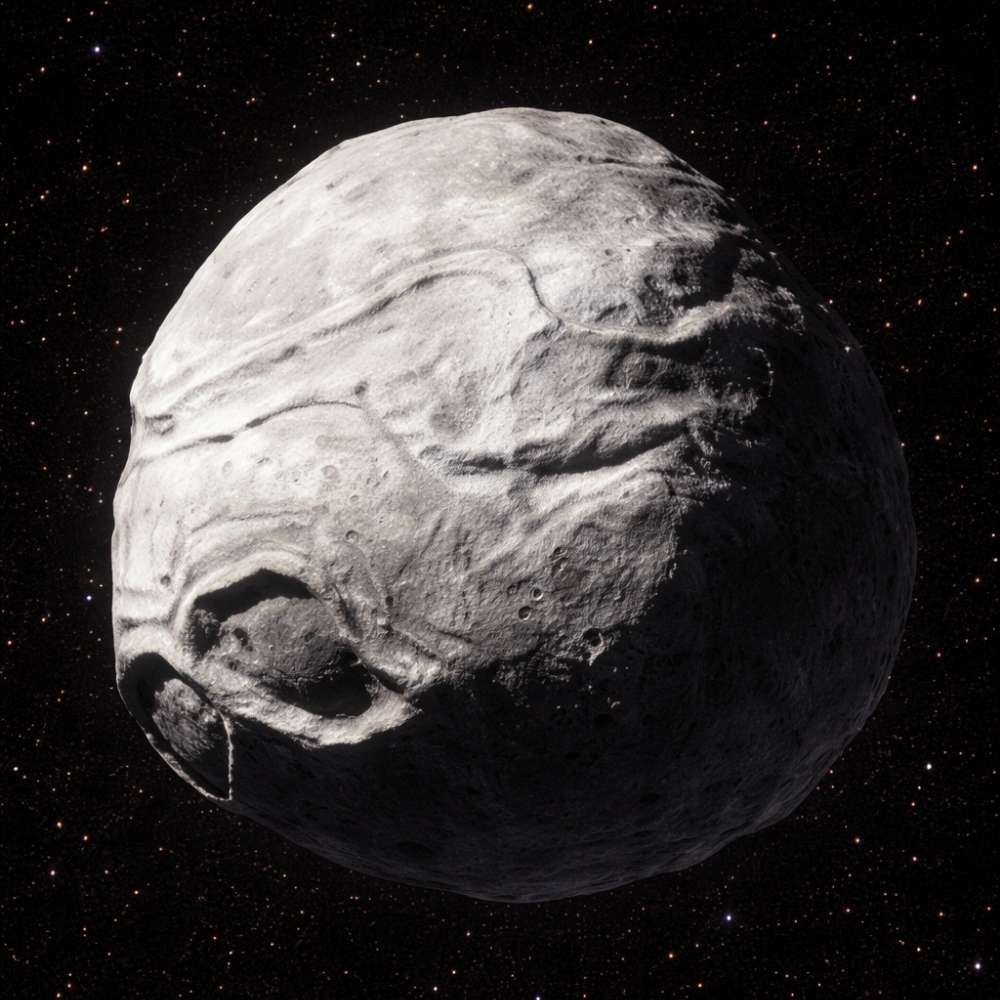
| Mean Diameter | ~5 km |
| Orbital Period | ~364 days (almost identical to Earth) |
| Orbital Relationship | 1:1 resonance with Earth |
| Orbit Type | Horseshoe orbit (relative to Earth) |
| Earth Moon? | No |
| Quasi-Satellite? | Temporarily (past/future phases) |
| Closest Approach | Millions of km (no collision risk) |
| Stability | Long-term (thousands of years, not permanent) |
| Name Origin | From Irish (Gaelic) mythology |
Key Points
- Cruithne is not Earth’s second Moon
- It shares Earth’s orbital period in a 1:1 resonance
- Appears to orbit Earth due to a horseshoe-shaped path
- Its motion is one of the most counterintuitive in the Solar System
- Often misrepresented in popular media
Introduction – The “Second Moon” That Isn’t
Cruithne is one of the most misunderstood objects in the Solar System.
For decades, headlines have described it as Earth’s second Moon, a hidden companion quietly circling our planet. This claim is wrong—but the real story is far more interesting.
Cruithne does not orbit Earth.
It orbits the Sun.
Yet from Earth’s perspective, its motion creates a complex looping pattern that mimics companionship. This illusion has fueled confusion, myths, and oversimplifications.
Cruithne teaches us a deeper lesson:
orbital mechanics can deceive the eye without breaking the rules of gravity.
What Is Cruithne?
Cruithne is a Near-Earth Asteroid belonging to the Apollo group, meaning its orbit crosses Earth’s orbital distance around the Sun.
What makes Cruithne exceptional is not its size or composition—but its orbital resonance.
Cruithne and Earth share nearly the same orbital period:
Earth: ~365.25 days
Cruithne: ~364 days
This near-equality locks Cruithne into a 1:1 orbital resonance with Earth.
But resonance does not mean orbiting Earth.
The Horseshoe Orbit – A Cosmic Illusion
Relative to the Sun, Cruithne follows a normal heliocentric orbit.
Relative to Earth, its path looks extraordinary.
When plotted in a rotating Earth-centered frame, Cruithne traces a horseshoe-shaped orbit.
Key characteristics:
It alternates between leading and trailing Earth
Never comes close enough to be captured
Appears to loop around Earth every few centuries
This motion arises because:
When Cruithne approaches Earth from behind, Earth’s gravity speeds it up
When it approaches from ahead, Earth slows it down
These energy exchanges shift its orbit slightly inward or outward
The result is a repeating, stable dance—without binding.
Why Cruithne Is NOT Earth’s Moon
A true moon must:
Orbit Earth directly
Be gravitationally bound to Earth
Remain within Earth’s Hill sphere
Cruithne satisfies none of these conditions.
Instead:
It orbits the Sun
Earth merely perturbs its path
It spends most of its time far outside Earth’s gravitational dominance
Cruithne is a co-orbital object, not a satellite.
Calling it a Moon is like calling a car driving alongside you on a highway your passenger.
Quasi-Satellite Phases – Adding to the Confusion
At certain times in its long-term evolution, Cruithne enters a quasi-satellite state.
During these periods:
It appears to circle Earth
Always stays near Earth in the sky
Still orbits the Sun, not Earth
This temporary configuration can last centuries but is not permanent.
Cruithne transitions between:
Horseshoe orbit
Quasi-satellite state
Other co-orbital configurations
These transitions further complicate public understanding.
Discovery and Naming
Cruithne was discovered in 1986 during a sky survey but was not immediately recognized as special.
Only later did astronomers realize:
Its orbital period nearly matched Earth’s
It occupied a rare resonant state
Its motion was dynamically stable
The name Cruithne comes from Irish mythology, referencing an ancient people of Ireland—symbolic of its elusive and misunderstood nature.
Why Cruithne’s Orbit Is Stable (For Now)
Cruithne’s stability arises from:
Resonant protection with Earth
Predictable gravitational energy exchanges
Avoidance of close encounters
However, this stability is not eternal.
Perturbations from:
Venus
Mars
Long-term chaotic effects
will eventually alter its orbit.
Cruithne is stable on astronomical timescales, not cosmic eternity.
Cruithne Compared to True Satellites
| Feature | Earth’s Moon | Cruithne |
|---|---|---|
| Orbits Earth | Yes | No |
| Orbits Sun | No | Yes |
| Gravitationally bound | Yes | No |
| Long-term stability | Billions of years | Thousands–millions |
| Classification | Natural satellite | Co-orbital asteroid |
This distinction is essential for scientific clarity.
Why Cruithne Matters
Cruithne matters because it:
Demonstrates advanced orbital resonance mechanics
Shows how Earth interacts with nearby small bodies
Corrects misconceptions about “extra moons”
Helps astronomers identify similar objects near other planets
Cruithne is not important because it is close to Earth—but because it reveals how order and complexity coexist in orbital dynamics.
Long-Term Orbital Evolution – A Dance That Slowly Changes
Cruithne’s motion is stable, but not fixed.
Although it remains locked in a 1:1 resonance with Earth, its exact orbital configuration evolves over time due to gravitational influences from multiple planets. Numerical simulations show that Cruithne’s path is quasi-stable, meaning it persists for long periods but eventually transitions between different resonant states.
Over thousands of years, Cruithne’s orbit:
Gradually shifts in eccentricity
Changes inclination slightly
Moves between co-orbital configurations
This evolution is slow, predictable, and governed by classical gravitational mechanics—not chaos.
Horseshoe to Quasi-Satellite – How Transitions Happen
Cruithne does not remain in a single configuration forever.
It transitions between two main co-orbital states:
Horseshoe Orbit
Cruithne alternates between leading and trailing Earth
It never approaches Earth closely
Relative motion traces a horseshoe shape
Quasi-Satellite State
Cruithne appears to circle Earth
It stays near Earth’s longitude
Still orbits the Sun, not Earth
These transitions occur because small gravitational nudges—especially from Earth—gradually alter Cruithne’s orbital energy.
Crucially:
No sudden capture occurs
No violent encounter is required
The process is smooth and continuous
This makes Cruithne a textbook example of adiabatic orbital evolution.
The Role of Other Planets
Earth is not the only influence on Cruithne.
Long-term modeling shows that:
Venus affects Cruithne’s eccentricity
Mars introduces slow orbital precession
Jupiter sets the background gravitational framework
Jupiter’s influence is indirect but essential—it shapes the resonant landscape in which Cruithne moves.
Cruithne’s orbit is therefore the product of multi-planet cooperation, not a two-body system.
Why Cruithne Is Not Permanently Stable
Despite its elegance, Cruithne’s configuration will not last forever.
Reasons include:
Secular resonances that slowly shift orbital parameters
Accumulated perturbations over tens of thousands of years
Sensitivity to small changes in inclination
Eventually, Cruithne is expected to:
Exit its current horseshoe orbit
Enter a different near-Earth configuration
Possibly move into a more typical Apollo-type orbit
This does not imply danger—it implies orbital evolution.
Comparison with Other Earth Co-Orbitals
Cruithne is not alone.
Earth hosts several co-orbital objects, though none are identical.
| Object | Orbit Type | Stability | Notes |
|---|---|---|---|
| 3753 Cruithne | Horseshoe / Quasi-satellite | Long-term, not permanent | Most famous |
| 2016 HO₃ | Quasi-satellite | Centuries | Closest persistent companion |
| 2020 CD₃ | Temporary satellite | Months | Briefly captured |
| 3753 Cruithne-like | Co-orbital | Variable | Rare configurations |
Cruithne stands out for its size, longevity, and stability, not proximity.
Why Cruithne Is Often Misreported
Cruithne’s misrepresentation stems from:
Earth-centered visualizations
Simplified explanations in media
Confusion between resonance and orbit
When viewed from Earth’s rotating frame, Cruithne’s motion looks like:
Loops around Earth
A distant companion
A second Moon
But these are coordinate artifacts, not physical realities.
Understanding Cruithne requires switching to a Sun-centered frame, where the illusion disappears.
Could Earth Ever Capture Cruithne?
Permanent capture is extremely unlikely.
For capture to occur, Earth would need to:
Remove significant orbital energy
Overcome solar gravitational dominance
Trap Cruithne within its Hill sphere
Such capture typically requires:
Atmospheric drag (not applicable)
Three-body dissipation (rare)
Exceptional circumstances
Cruithne’s current motion avoids all of these.
Earth does not own Cruithne.
It merely shares space with it.
Scientific Importance of Cruithne’s Orbit
Cruithne is not important because it is near Earth.
It is important because it:
Validates resonance theory
Demonstrates non-intuitive orbital stability
Helps predict co-orbital behavior around other planets
Improves impact risk modeling
Similar co-orbital configurations have been detected around:
Venus
Mars
Jupiter
Cruithne is Earth’s most accessible example of a broader phenomenon.
What Cruithne Teaches Us About Orbital Mechanics
Cruithne proves that:
Orbits can be stable without being bound
Resonance can mimic companionship
Apparent motion can mislead intuition
It reminds us that gravity does not always produce simple hierarchies.
Sometimes, it produces graceful ambiguity.
The Distant Future of Cruithne
Cruithne’s relationship with Earth is temporary on cosmic timescales.
Long-term simulations indicate that its current co-orbital behavior—cycling between horseshoe and quasi-satellite configurations—will persist for thousands to tens of thousands of years, not forever. Over longer periods, slow gravitational perturbations will gradually reshape its path.
Likely future outcomes include:
Exit from the 1:1 resonance with Earth
Transition into a more typical Apollo-type near-Earth orbit
Continued heliocentric motion with reduced Earth interaction
Cruithne is not on a collision course, nor is it destined to remain Earth’s apparent companion. It is passing through a long-lived, but finite, orbital phase.
Does Cruithne Pose Any Risk to Earth?
No.
Despite sensational claims in popular media, Cruithne does not represent an impact threat under current or projected conditions.
Key reasons include:
Its minimum orbit intersection distance remains large
Resonant dynamics actively prevent close encounters
Orbital solutions are well constrained and predictable
Even as Cruithne’s orbit evolves, models show no credible pathway toward Earth impact in the foreseeable future.
Cruithne is dynamically interesting, not dangerous.
Why Earth Has No “Permanent Second Moon”
Cruithne highlights an important point in planetary science.
Earth’s gravity is too weak, and the Sun’s influence too strong, for Earth to easily retain additional long-term natural satellites beyond the Moon.
Temporary companions can exist:
Small objects briefly captured
Co-orbitals sharing Earth’s path
Quasi-satellites with Sun-centered orbits
But permanent capture without energy loss is extremely unlikely.
Cruithne demonstrates how close Earth can come to having companions—without ever truly acquiring them.
Cruithne vs Temporary Mini-Moons
Occasionally, Earth captures very small objects for short periods.
| Feature | Cruithne | Temporary Mini-Moons (e.g., 2020 CD₃) |
|---|---|---|
| Size | ~5 km | 1–3 meters |
| Capture Type | None (co-orbital) | True temporary capture |
| Duration | Thousands of years | Weeks to months |
| Orbit Center | Sun | Earth (temporarily) |
| Stability | Long-term, resonant | Highly unstable |
Cruithne is far larger and far more stable—but never truly captured.
Why Cruithne Is Scientifically Valuable
Cruithne’s importance lies in what it reveals, not where it is.
It allows scientists to:
Test predictions of co-orbital resonance theory
Study long-term stability without capture
Improve models of near-Earth object evolution
Identify similar configurations around other planets
Objects like Cruithne help astronomers understand how planetary neighborhoods are structured, even when no moons are involved.
Frequently Asked Questions (FAQ)
Is Cruithne Earth’s second Moon?
No. It does not orbit Earth and is not gravitationally bound to it.
Why does it look like it orbits Earth?
Because of Earth’s rotating reference frame. The apparent loops are a visual illusion caused by resonance.
Could Cruithne ever be captured by Earth?
Permanent capture is extremely unlikely. No known mechanism supports it under current conditions.
Is Cruithne unique?
No, but it is the largest and most famous example of Earth’s co-orbital objects.
Will Cruithne always stay near Earth?
No. Its co-orbital relationship will eventually end as its orbit evolves.
Cruithne in the Context of Universe Map
Cruithne connects several major Universe Map themes:
Orbital resonance
Near-Earth object dynamics
Reference-frame effects in astronomy
Misconceptions in planetary science
Related Universe Map topics include:
Earth co-orbitals
Quasi-satellites
Near-Earth asteroids
Lagrange dynamics
Orbital resonance
Together, these topics explain how proximity does not imply possession in space.
Final Perspective
Cruithne is not Earth’s companion—but it is Earth’s mirror.
Its motion exposes the limits of intuition, showing how the same gravitational rules can produce behavior that looks impossible until the correct frame of reference is chosen.
Cruithne teaches a quiet but powerful lesson:
in celestial mechanics, appearance depends on perspective, but reality remains governed by precise laws.
It is not a second Moon.
It is something more subtle—and far more instructive.