




Mars Trojans
The Quiet Companions Sharing Mars’ Orbit
Quick Reader
| Attribute | Details |
|---|---|
| Object Type | Trojan asteroids (near-Mars population) |
| Primary Association | Mars |
| Orbital Relationship | Co-orbital with Mars |
| Lagrange Points | Sun–Mars L4 and L5 |
| Orbital Position | ~60° ahead (L4) and ~60° behind (L5) Mars |
| Orbital Stability | Long-term (hundreds of millions to billions of years for some) |
| Known Population | Few dozen confirmed (likely many undiscovered) |
| Typical Size Range | ~0.1 km to ~2 km |
| Largest Known Members | 5261 Eureka, 1998 VF₃₁ |
| Composition | Basaltic (V-type) and primitive types |
| Surface Albedo | Moderate to low |
| Age | Some may date back to the early Solar System |
| Scientific Importance | Clues to Mars’ formation, impacts, and migration |
Key Highlights
- Share Mars’ orbit without orbiting Mars directly
- Occupy stable gravitational points (L4 and L5)
- Far rarer than Jupiter Trojans
- Some may be fragments of Mars itself
- Preserve a record of early inner Solar System dynamics
Introduction – Mars Is Not Alone
Mars appears solitary.
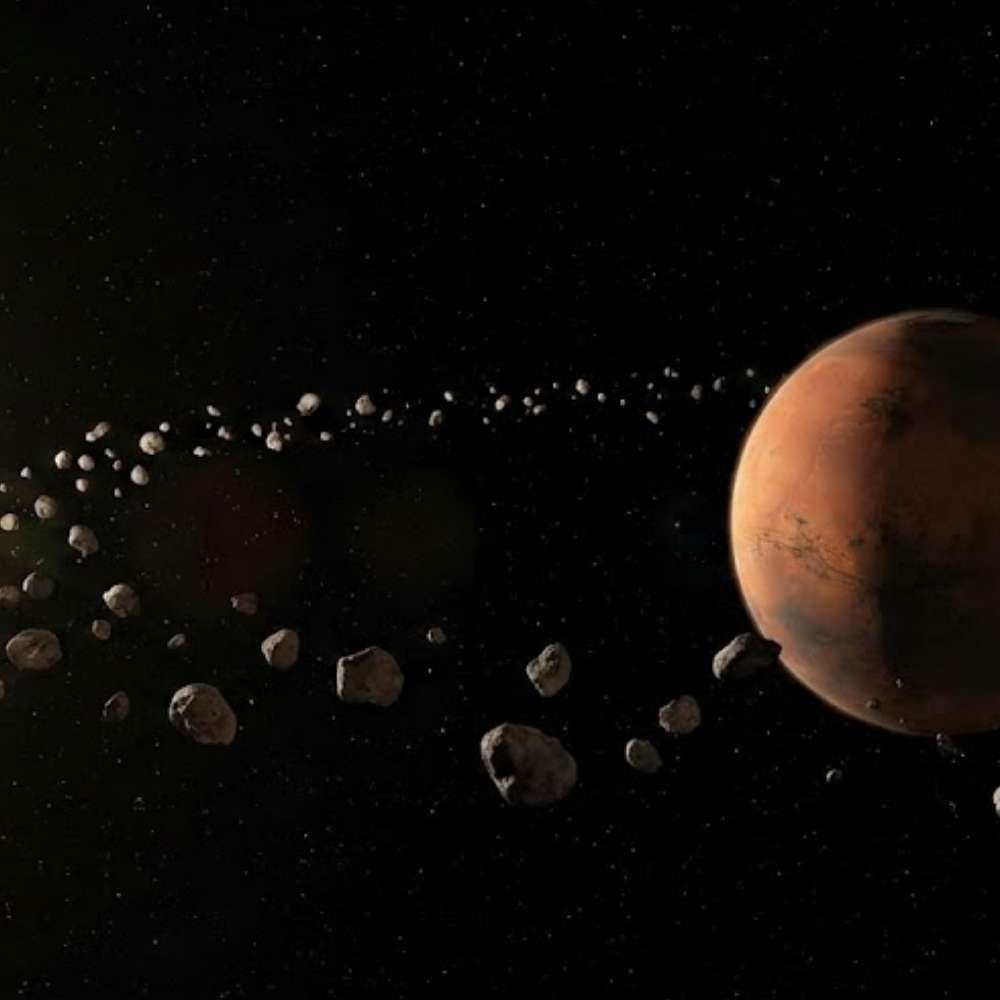
It has two small moons, Phobos and Deimos, and a quiet orbit between Earth and the asteroid belt. But hidden along that orbit are small bodies that move with Mars, keeping pace with the planet as it circles the Sun.
These objects are the Mars Trojans.
They are not satellites.
They are not typical asteroids.
They are co-orbital companions, locked into a delicate gravitational balance that allows them to share Mars’ path for immense spans of time.
What Are Mars Trojans?
Mars Trojans are asteroids that occupy the L4 and L5 Lagrange points of the Sun–Mars system.
Their defining characteristics:
Orbit the Sun, not Mars
Share Mars’ orbital period (~1.88 Earth years)
Remain clustered ~60° ahead of or behind Mars
Execute stable oscillations around these points
This configuration allows them to avoid close encounters with Mars while remaining gravitationally bound to its orbital path.
How Many Mars Trojans Exist?
Compared to Jupiter Trojans, Mars Trojans are extremely rare.
Reasons include:
Mars’ weaker gravity
Less efficient capture during early Solar System chaos
Greater sensitivity to perturbations from Earth and Jupiter
Current surveys have identified only dozens, but models suggest many more may exist—especially smaller bodies that are difficult to detect.
Mars Trojans are likely under-counted, not truly scarce.
The Eureka Cluster – A Clue to Their Origin
One of the most intriguing discoveries is that several Mars Trojans appear to form a dynamical family, often called the Eureka cluster.
Key facts:
Centered around asteroid 5261 Eureka (L5)
Members share similar orbits
Many show similar spectral properties
This suggests:
A common origin
Possible fragmentation of a larger parent body
A relatively ancient breakup event
This behavior is unusual for Trojan populations and hints at a violent early history.
Are Some Mars Trojans Pieces of Mars?
Spectral studies reveal that some Mars Trojans are V-type asteroids, similar to:
Basaltic material
Volcanic crust
Differentiated planetary surfaces
This composition closely resembles material from:
Asteroid Vesta
Or Mars’ own crust
One leading hypothesis proposes that:
A large impact on Mars ejected crustal material
Some debris escaped but remained near Mars’ orbit
Gravitational dynamics trapped fragments at L4/L5
If true, Mars Trojans may include literal pieces of Mars.
Orbital Behavior – Stable, but Not Permanent
Mars Trojan orbits are stable on long timescales, but not forever.
They are influenced by:
Gravitational perturbations from Earth
Secular resonances with Jupiter
Chaotic diffusion over hundreds of millions of years
Some Trojans may:
Escape their Lagrange points
Transition into near-Earth asteroid orbits
Be ejected from the inner Solar System
Mars Trojans are long-lived guests, not eternal residents.
Why Mars Trojans Matter
Mars Trojans are scientifically valuable because they:
Preserve material from Mars’ formation era
Provide insight into early inner Solar System impacts
Help test models of Trojan stability around small planets
Bridge planetary science and near-Earth asteroid studies
They are small objects with large implications.
Mars Trojans vs Jupiter Trojans – Why One Swarm Is Huge and the Other Is Tiny
At first glance, Mars Trojans and Jupiter Trojans seem to follow the same rule: both occupy L4 and L5 Lagrange points and share a planet’s orbit.
In reality, they represent two very different dynamical worlds.
Trojan Population Comparison
| Feature | Mars Trojans | Jupiter Trojans |
|---|---|---|
| Planet Mass | Low | Extremely high |
| Lagrange Point Stability | Moderate | Very strong |
| Known Population | Dozens | Tens of thousands |
| Typical Sizes | Small (sub-km to few km) | Wide range (km to >200 km) |
| External Perturbations | Strong (Earth, Jupiter) | Relatively weak |
| Long-Term Survival | Hundreds of Myr–Gyr | Billions of years |
This comparison highlights the core reason for the difference:
Jupiter creates a deep gravitational well; Mars does not.
As a result, Jupiter Trojans accumulate and survive, while Mars Trojans remain rare and fragile.
Why Mars Struggles to Hold Trojans
Mars’ mass is only about one-tenth of Earth’s and a tiny fraction of Jupiter’s.
This leads to three consequences:
Shallower Lagrange stability zones
Objects can remain trapped—but with less margin for error.Higher sensitivity to perturbations
Earth, Jupiter, and even Venus can slowly destabilize Trojan orbits.Limited capture efficiency
Early Solar System chaos did not favor large-scale Trojan trapping around Mars.
Mars Trojans exist in a narrow stability corridor, not a deep gravitational shelter.
Formation Scenarios – Where Did Mars Trojans Come From?
Unlike Jupiter Trojans, Mars Trojans likely have multiple origins.
Scenario 1: Primordial Capture
Some Mars Trojans may be ancient:
Captured during early Solar System rearrangement
Trapped when planetary orbits were still evolving
Survived long-term due to favorable orbital inclinations
These objects would be true fossils of Mars’ formation epoch.
Scenario 2: Impact Ejecta from Mars
This scenario explains the basaltic (V-type) Trojans.
Proposed sequence:
A large asteroid or comet impacts early Mars
Crustal material is ejected at escape velocity
Some debris remains near Mars’ orbit
A fraction becomes trapped at L4 or L5
If correct, this means some Mars Trojans are direct fragments of Mars’ crust—a rare case of planetary material preserved in heliocentric orbit.
Scenario 3: Main Belt Leakage
Other Mars Trojans may originate from:
The inner asteroid belt
Objects scattered inward by resonances
Temporary co-orbital capture
These bodies would be compositionally distinct from the Eureka family and explain the observed diversity.
The Eureka Family – A Trojan Family Unlike Any Other
The Eureka cluster is one of the most important discoveries in Mars Trojan research.
Key properties:
Clustered around L5
Similar orbital elements
Similar spectral characteristics
Likely formed from a single parent body
This suggests a collisional breakup within the Trojan region—something extremely rare for such small populations.
Implications:
Mars Trojans are not all isolated survivors
Local collisional evolution can occur
Trojan regions can host family formation under the right conditions
The Eureka family is a natural laboratory for studying small-population dynamics.
Orbital Inclination – A Clue to Survival
One striking feature of Mars Trojans is their high orbital inclination.
This is not accidental.
High inclination:
Reduces close encounters with Mars
Avoids destabilizing resonances
Enhances long-term stability
Low-inclination Mars Trojans are more easily lost over time.
This means the population we see today is selection-filtered—only the most dynamically protected objects survived.
Are Mars Trojans Temporary or Permanent?
The answer is: both.
Simulations show that:
Some Mars Trojans can remain stable for billions of years
Others escape within tens to hundreds of millions of years
Population slowly leaks into near-Earth space
Mars Trojans act as a semi-stable reservoir, feeding other small-body populations over long timescales.
Why Mars Trojans Matter for Mars’ History
Mars Trojans provide insights unavailable from the planet itself.
They help scientists:
Study ancient Martian crust without drilling Mars
Understand impact history in the inner Solar System
Constrain early orbital evolution of Mars
Test Trojan stability around low-mass planets
They are external witnesses to Mars’ early evolution.
The Long-Term Fate of Mars Trojans
Mars Trojans exist in a delicate balance.
Numerical simulations indicate that their futures follow several paths:
Long-term survivors that remain stable for billions of years
Gradual escapers that drift out of L4/L5 over hundreds of millions of years
Near-Earth migrants that become Mars-crossing or Earth-crossing asteroids
Ejected objects removed from the inner Solar System entirely
Unlike Jupiter Trojans, Mars Trojans experience continuous slow leakage rather than near-perfect confinement.
They are stable—but never completely safe.
Could Mars Trojans Pose a Risk to Earth?
Indirectly, yes—but not immediately.
Key points:
Mars Trojans do not currently cross Earth’s orbit
Some escaping Trojans can evolve into near-Earth asteroids
Their contribution to Earth impact risk is small but measurable
In planetary defense models, Mars Trojans represent a minor but persistent source of new near-Earth objects.
Why Mars Trojans Are Attractive Mission Targets
Mars Trojans offer unique exploration advantages:
Relatively low delta-v compared to main-belt targets
Stable, predictable orbits
Potential access to Martian crustal material
Scientific return without landing on Mars
A mission to a Mars Trojan could:
Sample ancient Martian material
Test Trojan dynamics directly
Bridge planetary science and asteroid exploration
Mars Trojans are natural stepping stones for inner Solar System exploration.
Frequently Asked Questions (FAQ)
Are Mars Trojans moons of Mars?
No. They orbit the Sun, not Mars, while sharing Mars’ orbital period.
How many Mars Trojans exist?
Only a few dozen are confirmed, but many more may be undiscovered.
Are Mars Trojans younger than Jupiter Trojans?
Some may be younger, especially collisional fragments like the Eureka family.
Can Mars Trojans be pieces of Mars?
Yes. Spectral evidence suggests some may be Martian crustal fragments.
Why don’t we see many Mars Trojans?
Because Mars’ weaker gravity and external perturbations limit long-term survival.
Mars Trojans in the Context of Small-Planet Trojans
Mars Trojans are part of a broader class of small-planet Trojan systems, including:
Earth Trojans
Venus Trojans (rare and unstable)
They demonstrate that Trojan stability:
Depends strongly on planet mass
Can exist even around small planets
Produces very different population outcomes
Mars Trojans define the lower mass limit for long-term Trojan survival.
Final Perspective
Mars Trojans are quiet companions—but scientifically loud.
Orbiting the Sun in step with Mars, they preserve fragments of planetary history that Mars itself no longer exposes. Whether primordial survivors, impact ejecta, or captured wanderers, they reveal how even small planets can host complex dynamical systems.
Mars Trojans remind us that planetary influence extends beyond a planet’s surface—sometimes far into the empty space along its orbit.