








Venus
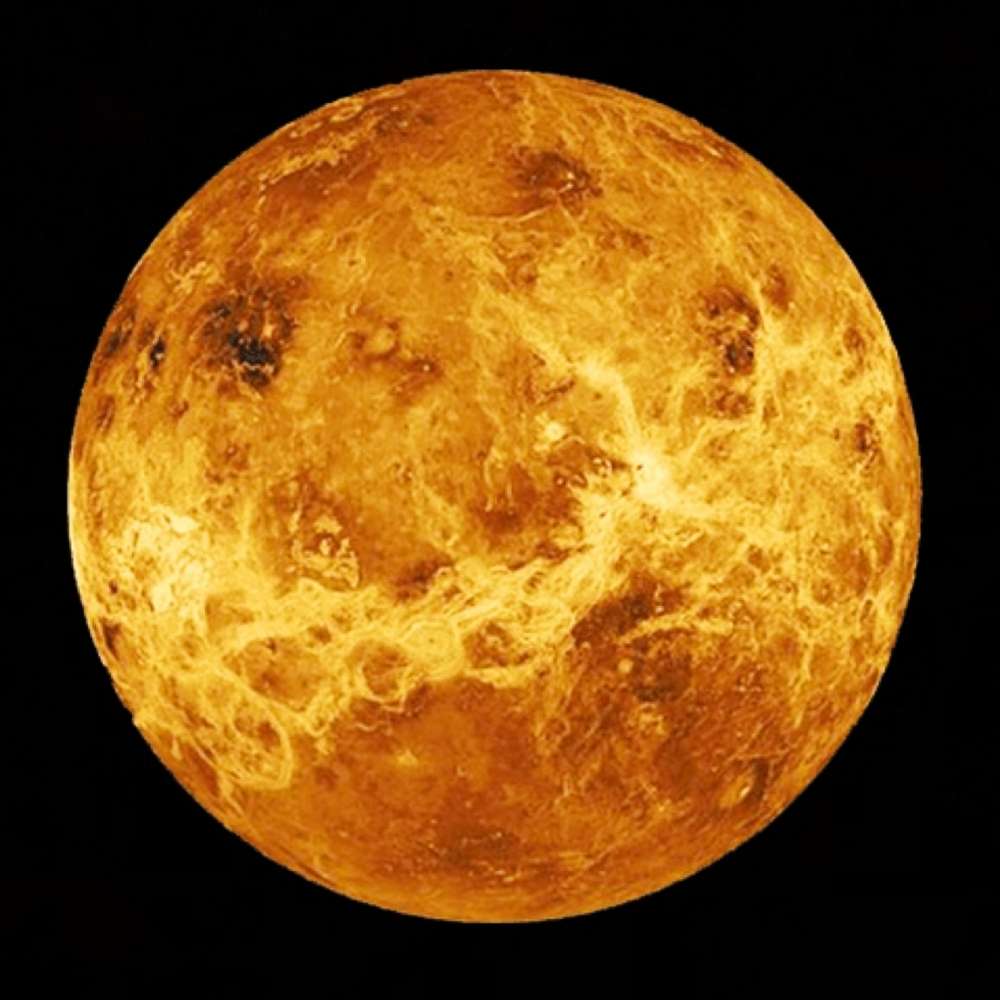
Earth’s Twin That Became a Furnace
Quick Reader
| Attribute | Details |
|---|---|
| Object Name | Venus |
| Object Type | Terrestrial planet |
| Position | 2nd planet from the Sun |
| Mean Distance from Sun | ~108 million km (0.72 AU) |
| Diameter | ~12,104 km (very close to Earth) |
| Mass | ~81.5% of Earth |
| Gravity | ~90% of Earth |
| Rotation Period | ~243 Earth days (retrograde) |
| Orbital Period | ~225 Earth days |
| Axial Tilt | ~177° (upside-down rotation) |
| Atmosphere | Extremely thick (CO₂-dominated) |
| Surface Temperature | ~465°C (average) |
| Surface Pressure | ~92× Earth |
| Moons | None |
| Notable Feature | Runaway greenhouse effect |
Key Points
- Venus is Earth’s closest planetary twin in size and mass
- It has the hottest surface of any planet in the Solar System
- Its atmosphere causes a runaway greenhouse effect
- Venus rotates backward and extremely slowly
- It represents the most extreme example of planetary climate failure
Introduction – When Similar Beginnings Lead to Opposite Outcomes
Venus and Earth are often called sister planets.
They formed at roughly the same time, from similar materials, and ended up nearly identical in size and mass. If planetary evolution were determined only by initial conditions, Venus should look very much like Earth.
It does not.
Instead, Venus is a world of crushing pressure, searing heat, and a sky filled with sulfuric acid clouds. Its surface is hot enough to melt lead, and its atmosphere is so dense that standing on Venus would feel like being 900 meters underwater on Earth.
Understanding why Venus failed where Earth succeeded is essential for understanding planetary habitability everywhere.
What Is Venus?
Venus is a rocky terrestrial planet, composed of silicate rock and a metallic core, just like Earth.
Structurally, Venus has:
A crust
A mantle
A core (likely partially molten)
Yet despite these similarities, Venus evolved into a radically different world. The reason lies not in what Venus is made of—but in how its climate and interior evolved over time.
Venus occupies the inner edge of the Solar System’s habitable zone, a location that placed it dangerously close to climatic instability.
Size and Gravity – Almost Earth, But Not Quite
Venus is often described as Earth’s twin because:
Its diameter is only ~5% smaller than Earth’s
Its mass is over 80% of Earth’s
Surface gravity is nearly Earth-like
A human standing on Venus (ignoring heat and pressure) would feel almost normal gravity.
This similarity makes Venus especially important.
It proves that Earth-like size alone does not guarantee Earth-like conditions.
The Atmosphere – Venus’s Defining Feature
Venus’s atmosphere is unlike any other terrestrial planet’s.
It is composed of:
~96.5% carbon dioxide
~3.5% nitrogen
Trace amounts of sulfur dioxide, water vapor, and other gases
Key consequences:
Extreme greenhouse trapping
Surface pressure ~92 times Earth’s
No liquid water on the surface
The atmosphere itself weighs more than Earth’s oceans.
Venus is not hot because it is closest to the Sun.
It is hot because it cannot release heat once absorbed.
The Runaway Greenhouse Effect
Venus is the Solar System’s most extreme example of a runaway greenhouse effect.
The process likely unfolded as follows:
Early Venus may have had oceans
Increasing solar radiation heated the surface
Water vapor entered the atmosphere
Water vapor intensified greenhouse warming
Oceans evaporated completely
Ultraviolet light broke water molecules apart
Hydrogen escaped into space
Once water was lost, there was nothing left to regulate carbon dioxide.
At that point, Venus crossed a climate point of no return.
Why Venus Is Hotter Than Mercury
Mercury is closer to the Sun than Venus—yet Venus is hotter.
This is because:
Mercury lacks a thick atmosphere
Heat escapes easily from Mercury’s surface
Venus’s atmosphere traps heat continuously
Venus’s surface temperature remains nearly constant:
Day or night
Equator or pole
Venus demonstrates that atmospheres matter more than distance.
Clouds of Acid – The Venusian Sky
Venus is permanently covered by thick clouds composed mainly of sulfuric acid droplets.
These clouds:
Reflect most sunlight back into space
Create a bright, reflective appearance
Prevent direct observation of the surface in visible light
Ironically, even though Venus reflects sunlight efficiently, its atmosphere still traps enough heat to create extreme surface temperatures.
Above the clouds, conditions are surprisingly mild—but the surface below is lethal.
Rotation – A Planet That Spins Backward
Venus’s rotation is one of its strangest features.
Key facts:
Venus rotates retrograde (opposite direction of most planets)
One Venusian day is longer than one Venusian year
The Sun rises in the west and sets in the east
The cause of this rotation remains uncertain.
Possible explanations include:
Ancient massive impacts
Atmospheric tidal interactions
Long-term internal torques
Whatever the cause, Venus’s slow, backward rotation likely influenced its climate evolution.
Venus vs Earth – The First Contrast
| Feature | Venus | Earth |
|---|---|---|
| Size | Nearly equal | Reference |
| Atmosphere | Thick CO₂ | Balanced N₂–O₂ |
| Surface Water | None | Abundant |
| Temperature | ~465°C | ~15°C |
| Plate Tectonics | Unclear / absent | Active |
Venus shows how small initial differences can cascade into planetary disaster.
Why Venus Matters
Venus matters because it:
Represents Earth’s most realistic alternate fate
Defines the inner limit of habitability
Helps interpret exoplanet atmospheres
Demonstrates irreversible climate tipping points
Venus is not just a failed Earth—it is a warning written in planetary scale.
Inside Venus – A Planet Without Relief Valves
Beneath its crushing atmosphere, Venus is structurally similar to Earth.
It has:
A rocky crust
A silicate mantle
A metallic core
Yet Venus behaves very differently internally. The key difference is how heat escapes.
On Earth, internal heat is released gradually through plate tectonics and volcanism. On Venus, that heat appears to be trapped for long periods, building pressure beneath a rigid outer shell.
Venus is not inactive.
It is sealed.
Does Venus Have Plate Tectonics?
There is no clear evidence that Venus has Earth-style plate tectonics.
Unlike Earth, Venus shows:
No global system of moving plates
No long linear mountain chains like subduction zones
No clear recycling of crust into the mantle
Instead, Venus appears to have a single, stagnant lithospheric lid.
This has profound consequences:
Heat cannot escape steadily
Carbon cannot be cycled efficiently
Climate regulation mechanisms fail
Without plate tectonics, Venus lost one of the most important stabilizers of planetary climate.
A World of Volcanic Dominance
Although Venus lacks plate tectonics, it is intensely volcanic.
The surface is covered by:
Vast lava plains
Thousands of volcanic constructs
Shield volcanoes larger than Earth’s
Notable volcanic features include:
Maat Mons – one of the tallest volcanoes on Venus
Pancake domes formed from viscous lava
Coronae – circular features caused by mantle upwelling
Venus’s volcanism is global, not localized.
Evidence for Recent or Ongoing Volcanism
For many years, Venus was thought to be volcanically dead.
Recent data suggest otherwise.
Key indicators include:
Changes in atmospheric sulfur dioxide
Thermal anomalies detected by orbiters
Fresh-looking lava flows with minimal erosion
Some volcanic activity on Venus may have occurred within the last few million years, and possibly much more recently.
Venus may still be intermittently active—but catastrophically so.
Global Resurfacing – Venus’s Violent Reset
One of Venus’s most distinctive features is its relatively young surface.
Crater counts suggest:
Most of Venus’s surface is only 300–700 million years old
Older terrain is rare
Craters are evenly distributed
This points to a dramatic event in Venus’s past.
The leading hypothesis is global resurfacing:
Internal heat built up under the stagnant lid
Pressure reached a critical threshold
Massive volcanic eruptions flooded the surface
Old terrain was buried almost planet-wide
Venus may periodically erase its own surface in catastrophic episodes.
Why Global Resurfacing Is a Problem for Climate
On Earth, volcanism releases CO₂ gradually, and plate tectonics eventually remove it.
On Venus:
Volcanic gases accumulate
There is no efficient long-term removal
Each resurfacing event injects enormous CO₂
This leads to:
Intensification of the greenhouse effect
Further surface heating
Reinforcement of climate collapse
Venus is trapped in a feedback loop with no exit.
The Missing Carbon Cycle
Earth’s climate stability depends on a working carbon–silicate cycle:
CO₂ released by volcanoes
Absorbed by oceans
Locked into rocks
Returned slowly via tectonics
Venus lacks:
Liquid water
Plate tectonics
Long-term carbon storage
As a result, carbon dioxide stays in the atmosphere indefinitely.
Once Venus lost its oceans, its climate system lost its brakes.
Venus’s Core and Magnetic Field – Another Missing Shield
Unlike Earth, Venus does not have a strong global magnetic field.
Possible reasons include:
Slow rotation
Weak or stalled core convection
Different core composition
Without a magnetic field:
Solar wind interacted directly with the atmosphere
Water vapor was stripped and dissociated
Hydrogen escaped to space
This accelerated the loss of Venus’s last remaining water.
Venus was stripped and sealed at the same time.
Why Venus and Earth Diverged So Sharply
Small early differences produced massive consequences.
Critical divergence points include:
Slightly closer distance to the Sun
Higher early surface temperatures
Faster water loss
Loss of plate tectonics
Failure to regulate CO₂
Once these processes crossed certain thresholds, Venus’s fate became irreversible.
Venus did not slowly drift into disaster.
It fell into it.
Venus as a Model for Exoplanets
Venus-like planets may be common in the galaxy.
Many exoplanets detected so far:
Orbit close to their stars
Are Earth-sized or larger
Likely experience strong greenhouse effects
Studying Venus helps astronomers:
Identify uninhabitable Earth-sized worlds
Understand false “Earth twin” signals
Define the inner edge of habitability
Venus is a template for planetary failure, not exception.
What Venus Teaches Us So Far
Venus shows that:
Habitability can be lost permanently
Plate tectonics may be essential for climate stability
Water loss is a one-way process
Earth’s stability is fragile, not guaranteed
Venus is not Earth’s twin anymore.
It is Earth’s counterfactual history.
The Venusian Atmosphere – A Climate Locked in Place
Venus’s atmosphere is the thickest and most extreme of any terrestrial planet.
Key characteristics:
Dominated by carbon dioxide
Extremely dense and heavy
Nearly uniform temperature across the planet
Unlike Earth’s atmosphere, which allows heat to circulate and escape, Venus’s atmosphere acts like a sealed thermal blanket. Once heat enters, it has no efficient way out.
This is why Venus’s surface temperature remains almost the same:
Day and night
Equator and poles
Venus is hot everywhere, all the time.
Atmospheric Pressure – Standing on Venus
The surface pressure on Venus is about 92 times greater than Earth’s.
This is equivalent to:
The pressure felt 900 meters underwater on Earth
At the surface:
The atmosphere behaves almost like a fluid
Winds are slow but incredibly forceful
Structural stress dominates over erosion
Any unprotected object on Venus’s surface is crushed long before heat becomes the main problem.
Super-Rotation – Winds Faster Than the Planet
One of Venus’s strangest atmospheric features is super-rotation.
Despite Venus rotating extremely slowly, its upper atmosphere:
Circles the planet in about 4 Earth days
Moves at speeds over 350 km/h
Flows much faster than the surface below
This means:
The atmosphere outruns the planet itself
Clouds complete dozens of rotations for each planetary day
The exact cause of super-rotation is still under study, but it likely involves:
Solar heating differences
Atmospheric tides
Wave-driven momentum transfer
Venus’s atmosphere has a life of its own.
The Cloud Layers – A Toxic Sky
Venus’s clouds are not made of water.
They consist mainly of:
Sulfuric acid droplets
Sulfur dioxide
Trace chemicals formed by photochemical reactions
The cloud layers are arranged vertically:
Upper clouds: reflective, bright, fast-moving
Middle clouds: dense and acidic
Lower clouds: thick and opaque
These clouds:
Reflect most incoming sunlight
Prevent visible-light views of the surface
Create a bright appearance from space
Ironically, Venus reflects more sunlight than Earth—but still remains far hotter.
Chemistry in Motion – A Dynamic Atmosphere
Venus’s atmosphere is chemically active.
Key processes include:
Ultraviolet light breaking apart molecules
Sulfur cycles forming and destroying cloud layers
Vertical mixing transporting gases
Sulfur dioxide levels vary over time, suggesting:
Ongoing volcanic outgassing
Chemical reactions altering atmospheric composition
Venus’s atmosphere is not static—it is constantly reacting.
The Greenhouse Trap – Why Heat Cannot Escape
Venus’s greenhouse effect is not just strong—it is self-sustaining.
Once CO₂ dominates:
Infrared radiation is trapped
Surface heats further
More heat remains stored
Unlike Earth, Venus has:
No oceans to absorb heat
No carbon cycle to regulate gases
No plate tectonics to remove CO₂
The greenhouse effect reached a point where cooling became impossible, even at night.
Lightning, Winds, and Electrical Activity
Evidence suggests Venus experiences:
Frequent lightning
Electrical discharges in the clouds
Static buildup due to dense atmosphere
These phenomena indicate that Venus’s atmosphere is energetically active, despite its slow rotation.
Lightning may play a role in:
Atmospheric chemistry
Sulfur cycling
Cloud formation processes
Venus’s sky is violent—even if its surface is still.
Could Life Exist in Venus’s Clouds?
One of the most intriguing ideas in modern planetary science is the possibility of microbial life in Venus’s upper atmosphere.
At altitudes of ~50–60 km:
Temperatures are similar to Earth’s
Pressure is near 1 bar
Conditions are relatively mild
However, challenges include:
Extreme acidity
Limited water availability
Intense ultraviolet radiation
While highly speculative, this idea has renewed interest in Venus exploration.
Venus may be uninhabitable at the surface—but not uniformly hostile everywhere.
The Phosphine Debate – A Scientific Controversy
In 2020, reports of phosphine gas in Venus’s atmosphere sparked global interest.
Why this mattered:
On Earth, phosphine is associated with biological or industrial processes
Known non-biological sources on Venus were unclear
Subsequent studies questioned:
Detection methods
Signal interpretation
Possible non-biological explanations
The debate remains unresolved.
Regardless of the outcome, the phosphine discussion highlighted how poorly understood Venus still is.
Why Venus’s Atmosphere Is Hard to Study
Studying Venus’s atmosphere is challenging because:
Clouds block optical observation
Surface conditions destroy landers quickly
Chemistry is complex and layered
Most data comes from:
Radar mapping
Short-lived landers
Orbital spectroscopy
Venus remains one of the least-explored terrestrial planets despite its proximity.
What Venus’s Atmosphere Teaches Us
Venus demonstrates that:
Atmospheres can dominate planetary destiny
Greenhouse effects can become irreversible
Earth-like size does not ensure Earth-like climate
Venus is the ultimate lesson in climate feedback gone unchecked.
The Future of Venus – Locked in Extreme Stability
Venus has already crossed its critical thresholds.
Unlike Earth, Venus no longer has the mechanisms needed to reverse or soften its climate. Its dense CO₂ atmosphere, lack of surface water, and absence of plate tectonics have pushed the planet into a stable but extreme state.
Over the next billions of years, Venus is expected to:
Remain intensely hot
Retain a thick, CO₂-dominated atmosphere
Experience episodic volcanism
Undergo very slow atmospheric loss
Venus will change—but only slowly, and never back toward habitability.
Why Venus Will Not Recover Naturally
Planetary recovery requires long-term regulation.
Venus lacks all major recovery pathways:
No oceans to dissolve CO₂
No plate tectonics to recycle carbon
No magnetic field to protect volatiles
No efficient heat-release system
Even if volcanic activity declined entirely, Venus’s atmosphere would remain massive for extremely long timescales.
Venus is not temporarily hostile.
It is permanently locked.
Could Venus Ever Be Terraformable?
Terraforming Venus is far more difficult than terraforming Mars.
The challenges include:
Removing or transforming a 90-bar atmosphere
Reducing surface temperatures by hundreds of degrees
Restoring water after complete hydrogen loss
Rebuilding a carbon cycle from nothing
All proposed ideas—such as atmospheric removal, chemical sequestration, or orbital sunshades—remain purely theoretical and far beyond foreseeable technology.
Venus is not a candidate for restoration.
It is a boundary condition for planetary science.
Human Exploration – Why Venus Is So Hard to Visit
Despite being closer to Earth than Mars, Venus is one of the most hostile destinations for exploration.
Surface challenges include:
Temperatures hot enough to melt lead
Pressures that crush spacecraft
Corrosive atmospheric chemistry
Past landers survived only minutes to hours.
Future exploration will focus on:
Orbiters
Atmospheric probes
High-altitude balloons
The surface of Venus remains effectively inaccessible with current technology.
Venus’s Upper Atmosphere – A Narrow Window
At altitudes of ~50–60 km above the surface:
Temperatures are Earth-like
Pressure is near 1 bar
Solar energy is abundant
This region has been proposed as:
A platform for long-duration probes
A possible location for floating laboratories
However, extreme acidity and lack of water still pose severe challenges.
Venus is layered—not uniformly deadly—but still profoundly inhospitable.
Venus as Earth’s Warning
Venus is often described as Earth’s climate cautionary tale.
While Earth is not Venus and cannot become Venus easily, Venus demonstrates:
That greenhouse effects can become runaway
That water loss is irreversible
That climate systems can cross hard limits
Venus shows what happens when regulation fails completely.
It is not a prediction for Earth—but it is a boundary we must never cross.
Venus and Exoplanet Science
Venus-like worlds may be common in the galaxy.
Many detected exoplanets are:
Earth-sized
Close to their stars
Likely subject to strong greenhouse effects
Venus helps astronomers:
Avoid false “Earth twin” classifications
Interpret dense CO₂ atmospheres
Understand uninhabitable outcomes
In many planetary systems, Venus-like planets may outnumber Earth-like ones.
Venus in the Context of the Solar System
Venus occupies a unique position:
Similar in size to Earth
Closer to the Sun
Radically different in outcome
Together with Earth and Mars, Venus completes a habitability triangle:
Earth: sustained habitability
Mars: failed early habitability
Venus: runaway climate collapse
These three planets show that small initial differences can decide planetary destiny.
Frequently Asked Questions (FAQ)
Is Venus hotter than Mercury?
Yes. Venus’s thick atmosphere traps heat far more efficiently than Mercury’s airless surface.
Did Venus ever have oceans?
Most models suggest Venus likely had liquid water early in its history.
Why does Venus rotate backward?
The exact cause is unknown, but likely involves ancient impacts and atmospheric interactions.
Can humans ever live on Venus?
Only potentially in the upper atmosphere, and even that remains speculative.
Will Venus ever cool down?
Not naturally. Its atmosphere will remain thick for billions of years.
Final Perspective
Venus is not a failed planet—it is a fully evolved one, shaped by unforgiving physics.
It began much like Earth, but small differences pushed it across irreversible thresholds. Once water was lost and carbon accumulated, Venus’s fate was sealed.
Venus teaches us a crucial lesson:
Planetary habitability is not guaranteed by size or location—it is sustained only by balance.
In understanding Venus, we better understand Earth—not as a default outcome, but as a rare success.