








Halley’s Comet
The Visitor That Returns Through Human History
Quick Reader
| Attribute | Details |
|---|---|
| Official Designation | 1P/Halley |
| Object Type | Periodic comet |
| Orbital Type | Highly elliptical |
| Orbital Period | ~75–76 years |
| Perihelion Distance | ~0.59 AU |
| Aphelion Distance | ~35 AU (beyond Neptune) |
| Nucleus Size | ~15 × 8 km |
| Composition | Ice, dust, organic compounds |
| Discovery | Known since antiquity |
| Last Perihelion | 1986 |
| Next Perihelion | 2061 |
| Visibility | Naked-eye at favorable returns |
| Origin Region | Kuiper Belt / scattered disk (likely) |
Key Points
- Halley’s Comet is the most famous periodic comet
- It is the first comet recognized to return predictably
- It links modern astronomy with ancient historical records
- Its orbit crosses the inner Solar System repeatedly
- It shaped humanity’s understanding of comets as regular celestial objects
Introduction – A Comet That Humanity Learned to Recognize
For most of history, comets were seen as omens, not objects.
They appeared suddenly, changed shape, and vanished—seemingly without pattern. Halley’s Comet changed that perception forever.
By recognizing that the same comet returned again and again across centuries, astronomers realized that comets were members of the Solar System, obeying the same gravitational laws as planets.
Halley’s Comet is not just a celestial object.
It is a turning point in scientific thought.
What Is Halley’s Comet?
Halley’s Comet is a short-period comet, meaning it returns to the inner Solar System on a predictable timescale—roughly once every human lifetime.
Unlike long-period comets that appear once and disappear for tens of thousands of years, Halley’s Comet:
Repeats its orbit regularly
Interacts with the planets repeatedly
Evolves measurably over time
It is officially designated 1P/Halley, making it the first periodic comet ever identified as such.
Edmond Halley – The Insight That Changed Astronomy
Although Halley’s Comet was observed for millennia, it was Edmond Halley who unlocked its secret.
In 1705, Halley studied historical comet records and noticed similarities between:
The comet of 1531
The comet of 1607
The comet of 1682
Using Newton’s laws of gravity, Halley proposed that these were the same object, returning on a predictable orbit.
He boldly predicted its return in 1758.
Halley died before seeing it—but the comet returned exactly as predicted.
This was one of the strongest early confirmations of Newtonian gravity.
A Comet Written Into History
Halley’s Comet appears throughout human history.
Notable historical sightings include:
1066 – Depicted on the Bayeux Tapestry before the Norman Conquest
240 BCE – Recorded by Chinese astronomers
1301 – Observed by Giotto, inspiring artistic depictions
1910 – Passed close enough to cause public panic
These records allow astronomers to trace Halley’s orbit back more than 2,000 years.
Few celestial objects are so deeply embedded in human culture.
Orbit – Extreme and Unusual
Halley’s orbit is highly elongated and tilted.
Key orbital characteristics:
Travels from near the Sun to beyond Neptune
Moves retrograde (opposite planetary direction)
Crosses the orbits of multiple planets
This makes Halley’s Comet:
Dynamically active
Sensitive to gravitational perturbations
Slowly evolving over time
Its orbital period varies between 75 and 76 years due to planetary interactions, especially with Jupiter.
Nucleus – The Solid Heart of the Comet
The nucleus of Halley’s Comet is:
Irregular in shape
Darker than coal
Rich in volatile ices
Despite its size, the nucleus reflects very little sunlight. Most of a comet’s brightness comes not from the nucleus, but from:
Gas and dust released when heated
The coma and tail formed near the Sun
Halley’s nucleus is a fossil from the early Solar System.
When Halley Comes Alive
As Halley’s Comet approaches the Sun:
Ice sublimates directly into gas
Dust is released into space
A glowing coma forms
Tails extend millions of kilometers
Halley develops:
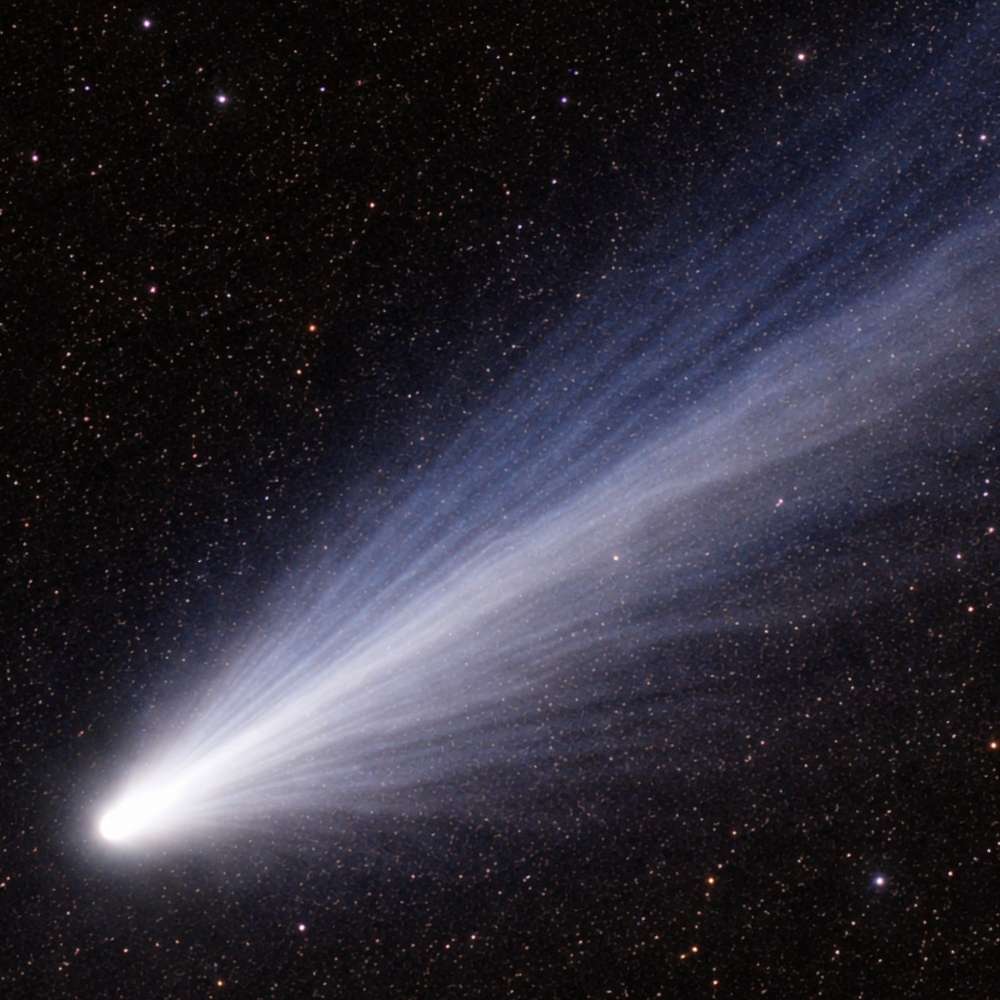
A dust tail (curved, glowing)
An ion tail (straight, bluish, pushed by solar wind)
These features make it visible from Earth—sometimes spectacularly so.
Why Halley’s Comet Matters
Halley’s Comet matters because it:
Proved comets are predictable
Linked celestial mechanics to observation
Preserves ancient Solar System material
Connects astronomy with human history
It is both a scientific object and a cultural bridge.
Visiting Halley – Humanity’s First Close Encounter with a Comet
Halley’s Comet was the first comet ever studied up close by spacecraft.
During its 1986 return, an international fleet of probes was sent to intercept it, marking a major milestone in space exploration.
Key missions included:
Giotto (ESA)
Vega 1 & Vega 2 (Soviet Union)
Suisei and Sakigake (Japan)
ICE (USA, distant flyby)
Among these, Giotto provided the most detailed images.
For the first time, humanity saw the solid nucleus of a comet.
What Giotto Revealed About Halley
Giotto’s images and instruments transformed comet science.
Key discoveries included:
The nucleus is irregular and potato-shaped
It is extremely dark, reflecting very little sunlight
Jets of gas and dust erupt from localized regions
Only a small fraction of the surface is active
This disproved the idea of comets as evenly evaporating “dirty snowballs.”
Halley behaves more like a dirty ice-covered rock with active vents.
Composition – What Halley Is Made Of
Halley’s Comet is a mixture of primitive Solar System materials.
Its composition includes:
Water ice
Carbon monoxide and carbon dioxide
Methane and ammonia
Complex organic molecules
Fine dust grains
These materials are largely unchanged since the Solar System’s formation.
Halley is a chemical time capsule, preserving the conditions of the early Sun’s protoplanetary disk.
Organic Molecules – Why Comets Matter for Life
Halley’s Comet contains complex carbon-based compounds.
This is important because:
Such molecules are building blocks of life
Comets may have delivered organics to early Earth
Similar processes could occur in other planetary systems
Halley supports the idea that life’s ingredients are common, even if life itself is rare.
Comets are not creators of life—but they may be cosmic suppliers.
Losing Mass – A Comet That Is Slowly Fading
Each time Halley passes near the Sun, it loses material.
Processes involved:
Sublimation of surface ice
Ejection of dust and gas
Fragmentation of weak regions
Estimates suggest Halley loses millions of tons of material per orbit.
Over many returns:
The nucleus shrinks
Active regions become depleted
The comet becomes less dramatic
Halley will not last forever.
How Long Will Halley Survive?
Based on current mass-loss rates:
Halley may survive for tens of thousands of years
Eventually, it will either:
Break apart
Become dormant
Transition into an asteroid-like body
This fate is common among short-period comets.
Halley is famous—but it is also temporary.
Meteor Showers – Halley’s Lasting Signature
Even when Halley is far away, it still affects Earth.
Debris released by Halley creates two major meteor showers:
Eta Aquariids
Occur in May
Fast, bright meteors
Best seen from the Southern Hemisphere
Orionids
Occur in October
Moderate rates
Visible from both hemispheres
When you see these meteors, you are seeing fragments of Halley’s Comet burning in Earth’s atmosphere.
Halley returns not only as a comet—but as starlight streaks.
Why Halley’s Orbit Is Unstable Long-Term
Halley’s orbit is influenced strongly by giant planets, especially Jupiter.
Effects include:
Gradual changes in orbital period
Shifts in perihelion distance
Potential ejection over very long timescales
This means Halley’s orbit is chaotic on million-year timescales.
The comet we know today will not follow the same path forever.
Halley Compared to Other Comets
| Feature | Halley’s Comet | Typical Long-Period Comet |
|---|---|---|
| Return Period | ~76 years | Thousands of years |
| Predictability | High | Low |
| Historical Records | Extensive | Rare |
| Evolution | Rapid | Slow |
| Cultural Impact | Massive | Minimal |
Halley stands apart because it bridges science, history, and human memory.
Why Halley’s Comet Is Scientifically Unique
Halley’s Comet matters because it:
Was the first predictable comet
Was the first comet visited by spacecraft
Links planetary science with history
Demonstrates cometary evolution in real time
Few objects connect past and future as clearly as Halley.
Where Did Halley’s Comet Come From?
The origin of Halley’s Comet is different from that of most short-period comets.
Although its orbital period is relatively short, its inclination and retrograde motion suggest a more distant birthplace.
Current evidence indicates that Halley’s Comet likely originated in the Oort Cloud—a vast, spherical reservoir of icy bodies surrounding the Solar System.
Over time:
Gravitational interactions with passing stars
Perturbations from giant planets
Long-term orbital evolution
gradually shifted Halley into its current orbit.
Halley is best described as a captured long-period comet that became periodic.
Why Halley Is Classified as a Halley-Type Comet
Halley is the prototype of a class known as Halley-type comets.
These comets are defined by:
Orbital periods between ~20 and 200 years
Highly elongated orbits
Often retrograde motion
Likely Oort Cloud origin
They differ from:
Jupiter-family comets, which originate in the Kuiper Belt
Long-period comets, which return only once
Halley-type comets form a bridge between distant and inner Solar System populations.
The Long-Term Fate of Halley’s Comet
Halley will not remain a comet forever.
Possible long-term outcomes include:
Gradual fading into a dormant nucleus
Fragmentation during a close solar pass
Ejection from the Solar System
Transition into an asteroid-like object
Given current mass-loss rates, Halley may remain active for tens of thousands of years—a brief chapter on cosmic timescales.
Halley’s Comet is famous, but it is not immortal.
Why Halley’s Comet Changed Astronomy Forever
Halley’s Comet represents a turning point in scientific thinking.
Its successful prediction:
Confirmed Newton’s laws of gravity
Proved that comets are regular Solar System objects
Shifted comets from superstition to science
This single insight reshaped celestial mechanics and observational astronomy.
Few discoveries have had such a broad impact.
Halley’s Comet in Human Culture
Halley’s Comet has inspired:
Medieval chronicles
Religious interpretations
Artistic depictions
Scientific revolutions
Its appearances were often linked to:
The rise and fall of rulers
Wars and disasters
Societal change
While these associations were symbolic rather than causal, they show how deeply celestial events shape human imagination.
Halley is a comet humanity remembers.
Frequently Asked Questions (FAQ)
How often does Halley’s Comet appear?
Approximately every 75–76 years, though the exact period varies slightly.
When will Halley’s Comet return next?
It will reach perihelion in 2061.
Can Halley’s Comet be seen with the naked eye?
Yes, during favorable apparitions. Brightness varies from return to return.
Is Halley’s Comet dangerous to Earth?
No. Its orbit does not pose an impact threat.
Why is Halley’s Comet numbered 1P?
It was the first periodic comet to have its return predicted and confirmed.
Halley’s Comet in the Context of Universe Map
Halley’s Comet connects many Universe Map themes:
Comet origins
Solar System dynamics
Early planetary chemistry
Human observational history
Related Universe Map topics include:
Comets
Oort Cloud
Kuiper Belt
Meteor showers
Early Solar System
Together, these topics explain how icy bodies link the outer Solar System to the inner planets.
Final Perspective
Halley’s Comet is more than ice and dust.
It is a messenger from the Solar System’s deep past, returning again and again across centuries. Each appearance reminds humanity that the cosmos is not random—it is governed by patterns that can be discovered, predicted, and understood.
Halley’s Comet taught us that even the most mysterious visitors follow the same laws as planets.
In doing so, it helped turn astronomy into a science.