











Comet Hale-Bopp
Hale-Bopp Overview (Expanded & Informative)
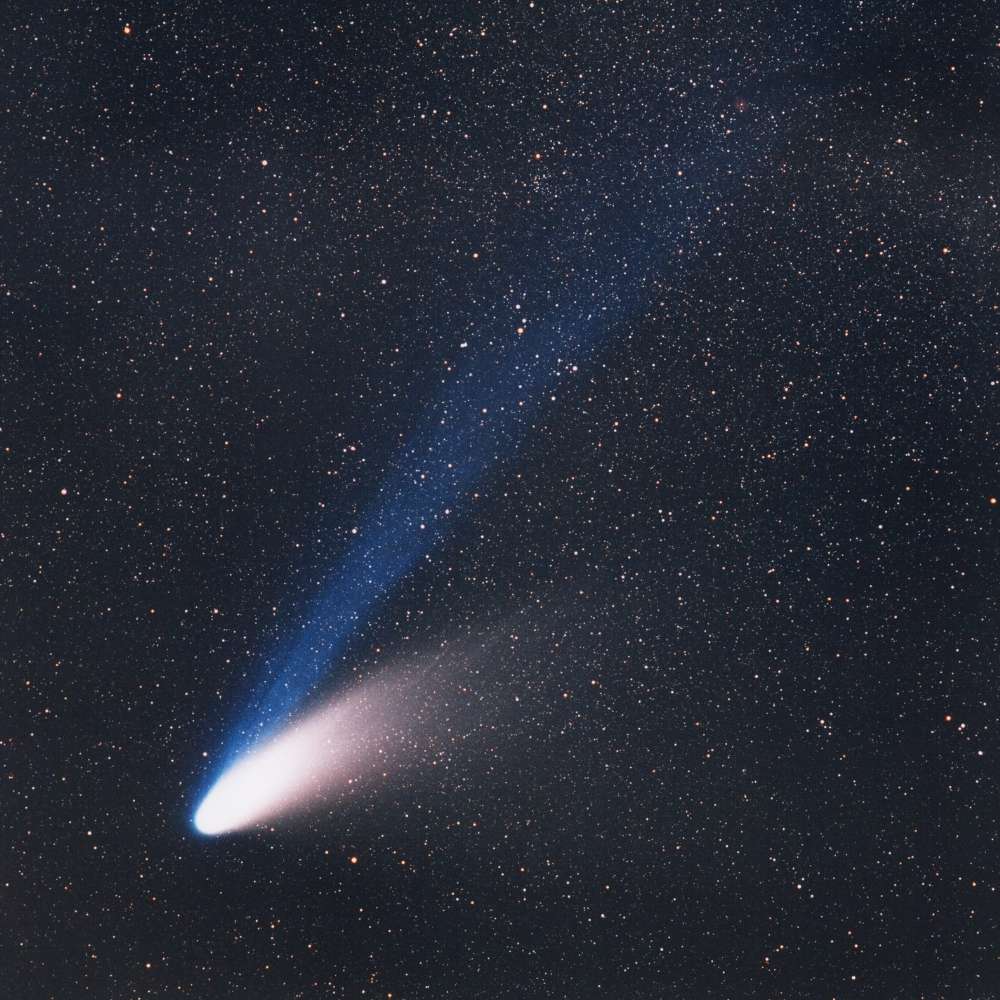
Quick Reader
| Attribute | Details |
|---|---|
| Official Designation | C/1995 O1 (Hale-Bopp) |
| Object Type | Long-period comet |
| Discovery Date | 23 July 1995 |
| Discoverers | Alan Hale & Thomas Bopp (independently) |
| Origin Region | Oort Cloud |
| Orbital Type | Highly elliptical, near-parabolic |
| Orbital Period | ~2,500 years (current orbit) |
| Nucleus Size | ~60 km diameter |
| Perihelion Distance | ~0.91 AU (inside Earth’s orbit) |
| Aphelion Distance | >300 AU |
| Peak Visibility | 1996–1997 |
| Tail Types | Dust tail + ion tail (exceptionally long) |
| Notability | Brightest naked-eye comet of the late 20th century |
Key Highlights
- One of the largest cometary nuclei ever observed
- Visible to the naked eye for over 18 months
- Displayed multiple, highly structured tails
- Observed extensively with modern astronomical instruments
- Became both a cultural and scientific landmark comet
Introduction — A Comet the World Could Not Ignore
Comets are usually fleeting visitors—appearing briefly, fading quickly, and leaving little impression on the public.
Hale-Bopp was different.
From late 1996 through much of 1997, this comet dominated the night sky, shining brightly even from light-polluted cities. It was visible for an unprecedented length of time, exhibited dramatic tail structures, and became one of the most widely observed astronomical objects in human history.
For many people, Hale-Bopp was their first and only naked-eye comet, making it a generational reference point—much like Halley’s Comet was for earlier eras.
Discovery — An Unusually Early Detection
Hale-Bopp was discovered on 23 July 1995, when it was still beyond Jupiter’s orbit, far earlier than most comets are detected.
This early discovery was possible because:
The nucleus was exceptionally large
The comet was already active at great distance
Modern sky surveys and amateur monitoring had improved dramatically
Within weeks, astronomers realized this was not an ordinary comet. Its brightness curve suggested something extraordinary was approaching the inner Solar System.
Why Hale-Bopp Became So Bright
Several factors combined to make Hale-Bopp spectacular:
1. Enormous Nucleus
With an estimated diameter of around 60 km, Hale-Bopp’s nucleus dwarfed most known comets.
A larger nucleus means:
More volatile material
Stronger outgassing
Greater dust production
2. High Activity Far from the Sun
Hale-Bopp began releasing gas and dust while still far beyond the region where water ice normally sublimates. This suggests:
Presence of more volatile ices (such as CO and CO₂)
A relatively pristine, unprocessed nucleus
3. Favorable Geometry
Its orbit placed it:
Close enough to Earth for high brightness
Well positioned in the sky for observers in both hemispheres
The result was a comet that refused to fade, night after night.
A Tale of Two (and More) Tails
Hale-Bopp famously displayed multiple distinct tails, often visible simultaneously:
Dust Tail
Broad, curved, yellow-white in color
Made of fine dust particles pushed by sunlight
Responsible for the comet’s dramatic visual appearance
Ion (Gas) Tail
Straight, bluish, sharply defined
Formed by ionized gas interacting with the solar wind
Showed rapid changes and disconnection events
At times, observers also reported secondary structures and striations, making Hale-Bopp a textbook example of cometary physics in action.
Orbital Characteristics — A Visitor from the Deep Freeze
Hale-Bopp originated in the Oort Cloud, a distant spherical reservoir of icy bodies surrounding the Solar System.
Key orbital traits:
Extremely elongated orbit
Approached the Sun only once every few thousand years
Gravitational interactions during its 1997 passage altered its period
Before its recent visit, Hale-Bopp’s orbital period may have been much longer, meaning humanity may have been the first intelligent observers ever to witness it.
Scientific Importance of Hale-Bopp
Hale-Bopp arrived at a perfect time for science.
By the mid-1990s, astronomy had access to:
Space telescopes
Advanced spectroscopy
CCD imaging
Global observational networks
This allowed astronomers to:
Identify dozens of molecular species
Study dust grain composition and size
Track nucleus rotation and jet activity
Observe how comets evolve as they approach the Sun
Few comets in history have been studied so thoroughly.
Cultural Impact — A Comet in the Public Eye
Beyond science, Hale-Bopp became a global cultural event.
It appeared in news broadcasts worldwide
Inspired photography, art, and public sky-watching
Became embedded in popular memory
Unfortunately, it was also associated with misinformation and tragedy, highlighting the need for clear science communication—a reminder that awe must be paired with understanding.
Why Hale-Bopp Still Matters Today
Hale-Bopp matters because it:
Set a modern benchmark for “great comets”
Demonstrated how large and active Oort Cloud comets can be
Showed the value of early detection and long-term monitoring
Connected professional astronomy with the general public
It stands as a reminder that the Solar System is still capable of delivering truly extraordinary surprises.
Hale-Bopp vs Halley’s Comet — Two Icons, Very Different Stories
Hale-Bopp is often compared with Halley’s Comet, but scientifically and observationally, they represent very different classes of cometary behavior.
| Feature | Hale-Bopp | Halley’s Comet |
|---|---|---|
| Official Type | Long-period comet | Short-period comet |
| Origin | Oort Cloud | Oort Cloud (captured to short-period) |
| Orbital Period | ~2,500 years | ~76 years |
| Nucleus Diameter | ~60 km | ~11 km |
| Visibility Duration | ~18 months | Weeks to a few months |
| Brightness (1997 / 1986) | Extremely bright | Moderate |
| Public Impact | Global, sustained | Episodic |
Interpretation
Halley’s Comet is a veteran traveler, heavily processed by repeated close encounters with the Sun over thousands of years.
Hale-Bopp was a relatively fresh giant, arriving from the distant Oort Cloud with enormous volatile reserves still intact.
This fundamental difference explains why Hale-Bopp dramatically outperformed Halley in terms of brightness, tail complexity, and sustained activity.
Cometary Chemistry — A Molecular Treasure Trove
Hale-Bopp became one of the most chemically rich comets ever studied.
Key Molecular Discoveries
Astronomers detected:
Water vapor (H₂O)
Carbon monoxide (CO)
Carbon dioxide (CO₂)
Methanol (CH₃OH)
Formaldehyde (H₂CO)
Hydrogen cyanide (HCN)
Sulfur-bearing compounds
Several molecules were detected for the first time in a comet, expanding knowledge of primordial Solar System chemistry.
Why This Was Important
These detections showed that:
Comets preserve pre-planetary material
Organic molecules were abundant in the early Solar System
Comets could have contributed prebiotic ingredients to early Earth
Hale-Bopp provided a near-pristine chemical sample of Solar System formation.
Jets, Rotation, and a Complex Nucleus
High-resolution imaging revealed that Hale-Bopp’s nucleus was anything but simple.
Observed Features
Multiple active jets
Rotational modulation of brightness
Asymmetric outgassing patterns
Day–night thermal effects
The nucleus rotation period was estimated to be around 11–12 hours, causing:
Periodic brightening
Changes in jet orientation
Complex tail structures
This confirmed that cometary activity is localized, not uniform across the surface.
Dust Production — Why Hale-Bopp Looked So Impressive
Hale-Bopp released enormous quantities of dust, far exceeding typical comets.
Dust Characteristics
Wide range of particle sizes
High reflectivity
Strong contribution to visual brightness
The dust tail’s brilliance was not just aesthetic—it allowed scientists to:
Study grain dynamics
Measure solar radiation pressure effects
Model comet–Sun interactions in detail
In many images, the dust tail was brighter than the coma itself.
Ion Tail Dynamics — Solar Wind in Action
Hale-Bopp’s ion tail became a natural laboratory for studying the solar wind.
Observed phenomena included:
Rapid tail disconnection events
Sudden kinks and waves
Interaction with solar magnetic fields
These observations confirmed that:
Ion tails respond directly to space weather
Comets can be used as probes of the heliosphere
Hale-Bopp functioned as a visible tracer of invisible solar processes.
Thermal Behavior — Active Far from the Sun
One of Hale-Bopp’s most surprising traits was its strong activity at large heliocentric distances.
This implies:
Significant amounts of supervolatile ices
A nucleus with minimal thermal processing
Preservation of early Solar System conditions
Most comets only become active near the inner Solar System. Hale-Bopp broke that rule.
Scientific Legacy of Hale-Bopp
Hale-Bopp reshaped comet science by proving that:
Large comet nuclei exist and survive intact
Cometary chemistry is more complex than previously thought
Activity mechanisms vary strongly between comets
Long-period comets can remain active for years
It became a benchmark comet, against which future discoveries are measured.
A Cautionary Cultural Footnote
While scientifically triumphant, Hale-Bopp also revealed how astronomical events can be misunderstood.
The comet became entangled with fringe beliefs, emphasizing:
The importance of accurate science communication
The responsibility of astronomers to engage the public clearly
The difference between cosmic wonder and misinformation
This social dimension is now part of Hale-Bopp’s historical footprint.
Hale-Bopp in the Context of the Oort Cloud
Hale-Bopp represents what the Oort Cloud is capable of delivering:
Massive icy bodies
Chemically rich nuclei
Rare but transformative encounters with the inner Solar System
It stands as direct evidence that the Oort Cloud is not a graveyard—but a reservoir of potential great comets.
The Future Orbit of Hale-Bopp — Will It Ever Return?
Hale-Bopp’s 1997 passage permanently altered its trajectory.
Gravitational interactions with the giant planets—especially Jupiter—reshaped its orbit, shortening its return time compared to its pre-1997 path.
Current orbital models indicate that:
Hale-Bopp’s post-encounter orbital period is approximately 2,400–2,600 years
Its next perihelion passage is expected around the year 4380
The orbit remains highly elongated and stable
It will not become a short-period comet like Halley
In other words, Hale-Bopp is not gone forever—but it is effectively a once-in-many-lifetimes visitor.
Is Hale-Bopp Still Active Today?
Surprisingly, yes—at least weakly.
Even as it receded far beyond the orbit of Neptune, Hale-Bopp showed signs of continued low-level activity. This is extremely unusual and reinforces the idea that:
Its nucleus is exceptionally large
Supervolatile ices remain near the surface
Thermal evolution has been minimal
Very few comets remain active at such extreme distances from the Sun.
Could Hale-Bopp Ever Break Apart?
Despite its size, Hale-Bopp is not indestructible.
Potential long-term risks include:
Internal stresses from repeated outgassing
Gradual surface erosion
Rare tidal interactions during distant planetary encounters
However, compared to smaller comets, Hale-Bopp’s massive nucleus gives it a high survival advantage. It is far more likely to fade slowly than to fragment catastrophically.
Why Hale-Bopp Is Classified as a “Great Comet”
Astronomers reserve the informal label Great Comet for only the most exceptional cases.
Hale-Bopp qualifies because it combined:
Extreme intrinsic brightness
Long naked-eye visibility
Spectacular tail structure
Scientific richness
Global public awareness
Few comets in recorded history meet all of these criteria simultaneously.
Hale-Bopp vs Other Great Comets
Hale-Bopp stands alongside a short but elite group, including:
The Great Comet of 1811
Comet West (1976)
Hyakutake (1996)
Halley’s Comet (historically)
Among these, Hale-Bopp is unique in how long it remained visible and how comprehensively it was studied with modern technology.
Frequently Asked Questions (FAQ)
Is Hale-Bopp dangerous to Earth?
No. Its orbit does not intersect Earth’s path, and there is no impact risk.
Was Hale-Bopp the brightest comet ever?
Not the brightest in absolute terms, but among the brightest and longest-lasting naked-eye comets of the modern era.
Can Hale-Bopp be seen today?
No. It is currently far beyond the outer Solar System and only detectable with powerful telescopes.
Why was Hale-Bopp visible for so long?
Its large nucleus, sustained activity, and favorable orbital geometry kept it bright over many months.
Will another comet like Hale-Bopp appear again?
Yes—but unpredictably. Such comets arrive on timescales of centuries, not decades.
What Hale-Bopp Tells Us About the Solar System
Hale-Bopp reshaped scientific understanding by showing that:
The Oort Cloud contains extremely large, intact bodies
Long-period comets can remain active for years
Cometary chemistry is complex and organic-rich
The Solar System still delivers rare, transformative events
It proved that comets are not just debris—but archives of planetary history.
Hale-Bopp in the Universe Map Context
Within Universe Map, Hale-Bopp connects naturally to:
The Oort Cloud
Long-period comets
Solar System formation
Cometary chemistry
Great comets of history
Together, these topics illustrate how distant reservoirs shape the inner Solar System in rare but profound ways.
Final Perspective
Hale-Bopp was not merely a comet—it was a moment in human observation.
For over a year, it reminded the world that the Solar System is dynamic, ancient, and capable of sudden brilliance. It bridged professional astronomy and public wonder, science and culture, past and future.
Long after it fades into the cold darkness beyond the planets, Hale-Bopp remains a benchmark—a standard against which all future comets will be measured.