





Solar Orbiter
A Mission to Touch the Sun’s Secrets
Quick Reader
| Attribute | Details |
|---|---|
| Mission Name | Solar Orbiter |
| Mission Type | Solar observatory (in-situ + remote sensing) |
| Space Agency | ESA (with NASA collaboration) |
| Launch Date | 10 February 2020 |
| Primary Target | The Sun |
| Closest Approach | ~0.28 AU (inside Mercury’s orbit) |
| Orbit Type | Highly elliptical, inclined |
| Mission Duration | Nominal 7 years (extendable) |
| Key Firsts | First mission to image the Sun’s poles |
- Solar Orbiter studies the Sun closer than any previous long-term observatory
- Combines direct particle sampling with high-resolution solar imaging
- Gradually tilts its orbit to observe the Sun’s polar regions
- Designed to answer how the Sun controls the heliosphere
Introduction – Why Studying the Sun Is So Difficult
The Sun dominates the Solar System, yet many of its most fundamental processes remain poorly understood.
Key challenges include:
Extreme heat and radiation near the Sun
Highly dynamic magnetic fields
Violent particle acceleration events
Rapidly changing plasma environments
For decades, solar missions either observed from afar or flew past quickly.
Solar Orbiter was designed to do something different: stay close, observe deeply, and change perspective.
What Is Solar Orbiter?
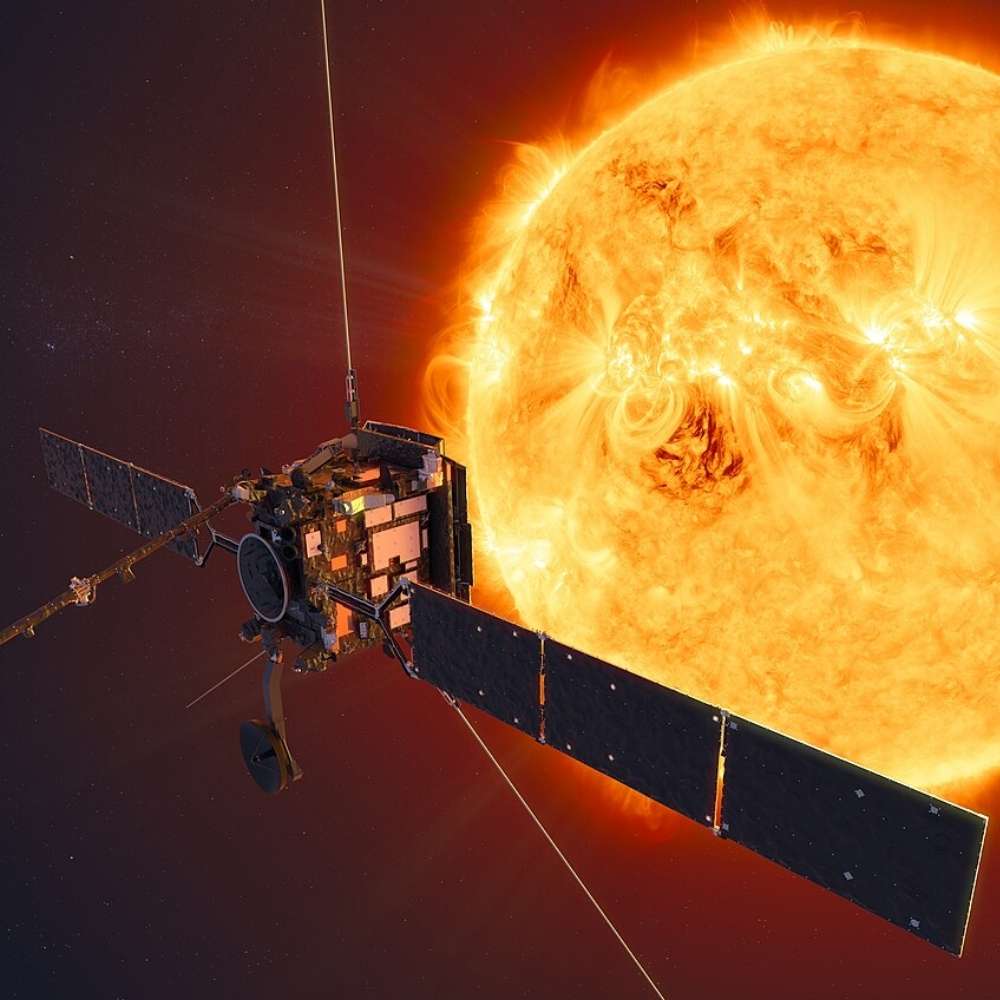
Solar Orbiter is a next-generation solar physics mission led by the European Space Agency, with strong NASA participation.
Its core innovation is dual observation:
In-situ instruments directly sample solar particles and magnetic fields
Remote-sensing instruments image the Sun’s surface and atmosphere
This allows scientists to link what happens on the Sun with what is measured in space, something never achieved before at this level.
Why Solar Orbiter Is Not Just Another Solar Probe
Solar Orbiter is often compared to NASA’s Parker Solar Probe, but their goals are different.
Solar Orbiter focuses on:
Connecting solar surface features to solar wind streams
Understanding magnetic field generation and evolution
Observing the Sun’s poles directly
Studying how solar eruptions propagate into space
It is not designed to dive as deep as Parker, but to see more clearly and more comprehensively.
The Sun’s Poles – A Long-Standing Blind Spot
From Earth, the Sun’s poles are almost impossible to observe.
As a result, critical questions remain unanswered:
How is the Sun’s global magnetic field generated?
Why does the solar cycle reverse every ~11 years?
What role do polar magnetic fields play in solar storms?
Solar Orbiter gradually tilts its orbit out of the ecliptic plane, eventually reaching high solar latitudes and providing the first direct views of the Sun’s poles.
A Mission Built Around the Solar Cycle
The Sun is not constant. Its activity rises and falls in an approximately 11-year cycle.
Solar Orbiter was timed to:
Observe the buildup toward solar maximum
Track magnetic field reversals
Study the origin of major solar eruptions
By observing the Sun over multiple years, the mission captures cause-and-effect relationships, not just snapshots.
The Instruments – Seeing and Touching the Sun
Solar Orbiter carries 10 scientific instruments, split evenly between two roles.
Remote-Sensing Instruments
These observe the Sun directly:
High-resolution visible and ultraviolet imagers
Spectrometers to measure temperature and motion
Coronagraphs to study the solar corona
They reveal where energy is released on the Sun.
In-Situ Instruments
These sample the space environment around the spacecraft:
Solar wind particles
Magnetic field fluctuations
Energetic particles from solar eruptions
They reveal how solar activity propagates outward through space.
Why Distance Matters
Solar Orbiter approaches the Sun close enough to:
Reduce blurring caused by solar wind turbulence
Observe smaller-scale magnetic structures
Measure young solar wind before it evolves
At these distances, scientists can study solar processes closer to their source than ever before.
Thermal Engineering Near the Sun
Near its closest approach, Solar Orbiter experiences intense solar heating.
To survive, it uses:
A heat shield capable of withstanding ~500°C
Precisely angled apertures for telescopes
Strict spacecraft orientation control
Specialized solar arrays that partially fold away
Without these measures, scientific instruments would fail rapidly.
Why Solar Orbiter Matters
Solar Orbiter addresses questions that affect not only astronomy, but modern civilization.
Its findings help explain:
Space weather that affects satellites and power grids
Radiation hazards for astronauts
Long-term solar variability and climate influence
Understanding the Sun is not optional — it is essential.
The Scientific Payload – Instruments Built for Solar Extremes
Solar Orbiter carries a carefully balanced payload designed to study the Sun as a complete system.
Its ten instruments are divided into remote-sensing and in-situ categories, allowing scientists to directly connect solar surface events with their effects in space.
This combined approach is central to the mission’s scientific power.
Remote-Sensing Instruments – Watching the Sun at Its Source
Remote-sensing instruments observe the Sun itself, capturing the processes that drive solar activity.
High-Resolution Imaging of the Solar Surface
Key instruments include:
EUI (Extreme Ultraviolet Imager) – Captures fine-scale structures in the solar atmosphere
PHI (Polarimetric and Helioseismic Imager) – Measures magnetic fields and internal solar motions
SPICE (Spectral Imaging of the Coronal Environment) – Studies plasma composition and temperature
These instruments allow scientists to:
Trace magnetic field lines from the surface into the corona
Identify the origins of solar wind streams
Study how energy is transported through the solar atmosphere
Observing the Corona and Solar Eruptions
Solar Orbiter also observes the Sun’s outer atmosphere.
Important tools include:
Metis – A coronagraph imaging the solar corona
STIX (Spectrometer/Telescope for Imaging X-rays) – Observes X-rays from solar flares
These instruments help reveal:
How solar flares release enormous energy
Where coronal mass ejections originate
How magnetic reconnection occurs
In-Situ Instruments – Sampling the Solar Wind
While remote-sensing instruments observe the Sun, in-situ instruments directly sample the environment around the spacecraft.
Measuring Solar Wind and Magnetic Fields
Key instruments include:
MAG – Measures the solar magnetic field
SWA (Solar Wind Analyzer) – Detects ions, electrons, and heavy particles
EPD (Energetic Particle Detector) – Measures high-energy particles
These instruments allow scientists to:
Track solar wind properties near their source
Identify particle acceleration mechanisms
Measure turbulence in the heliosphere
Why In-Situ Measurements Matter
By measuring particles directly, Solar Orbiter can:
Link solar surface activity to space weather events
Identify which solar regions produce fast and slow solar wind
Improve models that predict geomagnetic storms
This direct connection is one of the mission’s defining features.
Linking Cause and Effect – A First in Solar Science
Before Solar Orbiter, scientists faced a fundamental problem:
They could see solar activity, or they could measure its effects — but not both in a coordinated way.
Solar Orbiter changes this by:
Imaging a specific region on the Sun
Sampling solar wind from that same region days later
Tracking how solar features evolve into heliospheric structures
This closes a major gap in solar physics.
Early Scientific Results
Even in its early phase, Solar Orbiter delivered transformative results.
Early findings include:
Detection of small-scale magnetic structures previously unresolved
Improved understanding of solar wind sources
First close-up images revealing fine coronal textures
Initial glimpses of the Sun’s polar regions
These results confirmed the mission’s core design philosophy.
The Sun’s Poles – First Close Observations
Solar Orbiter’s gradually inclined orbit allows it to observe high solar latitudes.
This enables:
Direct measurement of polar magnetic fields
Observation of polar plasma flows
Improved understanding of solar cycle reversals
The polar regions are key drivers of long-term solar behavior.
Solar Orbiter and Parker Solar Probe – A Complementary Pair
Solar Orbiter and Parker Solar Probe are often described as sister missions.
Their roles differ:
| Feature | Solar Orbiter | Parker Solar Probe |
|---|---|---|
| Closest Approach | ~0.28 AU | ~0.046 AU |
| Imaging | Yes | No |
| In-Situ Sampling | Yes | Yes |
| Polar Views | Yes | No |
| Mission Focus | Source-to-space linkage | Near-Sun plasma physics |
Together, they provide a complete picture of solar activity.
Why Solar Orbiter Improves Space Weather Prediction
Solar storms can disrupt:
Satellites
Communication systems
Power grids
Navigation signals
Solar Orbiter improves forecasting by:
Identifying storm source regions
Tracking solar wind evolution
Refining propagation models
This benefits both science and modern infrastructure.
What Scientists Hope to Fully Understand
Solar Orbiter was built to answer questions that have shaped solar physics for decades.
By combining close-up imaging with direct particle measurements, scientists expect to:
Identify the precise origins of fast and slow solar wind
Understand how magnetic energy is converted into heat and motion
Determine how solar eruptions accelerate particles to extreme energies
Explain how the Sun’s magnetic field is generated and reversed
These goals require long-term, multi-perspective observation — exactly what Solar Orbiter provides.
The Sun as a Heliospheric Engine
The Sun does not end at its visible surface.
It drives a vast bubble of influence called the heliosphere, extending far beyond Pluto.
Solar Orbiter helps clarify:
How the solar wind shapes the heliosphere
How magnetic structures propagate outward
How solar variability influences the entire Solar System
Understanding this engine is essential for placing planets, spacecraft, and interstellar boundaries in context.
The Importance of Polar Observations
The Sun’s poles control the long-term evolution of solar activity.
Solar Orbiter’s high-latitude views allow scientists to:
Measure polar magnetic field strength accurately
Observe plasma circulation near the poles
Track the buildup and decay of magnetic polarity
These observations are crucial for understanding why the solar cycle behaves the way it does — and why it sometimes behaves unexpectedly.
Long-Term Mission Legacy
Solar Orbiter is not a one-time experiment.
Its data will remain scientifically valuable for decades.
A Foundational Dataset
The mission will provide:
High-resolution maps of solar magnetic fields
Long-duration measurements across multiple solar cycles
A reference framework linking solar surface activity to space weather
Future solar missions will build directly on Solar Orbiter’s findings.
Influence on Stellar Physics
The Sun is the only star we can study in such detail.
Solar Orbiter’s discoveries will influence:
Models of stellar winds around other stars
Understanding of magnetic cycles in sun-like stars
Studies of exoplanet space weather environments
In this way, Solar Orbiter connects heliophysics to astrophysics.
Solar Orbiter and Human Space Activity
As human activity in space expands, understanding the Sun becomes increasingly critical.
Solar Orbiter supports:
Safer crewed missions beyond Earth orbit
Improved radiation risk assessment
Better protection of satellites and infrastructure
Its science directly supports future exploration of the Moon, Mars, and beyond.
Frequently Asked Questions (FAQ)
Is Solar Orbiter the closest mission to the Sun?
No. Parker Solar Probe approaches closer, but Solar Orbiter combines proximity with high-resolution imaging and polar observations.
Why does Solar Orbiter take years to reach high solar latitudes?
Orbital inclination changes require gravity assists, primarily from Venus, which gradually tilt the spacecraft’s orbit.
Can Solar Orbiter predict solar flares?
It improves understanding of flare origins and evolution, which enhances prediction models, but it is not a real-time warning system.
How long will Solar Orbiter operate?
The nominal mission is seven years, with possible extensions depending on spacecraft health and scientific return.
Why Solar Orbiter Matters for Universe Map
For Universe Map, Solar Orbiter represents the bridge between:
Stellar physics
Planetary environments
Space weather
Human technological vulnerability
It shows how one star governs an entire planetary system — and why understanding that star is essential.
Related Topics for Universe Map
The Sun
Heliosphere
Solar wind
Parker Solar Probe
Space weather
Stellar magnetic fields
Together, these topics define the dynamic environment in which all Solar System objects exist.
Final Perspective
Solar Orbiter is not simply observing the Sun — it is rewriting how we understand stellar influence.
By seeing the Sun up close, measuring its breath in real time, and revealing its hidden polar engines, Solar Orbiter transforms the Sun from a distant light source into a fully mapped, dynamic system.
In doing so, it reminds us that every planet, spacecraft, and living system in the Solar System exists within the Sun’s reach — shaped continuously by a star that is far from quiet.