




Kamo’oalewa
Earth’s Mysterious Quasi-Moon
Quick Reader
| Attribute | Details |
|---|---|
| Official Designation | 469219 Kamoʻoalewa |
| Provisional Name | 2016 HO₃ |
| Object Type | Near-Earth Asteroid (Quasi-satellite) |
| Orbital Relationship | Quasi-moon of Earth |
| Discovery Year | 2016 |
| Discoverers | Pan-STARRS survey |
| Orbital Period | ~365 days (similar to Earth) |
| Average Distance from Earth | ~38–100 lunar distances |
| Estimated Diameter | ~40–100 meters |
| Rotation Period | ~28 minutes |
| Origin Hypothesis | Possibly lunar ejecta |
| Orbital Stability | Stable for centuries (temporary) |
Why Kamoʻoalewa Is Special (Quick Context)
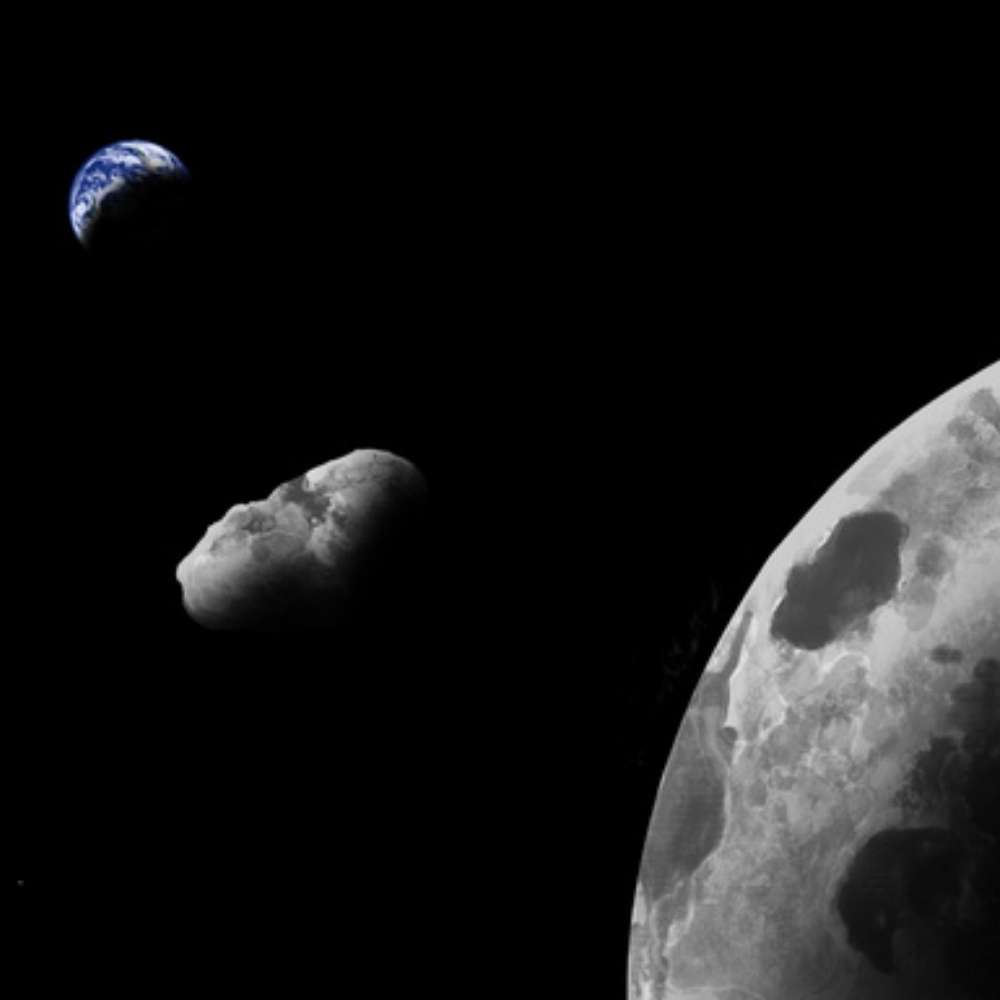
Kamoʻoalewa is not a true moon, yet it appears to orbit Earth. It follows the Sun, but its motion relative to Earth creates the illusion of a companion locked in a delicate gravitational dance.
Among all known near-Earth objects, it is the most stable and persistent quasi-satellite of our planet.
Key Insight Snapshot
- Earth’s closest and most stable quasi-moon
- Follows Earth for hundreds of years at a time
- May be a fragment blasted off the Moon itself
- A prime target for future sample-return missions
- Redefines what it means to “orbit” a planet
Introduction — Earth’s Second Moon That Isn’t a Moon
For centuries, Earth was thought to have only one natural satellite.
Kamoʻoalewa challenges that simple picture.
This small asteroid appears to circle Earth year after year, staying nearby, never drifting far away—yet it is not gravitationally bound like the Moon. Instead, it occupies a rare and subtle orbital state that makes it look like a second moon without ever becoming one.
Kamoʻoalewa reveals that Earth’s gravitational environment is far more complex than a single satellite system.
What Does “Quasi-Moon” Actually Mean?
A quasi-moon is an object that:
Orbits the Sun, not the planet
Has an orbital period similar to the planet
Appears to loop around the planet when viewed from that planet
In Earth’s reference frame, Kamoʻoalewa traces a slow, bean-shaped path around our planet. In reality, both Earth and Kamoʻoalewa are orbiting the Sun together, locked in a 1:1 resonance.
This makes quasi-moons fundamentally different from:
True moons (gravitationally bound satellites)
Temporary captured objects
Lagrange-point companions
Discovery — Found Late, Despite Being Close
Kamoʻoalewa was discovered in 2016, surprisingly late for an object that stays relatively close to Earth.
The reason it escaped detection for so long is simple:
It is very small
It reflects little sunlight
Its orbit keeps it near the Sun in Earth’s sky
Only with modern wide-field surveys like Pan-STARRS did astronomers finally identify it as a persistent quasi-satellite.
Orbital Behavior — A Delicate Gravitational Dance
Kamoʻoalewa’s orbit is one of the most stable quasi-satellite configurations known.
Key orbital characteristics explained in context:
It stays near Earth without being captured
It avoids close encounters that would destabilize it
Solar and terrestrial gravity remain finely balanced
Simulations show that Kamoʻoalewa has likely been in its current quasi-moon state for several hundred years and may remain so for several more—long by near-Earth object standards, but short on cosmic timescales.
Size, Shape, and Rotation — A Fast, Tiny World
Kamoʻoalewa is only tens of meters across, roughly the size of a small building.
Its rapid rotation—about 28 minutes per spin—suggests:
A solid, coherent body rather than a loose rubble pile
High internal strength
A violent past, possibly involving impact ejection
This fast spin rate makes it dynamically interesting and physically distinct from many other near-Earth asteroids.
The Lunar Origin Hypothesis — A Piece of the Moon?
One of the most compelling ideas about Kamoʻoalewa is that it may not be an asteroid at all—but a fragment of the Moon.
This hypothesis is supported by:
Spectral similarities to lunar surface material
Orbital characteristics consistent with Earth–Moon system ejection
Difficulty explaining its orbit through standard asteroid capture
If confirmed, Kamoʻoalewa would be:
The first known near-Earth object directly linked to lunar ejecta
A natural sample of the Moon, delivered without landing
This possibility has enormous implications for planetary science.
Why Kamoʻoalewa Matters Scientifically
Kamoʻoalewa is important because it:
Expands the definition of planetary companions
Demonstrates long-lived quasi-satellite dynamics
Offers insight into Earth–Moon impact history
Provides a nearby, accessible exploration target
It shows that small bodies can occupy stable, non-intuitive orbits for surprisingly long periods.
Why Space Agencies Are Interested
Because Kamoʻoalewa is:
Close to Earth
Energetically easy to reach
Potentially lunar in origin
It has been proposed as a target for sample-return missions, including concepts studied by Chinese space agencies. Studying it directly could answer questions about both asteroid dynamics and lunar geology.
Kamoʻoalewa in the Bigger Picture
Kamoʻoalewa connects multiple themes in Solar System science:
Near-Earth asteroids
Earth–Moon system evolution
Resonant orbital mechanics
Impact-generated debris
It reminds us that Earth does not travel alone through space—its gravitational influence creates companions that are subtle, temporary, and easily overlooked.
Quasi-Moon vs True Moon — Clearing a Common Confusion
Kamoʻoalewa is often described as Earth’s “second moon,” but this phrase is scientifically misleading.
A true moon is gravitationally bound to a planet and orbits it directly. Kamoʻoalewa does not.
Instead, both Earth and Kamoʻoalewa orbit the Sun, with Kamoʻoalewa locked into a subtle orbital resonance that keeps it near Earth.
Core Differences Explained
| Feature | True Moon (Moon) | Kamoʻoalewa |
|---|---|---|
| Primary Orbit | Earth | Sun |
| Gravitational Binding | Strong | Weak (indirect) |
| Long-term Stability | Billions of years | Hundreds–thousands of years |
| Orbital Shape (Earth frame) | Elliptical | Looping / bean-shaped |
| Classification | Natural satellite | Quasi-satellite |
This distinction matters because quasi-moons represent temporary dynamical states, not permanent planetary companions.
How the Quasi-Satellite Orbit Works
Kamoʻoalewa occupies a 1:1 mean-motion resonance with Earth.
In practical terms:
It takes nearly the same time to orbit the Sun as Earth does
It never strays far ahead or behind Earth
Earth’s gravity continually reshapes its path without capturing it
When viewed from Earth, this produces the illusion of a looping orbit around our planet.
From the Sun’s perspective, however, the path is smooth and unbroken.
Why Kamoʻoalewa Doesn’t Crash or Escape
The stability of Kamoʻoalewa’s orbit comes from balance, not strength.
Key stabilizing factors include:
Similar orbital period to Earth
Avoidance of close approaches
Continuous solar dominance
This balance prevents:
Collision with Earth
Permanent capture as a moon
Rapid ejection into interplanetary space
However, the stability is conditional, not permanent.
How Long Will Kamoʻoalewa Stay with Earth?
Numerical simulations suggest:
Kamoʻoalewa entered its current quasi-moon state a few hundred years ago
It may remain so for several hundred more years
Eventually, gravitational perturbations will shift its orbit
Future outcomes include:
Transition to a horseshoe orbit
Temporary capture into Earth orbit
Escape into a different near-Earth asteroid path
This makes Kamoʻoalewa a temporary companion on human timescales, but fleeting on cosmic ones.
Is Kamoʻoalewa Unique?
Kamoʻoalewa is the most stable Earth quasi-moon known, but it is not the only one.
Other objects briefly enter quasi-satellite states, but:
Most are unstable
Many persist only decades
Few remain near Earth for centuries
Kamoʻoalewa stands out because its orbit is unusually well-tuned to Earth’s motion.
Spectral Evidence — Clues to a Lunar Origin
Spectroscopic observations reveal that:
Kamoʻoalewa reflects light similarly to lunar regolith
Its surface does not match typical S-type or C-type asteroids
Its color and albedo resemble Moon-derived material
This strengthens the idea that it may have formed from debris ejected by a large lunar impact.
If confirmed, Kamoʻoalewa would be a natural lunar sample already in space.
Why Lunar Ejecta Can Become Quasi-Moons
When a large impact occurs on the Moon:
Some debris escapes lunar gravity
A fraction remains bound to the Earth–Moon system
Rarely, debris settles into a Sun-orbit that mirrors Earth’s
Such trajectories are:
Extremely rare
Dynamically fragile
Long-lived only under precise conditions
Kamoʻoalewa may be one of these rare survivors.
Exploration Potential — A Gateway Target
Kamoʻoalewa is scientifically attractive because it is:
Close to Earth
Low-energy to reach
Potentially Moon-derived
Studying it directly could:
Reveal lunar subsurface composition
Improve understanding of impact ejecta
Test quasi-satellite dynamics in situ
These factors make it a prime candidate for future robotic missions.
Why Kamoʻoalewa Changes How We See Earth’s Neighborhood
Earth’s space environment is not empty beyond the Moon.
Kamoʻoalewa shows that:
Earth can have temporary companions
Gravitational resonances create hidden structures
Near-Earth space is dynamically rich
It challenges the idea of a simple two-body Earth–Moon system.
The Ultimate Fate of Kamoʻoalewa — A Temporary Companion
Kamoʻoalewa’s relationship with Earth is stable, but not permanent.
Its quasi-satellite state exists because several gravitational influences—primarily the Sun and Earth—are delicately balanced. Over time, even small perturbations accumulate.
Long-term simulations indicate that Kamoʻoalewa will likely:
Drift out of its quasi-moon configuration
Transition into a horseshoe or near-Earth orbit
Eventually behave like a typical near-Earth asteroid
This evolution may take hundreds to a few thousand years, which is unusually long for a near-Earth object, but fleeting on astronomical timescales.
What matters is not how long it stays—but what its current state teaches us about orbital dynamics.
Why Kamoʻoalewa Is Dynamically Important
Kamoʻoalewa demonstrates that planetary neighborhoods are not static.
Its existence proves that:
Stable-looking orbital patterns can be temporary
Resonances create hidden companions without capture
Earth’s gravitational influence extends far beyond the Moon
This object occupies a transitional zone between asteroids, satellites, and resonant companions—blurring categories that once seemed clear.
Exploration and Mission Interest — Why Now Matters
Kamoʻoalewa’s accessibility makes timing critical.
Because it is relatively close to Earth and energetically easy to reach, space agencies view it as:
A low-cost scientific target
A potential testbed for near-Earth operations
A candidate for sample-return missions
If Kamoʻoalewa truly originated from the Moon, visiting it would provide lunar material without landing—an unprecedented opportunity to study subsurface lunar composition indirectly.
As its orbit evolves, this accessibility may change, making the current window especially valuable.
Frequently Asked Questions (Expanded)
Is Kamoʻoalewa a second moon of Earth?
No. It is not gravitationally bound to Earth. It orbits the Sun, but its motion relative to Earth creates the appearance of a companion.
Can Kamoʻoalewa ever become a true moon?
Permanent capture is extremely unlikely. Temporary capture is possible in theory, but long-term stability as a true moon is not supported by current models.
Is Kamoʻoalewa dangerous to Earth?
No. Its orbit does not pose an impact risk in the foreseeable future.
Why is Kamoʻoalewa so hard to observe?
It is small, faint, and often appears close to the Sun in Earth’s sky, making observations difficult except during favorable geometries.
Is it really made of lunar material?
Spectral evidence strongly suggests a lunar-like composition, but confirmation requires in-situ measurements or sample return.
Are there other quasi-moons of Earth?
Yes, but most are unstable and short-lived. Kamoʻoalewa is the most persistent known example.
Could quasi-moons exist around other planets?
Yes. Similar resonant companions are known around Venus and have been predicted for other planets, including Mars.
Why haven’t we learned about these objects earlier?
They are small, subtle, and require precise orbital analysis—something only modern surveys and computing power can provide.
Why Quasi-Moons Matter Beyond Earth
Kamoʻoalewa is not just an Earth story.
Quasi-satellites reveal:
How resonances shape planetary systems
How debris migrates after impacts
How temporary structures can persist for long periods
These insights apply to:
Planetary ring formation
Moon formation theories
Exoplanet systems with crowded orbital architectures
Studying quasi-moons helps astronomers understand how order emerges from gravitational complexity.
Kamoʻoalewa in the Universe Map Context
Within Universe Map, Kamoʻoalewa naturally connects to:
Near-Earth asteroids
Earth–Moon system evolution
Orbital resonances
Temporary satellite dynamics
Impact-generated debris
Together, these topics show that Earth’s cosmic environment is layered, dynamic, and still actively evolving.
Final Perspective
Kamoʻoalewa is small, faint, and easily overlooked—but conceptually powerful.
It shows that Earth does not simply move through space with a single companion. Instead, our planet participates in a shifting gravitational choreography, where objects can accompany us without ever belonging to us.
For a brief moment in cosmic time, Kamoʻoalewa is Earth’s shadow companion—quietly orbiting the Sun alongside us, reminding us that even familiar planetary systems still hold subtle, elegant surprises.