



Parker Solar Probe
Humanity’s First Mission to Touch the Sun
Quick Reader
| Attribute | Details |
|---|---|
| Mission Name | Parker Solar Probe |
| Mission Type | Solar probe (in-situ heliophysics mission) |
| Space Agency | NASA |
| Launch Date | 12 August 2018 |
| Primary Target | The Sun |
| Closest Approach | ~9.86 solar radii (~6.2 million km from the surface) |
| Orbit Type | Highly elliptical, progressively shrinking |
| Mission Duration | 7+ years (extended mission ongoing) |
| Key Firsts | Closest spacecraft ever to the Sun |
| Core Objective | Study the solar corona and solar wind at their source |
Key Insights
- Parker Solar Probe is the first spacecraft to enter the Sun’s corona
- It travels faster than any human-made object
- Designed to survive extreme heat using revolutionary thermal shielding
Introduction – Why We Had to Go to the Sun
For centuries, the Sun was studied from a safe distance.
Despite being our closest star, its most important processes remained hidden.
Two fundamental mysteries persisted:
Why is the solar corona hotter than the Sun’s surface?
How is the solar wind accelerated to extreme speeds?
Answering these questions required something radical:
a spacecraft that could fly directly into the Sun’s outer atmosphere and survive.
Parker Solar Probe was built to do exactly that.
What Is Parker Solar Probe?
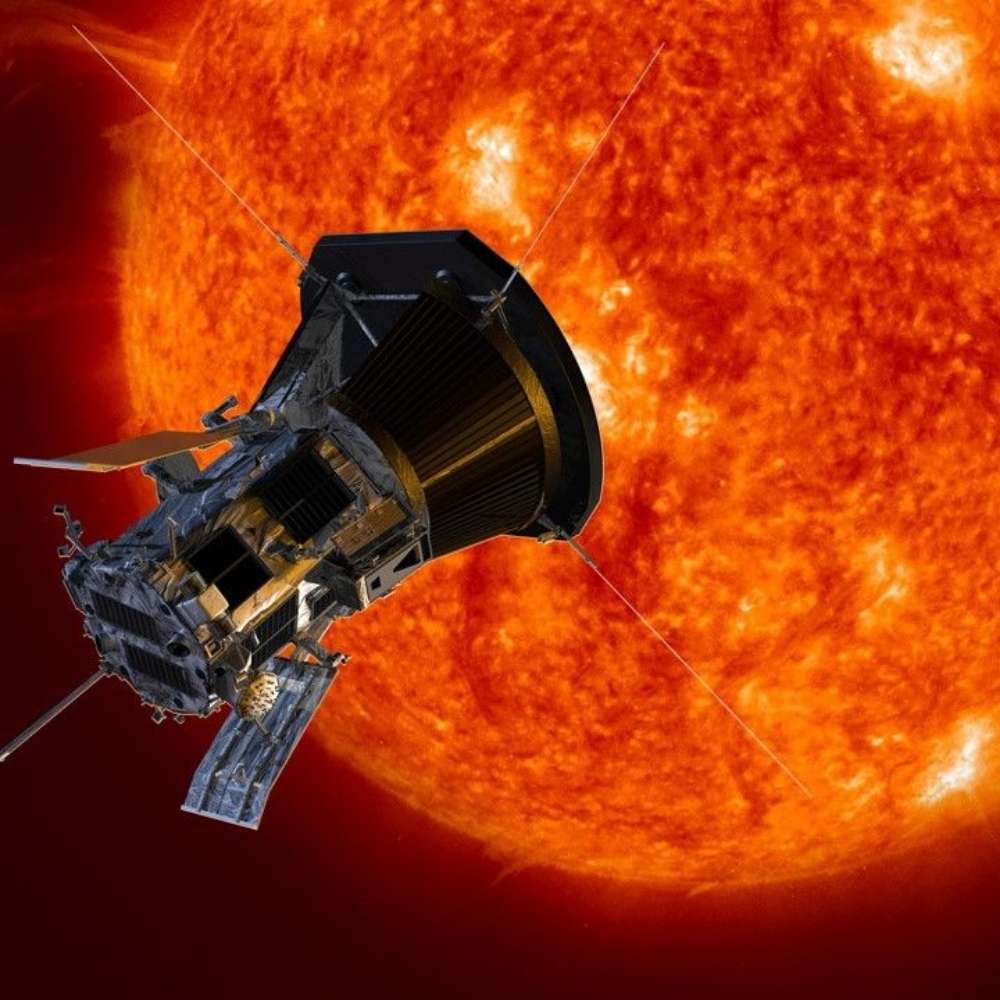
Parker Solar Probe is NASA’s first mission designed to directly sample the Sun’s corona.
Unlike traditional solar observatories that watch from afar, Parker Solar Probe:
Flies through solar plasma
Measures magnetic fields in real time
Samples energetic particles at their source
It does not take pictures of the Sun’s surface.
Its power lies in touching the environment where solar energy is born.
Why the Mission Is Named After Eugene Parker
The mission honors Dr. Eugene Parker, who in 1958 proposed the existence of the solar wind.
At the time:
His theory was controversial
It challenged established models
It lacked direct observational proof
Parker Solar Probe was launched during his lifetime, becoming the first NASA mission named after a living scientist — a rare recognition of transformative scientific insight.
The Two Great Solar Mysteries
1. The Coronal Heating Problem
The Sun’s visible surface is about 5,500°C.
The corona above it reaches millions of degrees.
This violates basic expectations of heat flow.
Parker Solar Probe investigates:
Magnetic wave heating
Turbulent energy dissipation
Magnetic reconnection at small scales
Understanding this explains how stars release energy into space.
2. The Origin of the Solar Wind
The solar wind shapes the entire Solar System.
Yet key questions remained:
Where exactly does it originate?
How is it accelerated so rapidly?
Why are there fast and slow streams?
Parker Solar Probe measures solar wind before it evolves, close to its birthplace.
How Close Is “Close” to the Sun?
Parker Solar Probe will eventually approach closer than any spacecraft before it.
To put this into perspective:
It flies closer than Mercury ever gets
It enters the Sun’s outer atmosphere
It experiences intense radiation and particle flux
At closest approach, sunlight is roughly 500 times stronger than at Earth.
The Heat Shield That Makes the Mission Possible
Survival near the Sun depends on one key technology: the Thermal Protection System (TPS).
The shield:
Is 11.4 cm thick
Is made of carbon-carbon composite
Withstands temperatures above 1,300°C
Keeps instruments near room temperature
Without this shield, the spacecraft would fail almost instantly.
A Mission Built on Gravity Assists
Reaching the Sun is not about speeding up — it is about slowing down.
Parker Solar Probe uses:
Multiple Venus flybys
Gradual orbital energy reduction
Increasingly close solar passes
Each flyby allows the spacecraft to dive deeper toward the Sun.
Why Parker Solar Probe Is Not a Telescope
A common misconception is that Parker Solar Probe is a solar imaging mission.
In reality:
It does not carry a traditional camera
It does not image the solar surface
Its instruments face sideways or backward
Its goal is measurement, not imagery.
Why Parker Solar Probe Matters
Parker Solar Probe represents a turning point in heliophysics.
It allows scientists to:
Test long-standing theories directly
Improve space weather models
Understand stellar winds beyond the Sun
Its data reshapes how we understand stars across the universe.
The Scientific Payload – Instruments Built to Survive the Corona
Parker Solar Probe carries a compact but highly specialized set of instruments.
Every component was designed with one priority: make precise measurements while flying through extreme solar conditions.
Unlike remote observatories, these instruments directly sample the environment where solar energy is generated and transported.
FIELDS – Measuring the Sun’s Invisible Structure
The FIELDS instrument suite measures electric and magnetic fields around the spacecraft.
It allows scientists to:
Map the structure of the Sun’s magnetic field
Detect plasma waves and turbulence
Study how energy moves through the corona
These measurements are essential for understanding how magnetic energy is converted into heat and motion.
SWEAP – Touching the Solar Wind
The Solar Wind Electrons Alphas and Protons (SWEAP) instruments directly sample particles streaming from the Sun.
They measure:
Particle density
Velocity and direction
Temperature of solar wind components
This provides the most direct evidence ever collected of how the solar wind forms and accelerates.
ISʘIS – Tracking Energetic Particles
The Integrated Science Investigation of the Sun (ISʘIS) focuses on high-energy particles.
It helps scientists understand:
How particles are accelerated during solar eruptions
Why some solar storms are more dangerous than others
How energetic particles propagate through space
These findings are crucial for astronaut safety and spacecraft design.
WISPR – The Only Imager on Board
Although Parker Solar Probe is not an imaging mission, it carries one camera system: WISPR.
WISPR observes:
Solar wind structures
Coronal mass ejections from within the corona
Dust and plasma interactions near the Sun
It provides visual context for the in-situ measurements, linking numbers to physical structures.
What Parker Solar Probe Has Already Discovered
Even before reaching its closest planned orbits, Parker Solar Probe delivered transformative results.
Key discoveries include:
Direct detection of magnetic “switchbacks” in the solar wind
Evidence that solar wind originates from small-scale magnetic structures
Measurements showing energy transport closer to the Sun than expected
These findings challenged long-held assumptions in solar physics.
Magnetic Switchbacks – A Major Surprise
One of the mission’s most important discoveries is the presence of magnetic switchbacks.
These are:
Sudden reversals in magnetic field direction
Associated with bursts of fast solar wind
Common close to the Sun
They suggest that the solar wind is far more structured and dynamic than previously believed.
Entering the Solar Corona
In a historic milestone, Parker Solar Probe crossed the Alfvén critical surface, officially entering the solar corona.
Inside this region:
Magnetic forces dominate particle motion
Solar plasma is tightly bound to the Sun
The solar wind has not yet fully formed
This was the first time a spacecraft operated within a star’s atmosphere.
Why These Measurements Were Impossible Before
Earlier missions could not approach close enough to:
Avoid solar wind mixing and evolution
Resolve fine-scale magnetic structures
Measure particles near their source
By flying through the corona itself, Parker Solar Probe removed decades of observational uncertainty.
Parker Solar Probe and Solar Orbiter – Different but Complementary
Parker Solar Probe and Solar Orbiter are often discussed together, but their roles are distinct.
| Aspect | Parker Solar Probe | Solar Orbiter |
|---|---|---|
| Closest Approach | Extremely close | Moderately close |
| Imaging | Minimal | High-resolution |
| Measurements | In-situ dominant | In-situ + imaging |
| Polar Views | No | Yes |
| Primary Goal | Local plasma physics | Source-to-space linkage |
Together, they form a complete solar exploration system.
Why Parker Solar Probe Changed Solar Physics
Parker Solar Probe shifted solar science from inference to measurement.
It provided:
Direct validation of long-standing theories
Evidence that small-scale processes dominate solar behavior
A new framework for understanding stellar winds
This marks a fundamental change in how stars are studied.
What Parker Solar Probe Ultimately Aims to Reveal
Parker Solar Probe was designed to resolve questions that define how stars interact with their surroundings.
As it completes its closest encounters, scientists expect to:
Pin down the dominant mechanisms heating the solar corona
Identify the precise sources of fast and slow solar wind
Quantify how magnetic turbulence transfers energy
Determine how and where energetic particles are accelerated
These outcomes are not incremental. They redefine the physical picture of how a star sheds energy and matter.
Crossing a Boundary No Spacecraft Had Reached Before
One of the mission’s most profound achievements is repeatedly crossing the Alfvén critical surface.
Outside this surface, the solar wind flows freely.
Inside it, magnetic forces still dominate and control particle motion.
Operating within this region allows scientists to observe:
Where the solar wind truly “breaks free”
How magnetic structures detach from the Sun
How energy transitions from magnetic control to particle flow
This boundary was theoretical for decades. Parker Solar Probe turned it into a measured reality.
Why These Discoveries Matter for Space Weather
Space weather affects far more than scientific instruments.
Solar storms can:
Damage satellites
Disrupt navigation and communication
Stress power grids
Endanger astronauts
Parker Solar Probe improves space weather science by revealing how dangerous events form, not just how they arrive at Earth. That distinction is essential for improving predictive models.
From Solar Physics to Stellar Physics
The Sun is the only star we can study at this level of detail.
What Parker Solar Probe teaches us applies to:
Other sun-like stars
Young, active stellar systems
Exoplanet environments exposed to intense stellar winds
Many exoplanets orbit much closer to their stars than Earth does to the Sun. Parker Solar Probe helps define the conditions such worlds experience.
The Long-Term Scientific Legacy
Parker Solar Probe’s data will remain valuable long after the mission ends.
A Reference for Future Generations
The mission provides:
The first direct measurements inside a stellar corona
Baseline data for solar wind formation
Ground truth for heliospheric models
Future missions will interpret their findings in light of Parker’s measurements.
Influence on Mission Design
The mission’s success reshapes how extreme-environment spacecraft are designed.
Its legacy includes:
Proven thermal protection strategies
Validation of close-approach mission profiles
New standards for radiation and plasma instrumentation
These lessons extend beyond solar missions.
Frequently Asked Questions (Expanded)
Is Parker Solar Probe actually touching the Sun?
Not physically. It flies through the Sun’s outer atmosphere, the corona, where solar plasma and magnetic fields dominate.
Why doesn’t Parker Solar Probe melt?
It stays behind a heat shield that blocks direct sunlight. While the shield reaches extreme temperatures, the instruments remain near room temperature.
Can Parker Solar Probe see the Sun’s surface?
No. It is not designed to image the photosphere. Its instruments focus on measuring particles, fields, and plasma conditions.
How fast does Parker Solar Probe travel?
At closest approach, it becomes the fastest human-made object, moving faster than any previous spacecraft.
Does Parker Solar Probe replace Solar Orbiter?
No. Parker Solar Probe measures local plasma conditions extremely close to the Sun, while Solar Orbiter provides imaging, context, and polar views. The missions are complementary.
How long will the mission continue?
The nominal mission lasts over seven years, with extensions possible depending on spacecraft health and scientific return.
Will there ever be a mission that goes even closer?
Possibly, but Parker Solar Probe already approaches the practical limit set by materials science and thermal protection.
Why Parker Solar Probe Matters for Universe Map
For Universe Map, Parker Solar Probe represents a category-defining mission.
It connects:
The Sun as a star
The heliosphere as a dynamic system
Planetary environments shaped by stellar winds
The limits of human engineering
It shows that understanding the Solar System requires not just distant observation, but direct immersion in extreme environments.
Related Topics for Universe Map
The Sun
Solar corona
Solar wind
Heliosphere
Solar Orbiter
Sun–Earth Lagrange points
Together, these topics explain how the Sun governs space from its surface to the outermost boundaries of the Solar System.
Final Perspective
Parker Solar Probe changed solar science by doing something deceptively simple:
it went where the physics actually happens.
By flying into the Sun’s atmosphere, it replaced decades of inference with direct measurement. The mission proved that the Sun’s behavior is shaped by countless small-scale magnetic processes, not just large, dramatic eruptions.
In touching the Sun’s corona, Parker Solar Probe did more than set records.
It transformed our understanding of how stars work — starting with the one that makes life on Earth possible.