





IKAROS
The First Spacecraft to Demonstrate Interplanetary Solar-Sail Navigation
Quick Reader
| Attribute | Details |
|---|---|
| Mission Name | IKAROS |
| Full Name | Interplanetary Kite-craft Accelerated by Radiation Of the Sun |
| Mission Type | Solar sail technology demonstrator |
| Operating Agency | JAXA (Japan Aerospace Exploration Agency) |
| Launch Date | 21 May 2010 |
| Launch Vehicle | H-IIA rocket |
| Primary Target | Venus flyby |
| Sail Size | ~14 × 14 meters (≈200 m²) |
| Sail Material | Ultra-thin polyimide film |
| Propulsion Method | Solar radiation pressure |
| Power Generation | Thin-film solar cells embedded in the sail |
| Mission Status | Technology success mission (completed) |
Why IKAROS Is Special (Quick Context)
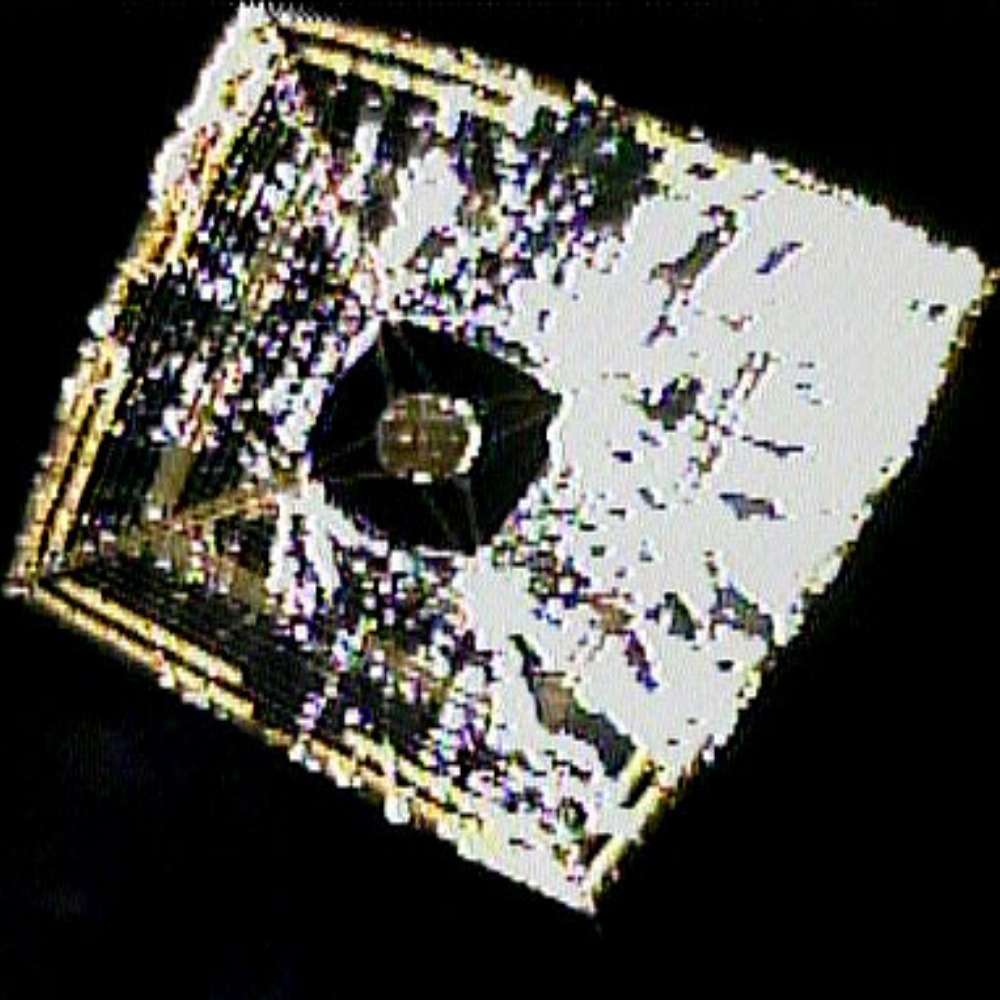
IKAROS was the first spacecraft in history to demonstrate controlled interplanetary flight using a solar sail. It proved that sunlight itself can be used not only for power, but also for propulsion, navigation, and attitude control in deep space.
Key Insight Snapshot
- First successful solar sail spacecraft
- First operational use of photon pressure for navigation and control
- First solar sail with embedded thin-film solar cells
- First solar sail mission to operate in interplanetary space
- Laid the foundation for future fuel-free deep-space travel
Introduction — Sailing on Sunlight
For centuries, sails harnessed wind to cross Earth’s oceans.
IKAROS asked a radical question:
Can a spacecraft sail on sunlight itself?
In 2010, Japan answered that question with a historic yes.
IKAROS did not rely on chemical fuel or ion engines for propulsion. Instead, it used the tiny but constant pressure of photons streaming from the Sun—an idea proposed by scientists decades earlier, but never proven at interplanetary scale.
What Is a Solar Sail? (Concept Explained Clearly)
A solar sail works on a simple physical principle:
Sunlight carries momentum
When photons strike a reflective surface, they transfer a tiny push
Over time, that push adds up
Unlike rockets:
No fuel is consumed
Acceleration is continuous
Speed increases gradually but indefinitely
Solar sails trade short-term power for long-term efficiency—making them ideal for deep-space missions.
Why IKAROS Was a Breakthrough
Before IKAROS, solar sails were:
Theoretical
Tested only in small-scale experiments
Never used for real navigation
IKAROS proved three critical things at once:
A large sail can deploy reliably in space
Solar radiation pressure can be measured and controlled
A spacecraft can adjust its trajectory using light alone
This combination had never been achieved before.
Mission Design — Simple in Concept, Radical in Execution
IKAROS was launched as a secondary payload alongside the Akatsuki Venus Climate Orbiter.
After launch:
The spacecraft spun to stabilize itself
Centrifugal force unfolded the sail gradually
The sail expanded into a square shape
Once deployed, IKAROS became a cosmic kite, stretched and steered by sunlight.
The Solar Sail Itself — Engineering at the Edge
IKAROS’s sail was a marvel of materials science.
Key characteristics:
Thickness of only a few micrometers
Total mass of just a few kilograms
Embedded thin-film solar cells
Reflective surface optimized for photon pressure
This made IKAROS both:
A propulsion system
A power generator
The sail was not just passive—it was functional infrastructure.
Attitude and Control — Steering with Light
One of IKAROS’s greatest achievements was active control.
The spacecraft used:
Variable reflectivity panels
Liquid crystal devices
Differential photon pressure
By changing how much light different parts of the sail reflected, IKAROS could:
Adjust orientation
Control spin rate
Fine-tune its trajectory
This proved that solar sails can be steered, not just pushed.
Venus Flyby — Proving Interplanetary Capability
IKAROS successfully flew past Venus, demonstrating that solar sail propulsion works beyond Earth orbit.
This confirmed that:
Solar sails function reliably in deep space
Navigation accuracy is sufficient for planetary encounters
The concept scales beyond experimental missions
The Venus flyby elevated IKAROS from a test craft to a true interplanetary explorer.
Why IKAROS Matters Scientifically
IKAROS matters because it:
Validated decades of theoretical physics
Opened a new propulsion category
Reduced reliance on onboard fuel
Enabled long-duration missions
It showed that propulsion does not always require burning mass—sometimes, light is enough.
IKAROS in the Bigger Picture
IKAROS represents a shift in how humanity thinks about space travel:
From explosive launches to continuous acceleration
From fuel-limited missions to endurance-based exploration
From short hops to long voyages
It marks the moment when solar sailing became real.
Measuring Photon Pressure — Turning Theory into Data
One of IKAROS’s most important scientific achievements was directly measuring the pressure exerted by sunlight on a spacecraft.
Before IKAROS, solar radiation pressure was included in spacecraft models—but never isolated and confirmed as a primary propulsion force.
IKAROS changed that.
By precisely tracking its trajectory and comparing predicted paths with and without photon pressure, engineers demonstrated that:
The spacecraft’s acceleration matched theoretical predictions
Sunlight alone produced measurable changes in velocity
The sail’s reflectivity directly influenced motion
This was the first time photon pressure was used as verifiable propulsion, not just a perturbation.
Active Control Experiments — Proving Solar Sailing Is Steerable
Solar sailing is only useful if it can be controlled.
IKAROS conducted a series of deliberate experiments to show that its motion was not passive.
Engineers varied:
Sail orientation
Reflectivity across the sail
Spin rate
These adjustments resulted in:
Controlled changes in trajectory
Predictable alterations in acceleration
Stable attitude control without thrusters
This proved that solar sails can function as precision navigation systems, not just drifting platforms.
Thin-Film Solar Cells — Power and Propulsion Combined
IKAROS was the first spacecraft to integrate solar power generation directly into its sail.
This dual-purpose design solved two major challenges:
Power generation without rigid solar panels
Mass reduction for large-area structures
The thin-film solar cells:
Generated sufficient electrical power
Functioned despite constant flexing
Did not compromise sail reflectivity
This concept laid the groundwork for self-powered sails in future missions.
Communications and Telemetry Challenges
Operating a spinning, flexible spacecraft millions of kilometers from Earth was not trivial.
Challenges included:
Maintaining antenna alignment
Managing power fluctuations
Interpreting data from a deformable structure
Despite these difficulties, IKAROS successfully transmitted:
Sail deployment data
Attitude measurements
Acceleration metrics
This validated communication strategies for non-rigid spacecraft.
Comparing IKAROS with Other Solar Sail Missions
IKAROS did not remain alone for long. Its success opened the door for later solar sail experiments by other space agencies and organizations.
| Mission | Agency | Key Contribution |
|---|---|---|
| IKAROS | JAXA | First controlled interplanetary solar sail |
| NanoSail-D2 | NASA | First deployed solar sail in Earth orbit |
| LightSail 1 & 2 | The Planetary Society | Demonstrated solar sailing in Earth orbit |
| NEA Scout | NASA | Solar sail CubeSat mission targeting asteroids |
IKAROS remains unique because it was:
- The first solar sail spacecraft to operate beyond Earth orbit
- The first to demonstrate active sail control in deep space
Later solar sail missions built directly on the technological and operational foundations proven by IKAROS.
Strengths of Solar Sail Propulsion
Solar sails offer advantages unmatched by conventional systems:
No propellant consumption
Continuous acceleration
Extremely long mission lifetimes
Scalability for large structures
For missions lasting decades, solar sails may outperform chemical or ion propulsion in total velocity change.
Limitations and Trade-Offs
Solar sailing is not a universal solution.
Key limitations include:
Weak acceleration near launch
Reduced effectiveness far from the Sun
Large deployment and control challenges
Solar sails are best suited for:
Long-duration missions
Inner Solar System exploration
Gradual orbital changes
IKAROS helped define where solar sails make sense—and where they do not.
Scientific Impact of IKAROS
IKAROS’s contributions extend beyond engineering.
It influenced:
Orbital dynamics modeling
Spacecraft attitude control theory
Materials science for ultra-light structures
Mission planning for fuel-free propulsion
It turned solar sailing from a speculative idea into a practical tool.
Why IKAROS Changed Mission Design Philosophy
IKAROS proved that spacecraft do not need to carry all the energy they will ever use.
Instead, they can:
Interact with their environment
Harvest natural forces
Convert constants (like sunlight) into motion
This philosophy aligns with sustainable, long-term exploration.
IKAROS’s Legacy — From Demonstration to Paradigm Shift
IKAROS was officially a technology demonstrator, but its impact went far beyond proving a concept.
It changed how propulsion is categorized in planetary science.
Before IKAROS, propulsion meant expelling mass.
After IKAROS, propulsion could mean interacting with the environment—using sunlight itself as momentum.
Its success established solar sailing as a legitimate, flight-proven propulsion method, not a laboratory curiosity.
How IKAROS Influenced Future Missions
Many later missions adopted ideas first validated by IKAROS:
Large-area, ultra-light deployable structures
Spin-stabilized spacecraft with flexible components
Continuous low-thrust trajectory design
Environment-driven propulsion concepts
Solar sail projects that followed—both governmental and private—were designed with IKAROS as their reference baseline, especially for deployment reliability and control logic.
Future Solar Sail Missions Inspired by IKAROS
IKAROS opened the door to mission concepts that were previously impractical.
Examples include:
Asteroid reconnaissance missions using long-duration sailing
Inner Solar System probes that spiral inward toward the Sun
Heliophysics missions hovering at non-Keplerian positions
Precursor interstellar probes using sunlight first, then other forces
The idea of reaching extreme orbits without massive fuel reserves became realistic only after IKAROS.
Solar Sails and the Road to Interstellar Space
While IKAROS itself was not designed for interstellar travel, it validated a key stepping stone.
Solar sails can:
Build velocity over years
Reach trajectories unreachable by chemical propulsion
Serve as acceleration stages for advanced concepts
Future missions may combine:
Solar sailing near the Sun
Gravity assists
Laser-assisted photon pressure
In that sense, IKAROS represents the first practical chapter in a much longer story of light-driven exploration.
Frequently Asked Questions (Expanded)
Did IKAROS reach Venus?
IKAROS performed a successful Venus flyby, demonstrating that solar sailing works during interplanetary navigation, not just in Earth orbit.
Was IKAROS powered only by sunlight?
Yes. Sunlight provided both propulsion (via photon pressure) and electrical power (via thin-film solar cells).
How strong is photon pressure?
Extremely weak—but constant. Over months and years, this small force produces meaningful velocity changes.
Can solar sails replace rockets?
No. Rockets are still required for launch. Solar sails are most effective after reaching space, especially for long-duration missions.
Why aren’t all spacecraft using solar sails now?
Solar sails are mission-specific. They work best for gradual trajectory changes, not for rapid maneuvers or deep-space regions far from the Sun.
Is IKAROS still operating?
The mission is considered complete. Its primary objective—demonstrating solar sail propulsion—was fully achieved.
What made IKAROS different from later solar sail missions?
IKAROS was the first to combine propulsion, power generation, and active control in deep space—setting the standard others followed.
Why IKAROS Matters Beyond Engineering
IKAROS changed more than spacecraft design—it changed mindsets.
It showed that:
Natural forces can be engineered, not just endured
Spacecraft can be adaptive, not rigid
Long-term thinking can outperform brute force
This shift influences how scientists think about sustainability, endurance, and scalability in space exploration.
IKAROS in the Universe Map Context
Within Universe Map, IKAROS connects naturally to:
Solar sail technology
Advanced propulsion systems
Interplanetary mission design
Deep-space navigation
Future interstellar exploration concepts
Together, these topics show how physics, engineering, and patience combine to expand humanity’s reach.
Final Perspective
IKAROS did something deceptively simple—it unfolded a thin sail and let sunlight push it.
But in doing so, it proved that exploration does not always require fire, fuel, or force. Sometimes, progress comes from understanding how to ride the forces that are already there.
IKAROS marks the moment humanity stopped merely traveling through space—and began to sail it.