



2002 VE₆₈
Venus’s Elusive Quasi-Moon
Quick Reader
| Attribute | Details |
|---|---|
| Official Designation | 2002 VE₆₈ |
| Object Type | Near-Earth Asteroid (Quasi-satellite) |
| Orbital Relationship | Quasi-moon of Venus |
| Discovery Year | 2002 |
| Discoverers | Lowell Observatory Near-Earth Object Search (LONEOS) |
| Orbital Period | ~225 days (nearly Venus’s year) |
| Resonance | 1:1 with Venus |
| Typical Distance from Venus | Tens of millions of kilometers (variable) |
| Estimated Size | ~200–300 meters |
| Orbital Stability | Temporary (thousands of years) |
| Other Influences | Strongly perturbed by Earth and Mercury |
Why 2002 VE₆₈ Is Special (Quick Context)
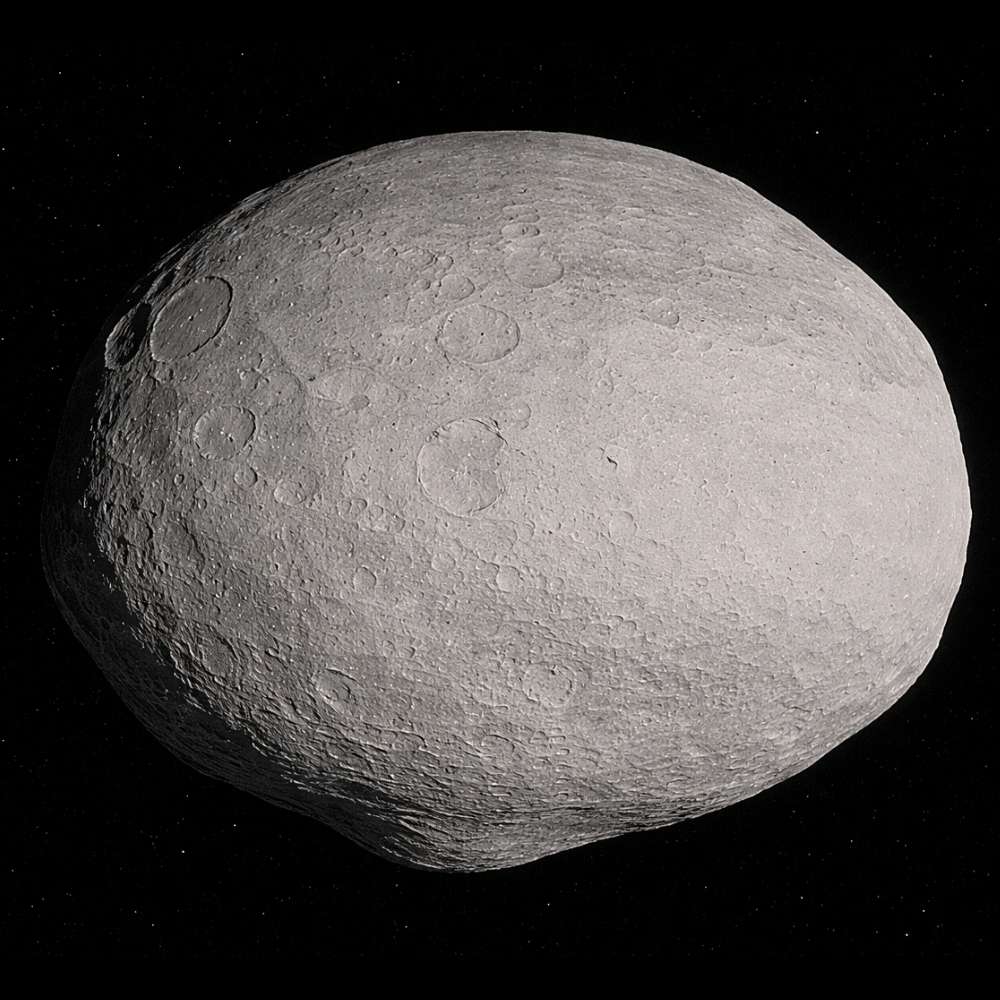
2002 VE₆₈ is the most well-studied quasi-moon of Venus—an object that appears to orbit Venus while actually circling the Sun.
It demonstrates that quasi-satellite states are not unique to Earth and can exist even within the dynamically chaotic inner Solar System.
Key Insight Snapshot
- A long-lived quasi-moon of Venus
- Locked in a 1:1 resonance without permanent gravitational capture
- Strongly influenced by Earth and Mercury
- Evidence that quasi-satellites can persist close to the Sun
- Challenges the idea that inner planets lack natural companions
Introduction — Venus Has a Companion Too
Earth is not the only planet with a quasi-moon.
Hidden in the glare of the inner Solar System, 2002 VE₆₈ quietly accompanies Venus, maintaining a delicate gravitational relationship that mimics satellite behavior without true capture. For long periods, it remains near Venus, looping around it in the planet’s rotating frame—yet it never becomes a real moon.
Its existence reveals that Venus’s gravitational environment, often considered simple and empty, is actually dynamically rich and subtly structured.
What Makes a Venus Quasi-Moon Different from Earth’s?
At first glance, quasi-moons seem similar across planets—but Venus’s environment makes 2002 VE₆₈ particularly interesting.
Key differences explained:
Venus orbits closer to the Sun, increasing solar perturbations
Nearby planets (Earth and Mercury) strongly influence trajectories
Orbital resonances are more fragile in the inner Solar System
That 2002 VE₆₈ survives at all is evidence of remarkably precise orbital tuning.
Discovery — Found Among Near-Earth Asteroids
2002 VE₆₈ was discovered during surveys focused on potentially hazardous near-Earth objects.
Initially, it appeared unremarkable—just another asteroid with an eccentric orbit. Only later did orbital analysis reveal that:
Its period closely matches Venus’s year
It remains near Venus for extended durations
It cycles between quasi-satellite and horseshoe states
This highlights how dynamical identity often emerges long after discovery, once enough data accumulates.
Orbital Mechanics — How 2002 VE₆₈ “Orbits” Venus
2002 VE₆₈ does not orbit Venus directly.
Instead:
It orbits the Sun
Its orbital period nearly matches Venus’s
Venus’s gravity reshapes its path without binding it
From Venus’s perspective, the asteroid traces looping paths around the planet. From the Sun’s perspective, the motion is smooth and continuous.
This duality—appearance versus reality—is central to understanding quasi-satellites.
A Highly Dynamic Life — Switching Orbital States
Unlike Earth’s Kamoʻoalewa, 2002 VE₆₈ does not remain permanently in one configuration.
Over time, it transitions between:
Quasi-satellite state
Horseshoe orbit
Near-resonant companion state
These transitions occur because gravitational nudges from Earth and Mercury slowly reshape its orbit.
This makes 2002 VE₆₈ a natural laboratory for resonance instability.
Physical Characteristics — What Kind of Object Is It?
Although direct imaging is limited, observations suggest:
A rocky, likely S-type composition
A size large enough to survive repeated perturbations
No evidence of cometary activity
Its durability may explain why it can remain near Venus longer than many other inner Solar System objects.
Why 2002 VE₆₈ Matters Scientifically
2002 VE₆₈ is important because it:
Confirms that quasi-satellites exist beyond Earth
Demonstrates resonance survival in the inner Solar System
Reveals how planetary neighborhoods exchange companions
Helps refine models of near-planet orbital dynamics
It shows that temporary companionship is a common gravitational outcome, not an Earth-specific anomaly.
2002 VE₆₈ in the Bigger Picture
This object links multiple themes:
Near-Earth asteroid dynamics
Inner Solar System chaos
Resonant orbital mechanics
Planetary neighborhood structure
It quietly undermines the idea that planets travel alone—even when they appear to.
2002 VE₆₈ vs Kamoʻoalewa — Two Quasi-Moons, Two Very Different Worlds
At first glance, 2002 VE₆₈ and Earth’s quasi-moon Kamoʻoalewa appear similar. Both are small asteroids locked in a 1:1 orbital resonance with a planet.
Dynamically, however, they live very different lives shaped by the environments of their host planets.
| Feature | 2002 VE₆₈ (Venus) | Kamoʻoalewa (Earth) |
|---|---|---|
| Host Planet | Venus | Earth |
| Solar Distance | Inner Solar System | Near Earth–Sun distance |
| Orbital Stability | Intermittent | Relatively persistent |
| Major Perturbers | Earth, Mercury | Moon, Earth |
| Quasi-Moon Duration | Episodic | Centuries-long |
| Orbital Behavior | Highly chaotic | Moderately stable |
Interpretation
Kamoʻoalewa persists because Earth’s orbital environment is comparatively calm, allowing its quasi-satellite state to remain stable for centuries.
2002 VE₆₈, by contrast, survives despite the intense gravitational chaos of the inner Solar System—making its repeated persistence as Venus’s quasi-moon far more surprising.
Why Venus Cannot Keep a True Moon
Venus is famously moonless, and this is not a coincidence.
Key reasons explained clearly:
Venus orbits close to the Sun, shrinking its gravitational sphere of influence
Solar tides overpower Venus’s ability to hold small satellites
Long-term stable satellite orbits are dynamically forbidden
As a result:
Any captured object is eventually lost
Only indirect companions, like quasi-moons, can persist
2002 VE₆₈ exists precisely because it is not a true moon.
The Role of Earth and Mercury — Constant Disturbers
Unlike Earth’s quasi-moon system, Venus’s environment is crowded.
Gravitational effects include:
Earth repeatedly nudging 2002 VE₆₈ during close orbital alignments
Mercury adding additional resonance instability
The Sun dominating all motion more strongly than for Earth companions
These forces cause:
Gradual orbital drift
Transitions between resonant states
Eventual loss of the quasi-satellite configuration
2002 VE₆₈ survives by constantly adapting—not by settling.
Orbital Transitions — A Dynamical Shape-Shifter
Numerical simulations show that 2002 VE₆₈ does not remain in one state indefinitely.
Over thousands of years, it cycles through:
Quasi-satellite loops
Horseshoe-shaped paths
Near-resonant drifting phases
These transitions illustrate an important principle:
Resonance is not a fixed location—it is a process.
2002 VE₆₈ demonstrates how small bodies move through resonant “zones” rather than occupying static orbits.
Long-Term Stability — How Long Can This Last?
Current models suggest:
The present quasi-moon phase is temporary
The object has likely entered and exited this state multiple times
Long-term survival near Venus is measured in thousands, not millions, of years
Eventually, outcomes may include:
Ejection into a different near-Earth orbit
Close planetary encounter altering its path
Transition into a non-resonant heliocentric orbit
This instability is a feature, not a flaw—it provides insight into resonance decay.
What 2002 VE₆₈ Teaches Us About Inner Solar System Dynamics
The inner Solar System is often treated as simple compared to the outer regions.
2002 VE₆₈ proves otherwise.
It shows that:
Resonant companions can exist even close to the Sun
Planetary neighborhoods are dynamically layered
Temporary structures can persist far longer than intuition suggests
This challenges simplified models of near-planet space.
Observational Challenges — Why Objects Like This Are Rarely Found
Studying 2002 VE₆₈ is difficult because:
It spends much of its time near the Sun’s glare
Orbital geometry limits observation windows
Small size reduces brightness
As survey technology improves, more Venus companions may be discovered—suggesting 2002 VE₆₈ might be the first known, not the only one.
Why 2002 VE₆₈ Matters Beyond Venus
This object informs more than Venus science.
Its dynamics help refine:
Resonance capture models
Near-Earth asteroid evolution
Stability limits for small-body companions
Exoplanet systems with tight inner orbits
What happens near Venus may mirror processes in compact planetary systems elsewhere.
The Ultimate Fate of 2002 VE₆₈ — A Companion That Cannot Stay
2002 VE₆₈ is not destined to remain with Venus forever.
Its quasi-satellite state exists only because multiple gravitational forces—primarily the Sun, Venus, Earth, and Mercury—are temporarily balanced. Over time, that balance shifts.
Long-term numerical simulations indicate that 2002 VE₆₈ will likely:
Exit its quasi-moon configuration
Transition into a horseshoe or near-resonant orbit
Eventually become an ordinary near-Earth asteroid
This process may take thousands to tens of thousands of years, which is long-lived for inner Solar System companions but short on cosmic timescales.
The key lesson is clear:
Venus can host companions—but only temporarily.
Why Venus Quasi-Moons Are Inherently Unstable
Venus’s position in the Solar System works against long-term companionship.
Several factors make stability difficult:
Strong solar tides due to Venus’s proximity to the Sun
Continuous perturbations from Earth’s gravity
Additional resonance interference from Mercury
Unlike Jupiter or even Earth, Venus lacks a large gravitational “buffer zone” where small bodies can settle permanently.
As a result, quasi-moons like 2002 VE₆₈ are visitors caught in resonance, not residents.
Is 2002 VE₆₈ Unique—or Just the First We Found?
There is no reason to believe 2002 VE₆₈ is alone.
Instead, it likely represents:
The most visible member of a transient population
Objects that drift in and out of Venus’s resonant neighborhood
A class that is difficult to detect due to solar glare
Future inner Solar System surveys may reveal:
Additional Venus quasi-satellites
Short-lived companions we have missed
A richer resonant environment than previously assumed
2002 VE₆₈ may be the prototype, not the exception.
Frequently Asked Questions (Expanded)
Is 2002 VE₆₈ a real moon of Venus?
No. It is not gravitationally bound to Venus. It orbits the Sun and only appears to circle Venus due to resonance.
Could Venus ever capture a permanent moon?
Current models suggest this is extremely unlikely. Solar tides destabilize long-term satellite orbits around Venus.
Is 2002 VE₆₈ dangerous to Earth?
No. While Earth perturbs its orbit, there is no known impact risk in the foreseeable future.
Why is this object more unstable than Earth’s quasi-moon?
Because Venus orbits closer to the Sun and lacks the stabilizing influence of a large moon like Earth’s.
How often does it switch orbital states?
On timescales of centuries to millennia, depending on planetary alignments.
Can quasi-moons exist around other planets?
Yes. They are known around Earth and Venus and are predicted around other planets as well.
Why don’t we see more Venus companions?
They are faint, small, and usually hidden in the Sun’s glare from Earth-based telescopes.
Why 2002 VE₆₈ Matters for Comparative Planetology
2002 VE₆₈ is valuable because it allows scientists to compare:
Earth vs Venus gravitational environments
Stability limits for small-body companions
How resonance behaves under strong solar influence
It shows that similar orbital mechanics can produce very different outcomes, depending on planetary context.
This comparative approach is essential for understanding both our own Solar System and compact exoplanetary systems.
2002 VE₆₈ in the Universe Map Context
Within Universe Map, 2002 VE₆₈ connects naturally to:
Quasi-satellites and resonant companions
Venus’s orbital environment
Inner Solar System dynamics
Near-Earth asteroid evolution
Earth–Venus comparative studies
Together, these topics reveal that planetary companionship is often temporary, subtle, and resonance-driven.
Final Perspective
2002 VE₆₈ is easy to overlook—a small asteroid hidden near the Sun, never forming a true orbit around Venus.
Yet conceptually, it is powerful.
It proves that even in the most gravitationally hostile regions of the Solar System, order can briefly emerge from chaos. Venus may not have moons, but for a while, it has companions—objects like 2002 VE₆₈ that travel alongside it, guided by resonance rather than capture.
In that sense, 2002 VE₆₈ reminds us that planetary systems are not static architectures, but living dynamical systems, constantly reshaping their own neighborhoods.