






Chang’e 5 Mission
China’s First Successful Lunar Sample Return Mission
Quick Reader
| Attribute | Details |
|---|---|
| Mission Name | Chang’e 5 |
| Mission Type | Robotic lunar sample return |
| Space Agency | CNSA (China National Space Administration) |
| Launch Date | 23 November 2020 |
| Landing Site | Oceanus Procellarum (near Mons Rümker) |
| Sample Returned | ~1.73 kg of lunar material |
| Return to Earth | 16 December 2020 |
| Spacecraft Elements | Orbiter, lander, ascender, return capsule |
| Historic First | First lunar sample return since 1976 |
| Mission Status | Completed successfully |
Key Insights
- Chang’e 5 returned the youngest lunar samples ever collected
- It marked China’s entry into elite sample-return capability
- The mission revived global lunar science after four decades
- Its results reshaped models of lunar volcanic history
Introduction – Why Returning Moon Samples Still Matters
At first glance, returning rocks from the Moon might seem like old science.
After all, Apollo missions did this decades ago.
But Chang’e 5 was not about repeating history — it was about answering questions Apollo could not.
Modern lunar science demands:
Precise age calibration
New geological regions
Improved laboratory techniques
Chang’e 5 delivered all three.
What Is Chang’e 5?
Chang’e 5 is China’s first fully successful robotic mission to collect lunar surface material and return it safely to Earth.
Unlike earlier Chang’e missions focused on orbiting or landing, Chang’e 5 was a multi-stage, highly complex operation, involving:
Automated surface sampling
Lunar ascent from the Moon
Orbital rendezvous around the Moon
High-speed reentry to Earth
This placed China among a very small group of nations capable of such missions.
Why the Mission Is Called “Chang’e”
The mission is named after Chang’e, the Moon goddess in Chinese mythology.
In legend:
Chang’e lives on the Moon
She symbolizes aspiration and exploration
Her story represents humanity’s reach beyond Earth
The Chang’e program reflects this symbolism — gradual, methodical steps toward deep-space capability.
Why Oceanus Procellarum Was Chosen
Chang’e 5 did not land where Apollo missions did.
It targeted Oceanus Procellarum, a vast volcanic plain on the Moon’s near side.
This region was chosen because:
It contains geologically young basalt
It was never sampled by Apollo or Luna missions
It preserves late-stage lunar volcanism
Scientists suspected these rocks could be 1–2 billion years younger than Apollo samples.
The Youngest Moon Rocks Ever Collected
Apollo samples are mostly 3–4 billion years old.
Chang’e 5 samples are much younger.
This matters because:
Crater-count dating relies on sample age calibration
Young samples refine the Moon’s impact timeline
Lunar chronology affects dating across the Solar System
Chang’e 5 provided a new anchor point for planetary science.
Mission Architecture – Four Spacecraft, One Goal
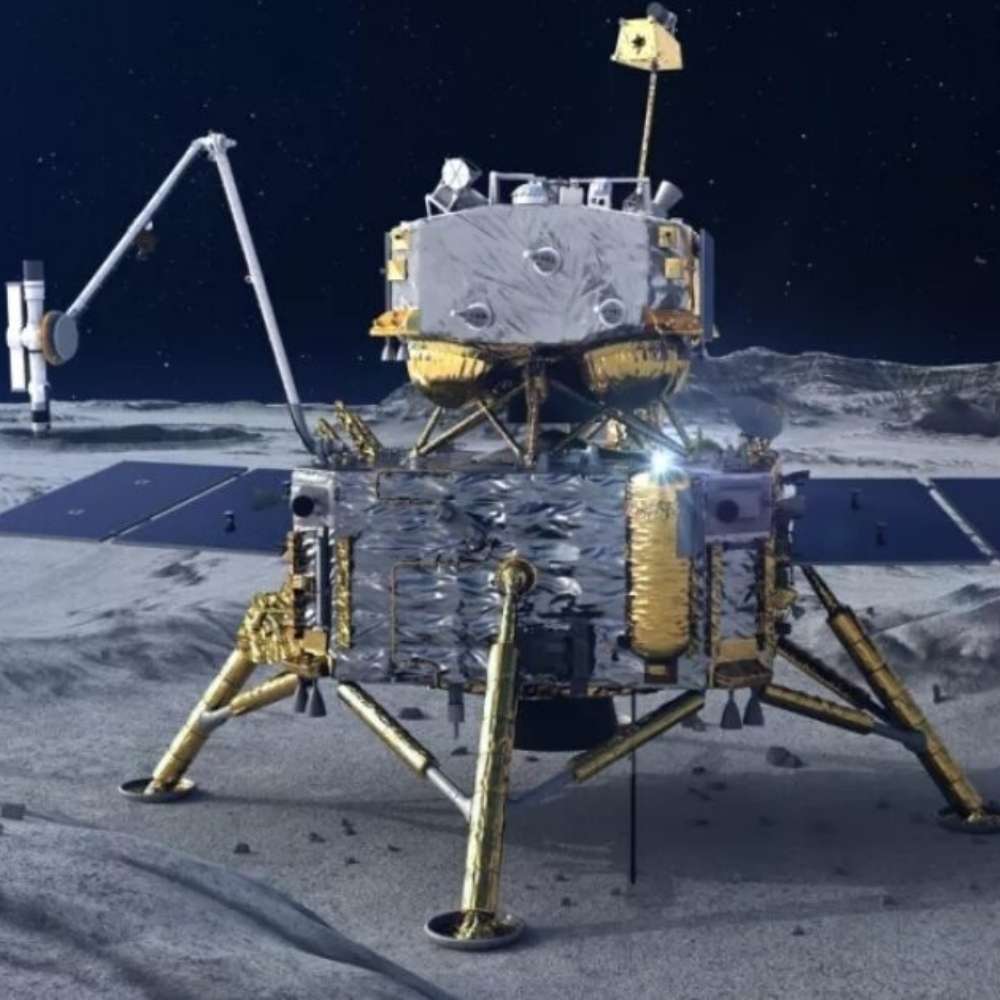
Chang’e 5 consisted of four coordinated elements:
Lander – Collected surface samples
Ascender – Launched samples from the Moon
Orbiter – Received samples in lunar orbit
Return Capsule – Delivered samples to Earth
This architecture had never before been executed by China — and only once before by the Soviet Union.
Autonomous Lunar Ascent – A Major First
After sample collection, Chang’e 5’s ascender:
Launched autonomously from the Moon
Entered lunar orbit
Performed robotic rendezvous and docking
No human intervention was possible in real time.
This step demonstrated advanced guidance, navigation, and control systems.
Why Chang’e 5 Was Technically Difficult
The mission required success at every stage.
Failure at any point would mean total loss.
Key challenges included:
Precision landing
Reliable drilling and sampling
Lunar ascent timing
Orbital docking around the Moon
High-speed Earth reentry
Chang’e 5 succeeded at all of them.
Why Chang’e 5 Matters Globally
Chang’e 5 was not just a national achievement.
It:
Revived global interest in lunar sample science
Provided new material for international research
Reset expectations for robotic exploration
Accelerated plans for future Moon missions
It marked the start of a new era of lunar exploration.
Universe Map Context – Why Chang’e 5 Deserves Focus
Chang’e 5 connects:
Lunar geology
Planetary chronology
Robotic autonomy
Modern spacefaring capability
It shows how returning even a small amount of material can rewrite planetary history.
How Chang’e 5 Collected and Returned Lunar Samples
Returning material from the Moon is one of the most technically demanding tasks in space exploration.
Chang’e 5 succeeded by executing a fully autonomous, multi-step sequence, each phase dependent on the success of the previous one.
No humans were involved in real-time control once operations began.
Landing and Surface Operations
Chang’e 5 landed in Oceanus Procellarum, a smooth but geologically distinct volcanic plain.
Once on the surface, the lander performed two types of sampling:
Drilling up to ~2 meters below the surface
Scooping loose regolith from the surface
This dual approach ensured that samples represented both:
Weathered surface material
Less-altered subsurface material
The samples were sealed inside a container on the ascender.
Why Drilling Was Essential
Surface regolith is constantly altered by:
Micrometeorite impacts
Solar wind implantation
Cosmic radiation
Drilled samples provide:
Cleaner geological signals
More reliable radiometric ages
Better insight into volcanic processes
This improved the scientific value of the returned material significantly.
Autonomous Lunar Ascent – Leaving the Moon Without Humans
After sample collection, the ascender launched from the lunar surface.
This step was historically significant because:
The launch was fully autonomous
Navigation and timing had to be exact
No crew or manual correction was possible
The ascender entered lunar orbit carrying the sealed samples.
Robotic Rendezvous and Docking in Lunar Orbit
One of Chang’e 5’s most advanced achievements was robotic rendezvous and docking.
In lunar orbit:
The ascender matched orbits with the orbiter
Automated sensors guided precise alignment
Samples were transferred to the return capsule
This technique is critical for future deep-space missions, including crewed lunar operations.
Returning Samples to Earth
Once the samples were secured:
The return capsule separated from the orbiter
It reentered Earth’s atmosphere at very high speed
A skip reentry profile reduced heat and stress
The capsule landed safely in Inner Mongolia
The mission returned approximately 1.73 kilograms of lunar material.
Why Skip Reentry Was Used
Lunar return speeds are extremely high.
To manage this:
The capsule briefly bounced off the upper atmosphere
This reduced peak heating
Improved structural safety
This technique had not been used since earlier Soviet missions.
What Made Chang’e 5 Different from Apollo
Chang’e 5 was not simply a modern version of Apollo.
Key differences include:
| Aspect | Apollo Missions | Chang’e 5 |
|---|---|---|
| Crew | Human | Robotic |
| Sample Return | Manual | Fully autonomous |
| Landing Sites | Older terrain | Young volcanic plains |
| Sample Age | ~3–4 billion years | ~2 billion years |
| Technology | 1960s–70s | Modern automation |
Chang’e 5 targeted a scientifically complementary region, not a duplicate.
Initial Scientific Results
Early analysis of Chang’e 5 samples revealed:
Basaltic composition consistent with late-stage volcanism
Lower titanium content than some Apollo basalts
Radiometric ages around ~2 billion years
These results confirmed that lunar volcanism lasted far longer than previously thought.
Why These Results Matter
Before Chang’e 5:
Models suggested the Moon cooled quickly
Late volcanism was considered rare or unlikely
Chang’e 5 showed that:
Heat sources persisted deep inside the Moon
Volcanic activity continued much later
The Moon’s thermal evolution was more complex
This forces revisions of lunar and planetary evolution models.
Chang’e 5 and Global Lunar Chronology
Lunar sample ages are used to calibrate crater-count dating across the Solar System.
Chang’e 5 samples:
Filled a major age gap
Improved dating accuracy for Mars and Mercury
Refined timelines of planetary surface evolution
A few kilograms of rock reshaped planetary chronology.
International Scientific Collaboration
China made portions of Chang’e 5 samples available to international researchers.
This enabled:
Independent verification of results
Broader scientific participation
Global integration of findings
Chang’e 5 became a worldwide scientific asset, not an isolated dataset.
Universe Map Perspective – Technology Serving Science
Chang’e 5 demonstrates how engineering precision enables scientific discovery.
Every technical success — drilling, ascent, docking, reentry — served a single goal:
bring back the Moon’s history in physical form.
The Long-Term Scientific Legacy of Chang’e 5
Chang’e 5’s importance does not end with the safe return of samples.
Its true legacy lies in how those samples redefine lunar science for decades to come.
Because the material is young by lunar standards, it provides a rare calibration point that was missing from planetary science. With Chang’e 5, scientists can now test and refine models that had relied on indirect assumptions for nearly half a century.
Rewriting the Moon’s Thermal History
Before Chang’e 5, the dominant view was that the Moon cooled rapidly after its formation, leaving little energy for late-stage volcanism.
Chang’e 5 changed that view.
The samples indicate that:
Internal heat sources persisted much longer than expected
Volcanic activity continued well into the Moon’s middle age
The lunar mantle may have retained heat through radioactive elements or insulating structures
This suggests the Moon was geologically active far later than classical models predicted.
Why Chang’e 5 Matters Beyond the Moon
Lunar science does not exist in isolation.
Because the Moon preserves impact records so well, its surface is used as a reference for dating events across the Solar System. Chang’e 5 samples therefore influence:
Mars surface age estimates
Mercury’s volcanic and impact history
The timing of asteroid bombardment episodes
In planetary science, the Moon functions as a chronological benchmark, and Chang’e 5 strengthened that benchmark substantially.
Chang’e 5 and the New Era of Sample Return
Chang’e 5 demonstrated that complex sample return missions are no longer limited to crewed programs.
Its success showed that:
Fully robotic sample return is viable
Autonomous rendezvous and docking can be trusted
Precision reentry from deep space is achievable
This has direct implications for future missions to:
The Moon
Asteroids
Mars
Icy moons and other small bodies
Chang’e 5 helped normalize robotic sample return as a core exploration strategy.
Pathway to Chang’e 6 and Beyond
Chang’e 5 was not an endpoint.
It serves as a technological and scientific foundation for:
Chang’e 6 – Planned far-side lunar sample return
Future lunar polar missions
Long-term robotic infrastructure on the Moon
By mastering sample return, China positioned itself for sustained lunar exploration rather than isolated missions.
Frequently Asked Questions (Expanded)
Why were Chang’e 5 samples so important if Apollo already brought Moon rocks?
Apollo samples came from older regions of the Moon.
Chang’e 5 returned much younger material, filling a critical gap in lunar age calibration.
Did Chang’e 5 land near Apollo sites?
No.
It landed in Oceanus Procellarum, a region never visited by Apollo or Soviet Luna missions.
Was Chang’e 5 fully autonomous?
Yes.
All critical phases — landing, drilling, ascent, orbital docking, and reentry — were performed without human control.
How much material did Chang’e 5 return?
Approximately 1.73 kilograms, a relatively small mass with enormous scientific value.
Are Chang’e 5 samples available to international scientists?
Yes.
China has allowed limited international access through formal scientific collaboration programs.
How do Chang’e 5 samples affect Mars and Mercury studies?
Lunar sample ages are used to calibrate crater-count dating, which is applied to Mars and Mercury.
More accurate lunar ages improve dating accuracy across the Solar System.
Is Chang’e 5 comparable to Apollo in significance?
In scientific terms, yes — but for different reasons.
Apollo provided breadth and human exploration; Chang’e 5 provided precision, automation, and modern analysis.
Why Chang’e 5 Matters for Universe Map
Chang’e 5 perfectly represents the type of mission Universe Map highlights:
Science-driven exploration
Technological milestones serving knowledge
Small datasets with system-wide impact
It shows how a few kilograms of material can reshape planetary history when returned at the right time, from the right place.
Related Topics for Universe Map
The Moon
Lunar volcanism
Lunar chronology
Chang’e program
Sample return missions
Planetary surface dating
Together, these topics explain why the Moon remains central to understanding the entire Solar System.
Final Perspective
Chang’e 5 did not simply bring back rocks.
It brought back time — a record of lunar history that had been missing for billions of years.
By reaching a young volcanic region, executing a flawless autonomous return, and delivering samples to modern laboratories, Chang’e 5 reconnected humanity with the Moon in a new way. Not through footsteps, but through precision.
In doing so, it marked the beginning of a renewed lunar era — one where robotic missions expand knowledge with accuracy, continuity, and global scientific impact.