



STEREO B
The Silent Half of Humanity’s First 3D View of the Sun
Quick Reader
| Attribute | Details |
|---|---|
| Mission Name | STEREO-B (Solar TErrestrial RElations Observatory – Behind) |
| Mission Type | Solar observatory (heliophysics) |
| Space Agency | NASA |
| Launch Date | 25 October 2006 |
| Mission Pair | Twin spacecraft: STEREO-A (Ahead) & STEREO-B (Behind) |
| Orbital Position | Trailing Earth in its orbit |
| Primary Target | The Sun |
| Key Role | Side-view imaging of solar activity |
| Operational Status | Contact lost in 2014 |
| Historic First | First stereoscopic (3D) imaging of the Sun |
Key Insights
- STEREO-B was part of a twin-spacecraft mission designed to observe the Sun in 3D
- It trailed Earth, providing a “behind-Earth” perspective of solar activity
- Together with STEREO-A, it transformed solar storm tracking
- Loss of contact did not erase its scientific legacy
Introduction – Why One View of the Sun Was Never Enough
For most of human history, the Sun was observed from a single vantage point: Earth.
That limitation caused a fundamental problem.
Solar eruptions are three-dimensional structures, but we observed them as flat projections. This made it extremely difficult to determine:
The true direction of coronal mass ejections
Their speed and spatial structure
Whether a solar storm was actually Earth-directed
STEREO-B was created to solve this geometric blindness.
What Was STEREO-B?
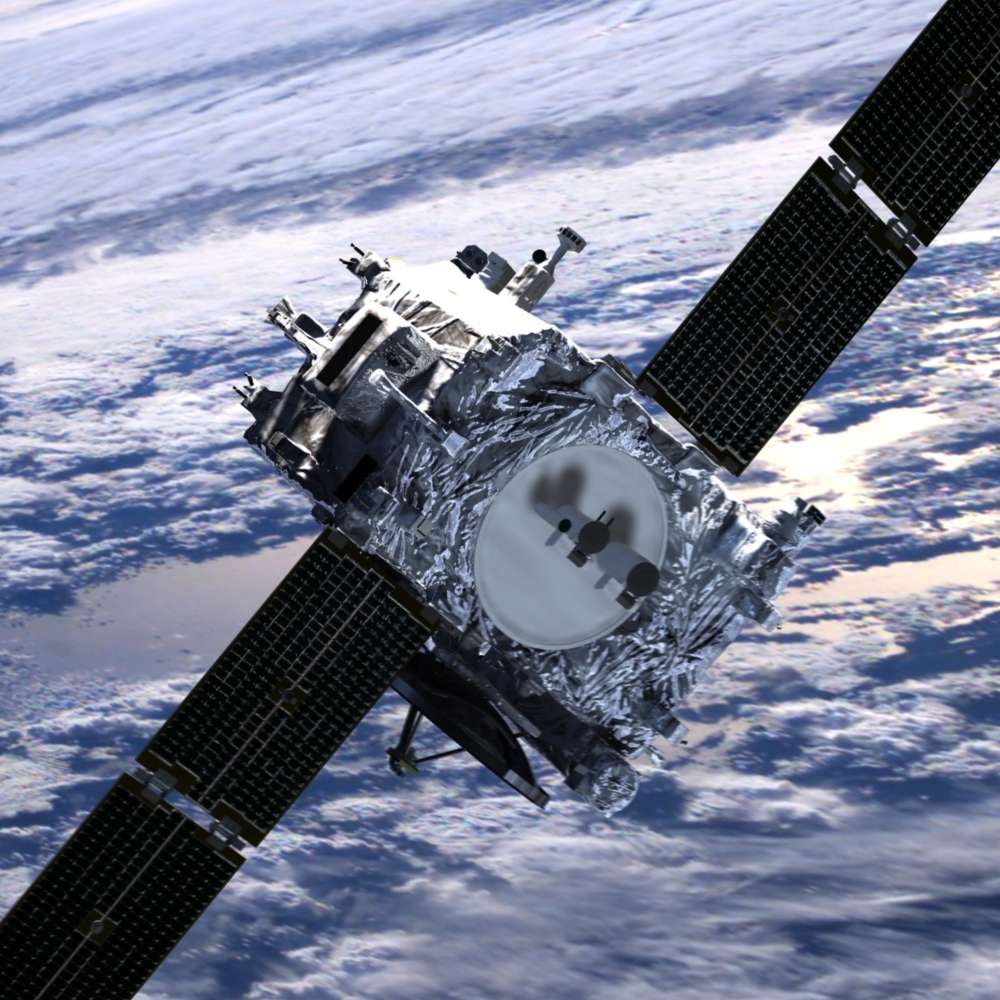
STEREO-B was one of two nearly identical spacecraft launched together under NASA’s STEREO mission.
The concept was simple but revolutionary:
One spacecraft would move ahead of Earth (STEREO-A)
One would fall behind Earth (STEREO-B)
Both would observe the Sun simultaneously from different angles
This allowed scientists to reconstruct solar events in true three dimensions for the first time.
Why “Behind”? The Role of STEREO-B
STEREO-B gradually drifted into an orbit slightly slower than Earth’s, causing it to trail behind over time.
From this position, it provided:
A rear-angled view of the Sun
Imaging of active regions invisible from Earth
Side-on perspectives of expanding solar storms
This geometry was essential for understanding how solar eruptions propagate through space.
The Problem STEREO-B Was Designed to Solve
Before STEREO:
CMEs appeared faster or slower depending on viewing angle
Some Earth-directed storms appeared harmless
Others looked dangerous but missed Earth entirely
STEREO-B helped disentangle projection effects, allowing scientists to distinguish real threats from optical illusions.
How STEREO-B Fit into the Twin Mission
STEREO-A and STEREO-B were not independent missions.
They functioned as a single, distributed observatory:
STEREO-A observed from ahead of Earth
STEREO-B observed from behind Earth
Earth-based observatories filled in the center
Together, they formed a triangulation system for solar events.
Why STEREO-B Was Crucial for Space Weather Science
Space weather forecasting depends on knowing where solar material is going, not just that it exists.
STEREO-B enabled:
Accurate CME direction determination
Improved arrival-time predictions
Better assessment of storm geometry
This represented a major step toward predictive, rather than reactive, space weather science.
Instruments on Board – Built for Wide-Angle Solar Vision
STEREO-B carried the same instrument suite as its twin, optimized for observing solar structures across vast distances.
Core instrument groups included:
Heliospheric imagers for tracking solar wind and CMEs
Coronagraphs to block sunlight and reveal the corona
Extreme ultraviolet imagers for solar surface activity
These instruments were designed to work best in combination with STEREO-A, not in isolation.
Why STEREO-B Was Not a Typical Solar Observatory
Unlike missions focused on close-up solar physics, STEREO-B prioritized geometry and context.
Its strength was:
Wide-field imaging
Long-baseline observation
Tracking solar events over millions of kilometers
This made it a bridge between solar physics and heliospheric science.
Universe Map Context – Why STEREO-B Matters
STEREO-B represents a key idea Universe Map emphasizes:
Understanding the Solar System requires multiple perspectives, not single viewpoints.
It connects:
Solar physics
Heliospheric structure
Space weather forecasting
Orbital geometry
STEREO-B showed that sometimes, where you observe from matters as much as what you observe.
The Scientific Payload – Seeing the Sun in Three Dimensions
STEREO-B carried the same instrument suite as its twin, STEREO-A.
Individually, these instruments were powerful. Together, and when paired with STEREO-A, they became transformative.
The payload was optimized not for extreme proximity to the Sun, but for wide-angle, long-baseline observation.
SECCHI – The Heart of the STEREO Mission
The primary instrument package on STEREO-B was SECCHI (Sun–Earth Connection Coronal and Heliospheric Investigation).
SECCHI consisted of five coordinated instruments:
Extreme Ultraviolet Imager (EUVI)
Two coronagraphs (COR1 and COR2)
Two heliospheric imagers (HI-1 and HI-2)
Together, they tracked solar activity from the Sun’s surface all the way to Earth’s orbit and beyond.
EUVI – Monitoring Solar Surface Activity
The Extreme Ultraviolet Imager observed the Sun’s atmosphere in multiple wavelengths.
It allowed scientists to:
Track active region evolution
Observe flare precursors
Identify eruption source regions
When combined with STEREO-A and Earth-based observatories, EUVI enabled true 3D reconstruction of solar surface features.
Coronagraphs – Revealing the Solar Corona
The coronagraphs aboard STEREO-B blocked direct sunlight to reveal the faint corona.
They were essential for:
Detecting coronal mass ejections (CMEs)
Measuring CME expansion and shape
Determining eruption onset times
From STEREO-B’s trailing position, CMEs could be seen from the side, eliminating ambiguity in direction and speed.
Heliospheric Imagers – Following Solar Storms Through Space
The heliospheric imagers were among the most innovative instruments on STEREO-B.
They allowed scientists to:
Track CMEs far from the Sun
Observe solar wind structures in interplanetary space
Follow storms continuously from Sun to Earth
For the first time, CMEs were observed as continuous evolving structures, not isolated snapshots.
How STEREO-B Enabled True CME Tracking
Before STEREO:
CME speeds were often overestimated
Earth-directed storms were difficult to identify
Arrival-time predictions were unreliable
With STEREO-B:
CME trajectories could be triangulated
True radial speeds were measured
Forecast accuracy improved significantly
This marked a turning point in space weather science.
Major Discoveries Enabled by STEREO-B
Working in tandem with STEREO-A, STEREO-B helped establish that:
CMEs have complex, three-dimensional shapes
Many eruptions previously thought Earth-directed were not
Solar storms can deflect and deform during propagation
These insights corrected decades of projection-driven misunderstanding.
Growing Separation – A Feature, Not a Bug
Over time, STEREO-B drifted farther behind Earth.
This increasing separation:
Expanded the stereoscopic baseline
Improved 3D reconstruction accuracy
Allowed full-Sun coverage when combined with STEREO-A
At peak separation, nearly the entire solar surface could be observed simultaneously.
Limitations and Challenges
Despite its success, STEREO-B faced challenges:
Increasing communication distance
Higher radiation exposure
Complex spacecraft orientation requirements
These challenges eventually contributed to mission difficulties, but they did not diminish its scientific return.
Why STEREO-B Was Essential, Not Optional
It is tempting to think STEREO-A alone could have sufficed.
In reality:
One side view is not enough for true 3D reconstruction
Depth perception requires dual perspectives
STEREO-B provided the missing half of the geometry
Without STEREO-B, the STEREO mission would not have achieved its defining breakthroughs.
Universe Map Perspective – Geometry as Science
STEREO-B demonstrates a core principle of modern astronomy:
Observation geometry can be as important as instrument sensitivity.
By changing where we look from, STEREO-B changed what we could understand about the Sun.
The Loss of Contact with STEREO-B
In October 2014, NASA lost communication with STEREO-B during a planned spacecraft reset.
Despite recovery attempts:
The spacecraft did not reestablish stable contact
Its exact orientation became uncertain
Scientific operations ceased permanently
Importantly, STEREO-B was not destroyed.
It continues to orbit the Sun silently, carrying with it a completed scientific legacy.
Why the Mission Was Still a Complete Success
Although contact was lost earlier than hoped, STEREO-B had already achieved its core objectives:
Enabled the first true 3D reconstruction of solar eruptions
Provided years of stereoscopic solar data
Fundamentally changed CME tracking methodology
In heliophysics, geometry matters more than longevity, and STEREO-B delivered exactly what was required.
STEREO-A vs STEREO-B – A Critical Comparison
This comparison is essential, because STEREO was never meant to be understood as two separate missions.
Its power came from symmetry.
Orbital Roles and Geometry
| Aspect | STEREO-A (Ahead) | STEREO-B (Behind) |
|---|---|---|
| Orbital Position | Ahead of Earth | Behind Earth |
| Orbital Speed | Slightly faster than Earth | Slightly slower than Earth |
| Viewing Angle | Forward-looking solar view | Rear-angled solar view |
| Primary Geometry | Leading perspective | Trailing perspective |
| Role in 3D Imaging | One half of triangulation | The complementary half |
Without STERO-B, STEREO-A would still see the Sun — but without depth.
Scientific Symmetry – Why Both Were Necessary
STEREO-A and STEREO-B carried identical instruments, but they were not redundant.
Their separation allowed scientists to:
Measure CME width, not just brightness
Determine true propagation direction
Calculate real CME speeds
Identify deflections and distortions
Removing either spacecraft collapses the geometry back to a 2D problem.
What STEREO-B Saw That STEREO-A Could Not
Because STEREO-B viewed solar events from behind Earth:
Some eruptions invisible or ambiguous from Earth were clearly defined
Limb events became central events from B’s perspective
Back-side solar activity was revealed before rotating into Earth view
This made STEREO-B especially valuable for early context, even when Earth was not directly threatened.
Impact on Space Weather Prediction
Together, A and B enabled:
CME arrival-time prediction improvement
False-alarm reduction in storm warnings
Better differentiation between Earth-directed and miss events
After STEREO-B was lost, forecasting accuracy declined slightly — a direct demonstration of its importance.
Why STEREO-B’s Loss Still Shapes Mission Design
Modern and future missions explicitly incorporate lessons from STEREO-B:
Emphasis on multi-point observation
Distributed spacecraft architectures
Side-view monitoring concepts (e.g., Sun–Earth L₅ missions)
STEREO-B directly influenced the shift toward constellation-based heliophysics.
STEREO-B as a Precursor to L₅ Strategy
Many current proposals for Sun–Earth L₅ missions exist because STEREO-B proved the value of side-on solar views.
Conceptually:
STEREO-B = mobile, temporary side observer
L₅ missions = permanent, stable side observer
The science case for L₅ is built on STEREO-B’s success.
Frequently Asked Questions (Expanded)
Was STEREO-B less important than STEREO-A?
No.
Both spacecraft were equally essential. Losing either breaks the stereoscopic system.
Why was STEREO-A recovered but not STEREO-B?
Recovery depended on spacecraft orientation, power balance, and communication geometry.
STEREO-B’s configuration prevented safe recovery.
Did STEREO-B collect unique data?
Yes.
Its trailing position provided perspectives that neither Earth nor STEREO-A could replicate.
Is STEREO-B still transmitting anything?
No confirmed signals have been received since 2014.
Could another STEREO-B-like mission be launched?
Yes, and many future heliophysics concepts explicitly aim to restore this missing perspective.
Why STEREO-B Matters for Universe Map
STEREO-B represents a core Universe Map theme:
Understanding space requires multiple viewpoints.
It connects:
Solar physics
Heliospheric structure
Orbital geometry
Predictive space weather
STEREO-B proves that some of the most important discoveries come not from better instruments, but from better positioning.
Related Topics for Universe Map
STEREO-A
Solar Orbiter
Parker Solar Probe
Sun–Earth L₅
Space weather
Heliosphere
Together, these topics explain how the Sun is not just observed, but understood in depth.
Final Perspective
STEREO-B never made headlines for dramatic images or record-breaking proximity.
Its contribution was quieter — and deeper.
By standing behind Earth and looking sideways at the Sun, STEREO-B gave humanity something it never had before: depth perception in solar physics.
Even in silence, its data continues to shape how we predict solar storms, design missions, and understand our star.
STEREO-B reminds us that in science, sometimes the most important role is not to lead — but to complete the view.