



Spitzer Space Telescope
Revealing the Infrared Universe
Quick Reader
| Attribute | Details |
|---|---|
| Mission Name | Spitzer Space Telescope |
| Mission Type | Infrared space observatory |
| Operating Agency | NASA |
| Launch Date | 25 August 2003 |
| Orbit Type | Earth-trailing heliocentric orbit |
| Primary Wavelengths | Infrared (3–180 microns) |
| Original Coolant | Liquid helium (cryogenic mission) |
| Cryogenic Phase End | 2009 |
| Warm Mission End | 2020 |
| Mission Status | Retired |
| Program | Great Observatories (final member) |
Why Spitzer Is Special (Quick Context)
Spitzer was the first space telescope to operate far behind Earth in a solar orbit, providing an exceptionally cold and thermally stable environment for infrared observations.
It opened a new window on the Universe by revealing objects hidden from visible-light telescopes, including dusty star-forming regions, cool exoplanets, distant galaxies, and the chemical fingerprints of worlds beyond our Solar System.
Key Insight Snapshot
- Opened the modern era of space-based infrared astronomy
- Revealed star formation concealed by cosmic dust
- Transformed exoplanet science and atmospheric characterization
- Mapped the cold Universe with unprecedented sensitivity
- Completed NASA’s Great Observatories program
Introduction — Why Infrared Changes Everything
The Universe we see with our eyes is incomplete.
Much of cosmic activity—star birth, planet formation, galaxy assembly—takes place behind thick veils of dust or at temperatures too cold to glow in visible light. To understand these hidden processes, astronomers must observe infrared radiation, where heat and dust reveal themselves.
The Spitzer Space Telescope was built to do exactly that.
It did not just extend human vision—it rewrote what the Universe looks like when seen through heat instead of light.
What Infrared Astronomy Reveals (Clear Physical Context)
Infrared light is emitted by:
Warm dust grains
Cool stars and brown dwarfs
Protoplanetary disks
Molecular clouds
Exoplanet atmospheres
Infrared observations allow astronomers to:
See through dust that blocks visible light
Measure temperatures of distant objects
Detect chemical signatures like water, methane, and carbon dioxide
Spitzer specialized in the cool and obscured Universe, where many of the most important astrophysical processes occur.
Why Spitzer Had to Go to Space
Earth’s atmosphere absorbs most infrared radiation and emits infrared heat of its own.
From the ground:
Infrared observations are incomplete
Sensitivity is severely limited
Thermal noise overwhelms faint signals
Spitzer solved this by operating in space, far from Earth’s heat, allowing it to detect extremely faint infrared sources that ground-based telescopes could never see clearly.
A Unique Orbit — Drifting Away from Earth
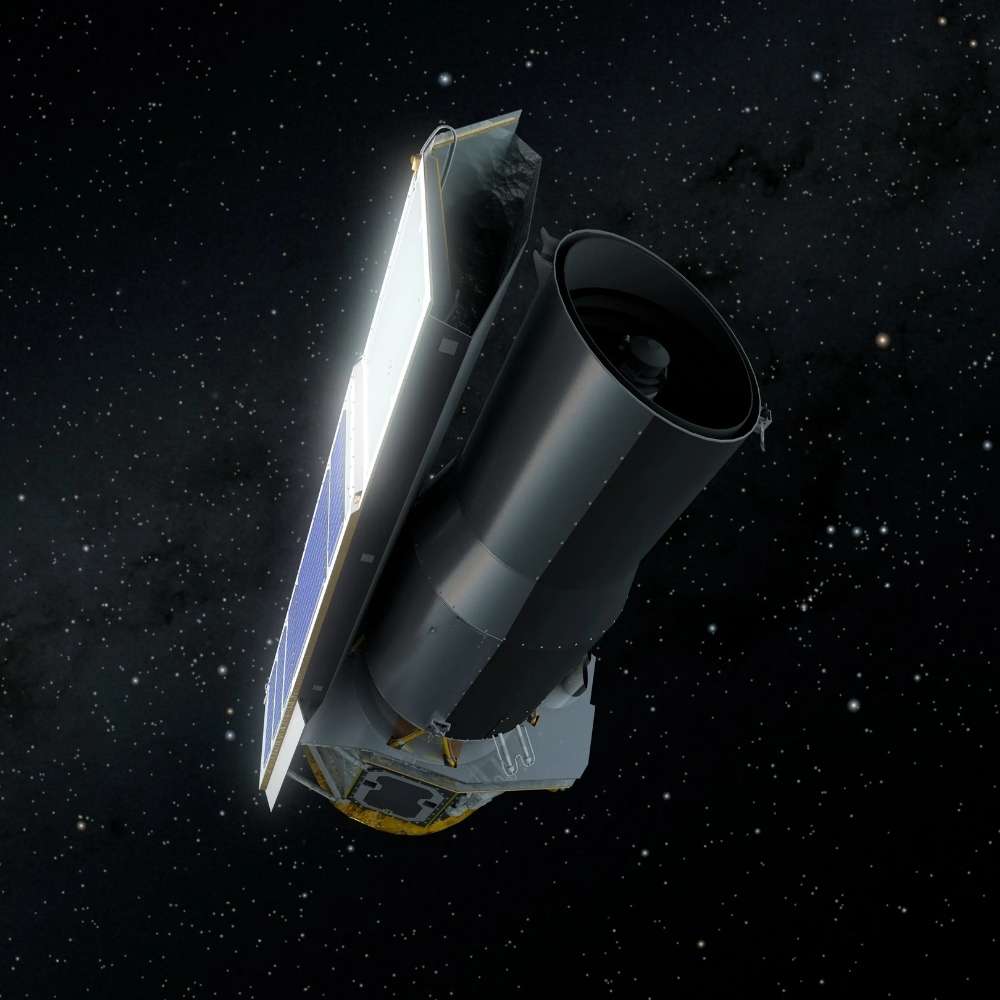
Unlike earlier space telescopes, Spitzer was placed in an Earth-trailing heliocentric orbit.
This design choice was crucial:
The telescope slowly drifted away from Earth
Earth’s heat and infrared glow stayed far behind
Thermal stability improved dramatically
As a result, Spitzer became one of the coldest and most sensitive infrared observatories ever flown, despite its relatively modest size.
Cryogenic Design — Keeping the Telescope Cold
Infrared telescopes must be kept extremely cold to prevent their own heat from overwhelming observations.
Spitzer achieved this by:
Using liquid helium to cool its instruments
Employing a “warm launch” architecture
Allowing space itself to act as a heat sink
This innovative design extended mission life and reduced complexity compared to earlier infrared missions.
Spitzer’s Instruments — A Focused, Powerful Toolkit
Spitzer carried three main instruments:
IRAC — Infrared imaging camera
IRS — Infrared spectrograph
MIPS — Multiband imaging photometer
Together, they allowed Spitzer to:
Image faint infrared objects
Analyze chemical compositions
Measure temperatures and dust properties
This combination made Spitzer both a discovery engine and a precision measurement tool.
Early Discoveries — Dust, Stars, and Hidden Structure
Soon after launch, Spitzer revealed:
Star-forming regions invisible in optical light
Dust lanes shaping galaxies
Cool, faint objects previously undetectable
It became immediately clear that the infrared sky was far richer and more complex than expected.
Spitzer was not just filling gaps—it was uncovering an entirely different view of cosmic structure.
Why Spitzer Matters Scientifically
Spitzer matters because it:
Exposed processes hidden from traditional telescopes
Connected star formation with planetary evolution
Provided infrared benchmarks for future missions
Enabled long-term studies across cosmic time
It turned infrared astronomy from a niche field into a central pillar of modern astrophysics.
Spitzer in the Bigger Picture
Spitzer was the final member of NASA’s Great Observatories, joining:
Hubble (visible & ultraviolet)
Chandra (X-ray)
Compton (gamma-ray)
Together, these observatories allowed astronomers to study the Universe across the full electromagnetic spectrum.
Spitzer completed that picture by revealing the thermal Universe.
Spitzer and Exoplanets — From Detection to Atmospheres
One of Spitzer’s most transformative contributions came in exoplanet science.
When Spitzer launched, exoplanets were still a new field. Most detections told astronomers only that planets existed—not what they were like. Spitzer changed that by making the first routine measurements of exoplanet temperatures and atmospheres.
Spitzer achieved this by observing planets in infrared as they:
Passed in front of their stars (transits)
Passed behind their stars (secondary eclipses)
These subtle changes in infrared light allowed astronomers to separate planetary heat from starlight, something impossible in visible wavelengths.
First Temperature Maps of Alien Worlds
Spitzer delivered several historic firsts:
First direct measurement of an exoplanet’s temperature
First infrared detection of an exoplanet’s thermal emission
First coarse temperature maps of “hot Jupiters”
These observations revealed that:
Many hot Jupiters have extreme day–night temperature differences
Atmospheric winds can redistribute heat
Some planets exhibit thermal inversions in their atmospheres
For the first time, exoplanets became physical worlds, not just orbital signals.
Chemical Fingerprints — What Spitzer Could Detect
Using infrared spectroscopy, Spitzer identified molecules in exoplanet atmospheres, including:
Water vapor
Carbon monoxide
Carbon dioxide
Methane (in some cases)
These detections demonstrated that:
Exoplanet atmospheres are chemically diverse
Planet formation pathways vary widely
Infrared spectroscopy is essential for habitability studies
Spitzer laid the methodological foundation later used by JWST.
Star Formation — Seeing Inside Stellar Nurseries
Spitzer revolutionized our understanding of how stars are born.
In visible light, star-forming regions appear as dark, opaque clouds. In infrared, Spitzer revealed:
Dense cores where stars are forming
Protoplanetary disks around young stars
Embedded stellar populations previously invisible
This allowed astronomers to build complete timelines of stellar evolution, from collapsing clouds to newborn stars surrounded by disks.
Planet Formation and Protoplanetary Disks
Spitzer provided some of the best early observations of protoplanetary disks, the birthplaces of planets.
Its infrared sensitivity allowed scientists to:
Measure disk temperatures and masses
Detect dust grain growth (a key step toward planets)
Identify gaps and inner holes in disks
These observations showed that planet formation begins early and efficiently, often while stars are still young.
Brown Dwarfs — Filling the Gap Between Stars and Planets
Spitzer was exceptionally good at detecting brown dwarfs, objects too small to sustain hydrogen fusion but too massive to be planets.
Spitzer discoveries revealed that:
Brown dwarfs are abundant
They cool and fade rapidly in visible light
Infrared surveys are essential to census them
This helped clarify the continuum between stars and planets, reshaping classification schemes.
Galaxies Hidden by Dust — Infrared Cosmology
On the largest scales, Spitzer transformed galaxy studies.
It revealed:
Dust-obscured starburst galaxies
Rapid star formation in the early Universe
Previously unseen populations of distant galaxies
Spitzer showed that much of cosmic star formation was hidden from optical telescopes, forcing astronomers to revise estimates of how quickly galaxies grew.
The Cryogenic Mission Ends — But Science Continues
In 2009, Spitzer’s liquid helium coolant was exhausted, ending its cryogenic mission.
However, the telescope was not finished.
Two of its infrared detectors continued operating at shorter wavelengths, beginning the Warm Mission phase.
During this period, Spitzer:
Continued exoplanet studies
Monitored stellar variability
Supported missions like Kepler and TESS
This extended Spitzer’s scientific impact by more than a decade.
Spitzer as a Pathfinder for Future Missions
Many of today’s infrared strategies were first tested with Spitzer:
Precision infrared photometry
Long-duration monitoring of exoplanets
Deep infrared sky surveys
In this sense, Spitzer was both a discovery mission and a training ground for the next generation of observatories.
Spitzer’s Legacy — How One Telescope Changed Infrared Astronomy
Spitzer’s greatest achievement was not a single discovery, but a shift in perspective.
Before Spitzer, infrared astronomy was limited, fragmented, and often secondary to optical observations. After Spitzer, infrared became essential—a primary tool for understanding how stars, planets, and galaxies form and evolve.
Its long operational life allowed astronomers to:
Observe multiple stellar generations
Track long-term variability in disks and atmospheres
Build statistically meaningful samples across cosmic time
Spitzer turned the infrared sky into a coherent scientific landscape.
Spitzer vs Herschel vs JWST — Clear Roles, Shared Vision
Spitzer is often compared with later infrared missions, but each telescope was designed to answer different scientific questions and operate in a complementary role.
| Mission | Strength | Key Difference |
|---|---|---|
| Spitzer | Sensitivity & longevity | Warm, stable platform enabling long-term infrared monitoring |
| Herschel | Far-infrared power | Probed cold dust and gas at very long infrared wavelengths |
| JWST | Precision & depth | High-resolution infrared imaging and spectroscopy |
Interpretation
Spitzer revealed what targets and phenomena were worth studying in the infrared.
Herschel mapped where the cold dust and gas reservoirs are located within galaxies and star-forming regions.
JWST now explains how these systems function in exquisite physical and chemical detail.
Without the foundational discoveries of Spitzer, the observing strategies and scientific priorities of JWST would be far less informed.
Why Spitzer’s Orbit Mattered in the Long Run
Spitzer’s Earth-trailing orbit proved revolutionary.
As it drifted farther from Earth:
Thermal stability improved
Infrared background noise decreased
Observations became cleaner over time
This orbit demonstrated that distance from Earth can be an advantage, influencing the design of later missions seeking ultra-stable environments.
The End of the Mission — A Controlled Farewell
In January 2020, Spitzer was officially retired.
The reason was not failure, but physics:
Increasing distance reduced communication efficiency
Orientation constraints limited power and cooling
Safe operations could no longer be guaranteed
NASA chose to end the mission gracefully, preserving its scientific legacy and data archive.
Few missions have concluded with such a complete and successful scientific record.
Frequently Asked Questions (Expanded)
Is Spitzer still operating today?
No. The mission ended in January 2020 after more than 16 years of operation.
Why didn’t Spitzer operate as long as Hubble?
Spitzer’s orbit caused it to drift away from Earth, eventually making communication and thermal control impractical.
Did Spitzer find Earth-like planets?
Spitzer did not directly image Earth-like planets, but it measured atmospheres and temperatures of many exoplanets, laying groundwork for habitability studies.
How did Spitzer help JWST?
Spitzer identified promising targets, refined observing techniques, and defined the key scientific questions JWST now addresses.
Why was Spitzer smaller than other space telescopes?
Infrared sensitivity depends more on cooling and stability than mirror size. Spitzer’s design optimized these factors efficiently.
Is Spitzer’s data still useful?
Yes. Its archive remains actively used for comparative studies, long-term trends, and historical baselines.
Spitzer’s Impact Beyond Astronomy
Spitzer influenced more than astrophysics.
It advanced:
Cryogenic engineering
Long-duration autonomous operations
Precision photometry techniques
Mission design for deep-space observatories
Many of these lessons directly shaped later flagship missions.
Spitzer in the Universe Map Context
Within Universe Map, Spitzer connects naturally to:
Infrared telescopes
Star formation regions
Protoplanetary disks
Exoplanet atmospheres
Dust-obscured galaxies
Together, these topics reveal a Universe where heat, dust, and chemistry shape cosmic evolution just as much as gravity.
Final Perspective
Spitzer did not show us a brighter Universe—it showed us a warmer one.
By revealing the glow of dust, the heat of distant worlds, and the hidden engines of star formation, Spitzer taught astronomers that the most important stories in the cosmos are often invisible to our eyes.
Long after its instruments fell silent, Spitzer continues to guide exploration—quietly shaping how we search for origins, planets, and life beyond Earth.