




DSCOVR
Earth’s Permanent Space Weather Guardian
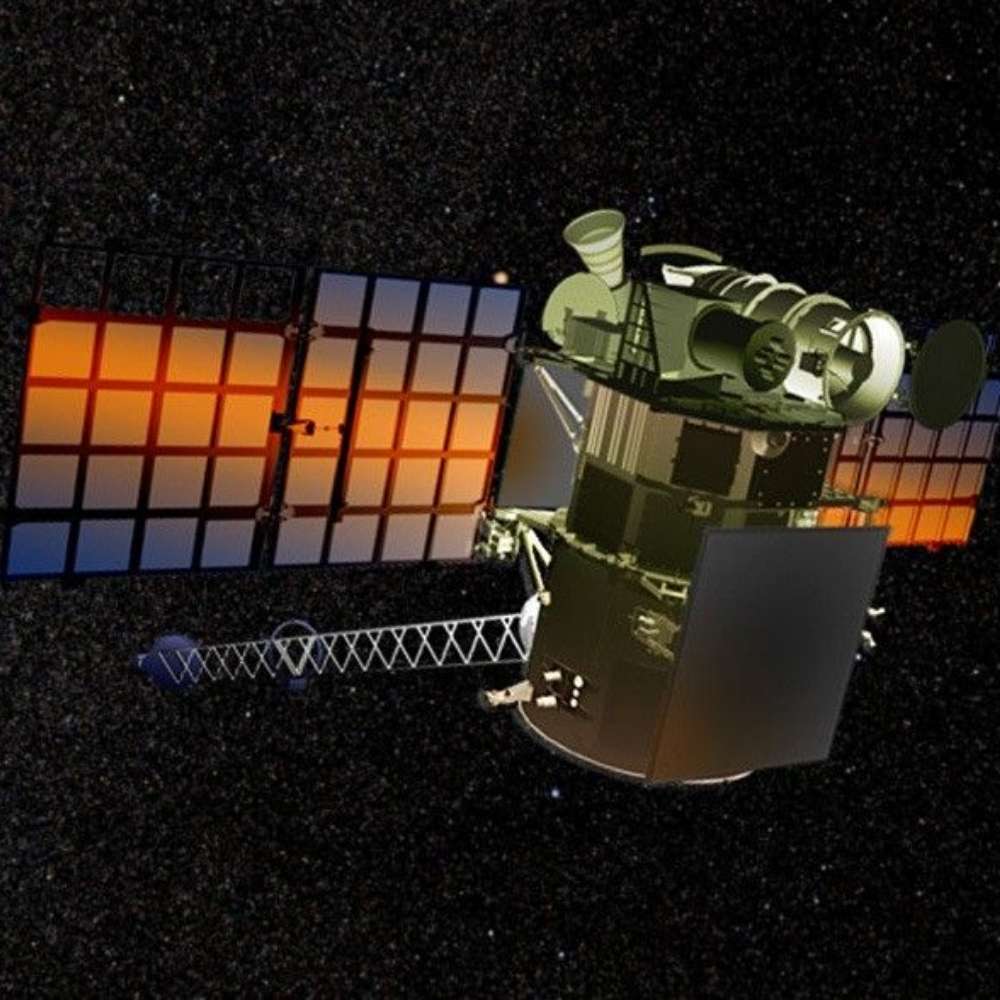
Quick Reader
| Attribute | Details |
|---|---|
| Mission Name | DSCOVR |
| Full Name | Deep Space Climate Observatory |
| Mission Type | Space weather & Earth observation mission |
| Operating Agencies | NOAA (operations), NASA (spacecraft) |
| Launch Date | 11 February 2015 |
| Orbit | Sun–Earth L₁ Lagrange point |
| Distance from Earth | ~1.5 million km |
| Primary Roles | Solar wind monitoring, space weather alerts |
| Secondary Role | Full-disk Earth imaging |
| Key Instruments | PlasMag suite, EPIC |
| Mission Status | Active (operational) |
Why DSCOVR Is Special (Quick Context)
DSCOVR is Earth’s primary real-time space weather sentinel. Positioned between the Sun and Earth, it continuously monitors the solar wind and interplanetary magnetic field before they reach our planet.
These measurements provide critical advance warning of geomagnetic storms that can disrupt satellites, power grids, navigation systems, and global communications.
Key Insight Snapshot
- Earth’s main operational space-weather monitoring spacecraft
- Provides approximately 15–60 minutes of advance warning
- Permanently stationed at the Sun–Earth L₁ point
- Combines solar monitoring with continuous Earth observation
- Acts as a bridge between scientific research missions and daily operational forecasting
Introduction — Why Earth Needs an Early Warning System
Earth lives inside a changing space environment.
Solar flares and coronal mass ejections eject vast clouds of charged particles and magnetic fields toward interplanetary space. When these disturbances strike Earth, they can:
Damage satellites
Disrupt GPS and radio communication
Trigger geomagnetic storms
Cause power grid failures
To protect modern technological civilization, these disturbances must be detected before they arrive.
That is the role of DSCOVR.
What Makes L₁ the Perfect Watchpoint
DSCOVR operates near the Sun–Earth L₁ Lagrange point, a gravitational balance point where a spacecraft can remain aligned between Earth and the Sun.
From this location:
Solar wind is measured upstream, before Earth impact
Continuous monitoring is possible without Earth eclipses
Data arrives early enough for warnings and mitigation
L₁ is now considered the front line of space weather defense.
From Concept to Mission — DSCOVR’s Unusual History
DSCOVR began life with a very different purpose.
Originally conceived as a climate observatory, the mission was later repurposed to focus primarily on operational space weather monitoring, while retaining Earth observation capabilities.
This evolution reflects a growing realization:
Space weather is not just a scientific curiosity—it is an operational necessity.
DSCOVR’s Primary Mission — Watching the Solar Wind
DSCOVR continuously measures key properties of the solar wind, including:
Particle density
Flow speed
Temperature
Magnetic field strength and orientation
Among these, the magnetic field direction is the most critical parameter for geomagnetic storm prediction.
A southward-pointing magnetic field allows strong coupling with Earth’s magnetosphere, dramatically increasing storm severity.
DSCOVR detects this condition before Earth feels it.
Operational Space Weather — From Data to Warnings
Unlike research missions such as WIND or STEREO, DSCOVR’s data is used operationally.
Its measurements feed directly into:
NOAA’s Space Weather Prediction Center
Real-time alert systems
Satellite operator response plans
Power grid protection protocols
In this sense, DSCOVR is not just observing space—it is actively protecting infrastructure.
The PlasMag Suite — Measuring the Invisible Threat
DSCOVR’s space weather capability comes from the PlasMag instrument suite, which includes:
Plasma sensors to measure solar wind particles
Magnetometers to measure interplanetary magnetic fields
Together, these instruments define the state of the solar wind minutes before it interacts with Earth.
This upstream measurement capability is irreplaceable.
A Secondary Role — Seeing Earth from Deep Space
In addition to space weather monitoring, DSCOVR carries EPIC, a camera that images Earth in full disk from L₁.
This unique vantage point allows:
Continuous observation of Earth’s sunlit hemisphere
Monitoring of clouds, aerosols, ozone, and vegetation
A global perspective impossible from low Earth orbit
DSCOVR is the only operational spacecraft that continuously views the entire Earth in a single frame.
Why DSCOVR Matters More Than Ever
Modern society depends on space-based systems.
DSCOVR matters because it:
Provides early warning for geomagnetic storms
Reduces risk to satellites and astronauts
Protects power grids and communication networks
Enables safer space and aviation operations
As reliance on space technology grows, DSCOVR’s role becomes more critical, not less.
DSCOVR in the Bigger Scientific Picture
DSCOVR connects multiple domains:
Solar physics
Space weather forecasting
Magnetospheric science
Climate and Earth system monitoring
It represents the point where scientific measurement becomes societal protection.
DSCOVR’s Instrument Suite — Built for Reliability, Not Experimentation
DSCOVR is an operational mission, not a pure research platform.
That distinction shapes everything about its instruments: they are designed to be robust, stable, and continuously available, rather than experimental or exploratory.
Its payload is deliberately compact but mission-critical.
PlasMag — The Core of Space Weather Monitoring
The heart of DSCOVR’s space-weather capability is the PlasMag suite, consisting of two complementary systems:
Plasma Sensor
Measures properties of the solar wind, including:
Particle density
Flow velocity
Temperature
These parameters define how much energy and momentum the solar wind is carrying toward Earth.
Magnetometer
Measures the interplanetary magnetic field (IMF) embedded in the solar wind.
This is the single most important factor in determining geomagnetic storm severity.
Why this matters:
A southward IMF couples strongly with Earth’s magnetosphere
This triggers magnetic reconnection
Energy is transferred efficiently into Earth’s space environment
DSCOVR detects this condition before impact, enabling warnings.
Why Magnetic Field Orientation Matters More Than Speed
Fast solar wind alone does not guarantee a major storm.
DSCOVR data showed clearly that:
Slow wind + southward IMF can be dangerous
Fast wind + northward IMF can be relatively harmless
This understanding, first clarified by earlier missions like WIND, is now operationalized by DSCOVR in real time.
In space weather, direction matters more than force.
From Measurement to Action — How DSCOVR Data Is Used
DSCOVR’s data stream is processed almost immediately.
Typical flow:
Solar wind reaches DSCOVR at L₁
PlasMag instruments measure particles and fields
Data is transmitted to Earth in near real time
NOAA analyzes storm potential
Alerts and advisories are issued
This process provides 15–60 minutes of warning, depending on solar wind speed.
That window is small—but crucial.
Who Depends on DSCOVR Data
DSCOVR supports decisions across multiple sectors:
Satellite operators adjust spacecraft orientation
Power grid managers reduce load stress
Aviation routes avoid high-latitude radiation exposure
Space agencies protect astronauts and hardware
Few scientific missions have such direct real-world consequences.
EPIC — Earth Seen as a Planet
DSCOVR’s secondary payload, EPIC (Earth Polychromatic Imaging Camera), serves a completely different purpose.
From L₁, EPIC images Earth as a single, complete disk, rather than a mosaic of regional views.
This allows:
Continuous monitoring of Earth’s sunlit side
Measurement of cloud cover and dynamics
Tracking of aerosols, ozone, and vegetation
Long-term climate trend analysis
EPIC shows Earth as it would appear to a distant observer—an important planetary perspective.
DSCOVR vs WIND vs ACE — Clear Operational Differences
Although these missions are closely related and all operate near the Sun–Earth L₁ region, their purposes and operational priorities are distinct.
| Mission | Primary Role | Key Strength |
|---|---|---|
| WIND | Scientific benchmark | Long-term heliophysics research and comprehensive datasets |
| ACE | Hybrid science + operations | Early operational monitoring alongside scientific investigations |
| DSCOVR | Operational sentinel | Guaranteed, real-time space-weather alerts for Earth |
DSCOVR exists because earlier science missions proved the value of upstream solar wind measurements—today, society depends on these observations for reliable, continuous space-weather coverage.
Why Redundancy Matters at L₁
L₁ is too important to rely on a single mission forever.
DSCOVR contributes to a redundant monitoring architecture, ensuring that:
Space weather data continues uninterrupted
Instruments can be cross-calibrated
Operational continuity is preserved
This redundancy is essential for long-term infrastructure protection.
Why DSCOVR Is Not a “Discovery” Mission
DSCOVR is not designed to find new physics.
Instead, it focuses on:
Consistency
Accuracy
Reliability
Continuous availability
This distinction is intentional.
Operational missions succeed not by surprise, but by never failing.
DSCOVR’s Quiet Importance
DSCOVR rarely makes headlines.
That is a sign of success.
When DSCOVR works perfectly:
Storms are anticipated
Damage is minimized
Systems stay online
Its impact is measured not in discoveries—but in disasters avoided.
DSCOVR’s Long-Term Role — From Mission to Infrastructure
DSCOVR is no longer just a spacecraft—it is part of Earth’s critical space infrastructure.
As dependence on satellites, GPS, aviation, and electrical grids increases, continuous monitoring of space weather has become as essential as monitoring terrestrial weather.
DSCOVR’s role has shifted from experimental to foundational.
What Happens If DSCOVR Fails?
This question highlights why DSCOVR matters.
Without an upstream monitor at L₁:
Geomagnetic storms would arrive with little or no warning
Satellite operators would be forced into reactive responses
Power grid protection would be far less effective
Aviation radiation exposure risks would increase
While redundancy exists, DSCOVR currently provides the most reliable real-time data stream for space weather operations.
Future Replacements and Successors
DSCOVR was never intended to be permanent.
Future strategies include:
Next-generation L₁ monitors with improved instruments
Multi-point monitoring using several spacecraft
Integration with heliospheric imaging missions
These concepts build directly on DSCOVR’s success, recognizing that space weather monitoring is a permanent necessity, not a temporary project.
Frequently Asked Questions (Expanded)
Is DSCOVR still operational today?
Yes. DSCOVR remains active and continues to provide real-time space weather data.
How much warning time does DSCOVR provide?
Typically 15–60 minutes, depending on solar wind speed.
Does DSCOVR detect solar flares directly?
No. It detects the solar wind and magnetic structures after they leave the Sun, not the flare itself.
Why is L₁ better than Earth orbit for space weather monitoring?
Because L₁ provides uninterrupted upstream measurements before solar wind interacts with Earth’s magnetosphere.
Can DSCOVR predict storm severity perfectly?
No. It improves prediction, but storm intensity still depends on complex magnetospheric processes.
Why does DSCOVR also observe Earth?
To maximize scientific return and provide a unique planetary perspective from deep space.
Is DSCOVR more important than research missions like WIND?
They serve different roles. WIND advanced understanding; DSCOVR applies that understanding operationally.
Why Space Weather Sentinels Are Now Essential
Modern civilization is vulnerable to solar activity in ways past societies were not.
Space weather affects:
Navigation systems
Communication networks
Financial transaction timing
Military and civilian satellites
Power distribution infrastructure
DSCOVR represents a new category of mission:
scientific instruments operating as protective systems.
DSCOVR in the Universe Map Context
Within Universe Map, DSCOVR connects to:
Solar wind physics
Space weather forecasting
Lagrange-point observatories
Sun–Earth interaction
Planetary magnetospheres
These topics show how stellar activity directly shapes technological societies.
Final Perspective
DSCOVR will never be famous like Hubble or JWST—and that is exactly the point.
It does not show breathtaking images or reveal cosmic origins. Instead, it quietly watches an invisible stream of particles that can disrupt modern life if left unmonitored.
By standing between Earth and the Sun, DSCOVR turns minutes into protection, data into decisions, and science into security.
In the age of space-dependent civilization, DSCOVR is not optional—it is essential.