






ACE
Advanced Composition Explorer and the Solar System’s Particle Sentinel
Quick Reader
| Attribute | Details |
|---|---|
| Mission Name | ACE (Advanced Composition Explorer) |
| Mission Type | Heliophysics & space weather observatory |
| Space Agency | NASA |
| Launch Date | 25 August 1997 |
| Operating Location | Sun–Earth L1 |
| Primary Targets | Solar wind, energetic particles, cosmic rays |
| Key Measurements | Elemental & isotopic composition |
| Mission Status | Active (far beyond design life) |
| Historic Role | Backbone of space weather monitoring |
| Notable First | Continuous upstream solar wind composition data |
Key Insights
- ACE is one of the longest-operating and most important heliophysics missions
- It provides early warning of solar storms before they reach Earth
- ACE measures the composition of particles, not just their speed
- Much of modern space weather forecasting depends on ACE data
Introduction – Why Particle Composition Matters
Most people think of space weather as bursts of energy or clouds of plasma.
But to truly understand the Sun’s influence, scientists must answer deeper questions:
What particles are arriving at Earth?
Where did they originate?
How were they accelerated?
ACE was designed to answer exactly these questions by studying the elemental and isotopic makeup of particles flowing through the Solar System.
What Is ACE?
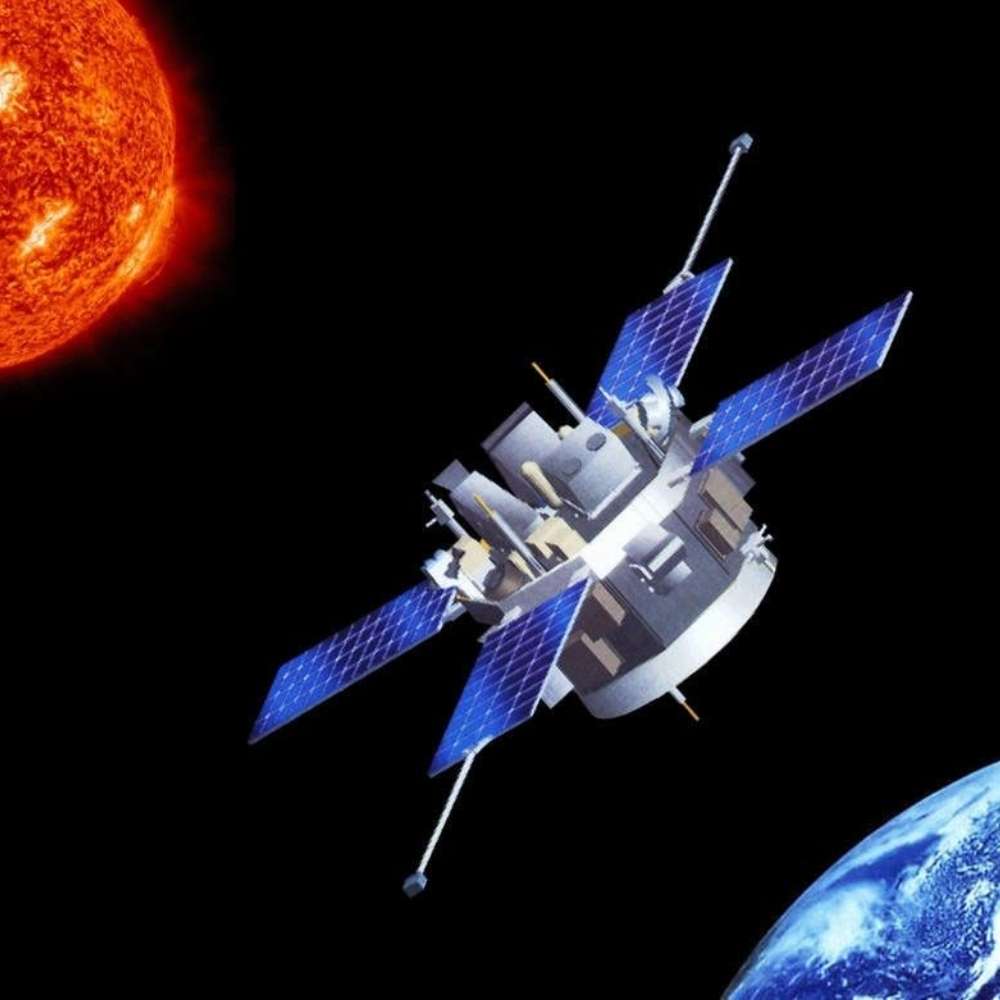
The Advanced Composition Explorer (ACE) is a space-based observatory dedicated to measuring the chemical fingerprints of energetic particles.
Unlike imaging missions, ACE focuses on:
Solar wind particles
Solar energetic particles (SEPs)
Galactic cosmic rays
By identifying their composition, ACE reveals the processes that created and accelerated them.
Why ACE Orbits at Sun–Earth L₁
ACE operates around the Sun–Earth L₁ Lagrange point, about 1.5 million km upstream from Earth.
This location is ideal because:
It samples solar wind before it reaches Earth
It provides 30–60 minutes of advance warning
It remains in continuous sunlight
It avoids Earth’s magnetic interference
ACE acts as Earth’s early warning sentinel against solar storms.
How ACE Changed Space Weather Science
Before ACE:
Solar wind monitoring focused mainly on speed and density
Composition data was sparse or intermittent
Forecasting was reactive rather than predictive
ACE introduced continuous, high-resolution composition monitoring, allowing scientists to:
Distinguish solar wind sources
Identify flare-driven vs CME-driven particles
Track changes in solar output over time
This fundamentally improved space weather models.
The ACE Instrument Suite – Built for Particle Physics in Space
ACE carries nine scientific instruments, each focused on different particle populations.
Together, they cover:
Low-energy solar wind ions
High-energy solar energetic particles
Galactic cosmic rays
The instruments are optimized for mass, charge, and energy discrimination, not imaging.
What Makes ACE Different from Other L₁ Missions
Many L₁ missions measure solar wind conditions.
ACE measures identity.
It tells scientists:
Which elements are present
Their isotopic ratios
Their charge states
This allows researchers to trace particles back to:
Specific solar regions
Acceleration mechanisms
Galactic or interstellar origins
ACE and the Solar Cycle
ACE has operated across multiple solar cycles.
This long baseline allows scientists to:
Track how particle populations change over decades
Compare quiet-Sun vs active-Sun conditions
Study long-term modulation of cosmic rays
Few missions provide this continuity.
Why ACE Is Still Operating Today
ACE was designed for a mission lasting a few years.
It remains operational decades later because:
Its instruments proved robust
Its orbit is stable
Its data remains scientifically essential
ACE is now a heritage mission that continues to deliver frontline science.
Universe Map Context – Why ACE Matters
ACE connects multiple Universe Map themes:
The Sun–Earth connection
Solar wind and heliosphere
Space weather and planetary safety
Cosmic ray origins
It shows that understanding the Solar System requires not just seeing it — but sampling it directly.
ACE’s Instrument Suite – Reading the Solar System’s Particle DNA
ACE was built around a simple but powerful idea:
to understand energetic particles, you must know what they are made of.
Its nine instruments together measure particle energy, charge, mass, and isotopic composition across a huge range.
Rather than listing instruments in isolation, it is more useful to understand them by what physical questions they answer.
Solar Wind Composition – Where the Wind Comes From
Some ACE instruments focus on the low-energy solar wind flowing continuously from the Sun.
These measurements allow scientists to determine:
Whether solar wind originates from coronal holes or active regions
How solar wind properties change with solar activity
How the Sun’s outer atmosphere supplies material to the heliosphere
By comparing elemental ratios, ACE distinguishes between fast wind, slow wind, and transient CME-driven flows.
Charge States – Tracing Solar Heating Processes
One of ACE’s most powerful contributions is the measurement of ion charge states.
Charge states act as thermometers.
They reveal:
The temperature at which particles were formed
How strongly they were heated before leaving the Sun
Whether particles were accelerated in flares or CME shocks
This allows scientists to reconstruct events that occurred millions of kilometers upstream, long before particles reached Earth.
Solar Energetic Particles – Understanding Radiation Storms
ACE plays a critical role in studying solar energetic particles (SEPs).
These high-energy particles are dangerous because they:
Damage spacecraft electronics
Pose radiation risks to astronauts
Disrupt radio communication
ACE measurements help determine:
Which solar events produce the most hazardous particles
How quickly particles are accelerated
How composition differs between flare-driven and shock-driven events
This knowledge feeds directly into radiation risk models.
Galactic Cosmic Rays – Visitors from Outside the Solar System
ACE does not only study solar particles.
It also measures galactic cosmic rays, which originate from supernova remnants and other energetic events beyond the Solar System.
By tracking their composition and intensity, ACE helps scientists understand:
How cosmic rays propagate through the Galaxy
How the heliosphere modulates incoming radiation
How cosmic ray flux changes over the solar cycle
This makes ACE a bridge between heliophysics and astrophysics.
Major Scientific Discoveries Enabled by ACE
Over its long mission life, ACE has enabled several landmark discoveries.
Solar Wind Source Identification
ACE showed that:
Elemental ratios differ between solar wind sources
Slow solar wind is chemically distinct from fast wind
CME plasma carries unique compositional signatures
This resolved long-standing debates about solar wind origin.
Particle Acceleration Mechanisms
ACE helped establish that:
CME-driven shocks dominate the most intense SEP events
Flare acceleration and shock acceleration leave different chemical fingerprints
Heavy ions behave differently from protons during acceleration
These findings reshaped space weather theory.
Solar Cycle Modulation of Cosmic Rays
ACE documented how:
Cosmic ray intensity decreases during solar maximum
Magnetic turbulence alters particle access to the inner Solar System
The heliosphere acts as a variable radiation shield
This clarified how solar activity affects radiation conditions near Earth.
ACE in Real-Time Space Weather Operations
ACE is not just a research mission.
Its data feeds directly into operational space weather forecasting.
In practice, ACE provides:
30–60 minutes of warning before solar wind impacts Earth
Real-time measurements used by forecasting centers
Inputs for geomagnetic storm prediction models
This makes ACE part of the invisible infrastructure protecting modern technology.
ACE Compared to Other L1 Missions
ACE is often discussed alongside missions such as WIND and DSCOVR.
| Feature | ACE | WIND | DSCOVR |
|---|---|---|---|
| Focus | Composition & particles | Plasma & fields | Operational monitoring |
| Isotopes | Yes | Limited | No |
| Energetic Particles | Extensive | Moderate | Minimal |
| Space Weather Role | Scientific backbone | Supporting | Operational primary |
ACE provides depth, while others provide context or continuity.
Why ACE Remains Scientifically Unique
Even decades after launch, no mission fully replaces ACE’s capabilities.
Its strengths include:
Long-duration, consistent measurements
High-resolution composition data
Coverage across multiple solar cycles
This makes ACE irreplaceable for long-term heliospheric studies.
Universe Map Perspective – Composition as a Clue to Origin
ACE demonstrates that knowing what particles are made of tells you where they came from.
It connects:
Solar surface processes
Interplanetary space
Galactic particle sources
Earth’s space environment
Composition turns motion into history.
Why ACE’s Legacy Is Bigger Than Its Hardware
ACE was launched in 1997 with a mission lifetime of just a few years.
It is still operating today because its scientific role turned out to be foundational rather than incremental.
ACE did not merely add data points — it changed how heliophysics asks questions.
Instead of asking how fast or how strong the solar wind is, ACE taught scientists to ask:
What is it made of?
Where did it originate?
What physical process shaped it?
Those questions remain central to solar–terrestrial science.
ACE as a Time Capsule of the Heliosphere
Because ACE has operated across multiple solar cycles, its dataset functions as a long-term record of heliospheric behavior.
This allows scientists to:
Compare solar minimum and maximum conditions directly
Track how particle populations evolve over decades
Identify long-term trends rather than short-term anomalies
Few missions provide this kind of temporal continuity.
Why ACE Outlived Its Expected Mission
ACE survived far beyond expectations for three main reasons:
Stable Orbit
Sun–Earth L₁ minimizes fuel use and thermal stress.Robust Instrument Design
Particle detectors degrade slowly compared to optical systems.Irreplaceable Data Type
No later mission fully duplicated ACE’s isotopic and compositional coverage.
As a result, ACE transitioned from a research mission into a permanent reference platform.
ACE and the Evolution of Space Weather Forecasting
Modern space weather forecasting depends on upstream measurements.
ACE helped establish a new operational model:
Continuous monitoring rather than episodic observation
Composition-based storm classification
Early-warning systems tied to real particle physics
Many forecasting techniques in use today were validated or calibrated using ACE data.
How ACE Complements Newer Missions
Newer missions such as Parker Solar Probe and Solar Orbiter explore regions closer to the Sun.
ACE provides the context at Earth’s doorstep.
Together, they form a complete chain:
Parker Solar Probe → particle formation
Solar Orbiter → source-region context
ACE → impact-ready particle composition
ACE connects origin to consequence.
Frequently Asked Questions (Expanded)
Is ACE still operational today?
Yes.
Although operating far beyond its planned lifetime, ACE continues to return scientifically valuable data.
Does ACE take images of the Sun?
No.
ACE is a particle and composition mission, not an imaging observatory.
Why is particle composition so important?
Because composition reveals origin and acceleration history.
Two particles with the same speed can come from very different processes.
How much warning does ACE provide before solar storms reach Earth?
Typically 30 to 60 minutes, depending on solar wind speed.
Has ACE been replaced by newer missions?
No single mission replaces ACE.
Some provide operational monitoring, others explore closer to the Sun, but ACE’s compositional depth remains unique.
What happens if ACE eventually fails?
Forecasting would continue, but with reduced compositional insight.
This is why future missions increasingly consider composition-focused instruments.
Why ACE Matters for Universe Map
ACE represents a class of missions Universe Map highlights:
Quiet, continuous observers
Infrastructure-level science missions
Platforms that enable other discoveries
ACE does not produce dramatic images — it produces understanding.
It anchors topics such as:
Solar wind
Solar energetic particles
Galactic cosmic rays
Space weather impacts on Earth
Related Topics for Universe Map
Sun–Earth L₁
Solar wind
Solar energetic particles
Cosmic rays
Heliosphere
Space weather
Together, these topics explain how invisible particle flows shape Earth’s technological and biological environment.
Final Perspective
ACE changed heliophysics by focusing on identity rather than appearance.
By measuring what particles are made of, it revealed where they come from, how they were energized, and what they mean for Earth.
Long after flashier missions come and go, ACE continues its quiet work at L₁ — sampling the Solar System, particle by particle, and turning invisible streams into physical knowledge.
ACE proves that sometimes, the most powerful explorers are the ones that simply stay in place and keep measuring.