



2010 TK₇
Earth’s First Known Trojan Asteroid
Quick Reader
| Attribute | Details |
|---|---|
| Official Designation | 2010 TK7 |
| Object Type | Earth Trojan asteroid |
| Orbital Class | Near-Earth Object (co-orbital with Earth) |
| Discovery Year | 2010 |
| Discovery Confirmed | 2011 |
| Discovering Mission | WISE (NASA) |
| Lagrange Region | Sun–Earth L4 (primarily) |
| Orbital Behavior | Tadpole / complex libration |
| Estimated Diameter | ~300 meters |
| Inclination | ~20° |
| Orbital Period | ~1 Earth year |
| Stability | Temporary (thousands–millions of years) |
| Impact Risk | None |
Key Insights
- 2010 TK7 is the first confirmed Earth Trojan asteroid
- It shares Earth’s orbit around the Sun
- It stays near the Sun–Earth L4 region but follows a complex path
- Its discovery proved that Earth Trojans can exist
Introduction – Earth’s Hidden Companion
For a long time, astronomers knew that Jupiter has thousands of Trojan asteroids.
Earth, however, appeared to have none.
That absence raised an important question:
Is Earth dynamically incapable of hosting Trojan companions, or were they simply hidden from view?
The discovery of 2010 TK₇ answered that question decisively.
Earth can host Trojans — and at least one does exist.
What Is 2010 TK₇?
2010 TK₇ is a small asteroid that:
Orbits the Sun, not Earth
Shares Earth’s orbital period
Remains gravitationally linked to Earth
Oscillates around the Sun–Earth L₄ region
It is not a moon, not a satellite, and not a typical near-Earth asteroid.
It is a co-orbital companion.
Why 2010 TK₇ Is Called an Earth Trojan
An object is called a Trojan if it:
Shares a planet’s orbit
Resides near the L₄ or L₅ Lagrange points
Avoids close encounters through orbital resonance
2010 TK₇ meets all these criteria.
However, unlike Jupiter’s Trojans, its orbit is highly inclined and dynamically complex, making it harder to classify at first glance.
Discovery – Found Where Telescopes Rarely Look
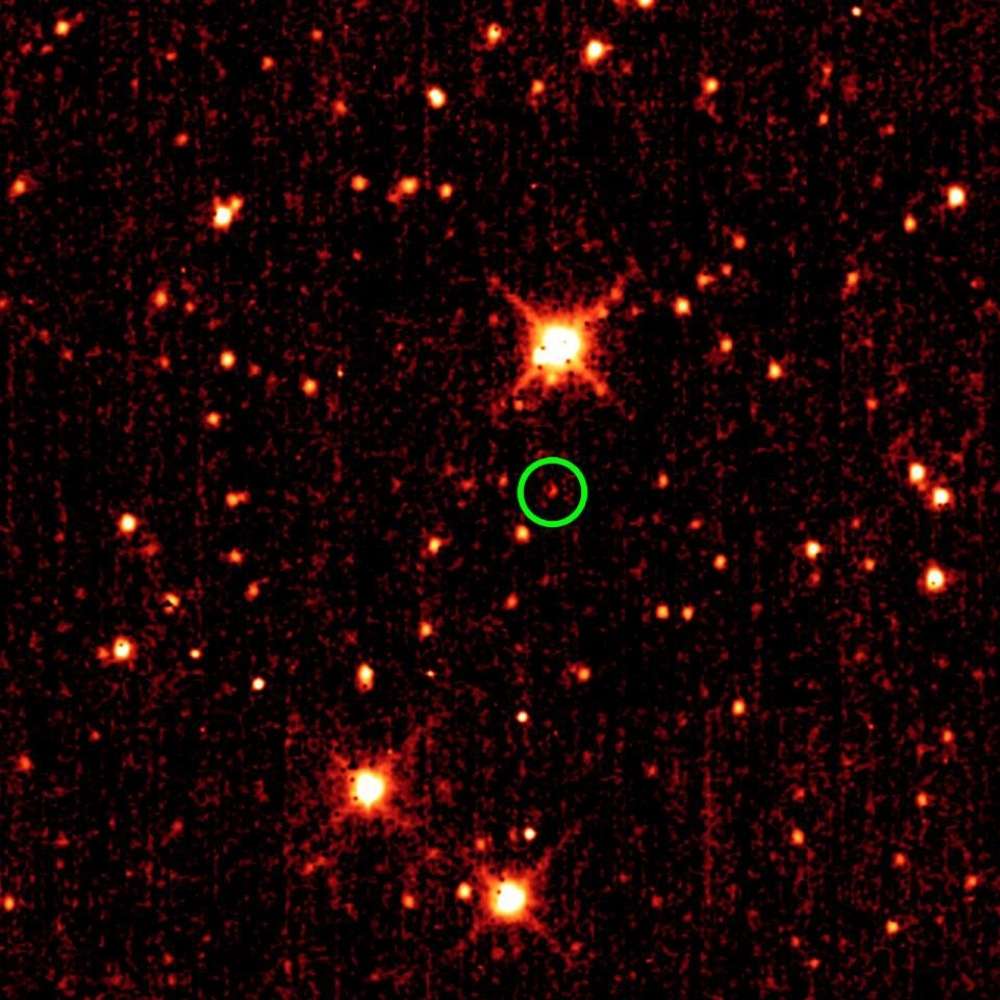
2010 TK₇ was discovered using data from NASA’s WISE space telescope.
This was critical because:
Earth Trojans appear close to the Sun in the sky
Ground-based telescopes struggle to observe that region
Infrared surveys can detect dark objects more easily
WISE observed TK₇ during twilight-like geometry, where traditional surveys are weakest.
Orbital Motion – Not Sitting Still at L₄
Although associated with Sun–Earth L₄, 2010 TK₇ does not sit quietly at the Lagrange point.
Instead, it follows:
A large-amplitude tadpole orbit
Significant vertical motion above and below Earth’s orbital plane
Slow oscillations that take centuries to complete
Its motion is better described as hovering near L₄, not occupying it precisely.
Why 2010 TK₇ Is Hard to Classify
2010 TK₇’s orbit is unusual because:
Its inclination (~20°) is high for a Trojan
It moves in and out of the L₄ region
It interacts gravitationally with Venus and Jupiter
As a result, it sits near the boundary between:
Stable Trojan motion
Temporary co-orbital capture
This makes it scientifically valuable.
Is 2010 TK₇ a Permanent Companion?
Current models suggest:
2010 TK₇ is not permanently stable
It likely remains an Earth Trojan for thousands to millions of years
Eventually, gravitational perturbations may move it elsewhere
This implies Earth Trojans can be temporary residents, not eternal companions.
Why This Discovery Was So Important
Before 2010 TK₇:
Earth Trojans were theoretical
Their absence raised doubts about Earth’s co-orbital stability
After its discovery:
Earth Trojans became a confirmed population
New searches were motivated
Models of Earth’s dynamical environment were updated
2010 TK₇ changed expectation into observation.
Universe Map Context – Why 2010 TK₇ Matters
2010 TK₇ sits at the intersection of:
Lagrange point dynamics
Near-Earth asteroid populations
Observational bias in astronomy
It proves that some of Earth’s companions are hidden not by distance, but by geometry.
Orbital Stability – How Long Can 2010 TK₇ Stay with Earth?
Once 2010 TK₇ was identified as an Earth Trojan, the next question was unavoidable:
Is it stable, or just passing through?
Numerical simulations show that:
2010 TK₇ is temporarily stable, not primordial
Its Trojan behavior persists for thousands to a few million years
Long-term stability is disrupted by planetary perturbations
This places 2010 TK₇ in a category between permanent Trojans and transient near-Earth objects.
Why Earth Trojans Are Less Stable Than Jupiter Trojans
The difference lies in planetary mass and gravitational dominance.
Earth Trojans face challenges that Jupiter Trojans do not:
Earth’s gravity is much weaker
Venus and Mars exert significant perturbations
Jupiter’s distant influence still matters
Secular resonances destabilize small bodies
As a result, Earth’s L₄ and L₅ regions are conditionally stable, not robust reservoirs.
The Role of Inclination in TK₇’s Instability
2010 TK₇’s relatively high inclination (~20°) plays a critical role.
High inclination causes:
Stronger interactions with Venus
Increased vertical oscillations
Reduced phase-space stability
Simulations suggest that low-inclination Earth Trojans would be more stable — if they exist.
Tadpole Motion and Long-Term Drift
2010 TK₇ follows a large-amplitude tadpole orbit, meaning:
It oscillates widely around the L₄ point
Its distance from the exact equilibrium varies significantly
Libration periods span centuries
Large amplitudes make it easier for perturbations to push the asteroid out of the Trojan region over time.
Could 2010 TK₇ Become a Horseshoe Object?
Some co-orbital objects transition between orbital states.
For 2010 TK₇:
A future transition to a horseshoe orbit is possible
Horseshoe orbits are less stable than Trojan ones
Such transitions increase dynamical chaos
Eventually, this could lead to its escape from Earth’s co-orbital region.
Comparison with Hypothetical Primordial Earth Trojans
If primordial Earth Trojans exist, they would differ from 2010 TK7.
| Feature | 2010 TK7 | Hypothetical Primordial ETs |
|---|---|---|
| Inclination | High | Low |
| Stability | Temporary | Long-term |
| Capture Origin | Likely recent | Early Solar System |
| Detectability | Very difficult | Extremely difficult |
2010 TK7 may not represent the most stable class — only the first detected one.
Why Detection Bias Matters So Much
Earth Trojans are hardest to detect when they are:
Low inclination
Deeply embedded near L₄ or L₅
Faint and small
Ironically, the most stable Earth Trojans would also be the hardest to find, meaning 2010 TK₇ may be an observational outlier.
What 2010 TK₇ Tells Us About Earth’s Orbital Environment
Its existence shows that:
Earth’s orbit can temporarily host companions
Co-orbital dynamics are more diverse than expected
Earth is not dynamically isolated
Even if temporary, such objects contribute to Earth’s long-term small-body environment.
Scientific Value Despite Temporary Stability
Even as a transient object, 2010 TK₇ is scientifically valuable because it:
Validates theoretical predictions
Constrains co-orbital stability models
Guides future survey strategies
It acts as a proof-of-concept, not a statistical sample.
Universe Map Perspective – Stability Is a Spectrum
2010 TK₇ reminds us that stability is not binary.
Objects can be:
Stable for billions of years
Stable for millions of years
Stable only briefly
Understanding where an object sits on that spectrum is essential for mapping the Solar System accurately.
The Future Fate of 2010 TK₇
Based on current dynamical models, 2010 TK₇ is not a permanent resident of Earth’s Trojan region.
Simulations indicate that:
It will eventually drift away from the Sun–Earth L₄ region
Gravitational perturbations from Venus and Jupiter dominate long-term evolution
Escape is likely on thousand- to million-year timescales, not imminently
After leaving the Trojan state, 2010 TK₇ may:
Transition into a horseshoe co-orbital orbit
Become a typical near-Earth asteroid
Be scattered into a different heliocentric orbit
Its journey highlights the temporary nature of some co-orbital companions.
Does 2010 TK₇ Pose Any Risk to Earth?
No.
Even though it shares Earth’s orbit:
Its resonance keeps it dynamically separated
Close encounters with Earth are avoided
Impact probability is effectively zero
Trojan motion is inherently protective, not threatening.
Why Earth Trojans Matter Even If They Are Temporary
2010 TK₇ is important not because it is large or dangerous, but because it reveals a hidden dynamical class.
Earth Trojans matter because they:
Probe the stability of Earth’s Lagrange regions
Constrain models of co-orbital capture and loss
Inform how material circulates near Earth’s orbit
Temporary objects like TK₇ may be the visible tip of a much larger, mostly unseen population.
Could There Be More Earth Trojans?
Almost certainly.
Current evidence suggests:
Observational bias strongly limits detection
Most surveys avoid the Sun-adjacent sky
Low-inclination Trojans would be hardest to find
Future discoveries are likely with:
Space-based infrared telescopes
Twilight-optimized sky surveys
Dedicated searches of L₄ and L₅ regions
2010 TK₇ is best seen as the first confirmed example, not the only one.
Earth Trojans vs Earth’s Moon – A Useful Contrast
Although both are companions of Earth, they are fundamentally different.
| Feature | 2010 TK7 | Moon |
|---|---|---|
| Orbits | Sun | Earth |
| Stability | Temporary | Long-term |
| Distance | ~1 AU from Sun | ~384,000 km from Earth |
| Role | Dynamical companion | Gravitational satellite |
Earth’s neighborhood includes both gravitationally bound and resonantly bound companions.
Why 2010 TK₇ Is a Milestone Discovery
2010 TK₇ resolved a long-standing question in celestial mechanics:
Can Earth host Trojan asteroids?
The answer is yes — but with conditions.
Its discovery:
Confirmed theoretical predictions
Refined expectations of stability
Motivated new survey strategies
Expanded the known diversity of near-Earth objects
In planetary science, proof often matters more than abundance.
Frequently Asked Questions (Expanded)
Is 2010 TK₇ the only Earth Trojan?
It is the only confirmed one so far. Others may exist but remain undetected.
Why was it discovered so late?
Because Earth Trojans appear close to the Sun in the sky, where observations are difficult.
Will it always stay near L₄?
No. Models show it will eventually leave the Trojan region.
Could Earth capture a Trojan permanently?
In theory, yes — but such objects would need very specific, low-inclination orbits.
Are Earth Trojans useful for science missions?
Scientifically interesting, yes. Practically accessible, not easily — their geometry complicates mission design.
Why 2010 TK₇ Matters for Universe Map
2010 TK₇ exemplifies a core Universe Map principle:
Not all important objects are large, bright, or permanent.
It connects:
Lagrange point dynamics
Near-Earth asteroid populations
Observational bias in astronomy
The subtle architecture of Earth’s orbit
It reminds us that Earth’s cosmic environment is structured, dynamic, and partly hidden.
Related Topics for Universe Map
Sun–Earth L₄ and L₅
Earth Trojans
Co-orbital dynamics
Near-Earth asteroids
Lagrange points
Together, these topics explain how resonance and motion create companions without capture.
Final Perspective
2010 TK₇ does not orbit Earth, shine brightly, or threaten our planet.
Yet its importance is profound.
By quietly sharing Earth’s path around the Sun, it proved that our planet is not alone in its orbit — and that stability in space can exist without attachment.
2010 TK₇ shows that some of Earth’s companions are not moons, but fellow travelers, bound by rhythm rather than gravity.